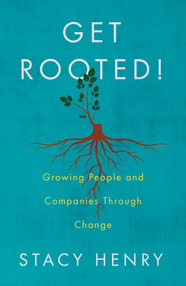
Stacy Henry: Get Rooted! Growing People and Companies Through Change
Read the full transcript
Stacy Henry
Stacy Henry is the founder and owner of CenterBranch, a people-centered business that helps companies and individuals perform to their highest potential through keynote speaking, workshop facilitation, women's development, and leadership and executive coaching. She brings twenty-five years of experience across a range of global industries as an executive coach and human resources business partner to C-suite leaders. In her book, Get Rooted! Growing People and Companies Through Change, she draws on eight common values to give readers a framework for responding to change and becoming value-based leaders.
📚 Books by Stacy Henry
Transcript
[0:00:22] DA: Inevitable change. It’s a phenomenon that enters your life whether or not you invite it in. It can make you feel helpless and out of control, but don’t let these feelings mislead you. You, in fact, control the most important element of change, your reaction. How we responded to change is based on a foundation of values, a root system that you nourish. In her new book, Get Rooted!, Stacy Henry identifies common values and provides you with a visual framework to understand your roots. You’ll reveal your priorities, strengthen your roots and move seamlessly through every change in your life with this exploration of the universal values that bring us the greatest growth. Hey listeners, my name is Drew Applebaum and I’m excited to be here today with Stacy Henry, author of Get Rooted! Growing People and Companies Through Change. Stacy, thank you for joining, welcome to the Author Hour podcast.
[0:01:10] Stacy Henry: Thank you so much for having me. I’m very excited to talk about my book today, Drew.
[0:01:15] DA: Awesome, can you kick us off by giving us a rundown of your professional background?
[0:01:19] Stacy Henry: Absolutely. I have spent about the last 25 ish years in the corporate world from sales to training, to talent management — I spent the biggest chunk of my time really in the leadership development and the talent management space and I’ve worked for organizations that were just starting up in private equity all the way through fortune 50 organizations. Each bringing just an absolutely different set of unique circumstances and learnings.
[0:01:54] DA: Was there an inspiration behind the book, did you have a big “Ah-ha” moment, why was now the time to write it?
[0:02:00] Stacy Henry: Now is the time because it’s all about change and it’s about the choice that we have in change and this year in particular, change is just rampant. It’s inevitable, it’s happening to all of us whether we like it or not. And so, I thought a lot about that and I thought about my experiences and if I would have had something like this book with the tools, as I was going through different changes in my career, it would have been helpful. So, I just kind of stepped back and said, how can I contribute to the greater good, how can I potentially share some wisdoms and learnings that I’ve had along the way with the broader population.
[0:02:46] DA: Now, who is this book for? Is it strictly for business executives?
[0:02:51] Stacy Henry: No, it’s actually for everyone. You know, I get asked that question quite often and I say, it’s literally for anybody because the topic is change and how we deal with that change and what we get rooted in. And so, whether you're a senior executive running a company or you’re an individual and you’re looking for personal growth, the content and the tools will be applicable to everybody across the board.
[0:03:21] DA: Now, the book is called Get Rooted! There’s tons of root metaphors — so I have to ask, is horticulture an interest to you?
[0:03:29] Stacy Henry: Trees in general are an interest to me. I’m not much of a horticulturist but I really am a visual type of person. And so, when I think about people and I think about individuals, we all have a center branch and that’s our core and then we’re all rooted in something, whether it’s a set of values or something else, everybody has that in common, that’s kind of why I think about “get rooted” so —
[0:03:58] DA: Moving forward on that, you say the success of almost every company is dependent on its people and specifically, those value that they’re rooted in. Why is it?
[0:04:08] Stacy Henry: This is what shows up in our everyday actions, our behaviors, our thoughts that either very blatantly or you know, behind the scenes, influence the work that we’re doing, and so every individual has a root system, just like every company has a root system and how that’s being displayed and what people are rooted in — that’s really going to set the trajectory of the culture and of how the company performs.
[0:04:43] DA: Now, in the book, you talk about eight universal values to root ourselves in to help us grow and thrive.
[0:04:49] Stacy Henry: Yes.
[0:04:50] DA: Can you mention them and maybe why specifically you chose these eight?
[0:04:54] Stacy Henry: Absolutely. The roots are love, relationship, trust, integrity, joy, spirituality and progress. And conversely on the other side of that, there’s things like conflict, disengagement, control, selfishness, complacency, what I call nothingness and perfection. And so, these are the most common roots that I’ve seen both in individuals as well as an organizations, over the course of the last 20 — 25 years. Now, are there more values or roots? Absolutely. These are simply the most common that I’ve seen and they’re the ones that really make a big difference in how people are showing up through change.
[0:05:45] DA: Now, how can you identify your own root system and more importantly, how do you know if it’s working for you?
[0:05:52] Stacy Henry: That’s a great question. Each of the root systems and we’ll take trust versus control, in the chapters, I walk the reader through, here’s some of the experiences that I’ve personally had, both good and not so good. Here are some of the ways that this could show up, and then I give the reader 10 action items at the end of every single chapter for them to try on and really look at where am I rooted? What should I be doing or what could I be doing differently, if I’m rooted in control versus trust? Or if I’m rooted in trust, what are some of the things that I can do as an individual or as a leader, that will help nourish and strengthen that. There are a hundred different action items that people can choose from, to figure out what are they rooted in and/or, how do they shift if it’s not the right thing?
[0:06:55] DA: I want to expand on something you just mentioned and at the end of each chapter, you list ways to put it all in practice, meaning, to start doing what you’ve just read. Now are the techniques here your own or did you base them off of another method?
[0:07:08] Stacy Henry: It’s a great question. A lot of them are my own, a lot of them are things that I’ve tried out and they’ve worked for me or they’ve worked for others that I coach. So, now that I’ not in the corporate world and I have my own business, I’m an executive in a leadership coach, so, a lot of these practices are things that other people have tried and they’re based on what I’ve seen as best practice over the course of the years. It’s a combination of all of those things starting with, here’s what worked for me, let’s try it on for you.
[0:07:44] DA: Now, can we ask you a personal question? Can you tell us a bit about your own personal root system and maybe what you found and maybe what has changed?
[0:07:54] Stacy Henry: Yes, absolutely. It’s a journey for me for sure. You know, I talk about in the book how I was rooted in the wrong things coming into the corporate world and a lot of that was really based on experiences I had growing up and a great example would be, the one I just used. Control. I was rooted in control, meaning, I would take over things or I would micro manage my teams or I would want to make sure that everything was just so. Versus, giving that over to my team to delegating and to really trusting them that they could do it the right way or in a different way than maybe I would but still get the job done. I’ve had to learn over the course of a long time, how to shift my roots from things like control and perfection and conflict into how do I love at work in an appropriate way, how do I use relationship to get work done and what is the progress that we’re making versus everything having to be perfect.
[0:09:08] DA: Well, one of the hardest things is to learn to trust others and let go of control and how and why is it so important to do in the work place and also elsewhere.
[0:09:18] Stacy Henry: It is one of those roots where folks really have to work at the trust root often times at least in the experiences that I have seen doesn’t come natural because control gives us a sense of power and when we have that sense of power, we feel like we have even more control over the situation and so it is like a spiral, if you will, and so the less trust I have in a situation, the more I am going to try and control it, which means the more I am going to feel like I have power. But the reverse is actually happening. What you’re doing is you are spiralling out for your teams — both directly and indirectly, you are giving them the message that you don’t trust them, that they can’t do the job either the way that you would or could and a lot of times — and this actually happened to me, people just start to disengage. Folks will say, “Well, if you are going to do it your way or you are going to take control of this, why do I bother putting a 100%, when I can just do 75 and you’ll just take it over the finish line?” So it is a practice where we have to kind of step back and say, “Where is this showing up and what are those little tiny things that I am willing to give up control on to practice building that trust muscle?”
[0:10:42] DA: Now change, especially like what you are talking about is really hard especially — when you have been doing something the same way for so long. It might even be in your mind very successful. So how should companies implement change and transition to these new values and new roots?
[0:11:00] Stacy Henry: It starts before you can even talk about the root conversation — with a conversation around, “Are we willing to embrace change or are we holding onto the past?” And that is your first choice point in change. And so, as an organization, the first thing I recommend when I work with companies is to really take a pulse of the people. Are they hearing things like, “We used to do it this way,” and “Why are we changing?” “This is how it is has always been.” Or is there an excitement and a mentality around, “Okay, there is a new way. It may not be easy. It is going to be difficult to maybe get to where we want to go worth it.” So the conversation usually starts with, “Where are you?” Are you embracing that change or are you holding onto the past? Once that’s identified, you can then start the conversation of “What do we as an organization want to be rooted in and how then do we go forward with our teams and make that happen?”
[0:12:07] DA: Right, how do you change the conversation to be between change over to growth?
[0:12:14] Stacy Henry: A lot of it is self-reflection, right? And so for individuals, it is really stepping back and saying, “What choices am I making, how am I making them?” Okay, if it is holding onto the past, there is some work to be done on the why’s behind that. Once you turn that corner to, “I am ready to embrace change, I am acknowledging that it will be difficult. I am acknowledging that it is not going to be rainbows and butterflies but it will be worth it on the other end.” That’s where the growth starts. It is like the trees when we think about it. A tree starts as a seed. It can either stay a seed or it can grow into something different but that doesn’t happen overnight, and it is intentional, and it takes a lot of work.
[0:13:09] DA: Now, another thing you write about, which I found very relatable was in times of conflict, you talk about – you almost match the attitude or tone that you are receiving from another person. Now, what are steps that you personally made and others can do to change this habit?
[0:13:29] Stacy Henry: The first thing is recognizing it. I want to say that often time and this is not an excuse but it is a reality, often times when we are faced with conflict in the workplace, our natural inclination is to give that right back. At least it is my natural inclination, maybe not everybody’s.
[0:13:47] DA: Yeah, it is.
[0:13:50] Stacy Henry: And so it is acknowledging what are my actions in this. So it is rather than placing a blame game on, “I had this boss who did this” or “I am in this situation and this happened,” it is, “How am I responding? How am I showing up?” For me, one of the things that worked was I asked them to be an accountability partner and I said, “I am not showing up well and I know it and I am not sure how to get out of it.” I know I want to because it is not a healthy situation for myself or for the people that were working around me. We just created a negative situation. So I asked somebody, “When you see this action or when you see me doing this, I am giving you permission to say “Hey Stacy, by the way this is what I’m experiencing.” And so that really helped me to be in the moment when it was happening and I gave that person permission to kind of bring it up and say, “Okay, here is what we are doing.” From there, from that awareness I was able to pause and say, “How do I want to react differently? How do I want to show up differently?”
[0:15:02] DA: I also love your chapter on complacency and can you tell us what you found and how folks who are complacent are actually setting themselves back?
[0:15:12] Stacy Henry: Absolutely. I think it is a place where we’ve all been. It is a place where complacency while you are in it, it doesn’t necessarily feel like a bad place. It is a place of, “Okay I am comfortable. I am doing my own job. I am getting stuff done,” but what’s missing is that spark and that joy. And so to get out of that complacency mindset is to really ask yourself, “When am I at my absolute best? When am I the most excited? When am I the happiest?” When am I just filled with a feeling that is not, “This is the routine that I am doing every day?” And those aren’t thoughts that we think about every day. Thinking about joy versus complacency isn’t something that we wake up and say, “Oh, how am I going to fill my day with joy?” Unless it’s intentional. So the first thing that I tell, that I ask people to think about is when is the last time that you are just filled with so much excitement you just didn’t even know what to do and what were you doing? How can you replicate that and then how do you bottle that for the moments where maybe it is not present so that you can continue going and you don’t slip back into that complacency space?
[0:16:36] DA: That is great advice and Stacey, writing a book especially like this one, which will help empower so many people is no small feat so I want to just congratulate you on putting this out there and writing this book.
[0:16:47] Stacy Henry: Thank you. Thank you very much.
[0:16:49] DA: You have so much in the book. I know we only touched on the surface a little bit but if you have to narrow it down to just one thing you’d like readers to take away from the book, what would it be?
[0:16:59] Stacy Henry: Change is inevitable. We don’t get to choose when change happens to us. Wouldn’t it be a luxury if we could? It happens, it is inevitable and the one thing that we have control over in all of that, the one thing that we have a choice on is how we show up, how we respond to that and that is directly related to what we are rooted in, in that value system.
[0:17:29] DA: Stacy, this has been a pleasure and I am so excited for people to check out the book. Everyone, the book is called, Get Rooted!, and you can find it on Amazon. Stacy, besides checking out the book where can people find you?
[0:17:39] Stacy Henry: Absolutely, so they can check out my website, www.centerbranch.com. On my website, they can absolutely take a look at all of the services that I offer. There is a page where they can get in contact with me directly or they can look me up on LinkedIn, Stacy Henry 01.
[0:17:59] DA: Stacy, thank you so much for coming on the show today.
[0:18:02] Stacy Henry: Thank you.
[0:18:04] DA: Thanks for joining us for this episode of Author Hour. You can get Stacy Henry’s new book, Get Rooted, on Amazon. Also, you can also find a transcript of this episode and all of our other episodes on our website at authorhour.co. For more Author Hour, subscribe to this podcast on your favorite subscription service. Thank you for joining us, we’ll see you next time. Same place, different author.
Want to Write Your Own Book?
Scribe has helped over 2,000 authors turn their expertise into published books.
Schedule a Free Consult