Doug Stewart: Episode 572
Read the full transcript
Doug Stewart
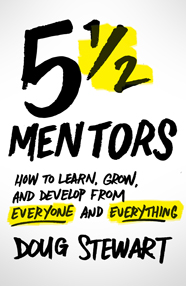
Doug Stewart is a TEDx speaker, certified Dale Carnegie instructor, and performance coach who helps people pursue lives of purpose through what he calls enthusiastic discovery. His work centers on mentorship and on learning from the people and experiences all around us. In his book 5 1/2 Mentors: How to Learn, Grow, and Develop from Everyone and Everything, he invites readers to join him on that journey of growth. He lives with his wife, Merideth, and their two children.
📚 Books by Doug Stewart
Transcript
[0:00:17] DA: Have you ever felt stuck in a rut or helpless in changing your life’s circumstances? Are you searching for more happiness and fulfillment but don’t know where to look? Author Doug Stewart doesn’t have your answers but he knows how you can find them for yourself. In his new book, 5 1/2 Half Mentors, Doug asks you to join him on a journey of enthusiastic discovery to learn and grow from everyone and everything. He reveals the mentors in your life you never knew you had, you’ll learn how to identify your blind spots, break through barriers and discover innate greatness that’s been with you the entire time. If you’re willing to look for it, a more exciting life is waiting for you. Hey listeners, my name is Drew, Applebaum and I’m excited to be here today with Doug Stewart, author of 5 1/2 Half Mentors: How to Learn, Grow and Develop from Everyone and Everything. Doug, thank you for joining, welcome to the Author Hour podcast.
[0:01:11] Doug Stewart: For sure, thanks for having me.
[0:01:13] DA: Let’s kick this off, can you give us a quick rundown of your professional background?
[0:01:18] Doug Stewart: Yeah, for sure. I grew up in a family business and so my professional career started when I was old enough to dust furniture in my parents and grand parents furniture store so I was maybe four years old and it’s really all I ever knew, And so growing up in the furniture business, I was on the sales floor and on the delivery truck early so, I would say, my professional career really started as early as I have memories of being alive. After college, I came back and took over the furniture business and then after realizing that that’s not what I wanted to spend the rest of my life doing. I left the family business and ended up working for some iconic brands. Sort of adjacent to the industry, the furniture and bedding industry, and this is around 2011 where I had the privilege of taking a program called The Del Carnegie program and it fundamentally changed my life. And I noticed that the instructors for that program had a real opportunity where they were able to, what I call now — they were able to watch miracles happen and they set a stage and created environment for people to have meaningful breakthroughs and I notice while taking that program that that’s what I wanted to do with my life. And so I started following the primary Del Carnegie person in North Carolina around until he agreed to – Allow me to apprentice under him and after that, it was sort of history. I worked for him as an apprentice, mostly unpaid for four to five years, and then got my own opportunity and then from that, found a way to end up on the TEDX stage and then after being on the TEDX stage, sort of opened up my speaking career and then my coaching practice and then here we are.
[0:03:18] DA: That’s such a great story and was there a that inspired you lately to write the book, did you have an “Ah-ha moment?” Why was now the time to write it?
[0:03:26] Doug Stewart: Well, something interesting really happened in around March of 2020, when I looked up and the news said, you need to stay home for at least two weeks and I thought, how am I going to quarantine for two whole weeks? I thought to myself, I’ve got to find something to do — and so, this book and this is something that I talked about on my podcast not very long ago, is that this book is something that I have had on my mind and heart for about the last 10 to 15 years. But the reason I hadn’t wrote it before was because I really wanted to live it. I wanted to be able to say, “Hey, here’s my personal evidence as to why these concepts or these tactics or these strategies or methods actually work.” When COVID 19 hits, I thought to myself, what better time to sit down and write this book?
[0:04:29] DA: Now, who is this book for?
[0:04:31] Doug Stewart: Ah man, what a question that is man. This book is first of all, I think when I was working with my manager at Scribe and we were first talking about “Hey, who is this for and what do you want to accomplish out of this book,” I think I was a bit of an irritant to her in the beginning because my answer was — what I want the results of this book to be. I said, you know, I wanted to be something, number one, that I’m proud of. Number two, I want it to be something that my children are proud of and number three, I want it to be something that my grandchildren are proud of. And so, I guess, to answer that question, the person that I wrote this book for in a lot of ways man, was me. This is the book that gosh, if I would have had this, if I would have gotten this as a middle schooler, as a high schooler — I would have not had to – life maybe wouldn’t have punched me in the mouth so often as a young adult and early in my career but overall, I would say, that this book was really written for people who feel stuck, who maybe feel like they need some sort of permission or they need some sort of access or they need some sort of a savior or a mentor to come and pry them out of their current situation and this book really is the evidence that they don’t need any of that stuff to get started.
[0:06:05] DA: Now, what can readers expect from the book?
[0:06:09] Doug Stewart: I would say the biggest thing that they can expect is that the book won’t change their life. I think a common myth conception people have a lot of times is if I read this thing or if I get this information or if I watch this video or take this course, it will be my answer. Really, what people can expect more than anything is this book may provide some insights, it may provide some — perhaps even inspiration but more than anything, I think readers can expect a bit of a practical roadmap so that they can go and change their own life, so, they can go and do work. The book won’t change their life. The book didn’t change my life, it’s the action that I took, it’s the action that people take and this is something that we talk about in the — I believe it’s somewhere at the end of the book, in the conclusion, where I talk about a piece of advice that someone I consider a mentor, sort of a peer mentor, his name is Mark Kinsley and he always says to me, when I’m struggling with how to get from where I am to where I want to go, maybe on a particular project — he’ll always say, you know, remember, that action reveals answers. If people are looking for answers, they may find some insights in the book but the real answers come from taking action after reading the book. While reading the book or gosh, before reading the book, the book really doesn’t matter, so long as they’re taking action.
[0:07:32] DA: You start off really strong in the intro saying this book will not change your life. I thought it was really interesting how you kicked it off like that and then you actually talked about many people, even make a living off the word and the theory of motivation. And yet, you say motivation is sort of worthless. Can you tell us why?
[0:07:53] Doug Stewart: Yeah, for sure. The reason I say motivation is worthless is because motivation is elusive. Motivation is sort of like that one friend that we all have that says that don’t meet us for lunch and about half the time they show up. You know? I just have never found motivation to be particularly reliable and what I find is, motivation is really a byproduct, it’s a symptom of something else. That something else is self-discipline. So, one of the things I talk about in the book is you know, my motivation is always there five PM, last night, 5PM, my motivation was there and ready to roll when I was thinking about getting up at five AM and going for a run this morning. The challenge was, when I woke up at five AM, my motivation was nowhere to be found. I didn’t feel motivated to go running when it was time to actually take action and do it. I wanted to hit t he snooze button. And then I hit the snooze button, motivation doesn’t show up at 5:10 and 5:15 at 5:20, at 5:30. But what I found is, is that I can create motivation in my life by number one, creating an environment that supports the disciplined decisions I want to make so that may be putting my running shoes by my bed, putting my workout clothes on my night stand. Making sure that my alarm as an example is too far away for me to just reach over and turn it off and if I get up, if I’m disciplined enough to get up unmotivated, put my shoes on, put my workout clothes on, open the front door and leave. My motivation normally shows up when I’ve gotten just far enough away from my house where it’s impractical to turn back. And then my motivation shows up, I feel good, I’m glad I’ve done it, the same is true with healthy eating. Anytime I’m hungry, ice cream always sounds better than a salad, you know? I’m never motivated — who’s ever motivated to eat a salad when ice cream is close by, you know? But if I eat a salad, if I make healthy, practical, conscious decisions about my health over time, once I start feeling better and it may take a month or two months or six months or a year, all of a sudden, my motivation shows up more often to make the types of decisions that serve me best.
[0:10:26] DA: Now, you just mentioned hitting the snooze button a few times and you bring up a term in the book called “Alarm Clock Moments,” can you talk to us about what an alarm clock moment is?
[0:10:38] Doug Stewart: Sure, I think we’ve all had this experience where you’re laying in bed, you’re sleeping well and then you kind of get that first moment of consciousness and you look at the clock out of one eye and you realized that your alarm clock didn’t go off. And that’s what I call, that feeling is what I call the alarm clock moment when you look around and you're like, my goodness, I’m going to be late and there’s no way I can catch up. You know, sometimes we get that when we’re late for maybe a meeting or you know, a flight back when people used to do those sorts of things or we’ve slept in for a zoom call or something. My experience was, I had an alarm clock moment in life because I found out I had this moment in my life where I woke up and I realized that I had fallen behind intellectually, spiritually, emotionally, relationally and almost every way I felt behind and I got this massive surge of intention to start taking action to do everything I could to try my best to catch up, to where my potential was. I didn’t know where my potential – I still don’t know what my potential is. But I found a way and this is one thing that I really encourage people to do in the book is to be comfortable not necessarily knowing your potential but be enthusiastic about discovering what it is.
[0:12:06] DA: Let’s dive into mentorship. What is it traditionally mean to people?
[0:12:11] Doug Stewart: I think mentorship, it reminds me of this movie I watched, admittedly more than once which I don’t know that everyone would admit this but there’s this movie called the Devil Wears Prada, where – you’re familiar?
[0:12:27] DA: Yeah, I didn’t see that coming.
[0:12:31] Doug Stewart: In this movie, Meryl Streep plays the lead role and she’s kind of the person that has all the access and all the affluence and all the influence and then this young intern comes in and sort of sees her kind of as the mentor or the standard and so she gets verbally and emotionally abused by Meryl Streep’s character for the entire movie and I think that’s what most – how most people see mentorship is like, there’s that person that has resources or access or influence or affluence and if I allow them to tell me what to do or maybe go get their laundry or their coffee for long enough, one day, I will get to be that person with all the resources and access and excess and then I get to mistreat people that come after me. I think that many times, Drew, that people don’t make a distinction perhaps between mentorship and apprenticeship. You know, apprenticeship has its place and many people think that in order to be mentored, there has to be an agreement, maybe a contract, they have to talk about it and then the mentor is there to “save them” in a lot of ways or give them things maybe that they can’t get on their own. Instead of seeing mentorship as something that they really do for themselves with another person — they see it as something that another person does either to them or for them. Which takes them out of the driver seat of their own life and puts them in a position to be a victim of their circumstance.
[0:14:11] DA: One of the cool things in the book is you actually do ask people to pause and think about what they just read and to take some action in the book. This isn’t one of those books where you just read through. It is actually you are going to want to make some changes and pause throughout your reading, and make some changes that you are reading about or if something sparks of interest along the way. Now can we dig into the five and a half mentors? And I love to start with the half portion because I think that’s really interesting. You call it the anti-mentor. Can you explain this?
[0:14:41] Doug Stewart: For sure. I think the reason is the anti-mentor and it is only half of a mentor is because in general, we are less likely to want to accept this type of person as a mentor and the reason that they still make the list and the reason that the first one that we talk about is because in my view they’re the most important ones. These are the people that irritate us, they frustrate us that maybe hurt us that maybe treat us poorly. These are the people that lack the level perhaps of integrity or insight or worldview that we find is valuable and it reminds me of this quote by Del Carnegie that I love so much where he says, “If two people always agree, one of them is unnecessary,” and so often, we want to be around people that are likeminded that see the world the same way we do that are positive and uplifting and make us feel warm and fuzzy and good and we forget the benefits of learning from people that see the world differently. And we sometimes we see them as evil when they’re merely inconvenient and I have learned through my experience in my life that my best teachers have been people that I was uncomfortable around or irritated by. You know the people that question me really taught me how to think on my own. The people who abandon me taught me resilience. The people that mistreated me taught me compassion. The people that frustrated me taught me new ways to communicate. And I think if we see those sorts of people, those what I refer to as sandpaper people or the people that could make a happy meal frown, you know those sorts of people, if we ask ourselves what is it that perhaps causes them to live in that way, not only can we help them but we can also change ourselves and we can see things in ourselves — because I think it is pretty universal that some of the things that irritate us the most about other people are often things that we don’t like about ourselves. So I think about myself as a father and I have a nine year old daughter and some of the things that get under my skin the most as a dad are typically things that I’ve struggled with myself or things that maybe I’ve hated about myself, you know? Like I am naturally not a very tidy or neat person — it is something I’ve had to work really, really hard to do better at and so when my daughter leaves dirty socks on the floor that irritates me in a way because I know that she probably got that from me. And when people are acting out in particular ways that irritate us, it can be really valuable to stop and go, “Why does that irritate me in this way? Why is it that I get this reaction from their behavior?” Instead of letting them own it. And then another thing that I think is really important about the anti-mentor is that they’re not always wrong. They might just make us uncomfortable because it can be really uncomfortable to come face to face with something that you’re wrong about. And I know there is nothing that has helped me uncover truth more than talking to people that see the world differently than I do that believe differently that are from different perhaps political persuasions or faith traditions or parts of the world and so often, we call this combination of likeminded people around us. We call it community when it is really not community at all. It is really a cult because I mean if you think about what is the definition of a cult it’s where everyone agrees, believes the same thing about all the same things and there is no ability to question anything. And when we fall into that, we really put ourselves in an echo chamber that not only stunts our growth but it really limits our ability to be happy, to relate to others, and to advance humanity in a positive way.
[0:19:03] DA: Now another one of the mentors you mentioned, which is a little off the beaten path was the virtual mentor. It’s a really interesting approach because if I have this correct, it’s almost doing research online on a particular topic.
[0:19:18] Doug Stewart: Yeah that’s it, a 100%. It’s so often that people have polar views of technology in general. There is the side that says you know technology is the best greatest thing of all time and they spend all of their time in technology. There is the other side that says technology is eroding the very fabric of society as we know it and one day, the robots are going to rise up and kill us all and I think there is a middle ground. I grew up in a world that technology wasn’t available. Like many people I’m sure listening to this podcast, when I was a kid and I wanted information, I had to go in my parent’s living room to the big credence and open these doors and then there was a bunch of these green books. They were alphabetized called The Encyclopedia Britannica and that was the only place that I could get information in my home. Now, if I couldn’t find in the Encyclopedia Britannica, I had to go to this thing that they call the Library and I had to fumble with the Dewey Decimal System, which I am convinced is the tool of the devil and you know there is this saying that knowledge is power and the challenge with this concept of knowledge is power is that knowledge has really been commoditized and knowledge, if you have an internet connection, you have access to all of the information of all humanity of all time. There are a very few things that you can’t either learn about or find something about that thing you didn’t know before and for me, I have found as many mentors virtually as I have physically in my real life and I think if we think about how do we use technology, am I using technology to enrich my real life and the real people that I am interacting with? Am I using it to learn in a positive way or am I using it simply for escapism to disconnect from the world? And there is space for that for sure but it certainly shouldn’t be the majority of our appetite when it comes to technology.
[0:21:30] DA: I have to ask you this question Doug, who are the mentors in your life right now?
[0:21:36] Doug Stewart: I’m really blessed and fortunate to have some really outstanding mentors. The first two and I would say most valuable and the most dynamic mentors that I have in my life right now, one of them is two years old and the other is nine years old. These are my children and I will tell you that my kids on a daily basis teach me things about how to show up in the world, how to see the world, how to be inclusive and open and energetic and in the moment and present the way that no one else had taught me before. And so I am really fortunate to have them and I think if we pay attention particularly to children, they can really call us back to what I would consider maybe our factory setting to the way that we are created to be in the first place. Another very important mentor that would be categorized in the book is a street view mentor is my wife. We’ve been married for 13 years. There is no one that supports me and also calls me out on my own BS like my wife. Additionally, actually I talk about these two people in the book, Tom and Molly Brazil, that’s who I apprenticed for with Del Carnegie for four or five years and Tom and I, I still have the ability to have these conversations with Tom, two or three times a week and we’ve had a decade long relationship. To be even more specific, I really do my best to make every single person just like Ralph Loro Emerson said that every person I meet is my superior in some way. And it’s my responsibility to find out in what way. And so when embodying that idea, everyone really is a mentor. Everyone is someone that I can learn something from.
[0:23:25] DA: Now when you were writing the book either via research or maybe some introspective research, where there any learnings along the way?
[0:23:34] Doug Stewart: Oh for sure. One of the biggest ones is we were just talking about the anti-mentor and one of the biggest ways that that concept has evolved is in the beginning, it was really about people that just rob us wrong but as I wrote the book, I realized it is not just about the irritants in our lives. It’s also about that sometimes we are the irritant. It is recognizing that, “Oh my gosh, I am an anti-mentor to people.” You know they say that there are two types of people in the world. There’s people that brighten the room when they come into it and then there’s the people that brighten the world when they leave it, and I make choices sometimes where I end up being the type of person that brightens the room because I have left and one of my biggest learnings in writing this book is just how much impact each of us have in the environments that we find ourselves and there is no such thing as a neutral impact. You know when someone comes in the room the energy changes. When someone logs on to a webinar or to a video call, the energy changes and it is really our choice of whether that energy change is going to be a positive energy change or whether the energy change is going to be a negative energy change.
[0:24:53] DA: Now you end the book saying, “Mentorship is a gift you give yourself with the help of everyone and everything,” and I thought that was such a lovely statement. Can you dig a little bit deeper and tell us what you mean here and why you chose to end the book this way?
[0:25:08] Doug Stewart: For sure. One of the main ideas that was so important for me to communicate well in this book and I hope I have communicated it well enough is that there is no need for permission to develop and the idea that you need someone to come along and give you access to start or give you permission to start is perhaps one of the biggest excuses and detriments to our growth. The reason I end the book that way is to concrete in this idea that mentorship is a choice that we make first — And then as we make that choice, as we consistently make the choice on a daily basis and we take action — that is the way, number one, we start but number two that’s the way we attract the best mentors. If we think about people that we want to help, no one wants to help someone that they feel like they have to drag them across their own finish line. You know, we are willing to help people when we go, “Gosh, they’ve got the right attitude, they’re already trying.” Those are the people that we’re willing to invest our time, our resources, sometimes our money in but rarely do we want to invest our money into someone that’s not trying, that’s sitting around and waiting and this is the primary idea of the book that the more – who said it? I forgot who said, I am going to paraphrase it and not accurately ascribe it to the right person, but I want to say it is Gary Player, the famous golfer, but I think it was him that said, “The harder I work, the luckier I get.” And I found for myself and for so many other people that I’ve had the privilege to coach, the more deliberate they are in taking action doing the right things for the right reasons expecting the right results and not having any attachment to the timing of those results, the more resources they attract, the more people that they attract, the more mentors they attract and ultimately, the more opportunities they get in their life.
[0:27:15] DA: Doug, writing a book especially like this one that will help the personal growth of so many people is no small feat. So congratulations.
[0:27:24] Doug Stewart: Thank you.
[0:27:25] DA: Now, if readers could take away only one thing from the book, what would you want it to be?
[0:27:30] Doug Stewart: If there is only one thing that people would take, I think it would be that they don’t need permission to start and that their personal develop is ultimately their personal responsibility.
[0:27:47] DA: Doug, this has been a pleasure and I am so excited for people to check out this book. Everyone, the book is called, 5 1/2 Half Mentors, and you could find it on Amazon. Doug besides checking out the book, where can people find you?
[0:27:58] Doug Stewart: The best place is just my website, dougstewart919.com and all of the resources and other connection points can be found there.
[0:28:05] DA: Awesome. Doug, thank you so much for coming on the show today.
[0:28:09] Doug Stewart: My pleasure man, thank you for having me.
[0:28:11] DA: Thanks for joining us for this episode of Author Hour. You can get Doug Stewart’s new book, 5 1/2 Half Mentors, on Amazon. Also, you can also find a transcript of this episode and all of our other episodes on our website at authorhour.co. For more Author Hour, subscribe to this podcast on your favorite subscription service. Thank you for joining us, we’ll see you next time. Same place, different author.
Want to Write Your Own Book?
Scribe has helped over 2,000 authors turn their expertise into published books.
Schedule a Free Consult