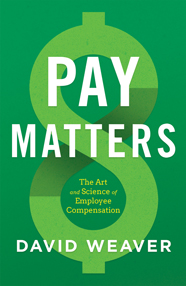
David Weaver: Pay Matters: The Art and Science of Employee Compensation
Read the full transcript
David Weaver
David Weaver is an award-winning author of the bestselling business book: Pay Matters: The Art and Science of Employee Compensation and the children’s book Pay Matters to Kids. He is the Founder of the Compensation and HR Group, an Instructor at the Compensation Analyst Academy, and the Executive Director of the Pay Matters Foundation, which is an independent and private nonprofit organization dedicated to providing people with knowledge about pay. For more information, David can be reached at info@paymattersbook.com.
📚 Books by David Weaver
Transcript
[00:00:19] DA: Most organizations fail to pay their employees properly. Not because they don't want to but because they don't approach compensation with a plan. If you don't pay your employees what they're worth, not only will your competitors leave you behind but you'll also leave yourself open to legal, social, and political backlash. In his new book, Pay Matters, David Weaver explains how to perform a detailed market analysis that reveals exactly how much each position in your organization should be paid. You'll learn how to develop a pay philosophy specifically tailored to your organization, and strike the elusive balance between profit and labor costs. Don't leave salaries open to the caprices of your organization's senior leaders. Approach them confidently with a proven methodology. Hey, listeners. My name is Drew Appelbaum, and I’m excited to be here today with David Weaver, author of Pay Matters: The Art and Science of Employee Compensation. David, thank you for joining. Welcome to the Author Hour Podcast.
[00:01:16] David Weaver: Thank you, Drew.
[00:01:17] DA: Let’s kick this off. Can you give us a rundown of your professional background?
[00:01:22] David Weaver: Absolutely, yes. I’ve been a compensation consultant for the last 20 years. Previous to that, I was managing compensation for three large corporations. In addition to being a compensation consultant, I also run a compensation training organization where we teach HR professionals about the methodologies around employee compensation.
[00:01:50] DA: Now, what inspired you to write the book now? Did you have an aha moment? Was there something else that really inspired you to say I need to put this down?
[00:02:00] David Weaver: Yes. I actually did have a moment where I realized I should write this book. I was attending a human resources conference, a national conference where there were 15, 000 human resources professionals in attendance, and they had a pop-up bookstore. I walked through the bookstore, and the attendees and the people at the bookstore were purchasing a bunch of books. So I went looking for the section on compensation, and there weren't any books regarding compensation. That’s when it hit me that there was a lack of information out there. Plenty of books on other topics like recruiting and employee relations and other types of topics but really none on compensation. When I started to dig into it, there were really only a few textbooks, and I thought there really needs to be a guide not only for human resources professionals but for managers because virtually every manager manages compensation for their employees. I felt like they needed a really good simple guide on really how to approach it.
[00:03:20] DA: Yeah. I’m glad you said that. So this book isn't strictly for just HR professionals, right?
[00:03:25] David Weaver: No. Any person, any manager, supervisor that manages their employee’s compensation could really benefit from this book because there's a lot of examples, and it goes into things like performance management, which virtually every manager does performance reviews. It talks about reward and recognition, which is a very important component for employees. They really crave that recognition, and managers tend to find it hard to come up with ways to recognize and reward employees. So we added that. That's part of this book.
[00:04:04] DA: Now, what can readers expect from this book?
[00:04:07] David Weaver: Well, the biggest takeaway I think is once they're finished reading it, they will have all of the components to build the infrastructure for a really robust compensation system. So it really touches on everything from analyzing jobs, understanding what people do, documenting those jobs, learning how to pay people in those roles, and helping them design incentive plans, sales compensation plans, doing the reward and recognition, and learning how to communicate pay to their employees.
[00:04:48] DA: Did you learn any lessons during the writing of the book?
[00:04:52] David Weaver: I think the biggest lesson for me was that this is a continuous process that you don't just set your compensation plan or your performance management system or your reward and recognition program. You don't just set it and forget it. You really have to go through and review your programs, review your plans every year because they're dynamic, and situations change. I think as we're speaking, we're in the middle of a global pandemic, and that changed a lot of people's perspectives on pay and remote work. So the whole nature of work is changing. Really, I was finishing this book right in the middle of the pandemic, and it really gave me kind of a different perspective that pay is important. Really in some cases, when your livelihood is at stake, it's the most important thing. So that was one of my big takeaways.
[00:05:58] DA: Yeah. Let’s dig into the book. You just touched on it a little bit, but I’ll ask the question that you opened the first chapter with. Overall, how important is compensation?
[00:06:10] David Weaver: Well, from my perspective, I believe it is the most important component from two different perspectives. I think from an employee's perspective, it's important for them. It’s their livelihood. It's how they make a living and how they're able to live outside of their work life. For the organization for which they work for, it’s the number one expense. So payroll is the number one expense in every single organization. You have this really situation where employees want to increase their pay, and organizations are trying to control the payroll. Those so those two things are at odds, and what I'm trying to teach is that we need to have a balance. So you want to be paying people competitively, paying people what they're worth. That's the cost of doing business and attracting and retaining employees. On the other hand, there's got to be a balance. You can't overpay everyone to keep them super happy because you would go out of business. There’s a balance there, and that needs to be communicated both to the employees and to the senior management teams out there. Senior management teams can't go into this thinking they're going to get the best person at the lowest price. It just doesn't work that way.
[00:07:39] DA: Now, you come up with what you call a perfect compensation system, and it consists of four parts; internal consistency, external competitiveness, employee contributions, and some administrative. Can you go through these?
[00:07:53] David Weaver: Sure. I’d be happy to. Yeah. Well, those are what we call the four pillars of a perfect compensation system, and I really break these down. At the end of the book, I turn these into a checklist so that the person that really wants to put together the infrastructure can go through and check off the components that they already have or that they're doing well. Then the other pieces, they're things that they can add on to their system or improve on. So really, the first one, the first pillar was internal consistency, and that's really building the foundation of your compensation system. So what you're basically doing is you're collecting information about the jobs in your organization. That's job analysis, finding out what people do. Once you find out what people are doing in their roles, you have to document that, and we document that in the form of a job description so that everybody's description is consistent. We show a really nice format in the book that people can use very straightforward. Then once every job is documented with a description, then you can build. You can really do an evaluation on the job. How does it stack up internally? Then build your job structure. So basically, you're ordering your jobs from an internal standpoint from the highest level job to the lowest level job. Then once you've got that piece done, you can really develop your pay philosophy, and your pay philosophy is really how are you going to structure your pay versus the external world. That's really the first pillar. The second one is looking at external competitiveness. In order to be competitive to the outside world, you have to measure the marketplace. So from an HR perspective, you have to fill out some salary surveys. You’ve got to obtain some data, some competitive data. Once you have our data, you can do a side-by-side comparison of what you're paying all of your jobs versus what the external market is paying. That’s called market analysis. Once you have the market analysis, then you can build salary ranges so that every job has a salary range. That's the worth of that job inside your organization that has an external view. Again, we set the midpoints of these salary ranges to really be the going rate outside in the marketplace for that role. So every roll has a salary range. The third pillar is really looking at employee contributions. So this is where you're measuring how people are doing in their job, how are they performing. What we want you to be able to do is pay people for their performance, right? Those employees that give the best results should get the greatest rewards, and that's how the majority of organizations do it. They have a pay-for-performance type philosophy. A lot of the book talks about that. Now, we do talk about seniority-based systems. But the majority of organizations use what I would call pay for performance. Then the final pillar is the administrative piece. So this is where organizations would budget and forecast their compensation costs for the next year. That's called salary planning. They would do some kind of regular communication to managers and employees regarding their pay, how it's derived, what the average increase will be in the coming years, so there are no surprises. Then the final piece of this is really looking at each one of these components, looking at the effectiveness of those components, and revising them as needed or recalibrating them on a regular basis.
[00:12:08] DA: Now, of course, there's always curveballs along the way, of course. What do you do with a job that you really can't categorize?
[00:12:16] David Weaver: That’s a great question. Not every job has a market rate. Some jobs are very new to the marketplace. Some jobs are what we call hybrid jobs. They are a combination of two or three different functions. You really see that in small organizations where people are wearing multiple hats and you can't necessarily get a market rate for that. So basically, what we suggest is that you do a market analysis on the jobs that you can get a market rate for. Then you look at those internal relationships for the roles that you cannot get market information for, and you really do a comparison, and we call it a slotting. So you put like jobs together from a pay standpoint, and that works you know virtually all of the time. That’s why we want you at the beginning to do that internal job structure because that way you already have a sense of where jobs compare and relate to each other.
[00:13:25] DA: Now, you have an interesting section of the book on seniority-based pay and you say that there are a lot more negatives than positives for seniority-based compensation. That longer time in a job doesn't necessarily equate to higher performance. Can you talk about that?
[00:13:41] David Weaver: Sure. I’d be happy to. We’ve done a lot of work with colleges and universities. Those are the ones that really come to mind, and those types of organizations value tenure. If you think about faculty members, they're tenured and that's all based on time. But when you talk to employees and I've done a lot of employee focus groups within colleges and universities and because it's seniority-based, the people that consider themselves high performers don't see any differentiation in their rewards, meaning everybody gets the same. Unless you have more time in your role, that's when you start to see differentiation. But time doesn't equate to high performance. So what we've done with many of these colleges and universities is we've moved them from a seniority-based system to a pay-for-performance system, which makes the employees much happier because they're being rewarded for their results. Now, because that's a cultural shift, it takes some time and it could take – I’ve worked on projects that have gone two to three years because it's really a shift in the culture. But when you look at the business leaders who are now presidents of universities and colleges, they're demanding performance. Really the only way to support that is through a pay-for-performance type compensation system.
[00:15:19] DA: Are there any compensation systems out there that rewards loyalty if you will?
[00:15:25] David Weaver: You do see those. Those have been being replaced. We've replaced many of them because people are not staying at their companies and their organizations for a lifetime like they used to. What we're seeing is kind of the average length of service is three to five years. So you're seeing people have many different jobs, and that's really becoming more acceptable from a hiring standpoint. As a matter of fact, many recruiters are saying that's an advantage because people have more experience. They have a greater breadth, and so we're seeing kind of the loyalty seniority length of service type systems really go away and be replaced by performance-based systems.
[00:16:13] DA: Now, I’m in marketing and I could tell you many employers look down on the marketing department at times because we traditionally don't “bring in the money” like a sales department does. Can you talk to us about why marketing is typically undervalued in the market?
[00:16:30] David Weaver: That’s a really good question, and I scratch my head on that one virtually every time we do a project because we see the marketplace undervaluing the marketing roles. But when we talk to our clients about that, what they see is that there's a big value to the marketing organization. So you should feel good about that. Many times, again, when you look at the other internal roles that are kind of at the same level, the organizations really want to upgrade the marketing roles, particularly the head of marketing, because they see that role having a strategic impact, and the market data has not really caught up with that. I bring that out in the book that it's really been undervalued from a pay standpoint but highly valued for the contribution within the organization.
[00:17:33] DA: Now, let's say you finally have your team and you think you've gotten compensation right. What are some of the ways that you can conduct effective performance evaluations without maybe stirring the pot a bit and having people on edge for you coming in and asking questions?
[00:17:51] David Weaver: That's another great question. What we've seen the transformation has been with performance management is that it's no longer a once-a-year event. It’s become more feedback. People in organizations are wanting more performance feedback. So what we've been suggesting is something like really a quarterly meeting. Not a long meeting but a quarterly meeting where you touch base. You ask some questions. You make a collaborative between the manager and the employee so that you're really understanding in the last quarter what the employee has accomplished and what they're planning to work on and what the manager wants them to work on in the next quarter. What we found is that more frequent feedback is more effective, and it's less overwhelming for both the manager and the employee because, again, when we talk to managers about performance management, they're dreading it. They're dreading writing reviews for all their direct reports. Then you talk to the employees, and they're dreading having a sit down about what's happened over the past year. So what we've come up with is really more frequent feedback. Quarterly really seems to be the way to go, and it takes away that daunting once-a-year review.
[00:19:22] DA: Now, incentives are a new phenomenon. There's ping pong tables in offices. There's free lunches on Fridays. Can you tell me what are some of the newer, more popular incentives today that you're seeing pop up?
[00:19:35] David Weaver: What we're really seeing is more on the spot type recognition. So when somebody does something really well and you can do this either privately or you can do it in front of the team is to give some kind of reward for that. What we're saying is for something significant, a significant achievement, we like to see that be in the form of a bonus, in the form of cash. Cash seems to be king when it comes to employees. They want to be recognized for something significant with cash. If it's something that's not as significant, they're fine with gift items or gift cards or even something as simple as a handwritten note thanking them and appreciating them for their contribution. That goes a long way. When we talk to employees, they tell us that some of their most memorable recognition was a handwritten note from either the president of the organization or the CEO, the top person noticing that they did something very well, and it's got an incredible motivational impact on the employee.
[00:20:58] DA: Now, for all the employers out there, you heard it first right here. Less lunch meat, more cash for employees.
[00:21:05] David Weaver: Exactly, exactly.
[00:21:08] DA: Now, David, you have a ton of resources on your site that you're offering for readers. Can you tell us what you have there and what your website is?
[00:21:16] David Weaver: Yes. Actually, we have two different websites. One is our compensation and HR group website, and that's really for our consulting business. This is where we're going to be doing compensation program review, building salary ranges, helping organizations build out incentive plans, those types of things. Then the kind of other side of our business is doing compensation training, and that's our compensation analyst academy. Basically, what we're doing is we're certifying HR professionals in the area of compensation. What we're doing is we're taking a lot of the concepts that are in this book, and we're helping with case studies and workshops and those types of learning experiences, and we're giving this learning to the HR professionals out there. They're getting a certification called the certified compensation analyst. So that's been running for about six years. It’s very exciting. Now that my book is published, all the participants in that compensation analyst academy are receiving a copy of the book. So we've got a training coming up next month. We've already shipped the books out to all the participants, and it's really a companion reference book for them. We see this as being really a reference book for any HR professional, any manager that manages employee compensation.
[00:23:01] DA: David, writing a book, especially one like this one which is going to be so helpful for people in that industry, it's no small feat, so congratulations.
[00:23:10] David Weaver: Thank you.
[00:23:11] DA: If readers could take away just one thing from the book, what would you want it to be?
[00:23:18] David Weaver: The one thing that I want them to take away from the book is that pay is important to everybody. It’s important to employees, it’s very important to organizations, and getting it right is extremely important. I think in some cases it's been administered in very haphazard ways. There's no rhyme or reason, there's no methodology, there's no thought behind it, and what we want to do is help bring a methodology and an infrastructure that's defensible, right? We want to be able to explain it and defend it to employees, and we want it to be defensible for the senior management team, so they feel like they're getting the best return on their payroll investment.
[00:24:17] DA: David, this has been a pleasure, and I’m so excited for people to check out this book. Everyone, the book is called Pay Matters, and you can find it on Amazon. David, besides checking out the book, where can people find you?
[00:24:28] David Weaver: They can email me at dweaver@comphrgroup.com, and I’d be happy to engage anybody in a discussion about compensation. It’s my passion, it’s what I’ve been doing for many years, and I'd really enjoy the interaction.
[00:24:47] DA: Amazing. David, thank you so much for coming on the show today.
[00:24:50] David Weaver: Thank you, Drew.
[00:24:52] DA: Thanks for joining us for this episode of Author Hour. You can get David Weaver's new book, Pay Matters, on Amazon. Also, you can find a transcript of this episode and all our other episodes on our website at authorhour.co. For more Author Hour, subscribe to this podcast on your favorite subscription service. Thank you for joining us. We'll see you next time. Same place, different author.
Want to Write Your Own Book?
Scribe has helped over 2,000 authors turn their expertise into published books.
Schedule a Free Consult