Dr. Nina Ahuja: Episode 576
Read the full transcript
Dr. Nina Ahuja
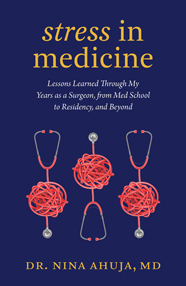
Dr. Nina Ahuja is an eye surgeon based in Hamilton, Ontario, with more than twenty years of experience in medicine. A graduate of McMaster University Medical School, she completed her residency in ophthalmology at the University of Ottawa and went on to hold leadership roles including Residency Program Director for Ophthalmology and Academic Division Head at McMaster University and President of the Medical Staff Association at St. Joseph's Healthcare Hamilton. In 2019 she founded Docs in Leadership, which delivers programs integrating emotional intelligence and neuroscience-based strategies for leaders working in high-stakes environments. She is the author of the bestselling memoir Stress in Medicine: Lessons Learned Through My Years as a Surgeon, from Med School to Residency, and Beyond.
📚 Books by Dr. Nina Ahuja
Transcript
[0:00:24] Dr. Nina Ahuja: As a medical doctor, every treatment prescribed or surgery performed carries high stakes for each patients. It could impact their quality of life in significant ways or literally mean life or death. But the culture of silence in medicine makes it difficult to talk about the unique responsibilities and stresses associated with being a physician. Dr. Nina Ahuja’s new book, Stress in Medicine, challenges this culture of silence and offers a unique glimpse into the world of medicine, sharing personal stories from her own journey. Woven through out these experiences and observations, Dr. Ahuja introduces a practical approach that could lower the stress level of any situation and sharpen your mind when you need it most. Hey listeners, my name is Drew Applebaum and I’m excited to be here today with Dr. Nina Ahuja, author of Stress in Medicine: Lessons Learned Through My Years as a Surgeon, from Med School to Residency and Beyond. Nina, thank you for joining, welcome to the Author Hour podcast.
[0:01:19] NA: Thank you Drew for having me, I’m excited to be here.
[0:01:23] Dr. Nina Ahuja: Let’s kick this off, can you give us a rundown of your professional background?
[0:01:27] NA: Sure, I went to medical school in 1995, graduated 1998, seems so long ago, that’s probably because it is actually. I did my residency in ophthalmology which I completed in 2003. At that point, I then started my surgical practice in Hamilton, Ontario, Canada and I’ve been located here ever since. In addition to having a surgical practice, I do own a private office and so I’ve been managing that for the last 17 years. I have also been part of the faculty at McMaster University, where I’m presently Academic Division Head for Ophthalmology. I have also done – had been quite involved in leadership at the hospital, Saint Joseph’s Healthcare Hamilton, have held various positions in the medical staff association, medical advisory counsel, and other committees that are involved with some of those positions — and now I’ve transitioned, or added another, initiative which is Docs in Leadership. An organization that I established to promote and deliver leadership education to healthcare professionals and also gearing more specifically towards medical students, residents, and just students in all health professions to help develop their leadership skills since that’s not really an integral part in the formal medical education curriculum at this point.
[0:02:55] Dr. Nina Ahuja: Now, was there an inspirational moment, did you have an “Ah-ha moment,” why was now the time to write this book?
[0:03:02] NA: When COVID 19 struck, the clinical practice and surgical practice that I have was significantly impacted, and the reason for that is, eye surgery, unless you’re dealing with trauma and emergency cases which you manage well on call, the day to day assessments and procedures are generally considered to be elective. And so, as a result of that and as a result of the requirements for social distancing and safety measures that we had to implement rightfully and understandably so, my practice was actually closed for three months. Now, having said that, despite my practice being closed, I was still very active in my leadership roles. Particularly as Academic Division Head for Ophthalmology. In that role, there’s quite a bit of interaction with residents and medical students in terms of how their curriculum is being impacted, how their exams are being impacted, particularly at our national level meetings which I was very involved in. During that time as we were talking about a lot of the challenges that were being faced by medical students and residents, I was brought back to my own time when I had a significant amount of stress going through my own medical education. As I was reflecting on that, everything just came back — like the memories of feeling the stress of not knowing what to expect, being overwhelmed and feeling bombarded with obligations and responsibilities, but now you’re in the situation where things were going to be prolonged because of the uncertainty associated with COVID. The stress of COVID on top of the usual stresses of medicine really tugged at my heart strings and brought back some memories that made me feel very passionate about addressing the issue for students so that they hopefully would be able to cope a little bit better based on experiences and mechanisms that I’ve developed over the years for coping that could then in turn hopefully help them get through this very difficult period. So, that really was the inspiration, that together with the fact that I actually had the time, that was a very unique opportunity for me which I was very happy to jump all over since I’ve always loved writing even as a hobby and this gave me a very definitive purpose to pursue that passion too. So — it’s a combination and multitude of circumstances and events that brought it together.
[0:05:34] Dr. Nina Ahuja: Now, did you have any learnings or breakthroughs while you were writing the book? Maybe doing some research or just by looking back and being introspective in your journey?
[0:05:44] NA: I did and in fact, in the initial weeks of the shutdown, as I was sort of figuring out how to manage various aspects that were being impacted in both my own practice and then my leadership roles — I was actually reflecting on the experiences, as I mentioned before, that I went through medical school and since then as well, in practice. That’s when it occurred to me that I could really divide my experiences into five phases of experience. Each one of those phases, I recognized, had a theory behind it or a concept behind it that could be explored in order to overcome the challenges in that particular phase. In that introspection and in that reflection, that was the origin of the framework that I developed which is referred to as admit and it forms the basis of the book. The five phases of experience that I talk about basically addressed various challenges and various issues that I really and share it with story to then delve in to the concept and some of the things that we can think through to help manage the stresses that we face in those various phases.
[0:06:58] Dr. Nina Ahuja: Yeah, you speak a lot about why you wrote the book, it’s because there is this current culture of silence in medicine. Can you tell us about that for the outsiders that don’t know what you’re speaking of?
[0:07:10] NA: Absolutely. Medicine is inherently a very competitive culture. So, right from – you’re in high school, if you have this vision of becoming a doctor or you enter your undergraduate studies and you have a vision of becoming a doctor, you have to achieve and achieve a certain level of objective success in order to be a candidate for admission into medical school — That’s evolving as the admissions criteria are trying to bring in people who are more rounded, but part of that is definitely academic achievement. And so, in that, through your education, there’s always a mindset I have to do well, I’m surrounded by people who are very motivated and very capable. And so, I need to stand and rise above all of that, of all of these very accomplished people in order to stand out to be an ideal candidate for a position in the medical program or in residency, which is the phase that you enter after you finish medical school. So — typically, medical school is three years, year-round or four years in a traditionally laid out program, after which you then pursue a specialty study in your area of interest. In order to enter specialty studies, it’s again yet another application process where it’s very competitive as there are limited seats in those various specialties. And so, at each space of the game, you’re basically competing so that when you enter into practice and even within the realms of those phases of competition. It’s very hard and very vulnerable to express openly express, challenges that you may be facing in any situation, whether it be personal or professional. And that’s in part related to the fact that we’re expected to perform at high standards in everything that we do. With that, the culture of silence in medicine prevails. We can talk about cases that are tough and you know, talk about situations with patients and how can we bring it together in a collaborative team with a collaborative team approach but when it comes to our own personal challenges and struggles — In both the personal and professional realm but experiences that we’re having internally, it becomes very hard to expose that because there’s that fear of being perceived, this person may not be as accomplished as we thought they were or you know, we see you as weak or we see you as not as smart as the next person. With that mindset of competitiveness, the vulnerability and competitiveness don’t really go together, they’re opposing thoughts really. And so that’s where we’re facing physician un-wellness or stresses in a way that you know, we haven’t before just given the way that the healthcare has been evolving and systems evolve and everything else on top of it and then throw COVID in there and it’s just not easy.
[0:10:16] Dr. Nina Ahuja: Yeah, I think a lot of us don’t’ know about the journey becoming a physician, or really understand the personal sacrifice that it takes. Did you always want to be a physician?
[0:10:26] NA: I actually always had an inclination to doing something in healthcare, it’s an interest that I had since I was a child, I used to play with bandages when I was a child, my parents used to buy me boxes and one day, my dad said, we’re happy you enjoy playing with bandages but we really can’t keep buying you boxes of bandages. My dolls were very well looked after during my childhood but as I grew up, I found biology very interesting. I was fascinated to learn how the body works and then over time, as I proceeded, I had a natural inclination towards math and science, and so that coupled with my interest of wanting to work with people and wanting to help people in ways that impacted them — all of those were derivers to me for me to enter medicine.
[0:11:17] Dr. Nina Ahuja: Going back to what you were talking about earlier, you say, you know, the job comes with a lot of stress and uncertainty so you created this framework called “Admit,” which brings together strategies that have helped you manage distress and personal wellbeing. So in turn, you could help patients more effectively. Can we dive in to Admit a little bit more and talk about what Admit actually stands for? And what you can expect if you put this theory into practice?
[0:11:48] NA: So, as I mentioned earlier, admit is a reflection of five phases of experience and the reason I coined the term the way that I did is twofold— number one, I thought that it’s an easy word to remember, we admit patients to hospital, we admit patients for care and it’s the concept of admitting something — which is actually the idea of encouraging people to speak openly about what they’re experiencing. It’s a word that I thought fit in many ways, in the healthcare profession and so that was how the framework began. A stand for adapting to new ways. When you enter a new circumstance, whether it be a new program, a residency program, medical program, or a new clinical rotation or a new phase in your life, your starting practice, you just got married, you’ve had a baby, you're trying to manage it all and balance it with practice and all the demands of your work. There are number of new things that you need to get used to. A lot of the barriers that come with adapting can come into play, they can be used if you're aware of them to then incorporate new ideas into your thought process so you can actually bring about a change that’s going to be beneficial to you and help manage that circumstance. D is about doing the work. Doing the work in medicine, there are so many responsibilities within medical practice and surgical practice itself. You're pulled in numerous directions within the profession and then on top of that, you're also trying to balance your family and personal life. For that, there are certain things that we can do to help manage the load that we’re feeling from all sides. To again, address the issues in a way that is consciously addressed as supposed to items being burdened on to us on top of one another and us not being aware or centered enough to be able to say how are we going to manage that? The M stands for measuring success and that discusses the idea that we are reared in a competitive culture and so, how do you define success in a way that you achieve the goals that you want to achieve but in a way that doesn’t tie your personal identity to it, such that, it becomes counterproductive to everything that you do and how you approach the world. So, there is an exploration in that chapter that discusses that phase about how do you define success and what elements can we focus on to make stress better when it comes to those measures. The I, is about introspection that focuses on the idea that we need to really take the time and be mindful of what we’re doing. And how we’re doing it and also how we’re responding to things at an emotional level so that we can be in turn be aware of these emotional responses and hopefully learn to manage them in a way that is constructive and rooted in growth as oppose to negativity. That is heavily tied to the concept of emotional intelligence, which I also talk about, which then leads to the final phase in that framework, which is transformation. And in transformation, the idea is having worked through whatever phase of experience is challenging your the most, at any given time in a circumstance. As you become introspective and as you are able to come to a point of realization of what is challenging you, why you are feeling challenged, how you are responding, why are you responding that way, and how can you overcome it — the idea is then to integrate that into your way of thinking. So that the next time you’re in a similar situation, you have the ability to go back and it becomes a quicker response each time because it is a matter of the learning process where you go through the various phases of learning, such that ultimately it becomes a skill in managing a certain situation that’s automatic because you worked through it in a way that’s tangible, real, authentic and meaningful.
[0:16:28] Dr. Nina Ahuja: I love to dig into the transformations a little bit more and you speak about in the book about changing how you see success and what can we do about the internal measures of success versus the external measures of success?
[0:16:46] NA: When we grow up and we go through school in various phases, we’re very much driven by external measures. So Mark’s on a test, how high did you rank on the honor roll or did you even make it to the honor roll? If you play soccer, did your team win? Was it first, was it last? Those are all external measures of success that are helpful to admissions committees or tournament judges or whatever assessor is the right context to really be able to gauge that this person or this team has performed well into a certain standard and the other hasn’t. Because we’re brought up in that sort of evaluation model, it becomes very hard to focus on the internal measures of success, which I feel strongly about in the sense that that the internal measures of success are the ones that can really help frame and shape our identities, our self-regard and how we see ourselves. So the challenge is well, how do you develop that when you’re so used to everything outside of the world being judged of how good you are or are not? And so in the book, I do talk about, I give an example of an exercise or a business scenario where some of the things that I examine are how can you overcome the idea of celebrating someone else’s success for example. So the example that I give in the book is rooted in how do we overcome that competitiveness that we’re so used to in medicine. And so within that, the idea is to learn to recognize what we are achieving for ourselves and within ourselves. Rooted more in the sense of our values, in terms of hard work, full effort, working with integrity, being truthful and being honest with one self as to how much effort one has put into something, what the true intention was and did we honour that intention throughout the process. So the idea is to go more towards the core values of what you hold dear and being able to align yourself with those values in a way that you can then define who you are by those aspect instead of the external aspects. And that’s not to say that the external aspects aren’t important. They very much are. You have to have at least some element of those in order to have some sort of order when it comes to admitting people into programs and hiring people for jobs and things like that but the reality is that circumstances in the world change around us and COVID-19 is the perfect example. So in that scenario with other elected procedures having been cancelled not just in ophthalmology but in other surgical specialties as well. Some surgeons were saying that we feel lost without our work. We don’t feel that we’re as valuable in society because we’re not doing that procedure and so their identity was rooted in what was they were contributing in a tangible realm to the world around them. So they performed X number of successful cases in a day. They treated X number of patients in a clinic. So it was very clear to me that here are these amazingly successful people — And yet their internal measures of success seemed to be something that was overlooked along the way at least in the discussions we were having it doesn’t mean it’s across the board, but in the discussions we were having, it became apparent that that piece of intrinsic awareness of one’s capability and worth, didn’t seem to be nurtured as much as they could have or perhaps should have been along the way simply because we end up having to be so focused on those external measures of success.
[0:20:48] Dr. Nina Ahuja: Now what are some of the unexpected changes you might see in your life once you progress along with this admit framework and mindset?
[0:20:57] NA: In my view, the admit framework provides you with a growth mindset and by that what I mean is it establishes an outlook of positivity where you learn to see all obstacles and challenges of learning opportunities. There are always two ways of looking at things. There is actually a story of I read in the book and I cannot remember the source right now but it was talking about how there was a man and his son was riding a horse and the son fell off the horse and broke his leg. And the father was upset and said, “Oh, how terrible that my son broke his leg by falling off the horse,” but then there was some major event that happened that the son would have been recruited to go to battle and so the son did not have to go to battle because his leg was broken and so the father said, “How, thankfully, you know this actually ended up being a good thing as much as I would have loved my son to go to battle, I’m glad that he isn’t and he’s protected because his leg was broken.” And there was another circumstance and that was a negative thing and then that turned out to be a positive thing. So there are always two ways that you can look at things and I feel like the admit framework gives you tools and concepts to think about that can help you shift into the idea that anything that happens there is always something positive in it but you have to look for the deeper lessons. So when it came to the broken leg example I just gave, there isn’t necessarily a deeper lesson in that example — But the idea is that there are always different ways that you can look at things. One is more on the positive line of thought and the other is on negative. So that with the admit framework having some ideas that you can think about, in whichever stage you’re struggling, that can hopefully redirect you into a pattern of positivity — where it’s still stressful but at least that feels like there is some sort of light at the end of the tunnel that needs to yet be discovered somehow, but it is there.
[0:23:02] Dr. Nina Ahuja: Now you end the book and it is almost full circle in this conversation — is talking about the support for physicians and are there any resources you can suggest, any groups of where folks can go?
[0:23:14] NA: There are lots of initiatives that are coming forth through the medical associations for physicians, through a lot of the hospital organizations themselves and also through the academic institutions. Physician wellness is very much at the forefront at this point in time. It’s always been there but COVID seems to have really brought it to light given the unique challenges and circumstances that physicians are facing with backlogs and many putting ourselves at risk to provide care to patients, despite COVID being extremely contagious disease or infection rather — And so, that’s really come to the forefront. Medical associations, hospital organizations, academic institutions, those are the more formal entities that are offering physician support when it comes to wellness but also as colleagues, we are resources to one another. We have the capability of empathizing in a way that is different than people who may not be in medicine and that is not to say that supports outside of medicine aren’t important. They’re very important, it is almost just as important to have an external perspective to remind yourself that this is medicine is one world but it is one world within a greater world but our colleagues are a resource that many of us don’t turn to again because of the issues and concerns that I’ve mentioned before about the competitive nature of the profession. It’s a resource, I think, that medical students and residents can utilize within themselves as well. In addition to taking advantage of mentorship programs within the academic institutions. And of course, those organizational and those are within the peers but there are also mental health professionals. So that is a very important resource as well that people should not hesitate to turn to if they feel the need.
[0:25:16] Dr. Nina Ahuja: Do you feel that the world has opened up a little bit and people are feeling that they can speak their mind and about their feelings a little bit more in the last five years or is it still just as quiet as it used to be?
[0:25:30] NA: I do feel it’s evolving. In medicine particularly, it’s evolved. I would say that as well. It is evolving so in general it’s evolving. In medicine it’s evolving but I don’t think at a large pace. With emotional intelligence coming to the forefront as a concept, I think there is great potential for it moving forward because we’re quite intellectual in our approach when we deal with patients and try to treat patients and so, some of these frameworks are very, very well structured — And I feel that that actually lends to the physician mind in being able to assess things in a way that allows you to become more aware of yourself and one of those competencies is actually emotional expression and I do talk about emotional intelligence in the book. It’s evolving but we have a long way to go.
[0:26:22] Dr. Nina Ahuja: Nina, writing a book especially like this one, which is going to help so many people is no small feat so congratulations.
[0:26:29] NA: Thank you very much.
[0:26:31] Dr. Nina Ahuja: Now if readers could takeaway only one thing from the book, what would you want it to be?
[0:26:37] NA: That is a great question.
[0:26:40] Dr. Nina Ahuja: It’s the hot seat question, it’s the last question.
[0:26:43] NA: That’s the hot seat question Drew. If they could take away one thing.
[0:26:48] Dr. Nina Ahuja: Just one thing.
[0:26:49] NA: I hope that they take away the sincere intention and effort to encourage people to share their experiences and to know that it is normal to have ups and downs, that it is okay to have ups and downs and that it doesn’t take away from who they are as an individual in terms of their ability, capability, worth or value and hopefully the admit framework helps them see that and grow into that mindset because it takes the circumstance and provides some guidance and avenue to help understand why you’re feeling what you’re feeling. It doesn’t necessarily have to do with you, it has to do with the circumstance and the nature of the circumstance and the contributing factors and elements that are resulting in that challenging circumstance.
[0:27:50] Dr. Nina Ahuja: Nina, this has been a pleasure and I am so excited for people to check out this book. Everyone, the book is called, Stress in Medicine, and you can find it on Amazon. Nina besides checking out the book, where can people find you?
[0:28:01] NA: People can find me on my website, which is www.docsinleadership.org.
[0:28:11] Dr. Nina Ahuja: Awesome. Nina, thank you so much for coming on the show today.
[0:28:13] NA: Thank you very much Drew. I appreciate the opportunity.
Want to Write Your Own Book?
Scribe has helped over 2,000 authors turn their expertise into published books.
Schedule a Free Consult