Doug Crawley: Episode 578
Read the full transcript
Doug Crawley
Doug Crawley is the president and CEO of Staffing Synergies and brings more than forty years of management and entrepreneurial experience, including executive roles at two Fortune 100 companies. He served as a navigator and flight instructor in the U.S. Air Force, flying 185 combat missions during the Vietnam War and leaving the service with the rank of captain. He holds a BA in mathematics, an MBA, and a doctorate of ministry, and he founded the MOST (Mentoring Our Students Together) Program, an after-school partnership between his church and the local school district. In Collaborate as If Your Life Depends on It, he draws on those experiences to show how working well together makes people better together.
📚 Books by Doug Crawley
Transcript
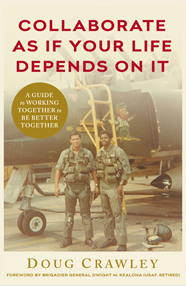
[0:00:29] DA: In many businesses, there is a huge issue, we aren’t trained on how to collaborate. If we are, it’s limited to team building exercises and this doesn’t create lasting change. Doug Crawley has learned how to collaborate in every area of his life, sports, business ministry and especially in the military where his life literally deepened on it. In his new book, Collaborate as If Your Life Depends on it, Doug shares stories from his life that illustrate the five C’s of collaboration, commitment, clarity, confidence, caution and courage. You’ll learn from his triumphs and his failures what it takes to begin working with others towards shared success. The book is your ticket to increase productivity, faster problem solving, enhanced innovation, better customer experiences and most important of all, vastly improved relationships in business and in life. Hey listeners, my name is Drew Applebaum and I’m excited to be here today with Doug Crawley, author of Collaborate as if Your Life Depends on it: A Guide to Working Together to be Better Together. Doug, thank you for joining, welcome to the Author Hour podcast.
[0:01:36] Doug Crawley: Thank you for having me.
[0:01:38] DA: Let’s kick this off, can you give us a rundown of your professional background?
[0:01:44] Doug Crawley: Well, first of all, you have to realize I’m kind of an old guy and there’s a lot that has happened in the 76 years but currently, I am the president of two companies, one that does staffing, warehouse staffing, assembly line workers, forklift drivers, that kind of thing. I also have a joint venture company that does packaging and distribution. I’m the president of both. We do about, combined about a hundred million dollars a year, that’s just one hat, I’m a grandfather of six grandkids, I am the father of three sons and in addition to that, I am the pastor of my church. So I wear a lot of different hats. My background prior to that was in corporate America so I did that for a number of years and prior to that, out of college, I joined the air force. I’m a Vietnam veteran, I flew 185 missions in Vietnam, 85 which was over North Vietnam. In synopsis, that’s kind of my background and what I do.
[0:02:58] DA: That’s a very successful resume.
[0:03:02] Doug Crawley: What I tell people is, if you live long enough, you get to do a couple of things.
[0:03:08] DA: You just mentioned, you’ve been around for a while, you’ve been in corporate America for a while, you’re now a CEO of two major companies, why was now the time to write this book? Did you have a recent inspiration, did you have an ‘aha’ moment or a learning moment?
[0:03:22] Doug Crawley: Well, it started out that one of my – one of the VP’s of one of my customers suggested to me that you need to do a TED Talk and I’m thinking, I don’t know if I would be good at that but I just one day I sat down and I start kind of thinking about what would I say. I’d always wanted to write, kind of write a book, sometimes before life ends and I thought, but this was not the book that I had in mind. The catalyst for this specific book came from thinking about what I would say in a TED Talk. As a result, one day I was talking to – I don’t remember which one of the two pilots that I flew, in the book, I talk about one I flew combat with and another good friend of mine that I flew with during peacetime but one of them, I was talking about it and I say it to them, “You know what? What we did in the mission that we flew particularly at night, that was the epitome of collaboration.” And because as a company or as either of my companies, we have to work closely with the customer, I’ve got to pull the team together, I play basketball, in fact, in the senior Olympics, stuff like that. It just kind of all came together. But the catalyst was that specific point in time when I said that to that particular individual that I was visiting with and it just kind of grew from that.
[0:04:55] DA: Did you have any learnings or major breakthroughs from writing the book through maybe doing some research or maybe just having that introspective journey of writing?
[0:05:05] Doug Crawley: I’ll say this, I don’t know that I had a major breakthrough but I think as I started developing the five C’s of collaboration which I talk about in the book, I saw them evident in many more places than I had anticipated. It also pointed out to me a couple of things in my own company and church that maybe I needed to improve upon. I don’t know if that completely answers your question but that’s kind of, it is as I remember it.
[0:05:43] DA: Yeah, that’s a learning for sure. Who is this book for? Is it strictly for business leaders or can you – can this be for religious leaders too?
[0:05:54] Doug Crawley: Yes, I started out quite honestly, wanting to write this book as a tool that I could use with my customers or potential customers to talk about how to work together which is so important in this day and age. As I started writing it, it evolved into more than that. It’s really a book that talks about any kind of relationship, any circumstance where you got, you have to work with people so that could be marriage, that could be ministry, that could be the military, businesses or it could be team sports and in the book, I use illustrations from all of those categories to make the points of why the five C’s are so applicable.
[0:06:41] DA: Yeah, you say in the book that the major things in life involve working together with someone else if we want to be successful. You did come up with this system to improve collaboration which you call the five C’s of collaboration. Can you tell us what the five C’s are?
[0:06:57] Doug Crawley: Yes, the five C’s of collaboration are first of all, commitment and the second C is clarity and the third C is confidence. Without those three, the other two really don’t work very well and the other two are caution and courage. Those are the five C’s.
[0:07:20] DA: Now, can you talk to us exactly what you just mentioned, why are the first three so important and why is building that foundation so important to the other two?
[0:07:30] Doug Crawley: Well, in the book, I use an illustration, I call it the ‘house that collaboration built.’ It’s a house that maybe a child would draw, I think it’s a five sided figure with the roof and the foundation and two sides. The foundation is commitment, if you don’t have that, if you could imagine a house, doesn’t matter about the walls because I’m sitting now in a place in Houston and oftentimes in Houston, I don’t live here anymore but when I did live here, houses had been built on a fault line. What happened is, the foundation would crack, doesn’t matter how well the walls and the roof were, if the foundation cracks. Commitment is the foundation and if you think of the walls as being clarity and confidence, then you, on top of that, the roof is caution and courage.
[0:08:27] DA: What can following this system bring to specifically a business?
[0:08:33] Doug Crawley: Well, one of the problems is overall, and I make this point in the book, is that collaboration, I’m not sure we do a good job of collaborating. Sometimes we do what I call painting the bull’s eye around the arrow, we look at what we have accomplished and we call it success but it’s not always success. I use an illustration where the farmer goes out and he asks the other farmer, he sees all these bull’s eye’s on the side of the barn. He says, “Man, you are great – how do you do that?” He says, “Well, I shoot the arrow first and then I paint the bull’s around the arrow.” We think we collaborate well but I’m not sure we do in business, even in collaborative efforts I’m involved in. One of the primary reasons is, unlike the military, unlike first responders, unlike the medical profession, we don’t frame people to collaborate, it’s more like what I do when I go to the gym, to the park and I’m playing pickup ball with young guys. If it’s at a new place and I haven’t seen the guys, we just pick five guys, we tell them, so you’re – “I got my five and you’ve got your five and let’s play ball.” Kind of what we do in business is, we just put people on the team, we play pickup ball. The difference between pickup ball and professional ball is practice. There’s a system, they trained the people to do what they do. I’m convinced that we don’t do a very good job overall in terms of training people to collaborate with each other when that’s one of the most important things particularly in this day and age that we can do.
[0:10:16] DA: Now, how do you suggest bringing the five C’s to a company or to a group and getting buy in from everyone at the table? I’m sure it’s really hard. You can’t just go in and say, ”Okay, we’re going to have this new system, we’re all going to collaborate perfectly.” Right?
[0:10:32] Doug Crawley: No, it doesn’t work, it wouldn’t work like that [inaudible]. Even five college guys who play college ball and they all were very good and you just tell them, “Okay, go out there and play.” That doesn’t work. You do have to get buy in. Part of commitment is that it has to come from the top. If the leader doesn’t buy into it, it’s going to be very difficult that those that are on the front lines are going to buy into it. I don’t want anyone to think that by reading the book, they can read this book and by tomorrow, they’re going to have the perfect teamwork, a perfect collaboration. It’s a process that you continually work on and so, you have to – one method may be to take the book and talk about the five C’s and have a discussion around that. But it has to come from leadership and not just something that someone at a lower level picked up on.
[0:11:34] DA: Now, when the five C’s are in place at a company, you’ve taken the time, you’ve implemented everything, what changes or improvements should leaders expect to see?
[0:11:46] Doug Crawley: That could be a myriad of things depending on the specific situation but one of the things and I make [inaudible] quotes in the book that others have said but you could expect if it is done effectively to see an increase to the top line and the bottom line. There is no iron clad percentage that I can guarantee you, that it will be a seven percent increase in profits or that kind of thing. I would say to you that there would be an increase if you do it, unless you are already done it to perfection in the beginning. And so the other thing is, the most important thing is I think, is that your teams, your departments, your silos will work together and become better together at what they do. I would also think that it would lead in a lot of cases depending on what you do, to better innovation because we kind of do the same thing where we want people to innovate. We just put them on a team and say you know, just try to come up with a good idea. But I think that top line, bottom line and the ease with which people work together regardless of whether they are democrats or republicans, black or white, male or female.
[0:13:06] DA: Now you mentioned a really powerful story in the book about how collaboration played a role in you still being alive today. Can you tell us about that day and what happened in that plane over Holland where you really saw all of these lessons come together?
[0:13:24] Doug Crawley: Yes, it is interesting. I have flown combat as I told you earlier and I had these 185 missions of combat and I never got a hole in my airplane, never even thought about ejecting. So I was stationed in England during peacetime and we were flying on just a regular low level training mission. We were flying over the northern coast of Holland. I had an individual with me that was – I was the captain at the time, he was a young lieutenant pilot. And he said to me he’d like to get around some clouds and I said, “Fine, I will get us back on course,” because I am sitting on the rear seat operating the radar systems. He’s sitting in the front seat actually at that point in time, flying the airplane. We had, in the initial training in that airplane, we saw a movie of an airplane in a spin that crashed and so no one ever would intentionally put the airplane in a spin. The airplane crashed but they got the video camera back and they showed us that as a film, as a training film. That day, when we were trying to get around the islands, I kind of looked up off from the radar scope and looked outside and all of a sudden, the airplane went into a spin. It was a flat spin and I remember thinking, I don’t know how I thought of this because we were approaching death but I thought. “This is just like the movie.” And he said to me, “Doug, we’re below 10,000 feet,” because that is the minimum ejection altitude meaning that if you ejected lower than that, even if you recovered the airplane you were still going to crash. And we had checked [inaudible] temperatures at 10,000 feet and he said to me, “Get out, eject, eject, eject.” I never heard it because we had done this multiple times in the simulator. We had trained for this and we did exactly what we had been trained to do. I got out. I don’t remember anything wholly from the time that I pull my ejection helmet to the opening shock of the parachute. He remembers going up in the seat and seeing the airplane explode on the ground while he is still going up in the seat. So we were pretty close to death. His parachute opened, he pushed off the side of a house and hit the ground. At first I couldn’t find him. We were fortunate because we landed, the airplane landed in a residential area but it landed in a pond. I landed in the pond and he landed somewhere. After we landed, a young lady ran out in front of me, asked me if she could help me. She took my parachute, there is a picture of that in the book and I ran up and saw him. So that was where all of those things came together, in one instance we are flying along and all of a sudden because I have been trained to do what we had to do, it went exactly like clockwork and to a large degree, even though I didn’t know, hadn’t identified the five C’s at that time when I went back and thought about what we had done and how we did it, it was an example of the five C’s all coming together.
[0:16:26] DA: Yeah, I mean it is an immediate example of when you have that foundation set and everything is set, you can just act quickly and trust everyone there and again, come out with what could be a lifesaving opportunity.
[0:16:41] Doug Crawley: Well yes, once we had identified that we were below 10,000 feet and the airplane is going to crash, we were committed to eject. I was going out first. We, not only did we commit but we were clear in our communication with each other and then he had the confidence in me and I had the confidence in him that I am going to do what I have to do and depend on you to do what you have to do. You never know how you are going to react when you are about to die. But it also exemplifies courage because you got to think in a split second, “Okay, I need to pull this ejection out, this is what I need to do,” but we, when I got into the airplane as we did every day, we set the system on automatic so all I had to do was pull the ejection out and it would then eject me and I didn’t have to do anything else other than wait for the opening of the parachute.
[0:17:35] DA: Moving into current events, how did the pandemic change your perspective or did it change your perspective on collaboration, especially what’s happening within our own government?
[0:17:49] Doug Crawley: It did and I am glad you asked me that. When I wrote this book even though the title of mine at this point seemed applicable, I didn’t know what a pandemic was. I had never thought about coronavirus, COVID-19 and so, I was in the midst, I had developed a manuscript and I was in the process of completing it when the pandemic hit and I actually had intended for the book to come out in May and it now it’s supposed to come out in December. If you will notice I have something in the book called “notes from the pandemic” well I had to go back. I had the manuscript written so I didn’t go back and changed the book. I just made two additions, notes from a pandemic and then I said the final words, which talks about it. Here is what, as I see it, when I started thinking about the pandemic, when I started thinking about the economy and what we were going through as a nation, when I think about racial injustice and the protests and everything that’s happened in this country and when I look at the partisan politics in the nation and I won’t even get into climate change, all of those things but most of all the pandemic and what was happening and so I thought about the fact that if the democrats and the republicans work together, if nations work together to come up with a vaccine, if we work together on treatment, tracking and tracing and that kind of thing. I thought about all of that and how applicable the five C’s were to doing that. And I’ve even got a couple of ideas that I want to do with my own company. An idea about a lab that I want to try and do so that we can, when the vaccine comes out we can get, not vaccines but we can get treatment and that kind of thing, we can get different things to the public in those areas that are normally hardest hit but don’t have access. Those are the kind of things that I want to do. So it’s had an impact on me and it’s had an impact personally because my life has changed because I am 76 years old and I am in that vulnerable category.
[0:20:20] DA: Yeah, I mean it was very glaring that right now, we don’t collaborate and that we are as divided I think as we have ever been, not the right time for that right?
[0:20:31] Doug Crawley: I would agree with you and this is a really difficult time for us as a nation because there’s so many things going on and it is not like, it would be enough if it was just the pandemic and everybody was cooperating. We would still feel a lot of pressure but that’s not the case.
[0:20:51] DA: Doug, writing a book especially like this one, which is going to help so many people and many businesses, is no small feat. So congratulations.
[0:21:01] Doug Crawley: Well, thank you. We’ll see, you know writing a book, this is my first book. I’ve never done this before and I understand from many other people who know more about this than I do that some of the ups and downs that you go through as an author, that some of those that I went through were not uncommon for others but it’s one of the most – I don’t know if it is difficult, it’s one of the most challenging things that I have ever done.
[0:21:31] DA: Sure. Now last question, if readers could take away only one thing from the book, what would you want it to be?
[0:21:39] Doug Crawley: It’s not a matter of if we collaborate but it’s a matter of that we will have to collaborate and since we have to collaborate, we ought to work together to be better together whether that’s in ministry, marriage, business, the military or anything else.
[0:22:03] DA: Doug, this has been a pleasure and I am so excited for people to check out this book. Everyone, the book is called, Collaborate as If Your Life Depends on it, and you could find it on Amazon. Doug besides checking out the book, where can people find you?
[0:22:16] Doug Crawley: I’m in the process of putting together a website that would go along with the book but we haven’t finalized that yet. The easiest place at this point in time would be to find me on LinkedIn.
[0:22:27] DA: Awesome. Well Doug, congratulations again on finishing your book and thank you so much for coming on the show today.
[0:22:33] Doug Crawley: Thank you sir for having me.
[0:22:36] DA: Thanks for joining us for this episode of Author Hour. You can get Doug Crawley’s new book, Collaborate as If Your Life Depends on it, on Amazon. Also, you can also find a transcript of this episode and all of our other episodes on our website at authorhour.co. For more Author Hour, subscribe to this podcast on your favorite subscription service. Thank you for joining us, we’ll see you next time. Same place, different author.
Want to Write Your Own Book?
Scribe has helped over 2,000 authors turn their expertise into published books.
Schedule a Free Consult