Alexsys Thompson: The Power of a Graceful Leader
Read the full transcript
Alexsys Thompson
Alexsys Thompson is a keynote speaker, executive coach, and the author of The Power of a Graceful Leader. A board certified coach and member of the Forbes Coaches Council, she founded Ubuntu Living and helps leaders align who they are with how they lead. Her book was featured by Entrepreneur as one of the best new leadership books of 2021.
📚 Books by Alexsys Thompson
Transcript
[0:00:29] DA: Do you have a division between who you are as a business leader and who you are as a spouse, friend, sister, brother, mother or father? In her new book, The Power of A Graceful Leader, Alexsys Thompson shares how to begin integrating who you are and how you lead. Through her experience with this disconnect in her own leadership and having coached hundreds of leaders in their integration journey, Alexsys offers tools, tenets and some relatable stories to support you in your journey towards becoming an integrated and graceful leader. She hopes you’ll find yourself making better decisions, building healthier relationships and experiencing joy, love and compassion as you transcend into the leader you were born to be. Hey listeners, my name is Drew Applebaum and I am excited to be here today with Alexsys Thompson, author of The Power of a Graceful Leader. Alexsys, thank you for joining. Welcome to the Author Hour Podcast.
[0:01:19] Alexsys Thompson: Oh, it’s my pleasure. Thanks for having me Drew.
[0:01:22] DA: Let’s kick this off, Alexsys, can you give us a rundown of your professional background?
[0:01:26] Alexsys Thompson: Sure. It is not a straight line but I can do my best. I would say –
[0:01:31] DA: Sometimes it is the most difficult question.
[0:01:34] Alexsys Thompson: Yeah, it can be. So I would say that what’s most relevant for the topic that we are going to talk about, which is the book, is I have about 15 years of executive coaching experience and consulting practice most recently moving more into the spiritual space on focused on leaders and integrating into their higher best version of themselves so the world can benefit from great leaders, which I would think that nowadays, we’re seeing the – a lot of examples of what doesn’t look like. So it would be nice to see more of what it does look like and people are out there doing that work. And mostly, I am an avid learner and I refiner of myself, which is a lot of what a graceful leadership practice and thought process requires is to constantly be in reflection and review and refining.
[0:02:22] DA: Now, why was now the time to write the book? Was it some extra time because of COVID? Was there some – outside inspiration out there? Did you have an “aha moment?”
[0:02:33] Alexsys Thompson: Yeah, so I have coached I guess over a thousand amazing human beings in my lifetime so far and I kept seeing some patterns that show up and in there, it was often a huge gap around the way a leader view self, And it was rigid and it was unkind many times about them viewing themselves and I was watching that transcend and project and transfer onto the people they were leading unconsciously and so as I started to trend the pattern and doing a lot of my own research. And my own re-farming and my own journey into being more graceful as a human being and as a leader, it kind of just all coalesced. Now, it ironically and this has taken me a couple of years to be committed to it, to put it down, rethink it, shift it a little bit. So, COVID did in a beautiful way, one of the gifts of it was allowed me a little more stillness that I am used to, to focused on finishing up what I started.
[0:03:37] DA: Now were there any learnings or major breakthroughs that you had while writing the book? Sometimes just by doing research, sometimes it’s the introspective journey?
[0:03:46] Alexsys Thompson: Yeah, there was a lot of them. So there were six tenets that came up through this writing process and the two of them that personally than everyone’s got to have a different couple for themselves that were really singing to me was the integration of mind, body and soul because I am one that has to work on being really aware of my body. I am much more of an intellectual, loner introverted type that can spend many days in my brain and be quite content. So learning that my body was giving me cues to things as I went through some illnesses and that there was some connection and integration work between my mind and my body was kind of an epiphany for me a few years ago and then the other part, I had an intuition about it but I didn’t really know how we’re going to practice it in leaders as leaders was the last tenant that’s listed as called “compassionately powerful in all things.” It’s the ability to do hold a duality and I let both things simultaneously exist. And that was also a pretty big challenge for a lot of leaders that I’ve been working with.
[0:04:54] DA: Now, a lot of people will write books for their former-self.
[0:04:57] Alexsys Thompson: Yes.
[0:04:58] DA: And usually because there were some adversity along the way. Can you tell us about a few of the issues you ran into earlier in your career and maybe some of the lessons that were learned?
[0:05:07] Alexsys Thompson: Sure and I would definitely say I fit into that category. I think you know, in the book I am actually pointing out several times that a lot of the hardships if we embrace them in our role so we can get to the other side at some point, it might not be the first attempt that we often can look back with a lot of healthy reflection and share of a lesson and this book is in large part of that, both my stories and other stories. So early on in my life and it’s in the book is that I was told that I was too much. I was too this, too that, T.O.O. too much of whatever I was showing up as because I bring a lot of energy with me and intensity and at a really early age in my leadership journey, I translated that into needing to really play small. To kind of dim my light, let me say. That was a lesson I had to unwind and it wasn’t graceful and one of the – in large part was a lot of grit and messiness and consistent messing it up, going and cleaning it up. Messing it up and cleaning it up but the more that I did that, the more of the grace became a part of how I was being with people but it took a long time and was not just a movement from being clunky and “too much” into gracefulness. It’s been a lifelong journey.
[0:06:26] DA: What are the questions that someone can ask themselves to know if they are even in need of a leadership skills tune-up?
[0:06:34] Alexsys Thompson: The fact that they’re asking questions is probably a really good cue that wherever they are and they may be evolved in their leadership journey that they are seeking something or some internal force that’s saying, “Hey, we can do something differently than we’re doing it today,” and there’s this prompting and this nagging internal voice that’s often hard to escape but some of the ones that are specific to being a graceful leader that I am most recently – Most often hear are my work at the executive level of leaders and so they’ll get there wherever senior VP, CEO, CFO and they’ll be quite accomplished like their resume is beautiful. Their education is spot on and they are sitting there and looking at the wall going, “If this is all there is, I am so disappointed.” There has to be a way and something deeper and more meaningful to my being than the spreadsheet and the shareholder report. Those types of things were moments of transition or trial or drama that’s someone’s experiencing where they have a pause in their life and it is just a question of whether or not they’re willing to enter the pause to look at a transformational experience on the other side of it.
[0:07:44] DA: Now, the goal is to become a graceful leader and can you tell us what your definition of a graceful leader or graceful leadership is and maybe who benefits from graceful leadership?
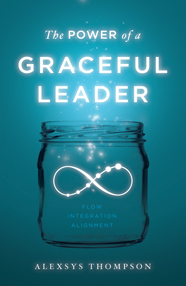
[0:07:56] Alexsys Thompson: Well yes, so the cool part about this is and why I chose to even spend time in the leadership space in this world is because really early on in my career, I was at some kind of conference and they were starting to spout off statistics and it said at that point Gallop I think was the resource and it said that every manager, this isn’t even an executive leader but every manager most likely will directly impact up to 12 people at any given point. So I quickly saw the leverage point, right? So I had worked for leaders that were awesome and I had worked for leaders that in my experience weren’t so awesome and I was like, “Wow, if we could have more leaders bringing out the best in people, then that multiplier, it’s endless.” And so as a result of that, everybody benefits from graceful leadership whether it is just the leadership journey within you in your own life, you know you believe in yourself into an aligned life or you are leading a multi-billion dollar corporation, the multipliers the only difference is the impact is no less significant. And when we talk about grace and it is funny because when I started writing this book, I had a lot of advice to take the word graceful thrown out the door because it was religious in connotation. It was slippery, people can’t get their arms around it and I was pretty resilient in the fact that this was the book that I was writing and so one of the first task was the need to define grace, right? To say in the context of this conversation, “Here’s what we’re talking about.” So a graceful leader is someone, there is an image in the book and on the cover, it’s the infinity symbol and you’ll see six of various size dots on that infinity symbol and it’s meant to represent a graceful leader is so many things. But paramount is the ability to flow along that infinity symbol in any given point in the nanoseconds of time using intuition as their guiding force. Not ignoring data, not ignoring logic but really letting the guide be their intuition, taking into account of those things And being able and willing to pivot on that infinity symbol at any given moment, meaning they are leading in crisis, they are sitting at the back of the room while other people emerge as leaders. They are standing next to their team leading, they’re practicing a heavy followership in their peer group or in their industry while also leading their organization and so this brings us back into that development, right? How can I follow and lead at the same time? Which is kind of an epitome of a graceful leader. You will see a – they actually have physical manifestations of a grace start to show up in you as you’re becoming because graceful leader is a way of being. It is not a doing and that’s probably the biggest distinction.
[0:10:50] DA: Can you give an example of a graceful leader who you look up to personally?
[0:10:55] Alexsys Thompson: There’s lot of like, I would you know say unknown to the universe people at the back of the book that I actually express gratitude for there but if we are looking for someone that most of us might know, we could use Jane Goodall and those of you that know who she is, she’s spent her whole life with chimpanzee community actually living inside their community and her, one of the key pieces of being aligned in graceful leader is understanding your mission and purpose in this incarnation of your life and she demonstrates that very clearly, very early on in her journey, which is a gift. So she understands that she’s going to be – she doesn’t know of the time of course because we don’t know how it is going to unfold what her role with chimpanzees may be but she’s got enough of a knowing to enter into that in a way different than most scientists or people in her field have done before and as a result, we know things about chimpanzees and that animal and relate to that animal in the way that we would not have been able to do without her gracefully leading us in and introducing us to this primate in a new and quite beautiful way. And then you’ll see her career, she transcends her career. She becomes, you know, a leader of leaders, right? Inside of a field of being good stewards with animals on our planet and so I think she’s a really good depiction of a graceful leader and how one can evolve over time.
[0:12:25] DA: Now, how much of an urgent need is there for graceful leadership in the world today?
[0:12:32] Alexsys Thompson: Well this is one thing that I couldn’t have known when I started the book pre-COVID. What I will say is that now, in my experience more than ever, we need our leaders at all levels in all industries like literally every leader that’s calling a meeting needs to actively choose leading not despite a default of the next promotion. So once you’ve actually you choose that leadership to something you’re called to do because it is a calling, then making the way that you lead a practice for you. And then evolving one of that, whether it’s through conscious leaders, servant leadership and then ultimately, a graceful and situational leadership that will be your own journey but the commitment and the calling to being graceful is one in my humble opinion because that’s what it is at this point is called for now more than ever and at the moment where we’re more divisive and more – we aren’t seeing strong acts of empathy and compassion in certain areas where we need that admission now.
[0:13:33] DA: I’d like to bring something back around that you mentioned earlier on our conversation and it’s compassion and power and many leaders are often caught on the tightrope of either being compassionate and still coming off as powerful. Is it possible for someone to be both?
[0:13:52] Alexsys Thompson: It is imperative that you’re both. So it is possible to be both. The distinction of a leader needs, we’ll dive into this tenant, is the distinction between force and power. So if you think about the industrial our age rate where it was command, much more of a command control and I don’t think that that left us yet, right? Our style of leadership, that’s a forceful way of being in the world. Power is much gentler, it is much more enlisting. It is definitely when it is aligned to a graceful [portal 0:14:23.3] it is more kind and loving and so the tenet and it actually reads that you influence with open heart and clear agenda, bonding stillness and action, understands and owns the impact of consequences on their behavior to self-organization in the world and they create room for flow while maintaining a structure. So we are moving into and I think a lot of us have read, you know some of the newer books about engagement and happiness and purpose and in life in general much less in a leader’s life. It was most imperative in a leader with that impact of 12 or more on our universe. So when the leaders steps into their gray center and their knowingness of who they are that is powerful meaning that they hold it but they don’t push it. They become this pillar of energy and power that more often is still that it is in action and it becomes a source of safety and compassion and directive when needed for the team and the groups in organizations that communities that it’s leading. It’s really imperative that this leader that moves into grace understands the duality and it can also understand the synergy and that they don’t have to have, you know the whole communication days. It is called the sucker’s choice, I can either be nice or I can get results. The truth is that you can do both.
[0:15:46] DA: How does gratitude play into all of this? What kind of role does it play in successful leadership and can you think of any, you know, maybe hypothetical situations where grace and gratitude combine in the workplace?
[0:15:59] Alexsys Thompson: Yeah, so gratitude is I’ve spent many years working the space with leaders and the short story is I used to when I work with leaders, I buy this beautiful leather journal and I’d send it to them and say, “We’re going to journal” and I’d get a paralyzed response or a, “No, I am not going to response,” but either way, it wasn’t working, right? It was they didn’t know where to start. There was some resistance to it and so I developed some guided gratitude journals with the intention to work with leaders in this space. So that has made all the difference in the world. Once you would imagine, just put yourself where we are now with COVID. There is times where it’s really hard to sit back and think, “What could I possibly be grateful for in this world that I am living in today? This new way of being and not being with people” right? When you can be still enough to explore where those gratitude’s are inside of what we might call undesirable or unwanted or a victim relationship with the state of the world or state of the situation. We have an opportunity to allow another duality to exist. We can acknowledge that COVID is not helping us in many ways, let’s just say in our economic list for small businesses we are seeing huge hurt there not to mention the health consequences but we can also say that in that same conversation that there’s a lot of small business that have learned agility and have adapted and have found new ways of working but they would not have slowed down in that stillness. Without the stillness being kind of forced upon them and wouldn’t have taken the time because it wouldn’t have been the pressure and need to figure out a new way it would be and when I work with a lot of entrepreneurs in the community, what I hear is, “I’m really thankful for the slowdown because I love to go back to doing this particular thing the way that it used to be done,” and that would have been missed opportunity in most cases. So that’s the – gratitude is like the portal to what I am calling a grace center, which is the part where your heart and your cyclical energy kind of connect and start communicating with each other where you have access to a power and a collective knowledge far bigger than the ego itself can even hold. So that’s the impact of gratitude and I’ve seen it evolve in leaders many, many times. Often times whether, you know it is the human nature or not but it’s come out of a – What someone would look, would call a horrible situation in the beginning. So as an executive coach, sometimes I’ll work with a leader that is under the pressure to make a shift pretty quickly and usually it is their behavior. So emotional quotient in their work. And so ,that is an undesirable place to be in. It feels, “If I didn’t choose this, it’s being done to me,” all of those things but once they enter into the gratitude in this situation, all of a sudden they start to find their grace connect. And their internal intuition, it starts to get turned on and if they allow that to happen, they’ve taken what could have looked like punishment or demeaning, shameful experience and they’ve turned it around into a very powerful but not forceful way of being in the world.
[0:19:15] DA: One of the more interesting things I found in the book is when you describe alignment and you even say to consider taking an alignment inventory, which is cataloging the times you acted in a way that you put yourself and soul into misalignment. Can you talk to us about how important alignment is and maybe what this alignment inventory looks like?
[0:19:38] Alexsys Thompson: Sure, thanks for calling that out. That’s not for the weak-hearted. It is literally being still enough to just start writing down where you weren’t the best versions of yourself and we all know those highlighted spaces where we’re like, “We could have done that better. If I knew now what I knew then, whatever, right?” Those types of things but to start cataloging them, I took each decade from the time I was 18 and I went a little bit beyond because I had some not good things prior to 18. But from 18 to the point where I was 50, I started just cataloging, “Okay, what are the events in my life that were highlights and transformational pivots? What was my role in that? Was I acting in my highest good? Did I get defensive and withdraw? Did I take the opportunity? Did I have to wait for that opportunity to show up a decade later?” Those types of a pattern inventory and then once you get that done, the really hard part is to like start listing the people. Because what I began to understand was because of the intensity that I bring into the world just being me with that “too much thing,” I had run over some people, right? It wasn’t my intention to be hateful and hurtful or dismissive or totally miss the boat but the reality was that that was the impact or the consequence of who I was being at that time. And I spent over a year, just over a year making that list and where people were still alive and where people were willing to have a clean-up conversation, I had those conversations. They were hard, they were humbling. Some of them people wouldn’t let me enter into that forgiveness space, there wasn’t an opening to create closure or a new way of being with somebody and that’s a graceful leader is really one of the tenets, it’s just understanding that all the consequences for your life are yours, right? It doesn’t mean bad things happen that maybe you didn’t bring into being but your relationship to that defined bad experience, you have total control on that. So that inventory for me was humbling and hard and so liberating. I was able to just let go of so much guilt and shame that opened up all of these space to be something else and that’s where gray centered in.
[0:22:03] DA: Now, there is so much more in the book, we really just scratched the surface but I like to ask one last question, which might be the most important one because the most important step in any journey is the first one and after reading the book, what is the first step folks should take to bring more grace into their lives?
[0:22:22] Alexsys Thompson: Start a gratitude practice if they don’t have one. It is that simple and it’s that hard. So when I say practice that means that there is a ritual to it. There is a consistency and a rhythm that you find and I have seen it done a bazillion different ways and all of them are lovely is the key to you defining if it is working for you is if you actually feel your heart expanding. If you actually start to see things in a different, more compassionate, more compelling awe and wonderstruck light in the world, that’s how you know that your gratitude practice is starting to kind of crack away at the hard armor that many of us put around our heart for many different reasons. Those are as unique as the individual. But the goal is to try to breakdown the armor so that you can learn discernment and you can create safety for yourself with your own heartfelt relationship. And then extend that beyond that and the gratitude practice is the fastest, simplest and hardest way to do so.
[0:23:24] DA: Well Alexsys, writing a book is no small feat, especially one like this one that’s going to help so many leaders and business professionals. So congratulations on publishing your book.
[0:23:34] Alexsys Thompson: Thank you for that. I appreciate your time Drew.
[0:23:37] DA: Now, if readers could take away only one thing from the book, what would you want it to be?
[0:23:42] Alexsys Thompson: Slow down and look within.
[0:23:45] DA: I mean I love it. This has been a pleasure and I am so excited for people to check out this book. Everyone, the book is called, The Power of a Graceful Leader, and you could find it on Amazon. Alexsys, besides checking out the book where can people connect with you?
[0:23:58] Alexsys Thompson: A couple of places, I’m in Instagram, Facebook, all that @alexsysthompson and we are also opening up a retreat center. A small, intensive, intimate retreat center in Vermont and that is called Ubuntu and you could find us on those social media channels and webpage as well.
[0:24:18] DA: Very cool. Alexsys, thank you so much for coming on the show today.
[0:24:21] Alexsys Thompson: Thank you, have a great day Drew.
[0:24:24] DA: Thanks for joining us for this episode of Author Hour. You can get Alexsys Thompson’s new book, The Power of a Graceful Leader, on Amazon. Also, you can also find a transcript of this episode and all of our other episodes on our website at authorhour.co. For more Author Hour, subscribe to this podcast on your favorite subscription service. Thank you for joining us, we’ll see you next time. Same place, different author.
Want to Write Your Own Book?
Scribe has helped over 2,000 authors turn their expertise into published books.
Schedule a Free Consult