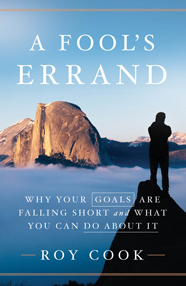
Roy Cook: A Fool's Errand: Why your goals are falling short and what you can do about it
Read the full transcript
Roy Cook
As Roy Cook shows, every person has 10-20 core values, unique to them.
📚 Books by Roy Cook
Transcript
[0:00:25] DA: Unless you’ve been living under a rock, you’ve heard how important it is to set goals, you probably also heard a million different life hacks to help you reach them, get more sleep, meditate, maybe write in a journal. It’s all helpful advice but when push comes to shove, it won’t help you lead a more fulfilling, peaceful life. That’s because the key to success is how you pick the best goals for you. Goals, you must set to be consistent with your inner core values. In Roy Cook’s new book, A Fool’s Errand, he shows that every person has 10 to 20 core values unique to them. He explains, what core values are, how to discover them and how to use your values to make wise goal choices. When you build a life around your core values, success will follow. To Roy, you don’t need life hacks, all the tools you need are already inside you. Hey listeners, my name is Drew Applebaum and I’m excited to be here today with Roy Cook, author of A Fool’s Errand: Why your goals are falling short and what you can do about it. Roy, thank you for joining, welcome to The Author Hour Podcast.
[0:01:26] Roy Cook: Thank you Drew.
[0:01:28] DA: Let’s kick this off. Roy, can you give us a rundown of your professional background?
[0:01:33] Roy Cook: Yeah, I graduated from Oregon State in engineering, physics and math. Learned after that that I wanted nothing to do with those areas, that’s rocket science and that wasn’t me. I went to work with Procter & Gamble for six and a half years in Cincinnati, they were the Apple of their day. It was tough to get a job there. Good people, very challenging environment. Then I – after that, I did – I left Cincinnati, I wanted to live in the west coast and went to work for a couple other companies over time. Then, when I was about 52, I became an entrepreneur. Then I retired 11 years after that. All of this was in the field of packaged goods and marketing. Like Procter, Kraft, Unilever, things like that.
[0:02:21] DA: Now, why was now the time to write this book? Did you have some extra free time, was there an inspiration behind it, did you have an “aha” moment that says, “I need to get my thoughts down right now?”
[0:02:36] Roy Cook: When I was 53, I had a kind of emergency in my life that I can talk about later. But then 11 years later, I retired. After that, I started teaching about core values to adults free at a local college in Northern California. I learned in doing that and in reading on medium.com that hardly anybody that’s writing now, writes anything about core values. They don’t understand it, they don’t understand it’s value, they’re writing about goals and life hacks. I just kind of accepted that, but then after a while, I thought, well, this made a huge difference in my life. Fulfillment, peace of mind and financial freedom. I thought, “Well that’s the trifecta.” Maybe I should write about what I discovered and what learned from a couple of other writers 30 years ago and then put in to practice. What the results were and as I looked around, I could see no other books on this subject except for one where they wrote about core values as though they were something you adopted from the outside. But my sources said that isn’t true. [Stephen R Covey 0:03:53.3] his partner, Hyrum Smith. Covey might be a familiar name to lots of you. They said, these are internal and they’re with you since childhood. I thought, well, I’m going to write that out because I think it will be helpful to people who have problems picking their goals. The goal should come from the values, otherwise, they’re based upon things you just read about or a celebrity you like or whatever, that sounds like a good goal. That’s not an effective way to grow your future.
[0:04:30] DA: Now, were there any learnings or major breakthroughs that you had while writing the book? Maybe through doing research or sometimes doing that introspective writing journey of looking at your past.
[0:04:42] Roy Cook: Yeah, there were, and one that stands out is for the first time in my life as I reflected back on it, I can say, until the mid-30s, I was a failure. I was selfish, self-motivated, I was broke, I borrowed money from women I dated who earned a fraction of what I earned. I was not a real good person. I had bad things that happened and when I go out on the weekend and drink too much and drive through highway signs on a freeway disappeared and – or drove into a bus boring at 50 miles an hour, in Cincinnati when Procter was on a Friday or Saturday night. Let’s just say there was room for improvement there. I had never thought about that or wanted to admit that to anybody before. But that’s in my book because part of it is a personal story, it’s the way I chose to talk about core values. I don’t think people are really interested in my life but it came from there, it came from that. Then, I learned also later that I confirmed in my mind that the reason that I reached a level of success in my life, especially when people would call now happiness. Which the two writers are for two earlier. I call peace of mind and fulfillment. That that only came fully from honoring my core values and every daily decision I made. That’s a big deal, there are about 400 values out there and I learned from teaching this that each of us has about 10 to 20 that are inherent within us. They’re there since child, they don’t tend to change much. If you live your life on the basis of that, then you have – I think you have the ticket to achieve your lifelong dreams. We all are different, not everybody has the same level of integrity or creativity or any number of other things that I can name. We’re different, even your wife is different from you, you may share some core values but many you won’t share. But if you’re not honoring your core value, if you got to create activity core value inside you and you’re not honoring that, unless you’re honoring some other ones that are equally strong, your chances of being happy and fulfilled are not real good. That’s what I learned in writing the book and right before I wrote the book.
[0:07:22] DA: Now, who is this book for? Is it for entrepreneurs, is it for CEO’s or is this something everybody could read and take something away from?
[0:07:28] Roy Cook: Well, I believe it’s for everybody, but when it gets right down to it, that isn’t the case. I found, when people get out of college, they make a decision. They either decide to primarily live a life based upon entertainment or they decide to live primarily a life focused on learning. Now, it’s not as pure as that, you can be interested in both and so on. But I found that about 80%, maybe 90% of the people that are out there, their life is won on entertainment. Watching TV, even their vacations are places where they go and have fun, not to learn or study art or history or whatever. They’re interested in parties and probably when we were young, we all are. Parties, entertainment, sports, stuff like that. Other people are interested in learning, the average person in this country reads five books a year. Those folks aren’t interested in learning. People that are on social media two hours a day, which is the average for Americans. They’re really not focused on that or if they’re watching nightly news two or three hours of that, they’re not focused a lot on learning. The learners are focused on reading. If you read about them, they’ll be reading 30 to 50 books a year. Some of the most successful people in business now talk about that. Even our president said, leaders are readers. I’m focused on the readers, the ones that feel things aren’t perfect in their life, they’re not where they want to be right now. There are people that learn, they read self-help. But not exclusively, they might read biographies and literature to learn. I’m not so much focused on the other people that haven’t gotten to that yet. Now, until I got to my mid-30s, I was focused almost exclusively on entertainment, entertaining myself, enjoying myself. This can change at some point, you can decide you know, this isn’t working. I’m writing for those that want to learn and want to have fulfillment and peace of mind and not for others.
[0:09:42] DA: Now, let’s start from the beginning and the super basic question of, “What is the definition of core values to you?”
[0:09:52] Roy Cook: I found there are about 400 values out there. Core values means, those values that are inherent within you. Covey and his partner Smith thought they came at birth. But those guys will have a spiritual background and that might be where that came from. Others feel it came from teachers, parents, friends, other associates when you’re young. But it doesn’t develop as best as I’ve been able to see after your childhood. You don’t adopt core values later in your life, they don’t come to you. Now, why they’re inside us, I don’t know but when you’re looking, reading my book and looking into what your core values are, you will find that these values will resonate with you. I would say, most people probably are aware of a third to a half of what their values are if they’ve got 10 to 20 of them. What makes those unique is that they’re really just kind of burned within you. Now, you may have other values that you credit but they’re not core values, they’re not ones you want to really base your life decisions on. You kind of draw that line, it’s just like things you’re good at. It’s not a one list of things you’re great at and everything else you're terrible at, there can be kind of a hierarchy there.
[0:11:13] DA: You know, you bring up an interesting question in the book and I’d love to dive into it more. Are the values you choose who you are or does discovering who you are allow you to choose the right values?
[0:11:29] Roy Cook: That’s absolutely a great question. It is a learning question that I toyed with a lot when I was writing the book. I learned about that. On the source, medium.com, I wrote a blog called Who Are You? I think most people, if they were asked that, they’d say, “Well, I’m married, I’ve got two kids, this is my dog’s name, this is my work.” That isn’t who you are, that’s what you’re doing. “Who you are” are your values in my opinion. They’re there to discover and in my book, I have a section called “The little helpers.” It’s about 15 or so circumstances I set up that you can test yourself with. They will uncover values for you, they’ll help you. Probably somebody you knew could probably tell you that too. But I’m going to give you one example, one that I like a lot. You walk into a room, and everybody you know is there, your kids, your family, let’s say your parents, your friends, people you work with. In the middle of the room is a coffin and you say, “Why is that here?” You walk over to look in and it’s you. Here’s my question, this is one of my little helpers. You’re going to hear from each of these people doing a eulogy, what would you like them to say about you? That in my opinion is almost 100% likely to uncover a core value. Like, “He was always good with everyone who was around him, he could help them.” “If you went to him, he was a good listener and he could do that.” Somebody else, “My god, she was creative, her house, her garden look beautiful, she could paint.” That’s a creativity core value. I wouldn’t have that. I don’t have a creativity core value, I don’t think, I like creativity but it’s not quite there. Somebody else will say, “Well one thing about Drew is he always told the truth, he had a high level of integrity, you could count on him.” I believe that they’re there and I think they will help you find out who you are. As a matter of fact, the bottom level of the productivity pyramid is your “Why”, your purpose. Then, in my view comes core values, and then comes goals on top of that, that tasks. The very bottom, I don’t think you can get to that without doing core values first. If you try it and that’s a big question, “What’s your purpose being here?” it’s very tough to do, I tried that for years. But after I had my values, it was easier for me to do that because I defined myself in terms of those values. I thought a lot about that and I thought, I put right in the book, “Don’t work on the base of the pyramid.” Which is your purpose or who you are. A sentence definition, maybe two sentences. Don’t work on that until you’ve done your core values.
[0:14:41] DA: Now, what you just mentioned is really interesting because you hear a lot of these values being thrown around. You say, “I would love to be like that.” What’s the issue when you try to adopt other people’s core values and make them your own?
[0:14:57] Roy Cook: Well, here’s what I think happens there. I’m going to be a little opinionated here. We read things by people in life that earn a lot of money to get to the end of their life and some of them who are candid, a matter of fact a lot of them say, “Yeah, I was never really happy. I achieved what I thought were my goals. You know, I was making a lot of money, I could do anything I wanted but I really wasn’t fulfilled or happy.” That’s almost a common, that’s a subject of films and media of all types, that’s a kind of a universal problem that famous authors deal with. I believe the reason for that is that they didn’t know goals that honor their values. Let’s say they had a value of integrity and they’re running a big company and they found out that they could be a little more successful if they shaded the truth, they weren’t always honest, they were calling the court, they had to lie to protect their company. If you got a core value of integrity, you’re going to be greatly troubled by that and probably that will be reflected in some way in your health. You’ll be troubled by it, you might have anxiety attacks which I did. Anyway, that’s my take on it.
[0:16:08] DA: Now, are core values only valid in terms of somebody’s career or they also in play outside of the work place or even once you retired?
[0:16:19] Roy Cook: Most of my usage and knowledge about core values has come from retirement. Once I adopted and retired 11 years being financially free. I never thought that would happen in my life, I never thought I was that kind of guy. If I looked around at women and men that are successful, I thought I wasn’t like that. For almost 20 years now, after retirement, I’ve lived according to my core values. In my book, I’ve defined all the activities I do in retirement based upon the core values. I list the core value and I said, “This is what I’m doing now.” I’m doing mentoring in school or I put together a group of people that do give-back with kids in LA and Mexico and stuff like that. Your core values are about your life, they’re not about your career, but your career is part of your life, your marriage is part of your life. Who your mate will be is part of your life, who your friends are is part of your life. Your core values will affect every part of you.
[0:17:19] DA: Now, you mentioned this earlier but I’d love to touch on it again. What does it mean to honor the core values that you’ve chosen for yourself?
[0:17:29] Roy Cook: When I wrote the book, I realized that what I felt was obvious, wasn’t obvious. That is, well, you have these core values, how do you use them? I wrote in there, “How you use them every day.” I took an average day and listed them and talked about the values saying “Honored” Here’s what I mean. After you have your core values, if you read my book, my guess is it would take a couple of months maybe, a month to get to their own and then another month or two to think about it or if you really have internal issues you’ve got to resolve, it could take longer than that. Once that’s done, you’re in business and each day you get up. You don’t do anything that doesn’t honor your core value with the exception of you’ve got to ignore household chores, you’ve got to ignore unusual circumstances like you’ve got an adult who you have to take care off. He has some problem, this long-term it involves a lot of care on your part or you’ve got a career that isn’t the best for you, you can just see it as a – well then, you can’t actually go in and just do what you want what honors your value. You’re going to have to. If you want to keep the job, you’re going to have to do something different. I just say get toward the – walk towards the light as soon as you can. Do the best you can to do that. My situation was a little unique and that I had core values. I operated off them for 11 years while I was an entrepreneur and then 20 after I retired when I can do anything I wanted. By the way, that’s what the psychiatrist that I had when I had the issue before I found core values said to me when I retired now for the first time has a blank sheet of paper, you can do whatever you want and so core values came into play there. For most people that are working, they won’t be able to be quite as free in doing that but they can do some other things. If they find they’ve got a high level of integrity and they’re not going to work for a dishonest boss and they’re going to get rid of people that they’re associating with now that are negative and bring them down. I have no people like that in my life. I have no caustic people or toxic people in my life. Of course, that’s easier to do when you’re retired. You know that is not difficult.
[0:19:55] DA: Sure. Now, are core values enough once you’ve chosen them, you’re honoring them? Are they enough to get you to where you want to be or are there other lessons and learnings, talents or skills that still need to be incorporated into your life?
[0:20:10] Roy Cook: My God that’s a wonderful question. On the first part, I think there are enough if your goal is fulfillment and peace of mind, which I would translate into happiness. Just that happiness is such a vague word in a way, what does it mean? In a real sense, I think that you know, a guy was sitting in a bar cool lounge here with a six-pack of beer watching an NFL game and say he’s happy but that is not what I am talking about, not that kind of happiness. I think if you’re talking about success in business, which is not primarily not Covey wrote about in The 7 Habits of Highly Effective People, it’s by the way sold 25 million copies. It’s kind of a business Bible and then What Matters Most by Hyrum Smith, they weren’t talking about career. They were talking about just life but if you want to do what I did, I retired financially free. I have written in the book that you’re going to have to develop some other skills, which will relate to your vocation in my opinion. You may have to – I just would say this, you definitely will have to develop people skills. You definitely will have develop courage. Twice in my life I quit jobs where my boss, in both cases the people that ran the company wanted me to do something unethical and I didn’t want to quit either one. Both were good jobs, I was paid well, I have travelled. I was able to live in San Francisco, which I like. If I hadn’t had courage, I wouldn’t have taken those steps. Then what you alluded to perhaps some other people skills, yes in terms of career, you probably have to develop other things but not if your goal is fulfillment and peace of mind. It’s enough to have your core values.
[0:21:57] DA: Are there tools you could use to helping your journey and to improve on your core values or just to measure how effective they’re being in your life?
[0:22:09] Roy Cook: In my book, there is a chapter where there are three to what you can use. One of them is called the wheel of life. Let’s say you have 10 core values, you cut the wheel on a piece of a paper into a pie of 10 slices and each of them represents a core value. Let’s say – let me just give you my core values very quickly without defining them. The definition is everything. So you’re not going to know from this word even though you’re thinking mine. Spiritual, family and these are in order of importance to me, health, integrity, value-based life, community, just what that does mean is give back to me but freedom, accomplishment, learning and teaching, resoluteness and renewal. So I’ve got 11 of them, let’s just say we have a pie. Well, you have 11 of them. Each of those, you want to cut into slices but if you start in the middle of the pie and that’s zero and the outer edge is 10. I am going to ask you cut the end of the piece on the outside, cut it at a number that represents how you feel you stand one to ten on how well you’re living that value or honoring that value. So, if you had a spiritual core value and you felt you’re honoring it, almost a 10, almost as much as you could. Maybe you felt it was an eight, put a little eight there and then cut the pie at eight and now several of them, you might be down to two or three, meaning they’re not developed at all. It was a surprise you even add them as core values like maybe creativity. Let’s say that’s a two that would be a little bitty piece just barely off from the center. My question once you’ve done that is you draw lines around the other parts of all of your pieces. Is that a wheel? Will it roll fast? In other words, if they were all tens, it would be a big wheel and it will roll fast and it would be even but if some of your core values were two’s and ones and three’s, you’ve got – The wheel is real small at one part, you know in fact, it wouldn’t roll at all. It would be a very bumpy ride. That may be hard for people to visualize and that’s why I have a picture of it in there and that’s one way, one tool. Well, I’ve got a couple of others in case someone doesn’t suit you but you can keep a record of it and then you can say, “These three are below five. I need to work on them.” The one warning I would give and I give that in the book and people that work on self-help, professional coaches and so on will say this too, work on one of these at a time. If you’re trying to correct three of them, you’re going to be in for a fall. It’s just too much for people to do. That’s a tool and then there’s others that are similar to that, slightly different. One that Eisenhower used and I think Covey did too call The Matrix. I won’t define that. That is equally difficult to define. It is a way to look at exactly how you’re using your time. Now by the way, I want to make sure I answered the question before this thoroughly. Each day you get up, before you decide to do something you ask the question, “Does this honor one of my core values?” If you don’t, you don’t do it. You do what Steve Jobs says, say no, you know? Jobs said, “Successful people say no to most things” and the Wizard of Omaha said all the very successful people he knows say no to almost everything. So that takes a lot of willpower to do that but if you’re doing core values that’s what you’re doing. Everything you’re saying does this sell your – like in my case, there are a dozen of those values, I am not going to do it and since I’ve got 11 out of the 400 that’s about I think in my mind about two or 3% that means that if all of the activities were spread evenly among the values that are not but if they were, I could skip 98% of the things that are out there. 98% of the television shows of the books, of the blogs, of the activities to do, I’m only focusing on the things that are in my wheelhouse. There’s no reason not to do that. The other things in there are not things that you love that are a part of you, so I view your core values, those 11, in my case being closest to my heart. Doesn’t it make sense to do things that honor what’s closest to my heart? I view that as true north.
[0:27:09] DA: Now you and the book with quotes from pretty famous, pretty important people and the quotes are about how they feel about goals and core values. Why did you choose to include these and how do you go about picking them out?
[0:27:24] Roy Cook: Like a lot of people, I’ve – that there’s some quotes that I am interested in and maybe collected overtime, maybe if other people haven’t collected them, they just like them even if they have seen it in a film or something like that. I’ve collected a lot of them and I – there often used to teach people that work in self-help like Ryan Holiday and Tim Ferriss and others use that as a way to teach and I found I want to do – I had so many of them. I’ve had about 70 of them, I was going to put them in a chapter and I can’t say to my publisher, held me back but they said, “This is unusual because we’re going to have to check the problems of each one and the fact that you have seen it a hundred times credited to Einstein doesn’t mean that it really came from him” and I said, “Well, I guess that’s why you don’t see many quotes in books.” I felt that that was another way to teach or make my point. Now, I also felt that people reading the book would say, “Who’s Roy Cook? I’ve never heard of him, why should I trust him?” they probably shouldn’t but if they’re listening to Socrates or Eleanor Roosevelt or President Truman or some very famous writers I thought and then they hear the same message that echoed time and again, I thought, “Well, that might make the point.” When you hear this from Stephen Covey, what else can he be talking about? “Peace of mind comes from when your life is in harmony with true principles and values and in no other way,” I love that, in no other way and Hyrum Smith, this is my favorite quote. This chap died a year ago, I went to visit him down in Southern Utah three weeks before he was going die. I knew he was dying but his book mattered the most to me even though The 7 Habits of Highly Effective People is more comprehensive and more people have read it. What Matters Most deals almost strictly with core values and here’s what he says: “The secret to achieving inner peace lies in understanding our inner core values. Those things in our lives that are most important to us and then seeing that they’re reflected in the daily events of our lives.” That’s exactly what my book does. So, those two people write about it and I just didn’t pick this quote out. It’s the only thing I’ve ever said about core values, they both write about it. There’s a fellow named Parker Palmer. He was kind of a remarkable guy. I only just became aware of him recently. He is a teacher and writer and here’s what he says about how you decide what you do in your life primarily probably your job. Here’s a quote, his quote: “Vocation does not mean a goal that I pursue. It means a calling that I hear. Before I can tell my life what I want to do with it, I must listen to my life telling me who I am. I must listen for the truths and values at the heart of my own identity not the standards by which I must live but the standards by which I cannot help and live if I am living my own life.” Now to me, he’s speaking directly to me. He said you’ve got to learn who you are and I suspect that people who read my book and are working in a career that isn’t right for them, they’re going to know that and it’s probably going to encourage them to go somewhere else sometime. That happened to me. I think it would be extraordinarily lucky if you got out of your 20s and knew the field you’re in and with the right company and the right city and everything going well. Once you do your core values it would be obvious to you what’s working in your life and what isn’t. It won’t be difficult and it is pretty simple to do. Chapter two of my book, the only chapter two talks about how to do it. The rest is all, dealing with different parts of these but not how to do it. Only chapter two does that but on medium.com by the way, I have serialized the book and everything except for chapter two is included so if people don’t want to buy the book, they’re not willing to spend six bucks when it comes out on January that’s fine. They can learn almost everything they need to learn and they maybe down the road I’ll even publish chapter two, which talks about how to find the core values, what tests to give and gives a long list of all of them. You’re going to go through just on a first cut, look down the list and see the ones that you think might be qualified and just circle under them. I give you ways to work on those to find out the ones that matter and the ones that don’t.
[0:32:17] DA: I mean that’s incredibly generous Roy and I just want to say writing a book especially like this one, which is going to help so many people that’s not easy is no small feat so congratulations on finishing and publishing the book.
[0:32:31] Roy Cook: Thank you. I’m quite relieved after almost three years to have someone be able to tell me that.
[0:32:38] DA: There you go. One last question, if readers could takeaway only one thing from the book, what would you want it to be?
[0:32:45] Roy Cook: That you have Truman North within you, that the answer is within. It’s not outside, it’s not what you need or who tell you. The answer is within. You probably just need to have a little direction on how to find that. I do find by the way women are probably better at this than men because they’re a little more intuitive. Just in general, I found in my teaching that they tend to know more of their core values. Nobody knows all of them but they tend to be a little bit higher on the list. So, the answer is within, you just need to have somebody to point in the right direction and use the little helpers to find what those are.
[0:33:25] DA: Roy, this has been a pleasure and I’m excited for people to check out this book. Everyone, the book is called A Fool’s Errand, and you could find it on Amazon. Roy, besides checking out the book, where can people connect with you?
[0:33:36] Roy Cook: A long time ago I’ve got a local college told me to go on medium.com. I write on there, people can search out my name. I guess there are other Roy Cook’s. Right now, they’ll find about half of the blogs. There are 13 chapters in the book, I’ve divided them into 25 blogs and I published around 10 of them and each week, I am publishing three more. So they can communicate with me there. They can read each one of these chapters and make comments about it. Ask questions, challenge me, whatever they want to do. That’s probably the best place because I don’t have a company. I am not interested in earning a living. That part of my life is done with. I am interested in helping other people. I am not against earning money. My wife encourages me not to say I have no interest in money because we want to get the money back that we paid to get the book published. You know it does cost some money. Anyway, I do want to say one other thing and that’s a plug. I worked with Scribe Publishing. I have pretty high standards in terms of the people I work with and they’re the best. From soup to nuts, every one of those people is sharp as hell and they’ve been a big, big help in helping me put ideas on paper, editing it and then telling me things that I have no way of knowing about the publishing world.
[0:35:00] DA: Well, thank you so much Roy and congratulations again and best of luck with your new book. Thank you for coming on the podcast today.
[0:35:08] Roy Cook: Thank you Drew.
[0:35:10] DA: Thanks for joining us for this episode of Author Hour. You can get Roy Cook’s new book, A Fool’s Errand, on Amazon. Also, you can also find a transcript of this episode and all of our other episodes on our website at authorhour.co. For more Author Hour, subscribe to this podcast on your favorite subscription service. Thank you for joining us, we’ll see you next time. Same place, different author.
Want to Write Your Own Book?
Scribe has helped over 2,000 authors turn their expertise into published books.
Schedule a Free Consult