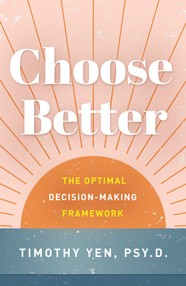
Timothy Yen: Choose Better: The Optimal Decision-Making Framework
Read the full transcript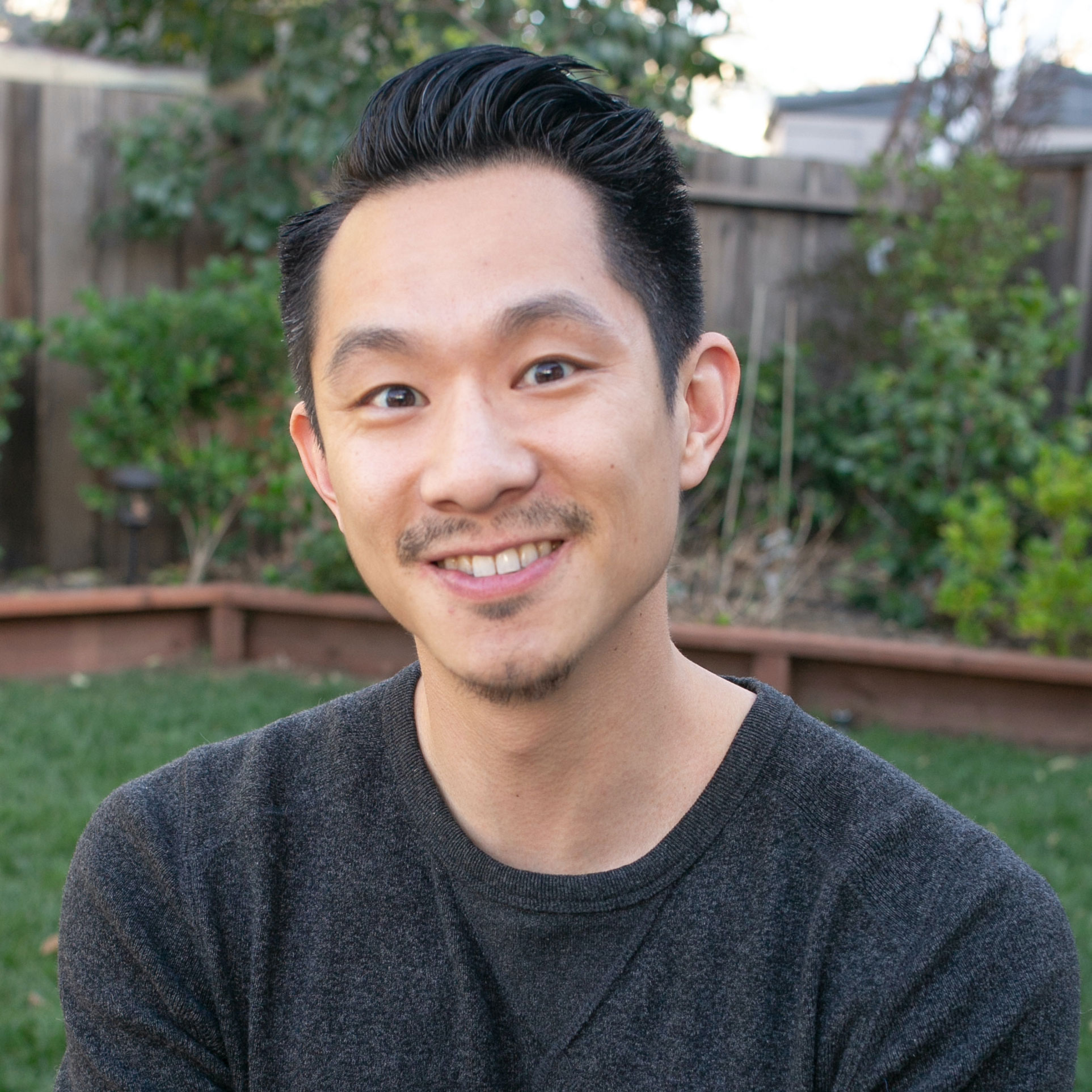
Timothy Yen
Timothy Yen is a licensed clinical psychologist and the founder and CEO of Pivot Counseling in the San Francisco Bay Area. He earned his doctorate in clinical psychology from Azusa Pacific University and previously served for more than eight years as a mental health specialist in the United States Army before spending years as a psychologist with Kaiser Permanente. In Choose Better: The Optimal Decision-Making Framework, he offers a step-by-step series of questions to lead readers out of indecision and into confident, purposeful action.
📚 Books by Timothy Yen
Transcript
[0:00:35] MR: Have you ever faced a challenge or decision that felt so overwhelming, you had no idea where to start? Or, do you consistently feel frustrated because you find yourself making poor decisions time and time again, and can’t figure out why? In the new book, Choose Better, Dr. Timothy Yen, a clinical psychologist, provides a systematic approach to solving any problem, no matter how difficult. His short, easy to remember framework, to help you choose better, is a series of questions that will lead you step-by-step, out of that state of indecision and into confident action that is more aligned with who you really are. Dr. Timothy Yen joins us in today’s podcast, where we discussed why we make bad decisions in the first place and how indecision can be so crippling, as well as how to bounce back when we do make a bad choice. Plus, he shares his decision-making framework with us, and I promise you, it’s worth sticking around just for that. Enjoy. Hey everyone, my name is Miles Rote, and I’m excited to be here today with Timothy Yen, author of Choose Better: The Optimal Decision-Making Framework. Tim, I’m excited you’re here. Welcome to The Author Hour Podcast.
[0:01:57] Timothy Yen: Thank you so much Miles for having me.
[0:01:59] MR: Yeah, of course man, I’m so excited to talk about this, I feel like this is the most important thing that you could really talk about, how do you make better decisions. But before we even jump in, tell us a little bit about your background and then really, what inspired you to write this book?
[0:02:15] Timothy Yen: My background, I’m a clinical psychologist and consultant. I love working with people, helping people live their best lives. My background consists of anywhere from working at hospitals, community mental health, I love working with teens, families, adults, corporations, non-profits, that’s my background. I did a stint in the military as well, which is what got me into the field. I was a mental health specialist in my time in the army. That gave me the first exposure. What inspired me to write the book is a conversation I had with an executive of a tech company and I was having dinner with her and I just asked the question about what would bring the most value to her employees, to her leadership team. She told me, “Critical thinking. How can I get my supervisors, managers, board members to make better decisions under stressful conditions, deadlines, different expertise, opinions? How do I help my people think better?” I took a moment to think about her, her prompt and I realized that in my work in the coaching-consulting-counseling world, that is essentially what I do, a big part of my work is helping people make better decisions that ultimately help them experience a better life. It wasn’t just for employees or tech people, it’s really for everyone. That’s where I decided to write a book on what I’ve discovered thus far.
[0:04:03] MR: I love it. You mentioned how it’s really for everyone and it sounds like you’ve really been working with all different kinds of people. What inspired you? I have to ask, to work with so many different groups? A lot of times, a clinical psychologist works with one demographic. But what you listed off seems like you’ve worked with all different types of groups and so, you’ve really been able to understand why people make decisions every walk of life and maybe, how to choose better. But what was it that made you want to work with so many different groups of people?
[0:04:35] Timothy Yen: If you want the honest answer, it’s part of the training program. I don’t know if I chose to work with these different kinds of people, you kind of get thrown into the water to learn how to swim and there’s different groups of people that I had the honor of meeting through my journey. I’ve always had a heart for working in the business, the leadership space even in the beginning of my training in graduate school. But they’re not going to hand me those people right off the bat. They’re going to let you work with elementary school kids, which was my first group. Some college kids, some middle school kids. It was just part of the journey of being a psychologist. I’ve got to – I had the opportunity to work with so many diverse people in my life.
[0:05:28] MR: That’s amazing. When it comes to – after talking to all of these people and really in intimate settings, sharing the decisions that they’ve been making and they’re seeing you so maybe not all decisions that they’ve made have been great nor of course, could any of us always make perfect decisions. But why is it you believe that we make bad decisions as human beings in the first place? What is it that doesn’t allow us to choose better in the first place?
[0:05:56] Timothy Yen: I am going to give you a psychologist answer, which is there’s a lot of unconscious forces that influence our decision making. I use the word unconscious because we’re not aware of what these forces are. Some of these forces may very well be your childhood experiences, different experiences with people that has led an individual to draw certain conclusions that may work in certain contexts but not so well in other contexts. Some of that has become an automated thing. They’re just making these decisions, kind of like a knee-jerk reaction, they’re just responding to something that feels familiar to their past and they’re just rolling with it because maybe it worked then but not so well now. Then we can get into other forces at play, be it societal norms, cultural influences, other messages that we hear from other people and those are also influencing the decision-making process that we have. Then of course, there is our emotions, our feelings. That can also prompt people to make decisions that are not really well-thought-out, then they have to live with the consequences after the dust settles when the decision is made. There’s a combination of a lot of variables that go into bad decision-making as well.
[0:07:30] MR: Yeah, it sounds like there’s so many different things at play so our unconscious thoughts, societal pressure and influences, marketing influences, even how much we slept or the food that we eat can influence our decision making. How much control do we really have over our decision-making when there are all of these outside forces and a lot of our choices are unconscious?
[0:07:57] Timothy Yen: The power in decision-making, in many ways, is moving from the unconscious to the conscious. This book really provides a guideline, a framework to help people put it on the table and begin talking about it, begin thinking about what these unconscious forces are. As long as they are in the background, you’re absolutely right Miles, you don’t have much of a choice. You’re just going to react, respond, based on how you feel, the forces that are at play. But the more conscious we are, the more authority, more of a command that we have over the available options at our disposal and of course, that leads to actually choosing and following through on the decision that is best for us.
[0:08:54] MR: Yeah, it’s so true. Even becoming aware and conscious of the fact that many of our decisions are unconscious, that in itself can provide that kind of reflection that can also allow people to make better choices because they realized that so much of it is unconscious. What about even – there’s bad decisions which I’m sure we’ll talk a little bit about more. But then there’s indecision. I know a lot of people suffer from indecision and just sitting on the fence and being afraid of being wrong or making a choice. How much of indecision have you bumped up with in your practice and how often do you see that?
[0:09:34] Timothy Yen: More than I would like. Indecision, I want to frame, indecision is a decision. It’s a decision not to do anything and having confusion as the culprit, the reason behind not doing anything. I think a lot of people believe that indecision is this innocent thing where, “Hey, I’m Switzerland, I’m neutral, I’m not doing anything, therefore, what harm can be done?” I would challenge people and say that it’s actually quite the opposite, you are actually giving away your power by not making a decision and using confusion or some sort of intellectualized excuse to say, “Hey, I’m not doing nothing, therefore, nothing bad is going to happen.” Many times, because of indecision, life still rolls on by. Things will still happen and there are consequences for indecision as well.
[0:10:39] MR: Yeah, it’s so true and I feel like you know, a lot of people with this debilitating fear to be wrong, they just – they sit back and their lives aren’t controlled necessarily by them but then they continue just to be a reaction to everything around them as supposed to living their own life.
[0:10:59] Timothy Yen: Absolutely.
[0:11:01] MR: You actually provide a framework to really help people make better decisions. It was one of my favorite things about your book by far. The graphic that you have and everything, which I highly recommend people check out. Can you tell us a little bit about your framework for helping people make better decisions?
[0:11:19] Timothy Yen: The framework consists of four parts and as you kind of read through the book, the book gives details as to what the specifics are of the framework. But the barebone, simple answer is, it’s made of these four parts and essentially, people are asking themselves these four questions. Before they make any sort of decision and by the way, being able to just pause and realize, “Hey, maybe it would be to my benefit to think this through before making a decision.” I think that’s 80% of the battle. A lot of bad decisions can be avoided when people just take a few seconds, take a deep breath and then choose. A lot of things can actually be avoided. But of course, we know that we live in a complex world so just pausing may not be enough and that’s where the framework comes in. Part one of the framework is identifying what feelings come up for you in this situation or this interaction with someone. Feelings are so important because they are part of our survival fight or flight instinct, the feelings hit us so much faster than our logical life can even catch up. It’s because there’s biological survival advantages to being able to pick up on some of these feelings before the logic part has time to catch up. What I say often in the book is, “If you feel strongly about anything, it must be important.” So listen up, listen to what your feelings are trying to tell you. That’s the first question. Which is, “What is my feelings trying to tell me about the situation?” More often than not, we have more than one feeling because we’re complicated. There’s more than one feeling. Each feeling is telling you something different about why this situation or this interaction is important. After you sort that out, then you go to part two, which is values of self, meaning, “What is most important, what is meaningful to me?” That is really the crux of what I keep referring back to as authenticity. It’s really anchored in this thing called values. What is most important to you so that your actions reflect those values. Then of course, you don’t live in a vacuum so you do interact with people, more so than not. So it’s also important to consider the values of others. What is meaningful, what’s important for other people? And factoring that into your decision-making process. Then last but not least, the fourth one is, reality factors, what is the context, what is the surroundings, the cultural influences, other, kind of, on earth variables that I may want to consider too when I make this decision? Each of this pillars, these four parts of the framework, they’re just data points. What I would argue are very important data points that one should consider when they make an optimal decision. What ends up happening is when people ask these simple questions, and for some people, it’s not even a long process, it’s just taking a couple of minutes to just think through each part of the framework, what ends up happening is, options start popping up. Different options, there’s some better ones, not so good ones but different options pop up and based on those data points, you make a decision on of these choices, “Which one is the best for me and for the people involved?”
[0:15:22] MR: I love that. You’re removing it from it just being an unconscious reaction and your choices being based on that, to putting it through these conscious filters and then your values to then have it like basically spit out the options that best align with those things that are much more conscious than they are unconscious.
[0:15:43] Timothy Yen: Perfect, exactly.
[0:15:47] MR: That’s amazing, I love that. I would love to run through each of these pillars because I think that they’re all so important and we’ll try to breeze through them so we can get to other things but it’s such a great framework. When you talk about just feelings. I think that’s an important thing to really kind of underline in bold. We’re talking about choosing better and we often will conflate that with just logically thinking and critical thinking as you kind of brought up earlier. But as you’re mentioning here, feelings are so important to the actual decision-making process and for us to think in general, is that right?
[0:16:22] Timothy Yen: That’s absolutely right.
[0:16:24] MR: Okay, we have feelings and paying attention to our survival instincts because those are – you know, that’s been with us the longest, before we even had the ability to think logically, we were you know, feeling these things. Then we run it through our values filter. Tell us a little bit more of like what that looks like? Maybe even from one of your clients or your own values filter. What would a values filter kind of look like?
[0:16:51] Timothy Yen: Values is a pretty abstract concept, it could be hard to really grasp what that means and values, again, by definition is what’s most important to you? What’s meaningful to you? It could be as abstract as attributes. Attributes such as integrity or respect. These kinds of big constructs and saying, “Hey, those are important to me.” But it can also be things as simple as preferences like, “My wife enjoys coffee in the morning, that is a strong preference of hers.” That would also be a type of value so to speak. It really depends on what the situation entails. The really cool thing about the framework is, when you do the hard work so to speak and looking inside, taking time to get to know yourself, the values that you identify, that surface for individual, doesn’t change a whole lot. It’s going to be somewhat the same kind of things. For example, for one person, maybe stability, routine, that’s really important for this individual, versus another person, novelty, variety, adventure, that is their values. Well, for these two different people, when they make decisions, chances are, they’re going to reference back to their values and seeing whether or not they can make choices that are aligned to things that are most important to them. Now, granted, when we start talking about the values of others, it does spice things up. There’s more things to consider than just, “What do I want and how do I get mine?” We want to create, win/win kind of scenarios as much as possible. That’s why values is so important. At least from the start, understanding your own.
[0:19:01] MR: Right.
[0:19:02] Timothy Yen: Then using that to relate to other people.
[0:19:04] MR: Right. Yeah, it is so important and like you said before, at first it may take, you know, a couple of minutes or it may seem daunting but once you do this practice over and over again, I am sure it becomes second nature where you could run it through all four steps in a matter of seconds.
[0:19:20] Timothy Yen: That’s right. That’s when you know you’ve mastered the framework.
[0:19:24] MR: Right.
[0:19:24] Timothy Yen: That it’s just almost like a moment of time and you just go through the framework and in some situations as I shared in the book with picking the ice cream flavor for example, you’re not going to need every single pillar, some of it is not really going to apply. Using the framework could be literally a matter of seconds because you’re just referencing this one particular pillar in which maybe values-of-self at that point.
[0:19:53] MR: Right.
[0:19:53] Timothy Yen: There’s just really no right or wrong answer but it’s how you feel about the strawberry of vanilla, hopefully, hopefully –
[0:20:00] MR: Hopefully the ice cream –
[0:20:01] Timothy Yen: Some people may over-complicate it.
[0:20:03] MR: Yeah, the ice cream barista gets offended because you chose strawberry shortcake and not vanilla or something.
[0:20:09] Timothy Yen: Well, that’s a values-of-other issue but I think that the ice cream guy wants you to be happy. They’re happy if you’re happy so that should be a win-win.
[0:20:21] MR: Definitely, so we have – okay, so the values for self and then running it through the values of others, which I love and I think is so important and then I think you bring up something that isn’t talked about enough and that’s – and I like how you term it, which is reality. This is something that I personally suffer with where I ignore the facts and instead I keep listening to the stories in my head and I am not paying attention to the reality and the facts and the data around me. Tell us a little bit more about the reality and how we should allow that to really help guide us in making better decisions?
[0:20:55] Timothy Yen: So, reality is, it is what it is, that’s the definition that I use with reality. It is what it is and it is not about how we feel about a certain thing, it’s just this is what’s out there in nature and in communities. I like to reference gravity as a reality factor. You could not believe in gravity, you can hate gravity, it doesn’t really matter what you think or feel about gravity, if you’re going to step off the cliff, you will feel gravity. You will experience gravity at its most visceral level because it’s not negotiable. That’s just what it is, if you’re going to live on earth there’s going to be gravity. So, I think about a lot of these other factors in the same way and some people may argue that reality is perception and there’s some truth to that. What we focus on tends to be how our reality, but then there’s still factors that are independent of our perspective and one way to really fact-check that is ask another trusted, sane person. Get their comments about whatever situation or dilemma that you’re trying to work through and you may be surprised that they will see certain things from their perspective of what reality may be. Hopefully, it confirms some of the things that you already recognized and that will be reassuring but if it’s not, it’s definitely worth having a dialogue around because we don’t want to make decisions based on the fantasy of what we wish or hope and then be terribly disappointed when it doesn’t really play out that way. Again, you can’t know everything but there’s definitely reality factors that are [inaudible 0:22:55] the gravity. If we only took a little bit more time doing the research, so to speak.
[0:23:01] MR: Yeah, like listening to the data. I think a perfect example is, you know, let’s say somebody does a presentation and they’re caught up because they screwed up one tiny part there and they’re all in their head about it and then afterwards they have 50 people who come up to them and tell them what an incredible job they did then they brush all of those off and instead they’re caught up with just the one thing in their head. They’re actually not paying attention to the reality at all or the data that’s coming their way. Instead, they’re just listening to the stories in their head.
[0:23:31] Timothy Yen: Yeah, there is a term for that. We call it discounting the positives and it’s okay to acknowledge how you feel and chances are there is some unconscious stuff going there for that individual because they believe that by putting themselves down, being really critical, that somehow, it’s going to help them in the future and not make another mistake but there’s no guarantee with that and you may still make another mistake. There’s probably another way to go about thinking about ways to improve without discounting the positives so to speak, so that’s a great example.
[0:24:09] MR: Yeah, so fear. Let’s talk about fear. Now, I’m thinking about this because I am looking at your framework here and you know, first thing we want to do is pay attention to our feelings and our survival instincts and I don’t think that there is any greater survival instinct besides wanting to drink water or eat food, than fear. How do people deal with fear when it comes to decision making?
[0:24:36] Timothy Yen: So, there is a whole chapter on that one principle, what I deem courage. Courage is the magic sauce to the decision making framework because without courage to actually act upon and do the decision that you have identified, it’s kind of all or nothing. Going through the framework but not actually doing the thing that you know is good for you, I mean that’s – what a shame for all the work that you put through. The fear is definitely going to be the number one barrier for most people. The thing that will cause resistance and push people back to indecision all over again and what I want to tell people is, one, it is a 100% normal. If you feel fear, welcome to the human race, like that is a very common response to something new or unknown, things that have potential downsides. That is our brain survival instinct to say, “Hey, maybe we shouldn’t chance it. Let’s not put ourselves in a worse position if things don’t work out.” So, all of those things are very normal responses and what I would say is, start simply by acknowledging the fear. Many times people try to push it out of their mind, they try to ignore it and I was like, “No.” Again, back to pillar one of the framework, what is your emotion trying to tell you? Going back to, “Why is this feeling coming up for me?” And this then ties back to the reality factors. Is it based on reality? Some of these concerns of potential harm or doom, like, “Is it based on something that’s real or is it something that is more hypothetical or based on something in my past experience?” Even though my past experience is a very different context from perhaps what we’re dealing with now. What I’m really encouraging people to do is begin having those dialogues. We begin challenging those fears as opposed to assuming that, “Hey, if I fear it, if I have anxiety about it, well, it must be right and I need to just listen to that feeling.” I’m saying, hey, sometimes we get false signals, that the fear is based on something that may have been true and it may have even helped you in the past but it is not giving you the results that you want now in your life and that’s why it’s worth challenging.
[0:27:24] MR: Yeah, no I totally agree and it can be that that sense of fear that keeps us away from living our lives and if we are not able to really label it and better understand it then it can continue to debilitate us but as I listen to you, I keep thinking about how just really running through this framework for people, it’s also a way to really begin to understand yourself better because you start to have a sense of self-reflection maybe like you’ve never had before. Instead of just believing the stories that you’ve always had in your head, when you run it through this framework, you’re forced to look at it from different angles. Have you found that this really helps people come to understand themselves better overall as well?
[0:28:08] Timothy Yen: Absolutely. What I tell a lot of my clients that I work with, counselling, coaching is not for the faint of heart. It is not an easy process, there’s so many of our old-self that will fight you on doing this work. The framework as simply as I have made it out, it will pull up different kinds of emotions and thoughts in the process and what I would want to really believe is through that process like you said Miles, it will help you become more of who you really are. That the 2.0 of you so to speak. It is a process, it is not something that gives people simple answers but rather it is you that’s growing as a decision maker and therefore, you’re going to make better decisions.
[0:29:07] MR: Absolutely and you are becoming, as you said, more yourself because you’re making more choices that are aligned with your conscious-self as opposed to the reactions that you’ve been programmed with, which don’t necessarily come from you. So instead of actually being a person that is a collection or a consequence of everything around them, you actually begin to have decisions that come from more of yourself and you get to consciously build who you are as opposed to just becoming who you’re programmed to be.
[0:29:41] Timothy Yen: So well said, absolutely.
[0:29:43] MR: What happens when people make a bad decision? How do we bounce back? We run through our framework and we still make the wrong choice. We realize it, we realize we didn’t take reality into consideration and we followed our old habits and decisions. What do you say to people, you know whether a clinical psychologist, coaching, what do you tell them when they’ve made a bad choice and how do you help them kind of move on from that?
[0:30:11] Timothy Yen: What’s funny is that the answer is the same. It’s going through the framework, just around the bad decisions. Again, the framework is starting with the emotions. Chances are when you’ve made a bad decision, you’re going to feel some stuff. You’re going to feel frustration, guilt, remorse, you name it. Some sort of feelings will come up as a result of it and again, taking the time to acknowledge those feelings, honoring them and also allowing yourself to be patient and compassionate towards oneself I think is such an important part of this process. Because, like, many of us, if let’s say an NBA star came up to me and taught me how to shoot a basketball and he told me all the mechanics, you know, where to put your arm, where to place your hand on the ball, I’m going to take a wild guess, I am still going to shoot terribly. Even though I have all of the knowledge, I mean it is not part of who I am yet but overtime, I am going to get better or I hope. I will get better overtime and I want people to think about the framework in that same way. Just because you have the knowledge, that’s just the starting point, you will make mistakes. You won’t always make the optimal choice but I am going to venture to guess that you’re going to make choices that are closer to the better choice as you continue to work some of these things out and the most important part of the rebound as I call it is to keep the resilience. To get back up on your feet and try again. It’s never too late for anyone. That is a message that is so important to be ingrained in your mind is it’s never too late to make a better choice. You’ve made a bad choice, a terrible choice but it doesn’t mean, it doesn’t discredit you from making a new choice that’s good again and when people buy into a lie that, “Hey, you screwed up. You screwed up way too much that it’s unredeemable. There’s no coming back from this.” That is the kind of lie that’s going to keep people from rebounding and choosing better. If we can just get that lie out of the way and say, “Hey, it’s never too late and I can choose better again”, you will. It’s as simple as that.
[0:32:51] MR: I love that and as you said, if you run the bad decision back to the framework again, you’re going to be able to point out most likely where you went wrong, right? That’s going to be the evidence for the next time that you are doing the framework, you will be less likely to make the same mistake because you caught it last time.
[0:33:12] Timothy Yen: Unless you really like pain and you want to go through it a few more times, you know, be my guest. But most people, they lighten up because they identify, “Hey, it was this aspect of the framework that I missed out on last time.” And what I want to tell people is sometimes, there is no other way. There’s no shortcuts. Sometimes we need to make some of these bad choices to learn the part that was missing so that we can make the better choice. It is all part of that personal growth process and being a better decision maker.
[0:33:53] MR: Well speaking of making good decisions, you made a wonderful decision in writing this book so thank you for writing it and congrats because writing a book is no joke. Tim, if readers could take away one or two things from your book, what would they be?
[0:34:06] Timothy Yen: I want to tell my readers that everyone can be a better decision maker. I don’t care if you’re a child, I don’t care if you’re of older age and you have a lot of bad decision-making consequences under your belt, everyone can improve on this framework. It is a skill. It is a way of living, of being, that everyone can improve on. So that is one big takeaway I want people to know is everyone can improve in that decision making process. The other part is the beauty of the framework is it takes up a lot of unnecessary chatter or noise that sometimes gets in the way of making a good decision. The framework makes it really streamline. Think about these four things, work through these four questions so that you can arrive at the best choice for you. That’s my hope is give it a shot, better understand yourself in the process and what improves is not the decisions, what improves is the individual that learns the framework.
[0:35:29] MR: Yes, which then improves everyone around them and it’s not a selfish thing for us to make better decisions. I think it’s better for everyone especially when you run through the filter, when you have the feelings of others. So Timothy, this has been such a pleasure. I am so excited for people to check this book out. Everyone, the book is called Choose Better: The Optimal Decision Making Framework and you can find it on Amazon. Tim, besides checking out the book, where can people find you?
[0:35:54] Timothy Yen: They can go on my website at www.timyen.com and I also have Instagram titled Choose Better Consulting and I’ll be putting out a lot of golden nuggets kind of week in and week out that will bring value to my listeners.
[0:36:12] MR: Beautiful and I highly encourage everyone to check out Tim’s site. It’s great and I am definitely going to be applying this framework. So thank you for it. Thanks again everyone for listening and Tim, thank you for everything that you have done and all of the work you’ve done in regarding to helping us all choose better.
[0:36:28] Timothy Yen: Thank you so much.
[0:36:29] MR: Thanks again for joining us for this episode of the Author Hour Podcast. You can get Dr. Timothy Yen’s book, Choose Better: The Optimal Decision-Making Framework, on Amazon. You can also find a transcript of this episode as well as our previous episodes on our website at authorhour.co. For more Author Hour, subscribe to this podcast and thanks again for joining us. We’ll see you next time, same place, different author.
Want to Write Your Own Book?
Scribe has helped over 2,000 authors turn their expertise into published books.
Schedule a Free Consult