Chris Belchamber: Episode 618
Read the full transcript
Chris Belchamber
Chris Belchamber holds a Math MA from Oxford University. He has been an investment professional since 1984. His first investment book was published by Credit Suisse First Boston in 1988. He was recruited by JPMorgan in 1989 to run their UK Sterling Bond Sales and Trading and then focused on Proprietary Trading, where he was promoted to Managing Director.
He presented JPMorgan's UK Bond Market's development paper, endorsed by Margeret Thatcher, to the Bank of England in 1989. In 2003, he started his RIA in the US. He enjoys music, reading, writing, and almost any sport, and is currently an active golfer.
★ Scribe Case Study
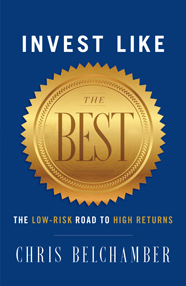
42 Years in Finance, One Book: How Chris Belchamber’s Invest Like the Best Draws His Right Clients
After 42 years in finance, Chris Belchamber wrote Invest Like the Best. Five years on it still works as a lighthouse, drawing the clients who get his low-risk method.
📚 Books by Chris Belchamber
Transcript
[0:00:35] EG: Chris Belchamber has been a prominent investment professional since 1984, weathering more than three decades of long-term economic trends with successful investment strategies. Chris spent much of his career at JP Morgan, running their UK Sterling Bond Sales and Trading. Before shifting to proprietary trading and on to the position of managing director. Throughout his career, Chris saw that his beliefs about investing and his approach to priorities and metrics differed from other investors in fundamental ways and his own success reflected how important it was to approach investing with the right mindset. Chris shares the mindset, math and strategies behind successful investing in his new book, Invest Like The Best: The low-risk road to high returns. In our conversation, Chris shared his thinking on how we can all invest smarter for better returns. Today, I’m in conversation with Chris Belchamber about his new book, Invest Like The Best and Chris, welcome to Author Hour, it’s great to have you.
[0:01:39] Chris Belchamber: Thank you, great to be here and thank you for setting this up.
[0:01:42] EG: Absolutely. Your book is such a wonderful resource guide for investors and let’s start by giving listeners an idea of how you got to this method of investing and what your background is?
[0:01:56] Chris Belchamber: I suppose I’ve been sort of a research trader, investor for almost 40 years and so there’s a lot of experience and conversations that have happened over that time and I’m always amazed at how people aren’t clear about investing and trading but everybody wants to dive in and get in the mix and, you know, I think there are so many things that people could do to have better results. So, this is really trying to distill a lot of things, many of which you can’t really get over in a short conversation so you really have to write them down and have a logical sequence, so this was a chance to really do that and hopefully it will be helpful to people when they think about investing.
[0:02:54] EG: What kinds of investors is your book ideal for?
[0:02:58] Chris Belchamber: Yeah, I really hope that it’s universal. I think that what’s surprising to me is, I think I go into great detail in chapter four about the LTCM experience, is how confused so many people are about the principles and process of investing and people tend to forget about the really important things for behavioral reasons. I think it’s worth being able to just walk through that to help people get a better way to see how they can do better.
[0:03:38] EG: Yeah, and in the first part of the book, you tackle the mindset people need to invest effectively. What are some of the ways you see investors needing to change their thinking? What misconceptions do they have?
[0:03:50] Chris Belchamber: The biggest misconception is really about their own decision-making. How do you actually make good decisions about investing? There’s a lot to that and I think people tend to rush in and learn from experience or surprisingly not learn from the experience and tend to repeat things. I think it’s really worth doing some groundwork before you rush in and make decisions and just to be aware of all the things that you need to know before you become repeatably successful as an investor. You know, I hope that people will be able to develop their own checklist and awareness so that they can start getting themselves towards a process where they can do so much better.
[0:04:47] EG: You write that part of this is changing people’s investing habits as well as their mindset. What kinds of habits do you see people have around their investments that do more harm than good?
[0:05:01] Chris Belchamber: Well, I think a lot of people are very much focused on returns and in particular, short term returns. You can understand that behaviorally, behaviorally it makes sense. But the problem with just looking at returns is it has many different components and, you know, those components basically being process, the amount of risk you’re taking and the luck that exists in the outcome because you don’t know the future, you don’t know whether any one trade is going to be successful. Being able to start breaking it down between those components, you're going to see whether you’re going to be repeatably successful or whether you’re actually on a journey for where you’re really taking more risk than you need to and you’re more exposed to luck in your outcome. You know, I really think that just looking at return leads to confusion but, and I think in the first chapter, you can see that. You can see that people’s allocation goes up with the market but that means that the highs, people are most invested, and at the lows people are least invested. On average, people end up with a sub-optimal return and that’s because they’re just thinking about returns. Now, if they can break that down, they can do a lot better. It’s not just the average investors, it’s also professional investors. You see the hedge funds, although, you know, they may have a lot more tools and be very dedicated investors, they get paid on returns. It’s very difficult, behaviorally, for them not to be biased at looking just at returns. I think it’s almost like there’s a return obsession that can easily set in and it leads to not seeing a lot of things you really need to be able to see if you’re going to be repeatably successful like the best investors.
[0:07:17] EG: What are some of those other factors that make an investment a good choice?
[0:07:23] Chris Belchamber: I really get into that really in chapter five and that is making sure that you’re investing in a high expected return with good risk management. Really, that’s the key to it all and you’re doing that with a good decision-making process. That sounds quite simple but you know, I think there are a number of steps you need to take to make sure that you're in that situation where you’re actually doing that and I think that there are a lot of things that lead you astray from actually doing that. You need to be aware of the traps and you need to be sure that your decision process is consistently good.
[0:08:11] EG: You write that you have a different approach from most financial advisors when it comes to setting priorities and setting metrics, tell us about that?
[0:08:20] Chris Belchamber: Yes, because I think you know, again in chapter five, that’s all about the difference between how best investors look at investing rather than financial advisors and that’s a generalized statement, so, you know, all financials are somewhat different. But it’s very clear that the best investors, every statement throughout the book, they’re stressing low risk, high return to risk. Whereas if you look at financial advisors in general, they are saying, “Well, we want to maximize your returns, and the way we’re going to do that is by maximizing risk as much as you can take from your financial circumstances.” Those are two very different perspectives on how to allocate what the relationship is between return and risk. You’re going to get two very different outcomes depending on which path you take and, you know, I don’t think enough people realize that there is a big difference between what financials typically say and what the best investors have practiced for multiple decades.
[0:09:36] EG: Do you have any specific examples that paint that picture of someone perhaps who began investments with one mindset and then changed their mindset and their investments and saw different outcomes?
[0:09:48] Chris Belchamber: Yeah, I think people eventually will, after enough experiences, will want to move towards that but I think that they have to go through many bad experiences to get there. I hope that one of the things that the book does is it shows that you can find out very quickly which path you’re on. Are you in the path where you’re doing pretty well for a while but then, things go badly wrong? Or, are you on a path where systematically you’re going to continue to do well year in, year out, decade after decade? I think that the book highlights two different sets of investors, particularly John Meriwether of Long-Term Capital Management who was spectacular for three years and then went completely bankrupt or Jim Simons and Stan Druckenmiller who, for 30 years almost never had a losing year, but still were compounding at 30% or more. Those are two very different sets of behavior. But you can see by looking at those two extremes, how important it is to be on the right track and how different the behaviors are between those two and I think with the metrics I introduced in the part two, you can very quickly find out now, which path you're on, rather than have to wait for years or even decades to find out which path you’re on and then it’s too late.
[0:11:26] EG: This is a vulnerable question but do you have any tragedies or successes of your own that helped you learn these lessons?
[0:11:33] Chris Belchamber: I’ve always thought this way, I guess. I’ve always been surprised at how other people look at investing, like you know, want to take a lot of risk. I think I’ve always been aware of the downside. Fortunately, I’ve never blown up so I think because of that, even when I was a branch trader at JP Morgan, I was, you know, I never had to have my manager tell me, “You need to cut positions,” or whatever. In terms of my own experience, I haven’t had that but I’ve seen it through others. I think you can learn a lot through other people’s experience. I was on a proprietary trading desk when the manager of that proprietary trading desk blew up. We all had to close down because the manager’s positions had raised concern at senior management. I have seen it happen and I could see why it was at all possible, at least that it could happen and I was, you know, very dismayed, you know, at the style that some other people have taken in terms of their trading. I guess that’s the experience that I’ve had, which has been very confirming.
[0:12:54] EG: What do you think is the hardest part of someone’s mindset to shift in this direction of making smarter decisions and understanding this relationship between risk and reward better?
[0:13:07] Chris Belchamber: It starts, I think a lot of that is in chapter one. It basically starts with taking responsibility. I think very often, when bad things happen, it’s very easy to blame someone else or something else that caused the losses and, you know, that can result from the confusion about the risk that you took on when you took a position. That’s a key part of it. I think a lot of people tend to imagine they kind of know the future and I think when you think you know something, you react more slowly, you don’t think about what you might do in different outcomes. So, they’re not flexible. I think there’s a lot of things that you have to make sure you’re fully aware of when you're investing and I think that people tend to jump to a simplistic idea and think that it’s done and it’s never done. You never know what’s going to happen tomorrow so you always have to be prepared. I think it’s understanding the environment and being sure that you’re equipped and responsible and know how you’re going to react when something else happens or you need to adjust and there’s actually a lot to that, you know, hopefully some of the ground work is in there in the book.
[0:14:38] EG: And chapter eight tackles investment myths and heresies as you call them. When you were first starting out, what myths in the financial industry surprised you?
[0:14:50] Chris Belchamber: I think it’s, passive investing has always surprised me and it’s been a massively growing movement as you would expect according to behavior. You know, like in chapter one, we showed that ever since World War Two when people like to see positive returns and that builds, people just think they can invest passively more and more and more but you know, essentially what that means is that price doesn’t matter and trends, long term trends are reliable forever and those are, you know, astonishing assumptions. Which, nevertheless, do work for a number of years but then people get anchored into those view points and stop thinking. I think that’s one of the things I look at in chapter eight and I actually use a quote from Benjamin Graham in that chapter, where he was talking in the 1930s looking back at the crash of 1929 and he was saying something very similar. It was bound to fail. This idea that it didn’t matter what the price you pay, you were just doing a very simple thing that would work forever. I find that very surprising but it’s a behavioral thing and if you look at history, it happens again and again and again and I think people just need to be aware that things do change and however well you’re doing, risk hasn’t gone away. There are ways to participate from the outside, which means that you can be involved but you can be involved safely in a way that you are going to keep those gains when things do change and that’s what I hope people may be able to find a way to learn how to do.
[0:16:50] EG: I love this other quote from Benjamin Graham that you use on the back cover of your book, which I think sums up your whole thesis so well. “The investor’s chief problem and his worst enemy is likely to be himself. In the end, how your investments behave is much less important than how you behave.”
[0:17:09] Chris Belchamber: Absolutely. You know, I think behavior is very important. I think a lot of people come into this thinking it’s a science and it’s math and if you’ve got good math then you’ll be very rich but you know, I think that the argument in chapter two about economics shows, I think quite convincingly, that after 300 years of economics, we should have learned one thing and that is that, you know, we are irrational. We’re not reliably making rational decisions and we are highly behavioral and so it’s worth embracing that. You can actually be mathematical about behavior. You can actually use that but you can only use it if you embrace it. You know, I think that people need to get away from the idea that this is just a science and accept that it’s complex, it’s behavioral and then use it to your advantage because it will provide an edge to you that other people aren’t using. Yes, behavior is something you need to understand, be aware of, embrace and then use to your advantage.
[0:18:31] EG: Well Chris, thank you so much for writing this book. It does such a great job of untangling all of the beliefs and habits that go into our behavior around investing and I know it is going to help so many people. If you wanted people to take away one to two things, maybe as a starting point for how they can enact change in their investments, what would they be?
[0:18:55] Chris Belchamber: First of all, there’s a reason why the best investors are the best investors and you know, I think the book studies what they do and I think it distills, you know, those four criteria, which can get you on track. The best investors really do use those four criteria and you can get that performance grid and you can see in a few seconds how well you’re doing and why you’re doing well or badly. You know, there’s four quadrants. You know, whether you’re investing intelligently and safely or you’re gambling or you’re really in things that you should be avoiding, that performance grid is really going to tell you really in ten seconds how you’re doing and you need to make sure that it’s compounded and the longer history you have that, the more it’s going to – more information it will provide you about that. I think that is one very easy thing where you can find out whether you’re on track or not. The other thing is that yes, you have to be – you have to do your own due diligence because I think as chapter four showed, the great majority of even so-called experts don’t necessarily behave like the best investors. You need to have your own tools so that you can know that you’re aligning yourself with a Stan Druckenmiller rather than a John Meriwether and I hope that with those, using those metrics and understanding how well you can do by using low-risk methodologies that people will be able to empower themselves with their investing.
[0:20:48] EG: Beautiful. Well Chris, it’s been such a pleasure chatting with you about your work and besides checking out your book, which again is called, Invest Like the Best, where can people find you?
[0:21:00] Chris Belchamber: Well, I have a website, chrisbelchamber.com, and all the information is on there. I have LinkedIn pages where I post, so you know, there’s – I’m not difficult to find and I very much believe that there’s a huge education part to investing and I very, very much want to be engaged in that. Those are the best sources I think, chrisbelchamber.com and my LinkedIn pages.
[0:21:30] EG: Fantastic and thank you for being a part of people’s financial education. We appreciate it.
[0:21:35] Chris Belchamber: Thank you so much.
[0:21:38] EG: Thanks for joining us again for this episode of Author Hour. You can find Invest Like the Best, on Amazon. A subscription of this episode as well as all of our previous episodes is available at authorhour.co. For more Author Hour, subscribe to this podcast on your favorite subscription service. Thanks for listening. We’ll see you next time, same place, different author.
Want to Write Your Own Book?
Scribe has helped over 2,000 authors turn their expertise into published books.
Schedule a Free Consult