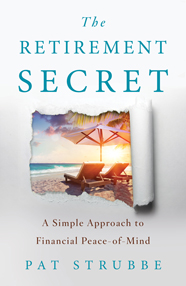
Pat Strubbe: The Retirement Secret: A Simple Approach to Financial Peace of Mind
Read the full transcript
Pat Strubbe
Patrick A. Strubbe, ChFC, CLU, RFC, is the founder and managing partner of Preservation Specialists, LLC, and has been helping clients plan for their financial futures since 1997. A master of story-based retirement planning, he has been featured as a retirement expert in USA Today, Investor's Business Daily, Fortune.com, and Entrepreneur.com, and on WIS-NBC TV News. He is the author of the Amazon bestselling books Save Your Retirement! and The Retirement Secret: A Simple Approach to Financial Peace-of-Mind.
📚 Books by Pat Strubbe
Transcript
[0:00:17] DA: Are you ready to make retirement planning a lot less stressful? If you’re like most people, you’re facing the looming specter of retirement on your own in a do-it-yourself retirement system. You're not sure you’ll ever have enough money to retire and you’re concerned that you won’t know how to make that money last as long as it needs to. That’s where Pat Strubbe comes in. In his new book, The Retirement Secret, Pat introduces the three retirement mentors, teaching you how to understand your finances and plan your retirement before you get there. His book will set your mind at ease, answer your questions in a fun and easy to read story that you won’t want to put down. Hey Listeners, my name is Drew Applebaum and I’m excited to be here today with Pat Strubbe, author of The Retirement Secret: A Simple Approach to Financial Peace of Mind. Pat, thank you for joining, welcome to The Author Hour Podcast.
[0:01:03] Pat Strubbe: Thanks Drew, looking forward to it.
[0:01:05] DA: Let’s kick this off, can you give us a rundown of your professional background?
[0:01:10] Pat Strubbe: Yeah, I actually kind of stumbled into working as a financial planner and retirement planner right out of college so that was well over 20 years ago back in 1997 and that’s what I’ve done my whole adult life. I was very blessed that that happened because I didn’t really know what I wanted to be when I grew up when I was in college. It was just kind of a turn of events through interviewing and I didn’t know what to expect but very quickly, I learned that I just loved it. I had a passion for sharing financial information with people and trying to help people with their finances and you know, that’s when I learned that none of us have a lot of education or experience most of the time with saving and investing and how to handle those things. It’s just a sorely needed area and that’s what got me excited about not only helping people individually but also sharing more information through a book.
[0:02:09] DA: Now, why was now the time to share these stories? Did you have an “aha moment,” did you have a moment of inspiration, did something happen after book one where you were like, “I got to go right into book two.”
[0:02:25] Pat Strubbe: Well, I will say, I thought book two would come a lot faster but they’re not that easy to put together. What we found was with many of our clients, one of the things that was so difficult and caused so much stress and worry was really just this simple idea, “Where do I put my money?” This came up over and over again and we actually found this idea, this basic concept that really just streamlines that entire question and we started calling it the secret and what we found is the more and more people we talked to and we worked with and even over a number of years, people just loved this concept and that was that “aha moment” when I realized, this is not just something we should be using with a few hundred clients of ours. This is an idea that could really change people’s lives and we’ve seen the change in people’s lives for the better to help them have more comfort with their finances and less stress and more peace of mind and I thought, what a powerful idea. That was what really got me to buckle down and start putting everything together to try and convey it through a book that hopefully will be a fun read for a lot of people and to help them learn about the secret.
[0:03:47] DA: Now, a lot of authors have the idea of the book rattling around in their head, you might even have the outline on paper but during that writing process and by sometimes just digging deeper into some of those subjects, you come to some major breakthroughs and learnings. Did you have any of these along your second time around in your writing journey?
[0:04:05] Pat Strubbe: I did actually. I can share the first time writing my first book, the “aha moment” was when I did my first chapter of my first draft, I thought it was really good and then I went back and read it and I thought, “This is the most boring thing I’ve ever read in my entire life.” That’s when I changed my first book into more of a story and so I continued that theme with this book but to your point Drew, you’re exactly right. I had the basic idea of talking about this secret but what I hadn’t fleshed out before actually organizing the book is that before actually digging into the power of the secret that there are actually kind of some fundamental principles about how we handle our money that I wanted to start with. We start the book with, kind of, these three foundational principles and then we lead into this idea of a secret that helps you give you a simple way of understanding how to handle your money.
[0:04:59] DA: Now, your last book that we had just talked about a second ago, you talked about storytelling and you taught America how to defeat these seven retirement villains. What is the difference between that previous book and this one?
[0:05:13] Pat Strubbe: Yeah, my first book was called Save Your Retirement and it had a super hero and a villain theme and so the idea there was really more of a broad education of the – what I felt like were the biggest concerns most people had as they’re entering retirement and going through retirement. Those seven villains represent those things. For example, one is lady longevity and of course, we would all love to live a long time and be healthy but when we’re handling our finances, living to 95 or 100 or beyond that just means we have to be that much more careful with our money to make sure we never run out, so that’s one example. The first book was really identifying those seven issues or concerns and then kind of just starting to broadly tackle, what are some solutions to those? In The Retirement Secret, we drill really down into how are you saving and investing going into retirement and then through your retirement. It’s really focused on that one area as opposed to a more broad look at income planning and tax planning and healthcare and estate planning and things like that. I really wanted to focus on what I find for most people is the number one worry, which is “I’m trying to accumulate money for retirement and I’ve got this pile of money and I just have no idea if I’m doing the right thing with it.”
[0:06:38] DA: Who would you say this book is for? Is this for early professionals in their 20s and 30s? Is this more geared towards folks nearing retirement in their 50s and 60s or actually folks in retirement?
[0:06:50] Pat Strubbe: Yeah, that’s a great question, Drew. I think that my first book, Save Your Retirement, was really geared towards someone who is about to retire. The Retirement Secret I think starts there, I think it’s ideal for someone who is six months to six years from retirement because that’s often who we – that’s often when we meet our clients, when they’re looking for someone to help guide them through retirement. One of the things we talk about in the book is there’s three phases of investing for most people and so I think it has value for anyone of any age. The first phase of investing is really when you're still, retirement’s still far off and for most people, they’re trying to figure out a way to save a little bit here and a little bit there, probably for decades before they retire. That’s that first phase. To your point Drew, the final phase then is when you're in retirement and your goals have changed dramatically, right? Instead of just trying to accumulate this big pile of money, when you’re retired, you want to generate as much income as you can but preserve as much as possible and in that third phase of investing is just the middle ground. Because for most of us, we don’t want to be really aggressive until the very day we retire and then switch over to something really safe and conservative. For most people, there’s a transition time in the middle. The retirement seeker talks about those three timeframes and if someone is either anxious about retirement or excited, then it really could be appealing and useful for anyone of any age.
[0:08:22] DA: Let’s start from the beginning of the book, it seems like a very basic question but I guess it’s kind of hard to answer. Is retiring successfully a hard thing to do?
[0:08:35] Pat Strubbe: That is a good question. I really believe Drew, that it’s not. The reason for that is, I’m 46 right now, I can remember a generation or two ago when my parents or grandparents and retirement was much more simple then, it was, work for the same employer for most people, retire with a gold watch and a pension, apply for social security and sit back and relax and enjoy retirement. Well, that is a day of long ago for most of us. Now, most people do not have access to a pension anymore and now it’s up to us to handle our own investments. We call this the “do-it-yourself retirement system.” What they really should do when you leave high school or college and you get your first full-time job is they should say “Congratulations on your job, by the way, you’re now your own retirement pension manager, so you better get to work at it.” You think about all the things that are incorporated into that, you have to figure out how much to save, where to invest it, how to structure it, try not to touch it until you retire, how do you deal with stock market highs and lows, how do you deal with interest rates changing, the list just goes on and on and on. Of course, most of us have little to no education on that at all. We’re all just kind of left out there and to me, that’s the biggest problem with the system in general. Now, you fast forward to where we are today and you have historically low interest rates, so if someone is retiring today and you think, “I’d love to just save my money and then plunk it into a CD or something to live off of the interest.” Well, no one’s going to do that anymore. I mean, because nothing pays any interest. Now, I really feel like we have people stuck between a rock and a hard place and that’s why I thought the book would be so helpful to so many people to talk through some of those issues and solutions.
[0:10:22] DA: This “do-it-yourself” method as you called it, is there anything generally wrong with that way of thinking and what are the big things that folks are missing when they go for the “do-it-yourself” method?
[0:10:36] Pat Strubbe: Well, there’s certainly nothing wrong with doing your investing yourself if you have the understanding of how to do it and the interest. I think both of those things are certainly important. The question is, first of all, do you have both of those characteristics? Of course, we’re probably a little biased because the people that approach us are not interested in doing it themselves, they’re looking for someone to solve that problem for them. I think that’s one area we all realize, we’re devoting time to our jobs and then when you have your free time, the question is, “What do you want to do with that?” A great analogy would be, I’ve decided over the course of my adult life, I don’t want to spend that time mowing my lawn so I will happily pay someone else to do that for me.Same thing with handling your finances. Many people could do just fine managing it themselves but I would say, the majority of people are uncomfortable with that and frankly, very scared by that. I think that’s kind of the starting point. And then to the second part of your question, most people, I would say, just get overwhelmed with financial information. If you look at the media, if you’re watching Kramer on Mad Money on CNBC or you’re seeing the stock ticker on the TV or you're hearing it on the radio. Wherever you're getting your media, you’re just kind of bombarded by all of these messages at the Dow Jones and Bitcoin and GameStop and all of these things that are constantly going on and for most people, because of the lack of training that we have that’s overwhelming and it causes a lot of stress and a lot of worry. That’s where we feel like providing people with some structure through the book can be really liberating.
[0:12:16] DA: Now, why are folks so hesitant to consult with a professional about planning their retirement? Again, is there anything that they should look out for when they’re looking for financial planners out there?
[0:12:30] Pat Strubbe: Yeah, I think there’s a couple of reasons, people are very hesitant and some of them are very good. One of them is, when you think about all the decisions we make in life, it can be very exhausting, right? It goes from, “What do we want to have for dinner?” to “What are we going to do over the weekend?” Then when you think about “How am I going to plan for my retirement?” The first step is for most people, that’s just too overwhelming. A lot of the times, we just kind of kick the can down the road and then we just procrastinate and procrastinate and that’s why many people will hire us very close to retirement because they just – they avoided dealing with it. The biggest reason though that I would say that the industry has kind of created a challenge for all savers and investors is one of the things that we like to say is, there is no such thing as an unbiased financial professional. What we mean by that is, usually, I think we think of the word bias as always being negative and I don’t mean that necessarily. What I mean is, literally every financial professional has an opinion and that’s really important that you understand that because it’s very rare, it would be impossible for you to go into someone and say, “Give me the best investment,” and have them not have an opinion on that. For example, what I mean by that is there are different schools of thought for investments. We call it three different ones, there’s a Wall Street way, there’s a bank way and there's an annuity and insurance way. If you're dealing with a Wall Street brokerage firm and you say, “Hey, what’s the best way to manage my investments?” it’s a very high likelihood that they’re going to talk about stocks and bonds and mutual funds. Again, I’m not saying any of those are bad, I’m just using it as an example of where the direction goes. If you walk into your bank and you ask them, they may talk about savings accounts and CD’s, which also have their place in certain scenarios and then if you go talk to an insurance agent, they might show you annuities and life insurance solutions. The challenge is, it’s very rare to find someone that’s willing to consider all of those different types of vehicles and that’s one of the things that we like to do, we think there are pros and cons to everything. Why not have a look at all of those to try and find the best combination of things for you? Now, to the point we talked about earlier, Drew. That means, we’re looking at everything which can be overwhelming and so that’s once again, it kind of brings us back to the goal of the book, to give our readers an idea of a way of understanding how those fit together and how you can use them together for your benefit.
[0:14:58] DA: I have to ask, you mentioned there are so many different types of investments. Is there such a thing as the perfect investment?
[0:15:06] Pat Strubbe: Well, you would think when you see advertisements that there are perfect investments, right? Because they all tell you how great they are and that’s a really important, it’s one of those foundational principles we have is that there is no such thing as a perfect investment and of course, we all want to know what that perfect investment is and that’s when things like Ponzi schemes and Bernie Madoff, that’s how those things happen, is because they tell us what our itching ears want to hear. Generally speaking, we say, most of us would love to have three things from a perfect investment, we’d love to have a really high return, we love to have our money be completely safe and we’d love to be able to access our money, wherever we want, whenever we want to. The truth is, there is no such investment that offers all three of those. Now, there are a number of places we can put our money that might get two of those three. I mentioned a bank account at a CD, if it’s FDIC insured, we would consider that safe. Let’s say it’s a savings account, that would be accessible but doesn’t have a high return. No, it is paying almost zero percent right now. Meanwhile, you might have something like a stock market mutual fund that might have a high long-term average return. You might be able to buy and sell it whenever you want but you have a lot of risk because if the market goes down, you could lose a lot of money. There are a lot of things that might combine one or two of those characteristics but we can’t have all three and that is the whole idea behind diversifying. We can’t put all of our eggs in one basket and we have to divvy them up and that’s once again one of those foundational ideas that we talked about in the book.
[0:16:38] DA: You’re saying I shouldn’t put all of my money into GameStop right now and retire next week.
[0:16:44] Pat Strubbe: Hey, I mean if you time it right, you’re a lot better than I am that’s for sure.
[0:16:48] DA: I have to stop real quick and just talk about the way you wrote the book. It’s in a format where you’re kind of following along the story of several characters and why did you decide to write it like this?
[0:16:59] Pat Strubbe: Well, I mentioned briefly when I wrote my first book, Save Your Retirement, I actually had it laid out almost like a text book and I thought, I laid it out and I wrote the first chapter, I put it away and I thought, “Man, this is going to be the best book. Everyone is going to love it,” and I came back the very next day and I read the first chapter and I was just bored out of my mind and I realized, that was my moment of realizing this is not what people want. And I like data. I knew that it needed to be different, so I came up with this idea of a couple and how they would meet the seven retirement villains and I’ve just gotten so much great feedback from it, Drew, over the years. You know we share that book with our clients and with people when they meet with us. What I found the most valuable from that is not only receiving compliments but also the number of people that have said, “I don’t like finance. I’m scared or I am intimidated by finance but your book was very helpful because it was understandable.” That’s really the feedback that kind of, I would say changed my life and made me realize that that’s where I can affect a lot more people. When I started cobbling together my notes and my ideas for this book, I absolutely wanted to retain that storytelling idea because there are certainly important concepts to discuss but the bottom line is, it doesn’t do you any good if you are too bored to actually read the book.
[0:18:23] DA: Now, let’s say you are – you are putting money aside, you’re putting it in variou spots, say you’re one of the smart ones, you are starting in your 20s or maybe your 30s, should your investments change overtime or is this something where you could read your book and say, “Okay, now I am going to set it and forget it and just hope it grows overtime?”
[0:18:43] Pat Strubbe: That’s a great question. Yes, so I think that that’s going to depend a lot, Drew, on kind of the phase of investing that someone is in. To your point, kudos to anyone who starts in their 20s or even in their 30s because it is really not that common. For most people, we’re just trying to survive in our 20s and maybe if you decide to get married and have kids in your 30s, you know, you’re overwhelmed by that and for a lot of people, they don’t really get serious about saving for retirement until the kids are gone or out of college or whatever. Then all of a sudden, you take a deep breath and say, “Okay, what’s next?” and then you realize, “Oh I’d like to retire in five or 10 or 15 years,” or whatever it is but if someone is investing for many decades down the road, that is part of that first phase of investing and yeah, for a lot of people, there can be a style that is almost set it or forget it. In fact, we’ve coined the term in our office, we call it the blinders strategy. If you’re 30-years-old and you want to retire at 65, the main thing that you have to do is just get that money, put aside. Whether that is your 401(k) or wherever you are saving it and then get it allocated into something that you are comfortable with and then put the blinders on and don’t pay attention at all because study after study after study show the more we tinker and manipulate with our money, the worse we do because human nature is when the markets are really high we think, “Oh, it’s going to do this forever,” and so we start piling into the market and then when the market starts to crash, towards the very end of the crash we all panic and we say, “We have to get out. It’s going to keep going down forever.” Of course, the last thing we want to do is be buying high and selling low. The blinders strategy can help a lot. Now, as you get closer to retirement, that’s when we can’t just set it and forget it because there is such a value or an important time frame when we’re transitioning towards the retirement years and of course, for most people having an aggressive portfolio and retirement just doesn’t make sense because that is different than what their goals are in retirement. That’s, ultimately the key is keeping an eye on what your goals are with your money and that is going to be heavily dependent on where you’re at kind of in your stages of life.
[0:20:49] DA: I think one the most important things in this whole process is finding the magic number you’re really looking for in retirement and I think a lot of people say a million dollars and that just seems really arbitrary. What is the best way to actually find that magic number?
[0:21:06] Pat Strubbe: Yeah, the million dollars is just a nice round number, right?
[0:21:09] DA: Right. I’d like a million dollars, okay.
[0:21:11] Pat Strubbe: Yeah, that’s right. This comes back to one of the other principles that I touch on in the beginning of the book, which is, the media talks about almost exclusively, rate of return. You know, the Dow Jones was up 20% last year, 10 year average or whatever those types of things are or you know, a specific stock is going up 200% in the last month or something like that and yet as odd as it sounds, investing success is not measured by rate of return. It is actually measured by if you accomplish your goals. And the example I always love to use is a transportation example. If I want to go talk to my next door neighbor, I could get in my car in my garage and drive 40 feet over their house but that is probably silly. I would probably just walk over there. If I wanted to go downtown, which is about a 25-minute drive away and go for a date with my wife, we could walk. We would probably be really exhausted and really probably not smelling very good by the time we get there, so we’ll probably drive. Then I’ve got across the country in California. I’ve got my old best friend from college. Well, I could drive to his house if I wanted to but I would probably fly. And the point I’m getting at is it doesn’t mean that walking or driving or flying if any of those is necessarily the ideal mode of transportation. The point is that it’s the purpose that matters. What am I trying to accomplish? That is going to help me determine the vehicle and I have very rarely met someone in all of my years of working as a financial planner, I’ve very rarely met anyone who said, “My purpose is to get the highest return and to get rich.” For almost all of us, the purpose is, “How do I retire, enjoy my life and not have to worry about dying broke?” And that’s the bottom line for most of us. That kind of comes back to your point of that number of, “How much do I need to save?” That we can’t figure that out until we have a better idea of exactly what you want your retirement to look like.
[0:23:12] DA: Now, in the book, you mentioned that a comprehensive retirement plan includes planning in five areas. If you could recall through top of mind what are they and is one more important than the other?
[0:23:25] Pat Strubbe: Yes, so there are – this is something that we preach to all of the people that we do their retirement planning for. Yeah, the first four I would say that are all very important but not the most important would be your investment plan because for most people, they don’t want to just live off of social security. They want to have some type of additional supplemental income in retirement. That’s where your investments are going to come in. Of course, you need that for emergencies as well. Your tax plan, we believe, is very important because it’s determining how much you’re saving in taxes as you accumulate your money but also how much you’re paying in taxes as you are living off of your nest egg in retirement. We have your healthcare and insurance plan, which we always say is kind of like in a football analogy, that’s the defense. Everyone loves the offense in sports but defense is just as important. How do we make sure if someone passes away early, if someone needs nursing care or health care, how do we make sure that is not going to bankrupt you or take away your nest egg? And then the estate plan is the fourth area, which is really all about how would you like things to pass on after you’re gone? How do we avoid taxes, how do we avoid the legal delays? If you are married, not only is that something that would be important if both of you pass away but it is a really important point to remember if one of the spouses predeceases the others early on, we want to make sure that surviving spouse is protected as well. Those are the four. To your point Drew, you’re exactly right. I do think one is the most important and that’s the one I skipped, is the income plan. We believe the key to a successful retirement plan is having some kind of written retirement income plan and it comes back to your previous question, most of us are kind of fumbling around wondering, “How much money do I need to retire on?” We have found that anyone at any age that’s interested in trying to figure out how to retire successfully, we can run some scenarios and try and put together a preliminary plan on paper and Drew, I’ve just found that for so many people, many dozens of people over my career, that is just a very freeing process because now, this whole strange idea of retirement that may be a couple of years or a couple of decades away, now you can actually see a path. For most people that can be encouraging and even exciting to actually see what that – where your income is actually going to come from and how you’re going to live off of it.
[0:25:50] DA: Now, I have to ask this question. Are there any real investment winners out there that people don’t really know about? Anything really under the radar that you found that maybe you use with a lot of your clients that you think, “Man, I really wish more people knew about this.”
[0:26:08] Pat Strubbe: Yeah, I would say that there is an idea. We talk about how Wall Street manages the bulk of money for Americans and their philosophy hasn’t changed much over the last century. It’s stocks for growth, it’s bonds for diversification and less risk and then cash for emergencies and for safety and that’s the way it’s always been and I even – this is an idea that we’ve been practicing for quite a while now because I even touched on it in my previous book. There’s an idea called endowment style investing, which is basically borrowing from some of the largest investment portfolios in the world. You think of Harvard and Yale and Stanford, all of them have multi-billion-dollar endowments that they manage and then they basically spit income off of those endowments to help support the universities and ever since, going all the way back to the 80s, they’ve taken a different approach. They’ve said, “We really think rather than being in stocks, bonds and cash, we think we can diversify into a slew of other different types of savings and investments and by divvying it up even more, we think there is an opportunity to lower risk and also potentially generate more return. The other nice thing about that approach is a lot of those other savings and investment vehicles pay dividends or income. A lot of our clients are near or in retirement and they love that. We talked earlier about the fact that if you have money sitting in the bank right now, you’re getting peanuts. You know most people are getting literally pennies a month when they get their statement. So to have something that is not tied to the stock market that is still generating some kind of income can be very appealing. The endowment style of investing isn’t perfect by any means but it is something, it is growing in popularity but to you point Drew, it’s not really very mainstream yet. We think it’s an exciting opportunity for people to learn more about how they can diversify their money even more and potentially gain the benefits of that.
[0:28:11] DA: Now Pat, I have read the book. I have heard you on this podcast, I’m in. What are the first steps I need to take to get my retirement planning started?
[0:28:23] Pat Strubbe: Yeah, so that comes back to what you asked me about earlier is one of the big decisions is, “Are you a do-it-yourself person or is it appealing to you to find an expert to help?” If you’re a do-it-yourself person and you’re in, then you’ve kind of got the guidebook, right? With The Retirement Secret, you’ve kind of got a starting point where to launch from and like I mentioned before, we’ve just met more people that just had either tried it themselves and it hasn’t worked out or they just don’t have a comfort or a desire to spend their time doing that. That’s why we always offer a phone call with us as kind of a get-to-know-each-other opportunity and we do not charge anything for that and there is no commitment or responsibility for anyone to take advantage of that. We would certainly offer a phone call with one of our advisers as an opportunity to see if there would be a way that our service would be of benefit to you.
[0:29:16] DA: Well Pat, you know we just touched on the surface of the book here but I want to say, writing a book, which is going to help so many folks make wise financial decisions is no small feat. Congratulations on your second book being published.
[0:29:29] Pat Strubbe: Thank you so much. As you well know Drew, it’s a lot of blood, sweat and tears over a long time and I’m really excited that we have reached this point.
[0:29:37] DA: Now, here’s the hot seat question. If readers could take away only one thing from the book, what would you want it to be?
[0:29:45] Pat Strubbe: Wow, that’s a great question. I think if readers could only take one thing from the book, I would say understanding that a system has been created in America, which is the greatest country in the world, but the system is a problem, the “do-it-yourself” retirement system, because most of us have very little to no training on how to do that, so I think the first step, the first takeaway is to understand that that’s a problem and then identify how you want to solve that problem by digging into the book and understanding the solutions that are out there because they are there. It’s very important, the book is not designed to discourage anyone. It is to encourage, it’s to show you that there is a way and ultimately, as the cover of the book says, it’s designed to create peace of mind and we believe that that’s the most important thing that you could possibly have with your finances.
[0:30:40] DA: Well Pat, this has been a pleasure and I’m really excited for people to check out this book. Everyone, the book is called The Retirement Secret and you could find it on Amazon. Pat, besides checking out the book, where can people connect with you?
[0:30:51] Pat Strubbe: We have a site ready for the book called theretirementsecret.com and then our financial planning firm website is scpreservation.com. That is SC as in South Carolina, scpreservation.com.
[0:31:03] DA: Pat, best of luck with your new book and thank you so much for coming on the show today.
[0:31:07] Pat Strubbe: Thank you so much Drew. I really appreciate it.
[0:31:10] DA: Thanks for joining us for this episode of Author Hour. You can get Pat Strubbe’s new book, The Retirement Secret, on Amazon. Also, you can also find a transcript of this episode and all of our other episodes on our website at authorhour.co. For more Author Hour, subscribe to this podcast on your favorite subscription service. Thank you for joining us, we’ll see you next time. Same place, different author.
Want to Write Your Own Book?
Scribe has helped over 2,000 authors turn their expertise into published books.
Schedule a Free Consult