Jeb White: Breaking Into College
Read the full transcript
Jeb White
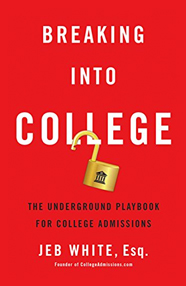
Jeb White is the founder of CollegeAdmissions.com and the author of Breaking Into College. Though he grew up in a working-class family that moved nineteen times before his sixteenth birthday, he earned an undergraduate degree from the University of Pennsylvania and a law degree from Georgetown University Law Center. After publishing his book, he left his job to focus on helping high school students get into their dream schools. He is a sought-after speaker who has appeared on CNBC and NPR and in outlets including the New York Times, the Wall Street Journal, and Bloomberg News. Breaking Into College is his playbook for gaining admission to selective colleges.
★ Scribe Case Study
How Jeb White Helps Students Get into Their Dream Schools
After publishing his book, Jeb White quit his job to focus on helping high school students get into their dream schools. Read more on Scribe.
📚 Books by Jeb White
Transcript
[0:00:28] Charlie Hoehn: You’re listening to Author Hour, enlightening conversations about books with the authors who wrote them. I’m Charlie Hoehn. Today’s episode is with Jeb White, author of Breaking Into College. Here’s the dirty truth about college. Students are sliding past gate keepers with the help of consultants, tutors, private coaches and even essay writers. But what about your kid? What happens if they get rejected? Not because they’re not good enough, but because their application looks like everybody else’s. In this episode, Jeb is going to give you his playbook so your kid can get into America’s most selective colleges and now, here is our conversation with Jeb White.
[0:01:29] Jeb White: By practice, I’m an attorney. I’ve represented whistle blowers in cases involving fraud on the government for a number of years and we have one of our cases hit for a large number and got the attention of one of my colleges that I attended and they came out for a fund-raising visit to talk to me. During that conversation, they asked me, “What did you enjoy about attending our college?” And you know, I mentioned a number of things and I said, “You know, one of the things that bothered me is that most of the people that I had class with were from a different economic background that I was.” I came from kind of the working-class background. They said, “Well, you know, things have changed but a lot of things haven’t that a lot of students who are coming from those backgrounds are not able to make it to the top of the admissions pile because they – the chances of getting into some of these more selective colleges or the chances are quite small. The chances of getting noticed or catching the attention of the admissions officers is becoming increasingly more difficult because the people who can afford a mission’s consultants are hiring them.” So everybody else is trying to package their application. The same way that their public school counselors are telling them to. And they’re getting what everyone else is getting, which is rejection letter. It bothered me that it’s getting harder and harder for working class families to get into some of these more selective colleges. For me, it was a gateway to a better life. I thought that somebody should do something so I decided I should do something. I thought writing a book was one way I can help alleviate this problem.
[0:03:01] Charlie Hoehn: Wow, okay. I’m curious how is your approach different then from what high school counselors are telling kids to do?
[0:03:11] Jeb White: Yeah. The common theme throughout my book, is that you should approach applying to college as you would as if you were an attorney, that’s my background, right? Whenever you bring your case to a jury, you want to make sure that your case is cohesive, coherent, impactful and persuasive. The best way to do that I have found, in the court room is also applicable to admissions world. That is that you bring forward how you are strong in a particular area or need that is of interest to the college. You make that the story line or the opening statement that’s backed up through corroborating evidence of essays, teacher recommendations, extracurricular activities. Then it becomes a consistent case that you’re making for admissions and the admissions committee buys into your storyline, because you back it up with corroborating evidence. For a lot of school counselors, the old way of doing it is that you try to make yourself appear well rounded. And a lot of school counselors still applying this old approach, the college admissions. It simply doesn’t work. That by making yourself look like –
[0:04:22] Charlie Hoehn: Does that mean basically that you’re trying to show that you can do it all?
[0:04:27] Jeb White: Exactly. Jack of all trades, master of none. It’s very true here that if you try to make yourself look like you’re so good in so many different areas, you come across like so many others. The only way to stand out is by making yourself stand out in the area of particular strength for yourself and that you play up that area and highlight it and spotlight it for the admissions officers.
[0:04:48] Charlie Hoehn: You know, this is really interesting to hear because we had another author named Jonathan Dison of the – he wrote The Consulting Economy and he told a story about the first time that he tried to work with a big fortune 500 company and he went in and he said, “Yeah, I can do this, I can do that.” He thought the meeting went amazing and then somebody told him after, “You’re not going to get hired and here’s why. You said you could do it all, and they don’t believe it. I’m your friend and I don’t believe it.” I think it sounds like it’s the exact same thing where it’s like, you got to be clear about why this is a good fit for you.
[0:05:32] Jeb White: Yeah, I think the reason why that’s true for his world and my world and the courtroom is because that’s the way we’re hardwired, right? We want to see people stand out in certain areas and that colleges are no longer looking for the well-rounded student. They’re looking for the well-rounded student body. They need different places, different roles to be played by students and you just simply aren’t going to be able to do that for all the different areas for a university.
[0:05:59] Charlie Hoehn: Before we get into some concrete examples of this, because I think I get it but I’m not totally sure.
[0:06:06] Jeb White: Sure.
[0:06:06] Charlie Hoehn: Who is this book really for? Is this for the student or is it for the parent or is it for the high school counselor?
[0:06:13] Jeb White: Yeah, the answer is yes. It’s for all three and what I’ve seen play out which is really interesting thing is, the parent finds the book first which happens 99% of the time. Then they work through the book with their student and there comes some point where they sit down with their school counselor and the school counselor tries to push them back towards the old way of doing things. At that point, the book comes out from a purse or from a backpack and the discussion starts from there. It’s for all three audiences and what I found is that – I’ve given this book to hundreds of people and it’s our goal to give it out to 10,000 people in the next year. Is that school counselors is the audience that seems to be receiving it the most, is that they recognize that they can’t keep up with the evolving trends of the college admissions world and this playbook is a welcome. A gift that that they’re receiving because it’s helping them realize that there’s a new way to do it, that really has seen better results for students.
[0:07:11] Charlie Hoehn: Wow, I love it, this is great. I’m excited to learn this. Tell me, the average high school counselors like “Okay, we got to beef up your resume to make you seem well rounded. We got to show that you played sports, that you were in an honor student that you volunteered at a homeless shelter.” Tell me what a good college application looks like that follows your methodology. What are some of the things that you’re taking off that person’s resume and application and what are you emphasizing?
[0:07:46] Jeb White: Yeah, I think you just hit the nail on the head, you know, what are you taking off that there’s this desire to hit every check box and include everything you ever done in the history of mankind in high school and that simply is the wrong approach. The applications that we see, once people work through the book, in the playbook, that we’d lay out is a very tailored application that speaks to that student. For example, a couple of years, I was working with a student who is very good at languages so she spent a lot of time starting clubs that helped students learn new languages. She was a ESL tutor working with students who were trying to master English but Spanish was the first language. She was also involved on the field hockey team. The field hockey team, although was a big part of her schedule was not something that we highlighted in her application because there’s 48,000 high schools in America, there’s 19,000 slots in the Ivy league, okay? By its very nature, there are tens of thousands, a hundred of thousands of field hockey players applying to the Ivy league. But people who have shown demonstrated interest and talent in languages is very few and it’s an area that’s of need for a lot of colleges. They have a linguistics department that they need to beef up. They have programs and clubs that they need to make sure are filled. We highlighted that strength in her essays, we highlighted it in her teacher recommendations, went to teachers who had taught her languages and talked about the enthusiasm that she had for that area and we also talked about it in her interviews. Everything about her package spoke to that strength and the field hockey became one of the things that yes, she included but was not spotlighted in her application. There’s a lot of stuff that we encourage students to just not include because it dilutes their application. Being included as a member of a football team where you didn’t play an all-state role is not something the spotlight whenever you're really trying to focus on some other area for example. That’s a discussion in what to leave out and what the spotlight, ultimately is the discussions we play through with the students.
[0:10:02] Charlie Hoehn: It sounds like in deciding what to spotlight, you’re not just taking into consideration how good the student is at that particular strength or how passionate they are about it. You’re also taking into consideration like, hey, there are a lot of open slots for this particular strength, the demand for it at these colleges is high. And the supply is very low, right? You're taking into consideration the actual market itself.
[0:10:35] Jeb White: That’s exactly right. We start not with what the interest of the school is, we start from chapter one, what are the passions, skillsets and strengths of the student and then try to find a college where that matches up. That if you go the other way, where you’re chasing significance, you’re chasing the rankings list. That you end up with a student who ends up at a college where they’re miserable. Starting with their strengths and passions and then finding a college where that is a particular need for that college and then marrying the two, right? So you are saying you are looking for student X, I am that student and let me show you how is the best way to approach it.
[0:11:13] Charlie Hoehn: I’ll give you a personal example. In high school I threw out my arm. I was a pitcher and I was pretty good I was entertaining the idea, maybe I’ll play in college. I don’t know and then I burned out my arm and so that career path came to a halt which I was okay with because it ended up creating a new passion for me which was videography and editing because I was so board at my baseball games that I started filming them and making little videos. I got more and more into that. And I started making videos for pep rallies and stuff and I got a lot of recognition and I thought, “Wow I actually have a knack for this thing that I would have never discovered had it not been for this injury.” But the thing was I followed the old kind of career counselor advice that you were talking about which was I had a really well rounded resume, that emphasized my volunteer hours, that emphasized the time I’d spent in Spanish. These other things that I didn’t really care as much about but it made me come across as the cookie cutter model that could do it all. On looking back on my college experience, I was dropping in on media classes I was not enrolled in. I was taking this classes because I was so interested in and I couldn’t get in them because of the major I’d taken and the fact that they were only for a certain degree type and all of these sorts of things. I don’t look back and think, “Why didn’t I do that?” But I do think, “Boy if I had followed this model I wonder if I’d be in a completely different position today. I wonder if I had pursued that much harder than I did on my own.”
[0:13:08] Jeb White: Right, yeah Charlie. I’ll tell you the parents that read this book, well over half the time, they’ll email me or call me or approach me and say, “You know I wish I had this book when I was going through the high school process.” And for a lot of them, there is a chapter in the book that’s about trying to figure out where your passion is and it’s called The Mountain Exercise. I have parents go through this exercise too and I’ve had parents to go through career changes after going through this exercise. It’s an exercise to help out students but it’s for everybody, right? You are at no point in your life are you at the end of the road. You have this opportunity to stir yourself onto what ultimately was your right path. The Mountain Exercise does that and what it does, well if I can take a step back, it came out of my own point where I had a similar awakening. I was in my front yard playing soccer with my six year old son and the beautiful thing about soccer, unlike baseball or football, is that you don’t really have to look at the person. When kick the ball back, you just generally kick in their direction. So it is really good for multi-tasking. I could take a conference call, kick the ball on his general direction and continue on with my call.
[0:14:30] Charlie Hoehn: Are you recording this podcast while kicking a soccer ball?
[0:14:33] Jeb White: I am not but I would love to. You can do it, you easily could do it but yeah. I kicked the ball to them and the conference call ends, it runs up to me and he’s like, “Dad, I got to tell you what happened about in school,” and at that moment my phone rings again. I’m like, “Hold on one second because I got to take this call. It is on my schedule.” I put the phone up to my ear and I kicked the ball back towards him and the ball never came back and I kind of looked over at him. And I could see his eyes were welling up. So I got off the phone I said, “Hold on guys,” so I put the phone down and I said, “Finley what’s going on,” and he looked up at me and he’s like, “Well dad how do I get on your schedule?” And as a father, you know that’s a knife. That’s a dagger to the heart and to this day, I actually have it in my computer, “How do I get in on your schedule?” It’s a reminder to me that here I was at the top of what I perceive as my mountain right, I’m in it. Helping out with cases at the US Supreme Court as a lawyer and I am presenting to congress on different points of national concern but I am missing out at home. That mountain, my family mountain, I wasn’t on. I am looking at one mountain and I am looking over and saying I should be over on this other mountain. That was one of my wake up call, that there is so many people like me and like you, who ultimately get to some point and you’re like, “Wait a second, what am I doing here?” You know I am working so hard to climb this ladder and it is leaning up against the wrong wall. Let me readjust where I should be and that is true for so many parents. I think parents identify with that chapter and they walk their students though that because they don’t want them to have that same experience that you had and that I had. That there is an opportunity early in life to identify where you have some strength and compassion. And try to steer your college admissions process to put you in a position where you ultimately can find out at the end of the day, that you are living a life of not only success, but of fulfillment.
[0:16:34] Charlie Hoehn: You know, thank you for sharing that story. Man that was so powerful. This is really refreshing to hear. I think of all the groups that you listed your book is for, I think it really is for the parents like you said, 99% of the time it starts with them anyway. I think it puts them in a better state of mind. I mean I have heard of so many cases of parents who pressure their kids into going into some field that they didn’t want to be in but it’s because the parent themselves – they just want their kid to be secure and safe. And so they encourage them to get into whatever field they perceive as that and the kid ends up miserable or resentful, or they end up avoiding that career and creating some friction with the parents. So, it sounds like you really get the parents into a healthier state of mind and also just a more effective way of applying. Rather than just doing the traditional thing that just doesn’t frankly work very well. I like this because it is such an inflection point. If you start their career, which technically starts at this moment, when they are applying to college and they’re like, “Okay I am putting a stake in the ground about who I am,” if you are starting them off as somebody with a specific passion and strength, playing to their strengths rather than a generalist or even somebody who plays to their weaknesses, like Rudy in the film that celebrates the power of playing to your weaknesses. Man, what a transformational thing to go through that has a ripple effect into the rest of your life.
[0:18:26] Jeb White: Yeah you know it’s interesting talking with parents and I think you’re right. This book is a playbook for students but certainly it makes – it allows parents to play a more effective role and when you talk to parents at the end of the day every parent is going to tell you that they just want their child to be happy, right? But there is a disconnect at some point in the college admissions process that a lot of students and especially parents fall into this trap of feeling like they have to keep up with a certain level. The old keeping up with the Jones’ story, that you have to do certain things, they have to go to certain colleges and then just doesn’t quite fit the need of the student. My hope is that this book will help steer parents in a healthier direction, that if they approach it in a way that will help their child and not hinder their child and will allow that child to really go on the path that is best for them, it will allow for a healthier relationship between the parent and the student. And that is the best thing possible and the other thing is it will allow them to play a more informed rule, that if they have a counselor at their school that does not able to help out the student and for a lot of students and for a lot of counselors, it’s just simply a matter of numbers for some public schools and across the country. There are 500 students for every one school counselor. So that 500 to one ratio simply doesn’t allow the counselor the time, money or resources to devote to a particular student. So they need help, they need help and the parents need help to help them guide along the path and that really is the purpose of the book, is to give them a way to make an informed decision that puts them on a better path and not allow them to not fall into some of these traps that really does a lot of damage to the student and to the parent-child relationship.
[0:20:19] Charlie Hoehn: Author Hour is sponsored by Book in a Box. For anyone who has a great idea for a book but doesn’t have the time or patience to sit down and type it out, Book in a Box has created a new way to help you painlessly publish your book. Instead of sitting at a computer and typing for a year, hoping everything works out, Book in a Box takes you through a structured interview process that gets your ideas out of your head and into a book in just a few months. To learn more, head over to Bookinabox.com and fill out the form at the bottom of the page. Don’t let another year go by where you put off writing your book. Is there anything else in your book that goes against conventional wisdom that we haven’t talked about yet?
[0:21:10] Jeb White: Yes, so there is a chapter that talks about the SAT and the ACT and it’s one of the smaller chapters and I do that for a reason. There is a lot of focus on numbers in the college admissions process you know, “What is your SAT, your ACT, what’s your GPA?” This idea that you can reduce somebody to a number, I really try to go against that numbers get you so far that if your idea that you want to go to the most selective college in America that everyone appears the same at a certain point. That the numbers aren’t going to tell the full story. So the idea in this book is that yes, there are certain thresholds that you have to clear but if you’re so focused on your SAT’s, on your ACT’s for example deter or take away from your ability to excel outside of the classroom, you’re really putting yourself behind the eight ball. That a large focus of your time and effort should be on doing things that make an impact. That it’s not about making a high score in your SAT. It is about leaving your school and your community in a better place and that at the end of the day, the admissions committee is looking for a student who is just not showing up and making good grades. You know anybody can go and sit on a dorm room and study for hours and hours and hours and make a good grade. They are looking for students who are going to show up and actually contribute something of significance to their school. So you need to show that by doing that so you must do that at a high school level and the way to do that is not by just taking on a leadership role. It is by taking on a project or doing something that’s going to show that you were there, right? You are leaving your mark. So this book is about that, it’s not about showing up in the classroom and getting good grades. Those are important but it is really about making sure that you are showing up outside of the classroom and making an impact on your community.
[0:23:00] Charlie Hoehn: What has been some of the projects that you’ve seen that are like sure ins into this higher tier schools?
[0:23:10] Jeb White: Yeah, so there is a student that I worked with a couple of years ago. His name is Colin, he was heading into his senior year of high school, so we’re late in the game, right? And he has an interest in computer science and I am looking through his list of activities and accomplishments and I am not seeing computer. The word computer appears nowhere in his list of activities. I said, “You know there’s nothing here that says computer but you want to tell colleges that you have this passion and strength in computers.” “Is there some need that the school has?” And he thought about it and he said, “Well we don’t have a computer science club at our school” and he lives in a part of a country where actually basic internet is pretty slow. So, what he did was in his senior year he went to the administration of his school and got funding to start a computer science club and he just founded the club, so there is nothing in there to point to as far as results from that club. But the mere fact of founding a club shows initiative and it was in his area of interest. So he was able to write his essay about that and then he ultimately got into Johns Hopkins University and part of his essay to Johns Hopkins was he has this interest in computer science and starting a computer science club that’s geared toward entrepreneurs at Johns Hopkins and went to Johns Hopkins and ultimately founded that club. He saw that there was a need at Johns Hopkins and that his record of being an initiator, a founder of a club in high school would translate, would future cast for Johns Hopkins and ultimately would allow him to receive an acceptance letter from them. So sometimes even late in the game, if you are able to show you’re able to take initiative and start something that’s consistent with a need of a particular school, you get yourself a lot further than just being for example the president of a computer science club that’s always been there.
[0:25:02] Charlie Hoehn: I think this is so important and useful to anybody who wants to get a yes from anyone including future employers. If you have something that you can show that you have a history of doing that successfully, doing it well and saying I’d like to do it for you too and showing them why it’s valuable and why they need it. If they haven’t made that connection yet themselves, you can effectively get anybody to say yes to you. I mean you may need to remove some of the friction and some of their internal obstacles that they see to bringing you in, but this has worked for people’s careers forever, not just college.
[0:25:55] Jeb White: Yeah that’s exactly right. So, this is the same, these are persuasion tactics. The same persuasion tactics that we use on the courtroom apply here and they apply at any stage in your career and absolutely right, is that you want to show not tell, right? You want to show through your track record or evidence of success, that you have shown up in your life and made an impact and when you do that it is just natural. People start to think about themselves. How is that going to translate when you work for me? How is that going to translate if I allow you into this college? How is that going to translate if we get into a relationship, right? It’s that by seeing how other people performed in the past it’s just natural that you are going to say, “Oh I wonder how that would work for me if you work for me, or if we are in a relationship?” And that’s why I spend a lot of time in the book telling stories. There is a lot of my personal stories in here and stories of my students. Because I want people to see themselves in the stories and see that it is possible to do what others have done. It is just a matter of making sure you follow the playbook that is laid out in the book.
[0:26:59] Charlie Hoehn: Yeah, so share with me your favorite story from the book.
[0:27:04] Jeb White: Yeah, so I tell my personally because I want people to know that I’ve been there right? I’ve been at a point where I was near rock bottom at least at a personal level. I was 15 years old standing outside of my high school waiting for the bus and in the bus line drove up my dad in a U-Haul truck and my friends go, “Is that your dad?” I said, “Yes that is my dad” I got in the truck with him and he said, “Alright we have until the morning to move out” and we have moved 19 times up to that point. And so moving in the depth of the night was a very common practice in my family. We moved for many different reasons and on that particular night, we went and got the boxes. My brother and I made a game of let’s get the house boxed up in under 12 hours, was our record. And as we did that, we pulled out of the driveway and we can see the police car pulling in the driveway as we left and that was just part of my childhood. That there is this uncertainty and instability and we ended up moving again and again. I went to three high schools in a period of one month.
[0:28:13] Charlie Hoehn: The police car was pulling in your driveway as you all were leaving?
[0:28:17] Jeb White: That’s right and that was my childhood. It was moving a lot. There was always this uncertainty three high schools in one month of my sophomore year and I said, “You know if I am going to get somewhere in life, I really need to have some level of certainty.” That this life of insecurity is not putting me on a good path. So. I reached out to different teachers and shared my story and they said, “You need some level of stability.” So I sent out applications to every boarding school in the country and said, “I have no money. I make good grades and I can play a little bit of football. Is there some spot in your school?” I was able to get a financial aid package, a scholarship to a boarding school that set me on a trajectory that ultimately led to where I am today. I am very thankful to that school but the reason that I share that story is not the later part of that, but it was the story of no matter where you are – No matter what level of insecurity and instability you have, there is some way to make that into a good story. So I took what was a bad story for me and said, “Even through this turmoil and these struggles, I have been able to maintain good grades. Imagine what I can do for your school if I am there every single day,” right? I was using the same playbook that I’m abdicating now back then that if you take your what are perceived stumbling blocks and turn them into stepping stones, people really pull for the underdog. And of you paint yourself as the underdog who is able to succeed even through mounting challenges, people identify with that and they will pull for you and will ultimately allow you into their school.
[0:29:59] Charlie Hoehn: That’s powerful and man, I wish I could transfer that message to some of my friends. It is so easy for people to get into their head about their limitations and “Oh this failure happened,” or “I just haven’t done much with my career therefore I am stuck like this forever,” and like you just said everything can be a stepping stone to propel you upward rather than just keeping you set at that level forever. So, thank you for sharing that and I’m really curious to read the rest of the story in the book. Jeb can you give our listeners a challenge like what is one thing they can do from your book this week to change their life for the better?
[0:30:44] Jeb White: Yeah, so we talk a lot about having the right mindset. A nice segway to what you were saying is as you look at your life as it currently stands today, I challenge people to think about where they like to be five years from today and to say why do they want to go there. Okay this is the mountain exercise, why do they want to go there, what is the particular summit? So how will they know they will actually reach where they want to go, who can help them get up the mountain? So for example, who’s been where they want to be and ultimately it can be a mentor for them. It could provide a road map and help them up that particular mountain and then what obstacles do they see in front of them? What’s ultimately going to prevent them from getting there? It’s a very objective look at their future. So it’s not a matter of saying or getting into the victim mentality of saying, “I can’t do that.” What if you could do that? What if you could get to ultimately where you want to go? So for my students that I work with for example, they’re in their freshman and sophomore year they say, “I want to go to a particular school,” and I always ask them why? Why do you want to go to that particular school? Is it the prestige that you’re after or is that because that school is going to put you up on a position where you’re ultimately going to reach some higher career level, right? And then I ask, “You know is there anybody in your life who’s been there?” If no, I can supply those names for you. What obstacles do you perceive?” For example, I have worked with students who have had a horrible freshman year. Their GPA is near 2.0 and they have desires to go to the Ivy league right? They are stumbling out of their gate of their freshman year. So I had a 1.7 GPA after my freshman year at Penn. My storyline then became that I worked up to a GPA that allowed me to get into doors to law and a lot of the other law schools across the country. How? Because I made that opening storyline be that I overcame the odds of my freshman year and I got focused. For a lot of students in high school, it is a coming of age point where you’re really discovering how to study and you are finding yourself. So making that story into a story of success is one way to do it. So identifying the obstacle, what you perceive as obstacles of your low grades for example and making that into a success story. It’s all a matter of seeing where you want to go, identify why you want to go there. Identifying people who can get you there and trying to make your obstacles into stepping stones to better things.
[0:33:13] Charlie Hoehn: Beautiful. This interview, I hope people end up listening to it that aren’t just thinking of applying to a college right now. How can our listeners connect with and follow you? And by the way, Jeb, I’m going to be doing that mountain exercise myself because I’ve been thinking about that in my head like swimming around. It’s funny, all the questions that you just asked are questions that I ask the authors that I serve that I help when they are launching their book. Those are great. How can our listeners connect with you and follow you?
[0:33:47] Jeb White: Yeah, if they go to collegeadmissions.com, that’s where I am. They actually can get a free copy of the book there, just cover the shipping, I’ll ship your book anywhere and I speak to high schools across the country and I give books to all the students who are in attendance. You know, it’s just a matter of getting the message out to the world, is what we’re trying to do here but collegeadmissions.com is where to find me. I have all my information there.
[0:34:09] Charlie Hoehn: Fantastic, this was excellent. Thank you so much Jeb.
[0:34:13] Jeb White: Thank you Charlie.
[0:34:14] Charlie Hoehn: Many thanks to Jeb White for being on the show. You can buy his book, Breaking Into College on amazon.com. Thanks again for listening to Author Hour, enlightening conversations about book with the authors who wrote them. We’ll see you next time.
Want to Write Your Own Book?
Scribe has helped over 2,000 authors turn their expertise into published books.
Schedule a Free Consult