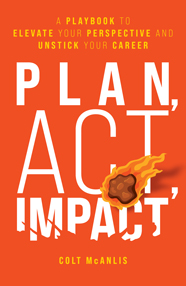
Colt Mcanlis: Plan, Act, Impact: A playbook to elevate your perspective and unstick your career
Read the full transcript
Colt Mcanlis
Colt McAnlis is an engineer, mentor, consultant, and lover of pumpkin pie. As a developer advocate for Google, his content has helped more than 4.5 million developers learn to build better, cheaper, and more performant applications. Prior to Google, Colt was a graphics and performance engineer in the games industry for Microsoft’s Ensemble Studios, Blizzard Entertainment, and Petroglyph Games. He has been an adjunct professor at Southern Methodist University and takes the opportunity to lecture at UCLA every now and again.
📚 Books by Colt Mcanlis
Transcript
[0:00:26] JB: The elusive idea of impact, your whole career can depend on whether or not you're making impact, but often it’s hard to know what that means or looks like, much less how to achieve it. Fortunately, Colt Mcanlis is demystifying all of this in his new book, Plan, Act, Impact: A playbook to elevate your perspective and unstick your career. On Author Hour today, he discusses common behaviors that sidetrack us, how we can get out of our own way and what it means to create plans that will actually lead to results. Hi Author Hour listeners, I’m here today with Colt Mcanlis, author of Plan, Act, Impact: A playbook to elevate your perspective and unstick your career. Colt, thank you for being with us today.
[0:01:16] Colt Mcanlis: Hey, thank you so much for having me, it’s been something I’ve been looking forward to for a while, big fan.
[0:01:22] JB: Great. Okay, first of all, tell us what you mean when you say impact?
[0:01:28] Colt Mcanlis: That is the 20 million dollar question I think, you line 20 people up and ask them that question and they’re all going to have 20 different responses and that’s kind of the whole point of the book, to be honest with you.
[0:01:41] JB: Okay, who do you think is getting it right or at least, what do you mean when discussing impact in this context?
[0:01:49] Colt Mcanlis: Yeah, you know, I think for a lot of us who are in modern corporate worlds right now, we’re constantly judged by the concept of impact. It is something that our managers bring up, our CEOs bring up, as folks who are judging us and figuring out whether or not we get raises or promotions and they are constantly talking about how much impact you’ve had. From our perspective though, that creates an issue because we don’t’ really get a good definition of the term impact. If you talk to your VP of sales, they might say that impact is doubling the number of customers, if you talk to the VP of engineering, they may say that impact means reducing their bug queue or making the software run faster and if you might just talk to the VP of HR, impact might mean bringing on 2x the number of people from before. This is kind of the problem is that all of us are being judged by this moniker of what impact is, but none of us were ever really given a clear definition of not only a uniform definition of it but how we should go about achieving it and it’s not something any of us have really been taught in any of our schooling up to this point so to speak.
[0:02:58] JB: Okay, loosely impact is kind of like achieving a goal?
[0:03:03] Colt Mcanlis: Yeah, be it your goal or for most of us, the goal that’s kind of given to us by those around us.
[0:03:09] JB: If it’s given plainly.
[0:03:11] Colt Mcanlis: Yeah.
[0:03:12] JB: Because sometimes it’s not. Okay, let’s back up for a second. Tell our listeners what you do for a living and how and why this topic became important to you?
[0:03:21] Colt Mcanlis: Yeah, for about the past 20 years, I’ve been in various stages of the engineering world. I’ve been a low-level graphics programmer, I’ve been a high-level front-end developer or web developer, I’ve been an educator at universities, I’ve kind of been all through the spectrum here and lately, in sort of the past five or six years or so, I’ve been taking on a lot more mentorship work and a lot more consulting work. I started noticing that there was a consistent pattern in the types of people I was working with. That they were all just low-level worried about their performance or about their environment and never really able to quite put their finger on what was driving that unsettled nature. What it kind of all came down to was that everyone was kind of nervous about the same thing. They were nervous that they didn’t have a clear understanding of how their work was being evaluated at their job and of course, you know, that can be unsettling because that has impact for your career progression and your finances, and your future. There’s a lot of anxiety tied with your career progression, a lot of self-worth too. But because they really didn’t have a clear definition of that, then the full anxiety came to fruition, which was you never really knew if what you were doing right this second was helping or hurting that. As I started kind of unraveling this kind of picking at this for a while, I started realizing how deep down the rabbit hole this problem went. That it wasn’t just an individual skillset but it was like a corporate problem and an environmental problem. What really got me interested in this was how complex this concept of impact actually is and how easy it is to have no impact and how most of us day to day spend our time on things that are non-impactful and that’s really what I started to focus on. Once we started honing in on what impact was, we started seeing the mentorships get stronger, progress start making a lot stronger strides, we started seeing corporations get aligned. Everything just started falling into place, once we were able to start bringing clarity to what impact really was.
[0:05:34] JB: Interesting. Because so many of us are just going through our days working without knowing, what you said, the impact of our work, the effects if we’re doing the right thing, and then especially if you’re not getting feedback, you’re just kind of in a dark room. What have you learned about how we aren’t having an impact? What are some of the traps that people fall into that keep them from being more impactful?
[0:06:08] Colt Mcanlis: Yeah, to be honest with you, I mean, the majority of unimpactful things that we do or the patterns that we get caught into are by our own design. This could be as small as just not being able to really have introspection about your emotions and your emotional state. Sure, we’ve all committed the sin of firing off that angry email to a co-worker because they did something like move a pen or use our last staple. That is obviously going to lead to ramifications down the line which could keep you from being unimpactful. There’s little things like that of just not being aware of how behavior influences your ability to have impact, both on your life and in your corporate environment but then there’s larger things too. Once you kind of start picking your head up and looking towards the horizon of your career, you know, you start asking questions about what are my goals and how are my goals contributing to the overall success of things. Even then, you might end up picking sort of the wrong goals or goals for the wrong reason and that comes to a very unimpactful place as well because even though it might be a good goal, if you have it for the wrong reason that it’s the wrong goal, right? I’m sure everyone has been to a spot where we’ve chosen a goal just to get back at a co-worker, right? Or maybe commit that extra foul during a game just to show the referee who is boss, but these types of things come and go and at its core, it’s about focusing too much on the short-term and not really having the elevated perspective to see how all these small actions add up over time.
[0:07:44] JB: Okay, I feel like we’re talking about it a little bit right now but I want to put a button on it. Anti-patterns, is a phrase you use. What are anti-patterns?
[0:07:56] Colt Mcanlis: Yeah, any behavior we take on a repeated basis could be considered a pattern, right? Of course, anti-patterns then are the ones that we’re taking that are hurting our end goals.
[0:08:08] JB: Okay and you write that our biology fuels our decisions to follow anti-patterns? Please tell me more.
[0:08:18] Colt Mcanlis: Yeah, listen, I am by no means a biologist or a PHD in this area but you know, when you do a lot of reading in a space and you try to figure out why you keep falling into similar behavior patterns, a lot of this comes back to the basic building blocks, the hardware that we’re all running on so to speak. Here's a perfect example. When you look at how the human body reacts to stimulus, basic fight, flight or freeze scenarios, how your body goes through this process is it dumps a bunch of chemicals into your system and that basically tells all of your system what’s about to go down, right? If you have a lion or a rhinoceros running down on you, your body’s gearing up to either take off or start a fist fight, which I don’t recommend with a rhino but that’s how your body communicates. There’s a really beautiful side effect of that is that your body is brilliant in understanding how to move resources around to get ready for this sort of survival-based scenarios. For example, as these chemicals are dumped in your system, certain things are turned off, like your body stops processing your digestive system. If you have food in your stomach, just kind of pauses and relaxes that for a while. Certain other systems are dulled as well, like your audio-visual cortex might get more information while other systems like your reproductive tract might dip through the floor. It’s all a response of how your body is trying to utilize resources to prepare for the coming battle. Now, here’s where all of this comes together, right? That’s just basic biology survival 101. Here’s the thing, it’s that we’re all running on that same hardware right now, right? When you get an email from a co-worker that puts you on edge, your body is triggering those same fight, flight or freeze responses that your ancestors had. To your body, it doesn’t know the difference between an angry email and a tiger jumping at you. All it knows what to do is hey, stimulus has come in, I feel threatened, let’s dump this system or dump these chemicals into your body so that you can react appropriately. Now, this is interesting on its own but when you look at the next step of that, you start really seeing how this fuels anti-pattern behavior. Let’s say you get that weird email that causes you to be angry, right? Get a co-worker who says, “Hey, I didn’t like your report” or you don’t read their tone well, suddenly you get angry. The chemicals that get released during anger create a sort of self-fulfilling prophecy. It makes you feel more correct. I mean, honestly, tell me, have you ever felt angry and wrong at the same time?
[0:11:02] JB: No.
[0:11:03] Colt Mcanlis: This is how your body has adapted over all of these years, right? If you have an anger moment, chances are, you need to feel right about that and it’s also why you get those beautiful colloquialisms of let cooler heads prevail. It’s effectively trying to say let these chemicals path through your systems so you can think straight. When this happens in a corporate environment and you get angry, you feel correct and you feel that whatever action you’re about to take is valid and the most universally correct action to do. Replying with that super snarky email that then gets you called into HR in two days seems like it’s totally the right thing to do right now. Even though you objectively know that it’s going to get you in trouble, the fact that you’re under the influence of these chemicals, means that you’re not thinking in a sound mind. That’s really how this biological foundation can cause these anti-patterns to continue again and again and again.
[0:12:02] JB: Okay, the idea here, tell me if I’ve got this right is that before we can learn how to have more impact, we have to get out of our own way by learning how to break free from these anti-patterns?
[0:12:23] Colt Mcanlis: Yeah, that’s absolutely correct, right? It’s any other thing, if you’re going to go hike the Grand Canyon, you don’t just start hiking the Grand Canyon. You have to figure out how to get your body prepared for it, you have to do exercises, you have to get more aware of what you can and can’t do and when it comes to impact, the same thing prevails. If you’re trying to make impact but you just have fundamentally bad habits, or fundamental inability to really be self-reflective and see how these actions are causing you problems, then you're never going to achieve what your goals are. You're just going to spin your tires, you’re going to waste your energy and it’s always going to seem like that thing is out of reach.
[0:13:01] JB: Okay. In the first part of the book, you write about the importance of having this foundation and how we can kind of get out of our own ways to have more impact. Now, talk to us about what it means to be more impactful, what are some behaviors we can be aiming toward once we’ve kind of gotten out of our own way?
[0:13:29] Colt Mcanlis: Yeah, absolutely. It all starts with goals, right? We talk in the book a lot about how to pick the right goals such that you can measure whether or not you’re making impact on it and this is a really important thing. I think a lot of us fall into a trap that we can set a goal that might be too vague. For example, “Hey, I want to be famous.” Cool, great goal, how do you measure that, right? How do you go about achieving that? What are the steps it takes to get there? If you don’t really have the clarity of that goal, you really can’t make impact towards it. A better goal would be something like, “Hey, I want to be a singer on Broadway in a mid-level musical by the time I’m 31.” Now, that’s a really cool very specific goal that you can start planning for and start making impact towards and this was really kind of where the foundation of impact comes from is understanding what things move you towards achieving your goal rather than the things that move you away from achieving your goal.
[0:14:33] JB: Okay and what would be some things that move you away from achieving your goal? Anger for example.
[0:14:41] Colt Mcanlis: Yeah, anger is definitely one of them. I think all of us we get a little too focused on corporate politics in some cases and that can anchor us down but also you know and sort of speaking from someone who’s been in America in the past five or six years, there’s also this rise of allowing social media and electronic influences to kind of trigger these spirals where a lot of folks can’t get out of bed in the morning because they feel too obsessed and too depressed and it is just this constant cycle. Of course, that is going back to the biology. When it comes to a more corporate environment, we have to look at things like not really understanding what the true goals are or focusing on goals that feel right at the time, but don’t actually manifest in value towards your end goal. And of course, what that all comes back to, if you don’t really have a good end goal that you are consciously working towards, you’re never really making impact. You’re just kind of be spinning your wheels here to there, hoping I guess for inspiration to fall from the sky from you.
[0:15:43] JB: Yeah, I mean speaking of hoping for something to fall from the sky, it seems like communication would be such an important part of this to fully understand the goal you’re going toward. I mean you need to be talking with your superiors, probably also your other collaborators, people in different departments I imagine.
[0:16:04] Colt Mcanlis: Absolutely, you’ve hit the nail on the head and that’s why the first word and the title is plan. A lot of it comes down to you have to be a student of impact and you really need to approach this goal setting and execution of impact towards those goals like you were a student. You have to go research, you have to ask questions, you have to talk to people, you have to get perspectives from multiple people, you have try stuff, you have to fail, you have to learn. I mean so many of us don’t really approach our jobs as though it were a job to do so, right? Does that make sense? We execute our jobs, which is fine and we think about, “Oh by executing our jobs, of course our career will progress” or “By executing our jobs, of course I’ll get a promotion and a raise” but we don’t really realize that there is an art and a skill and a talent to increasing your career and getting those next level steps and you can’t really start doing that until you’ve put in the research to figure out what’s involved, who’s evaluating that and how you can go about achieving those things that the board of directors or your manager or the promotion committee actually want to see.
[0:17:15] JB: It’s not enough to just show up.
[0:17:17] Colt Mcanlis: I think we can agree that that’s not the case, yeah.
[0:17:22] JB: To make an understatement but you brought up a sports analogy earlier and that’s interesting. I mean you wouldn’t just show up to play a game. You practice, you run drills, you study plays.
[0:17:34] Colt Mcanlis: Yeah, absolutely. I mean that’s kind of what we see at the professional and elite levels, right? I mean the difference between a casual athlete is someone who shows up and executes and maybe the spend a couple of extra days in the gym or you know, maybe they’re focus ebbs and flows for how much cardio they might be doing but once you start getting into more serious athletics a considerate amount of time is given towards not just the execution of your physical prowess but also the meta around that, right? When you talk to professional football players, professional basketball players, professional coaches, it’s always going to come down to, “Did we throw the ball? Did we catch the ball? Did we hit the ball” but you hear them talking in this meta environments about how the defense is going to react and who put in the extra reps and how much time did they spend on the tape and et cetera, et cetera, et cetera. It’s all about this massive undertaking of planning and research so they can understand that at the right spot, at the right time, they can create the impact they need within two to three seconds of a ball being released or a shot being thrown up. It all goes, it all starts so much further down the line than any of us see when we’re watching the games.
[0:18:48] JB: Right, and I imagine in the digital age when there is so much data and we can measure everything that it’s easier now than ever to plan, to figure out what is the impact that’s most beneficial and how do we get there.
[0:19:08] Colt Mcanlis: You know, I would love if that were the case to be honest with you. I actually have to say with all the people I talk to, with everyone I work with, the opposite is actually true. We are bombarded with stimuli and those stimuli cause us to get distracted quite frequently. I mean hey, I’m sure you and I are both guilty of totally having the intention to sign on and pay our bills and do everything and then getting lost in a rabbit hole of Pinterest or YouTube, right? That type of stimulus from so many directions actually muddies the water and it’s also really difficult too to figure out what a solid plan looks like. I mean to go back to my previous example, let’s say you want to be famous. Well, what kind of famous do you want to be? There are millions of people on the Internet who are famous for different reasons. Do you want to follow one of their paths? Well, let’s get more specific, let’s say you want to be a singer. Okay, fantastic, whose plan do you follow? Can you follow the same plan as Taylor Swift or do you have to follow the plan of Jay Z, right? This information is out there and you can get to it but it’s so diverse and it’s so noisy that it’s really difficult to figure out what will work for you and that’s what we kind of talk about in the book is how to really determine what information and what plans and what goals and how to measure these things because again, if you set a goal that you can’t measure progress towards it’s a bad goal. You know, you’re never going to make impact towards it and that comes back to your corporate environment too. If you straight up ask your manager, you know, what does it take to get promoted and they hem and haw and never answer you, you’re never going to get there.
[0:20:49] JB: Okay, so what is the impactful actions playbook? Can you tell our listeners?
[0:20:57] Colt Mcanlis: Yeah, so the first few sections of the book, we really talk about sort of the ground work of understanding yourself, understanding the situations that you might be putting yourself in that keep you from making an impact and once we get into section three, we talk about the playbook and the playbook is really the meat and potatoes of this thing because it allows you to start putting together a plan of how to identify your end goals and then how to rank and source actions that you can take towards that goal and the playbook basically comes down and it says, hey, every action you can take, you need to think of it like a – I guess to completely give a 1990s movie reference, like a meteor hitting a planet. If the meteor is the impact, you’ve got the energy that’s moving the meteor through space. You’ve got the impact, which is it hitting the planet but then you have a third thing, which is ejecta and that’s all the other stuff that’s kicked up around that impact environment that you may not have thought about. And what we do in the playbook is try to give you a perspective to start thinking about your actions in terms of these three steps, right? Yeah, I can take an action towards my goal, what’s the effort involved in that? What is the result of the impact going to be for that effort and then think about what is the ejecta or unintended side effects that might be coming with that? This is a really important framework to think about because or let’s give a more concrete example. Again, you could really be a rock star engineer and you could be one of those folks who are just on the upward trajectory and you knew everything and you’re the smart one in the room and you like to remind people that you’re the smart one in the room. When it comes down to it, you have no problem yelling at people and belittling people because it gets the job done but all of those actions create an impact but have a huge amount of ejecta on the backend as well, right? You’re constantly bombarded with this need to deal with all of the relationships you’re breaking and all of the HR meetings to tell you to be more sensitive, right? It’s obvious that those, the effort that you’re putting in for the impact that you’re receiving is actually creating worse or negative impact for you because you have a whole lot of ejecta to deal with as well. The playbook and the framework try to get you to think in this method of trying to really understand what actions give you a positive impact or progress towards your goal and which of them are negative impact because they either take too much effort for what’s given back to you or the amount of ejecta is too high that it is not really worth putting in the time.
[0:23:32] JB: Okay, that sounds very helpful.
[0:23:37] Colt Mcanlis: That one, is that a little close to home?
[0:23:39] JB: Yeah. I mean I can’t imagine anyone reading this and not seeing themselves in it, you know?
[0:23:47] Colt Mcanlis: You know, yeah.
[0:23:48] JB: I think the terminology might be new to some people but that helps us wrap our head around it, you know? Colt, is there anything that you want to talk about that I haven’t asked?
[0:23:59] Colt Mcanlis: Well, that’s a good question. Not really, you’re a good question-asker so we kind of got there. Hey listen, you know one of the things that always comes up here is who is this book for and I got to tell you, I’m an elder millennial, which means that I’m in the millennial age group but I somehow got into the job market before everything fell out of the bottom, right? It’s really kind of interesting to be on the elder side of this, because I see a lot of contemporaries who may just be a couple of years younger than me falling into these traps of trying to get their career off the ground but not making impact. The pattern is weirdly identical, right? They might be sitting at their desk, putting in the long hours, you know, they’re there. They’re the first ones there, they’re the last ones to leave but at the end of the day, It’s the person sitting two seats to the left that actually ends up getting the promotion or getting the raise or getting the praise and this creates a massive anger and anxiety spiral for most people because you just feel like you don’t understand what’s going on. And it’s too easy I think in those scenarios when you don’t have information to turn inward and blame it on yourself or blame it on the system or blame it on the people. What it really comes down to is just a lack of visibility and a lack of execution towards what really matters for your goal and I really, really want, you know, folks of my generation to find something in this book to help get them out of the ruts and help get them back on a path where they can understand who’s evaluating them, what those folks think impact is or what they’re going to require you to get to the next step in your career or achieve your goals and then a good framework for how you actually go about doing that because again as you said, you can’t just show up. It’s not enough to just ask the questions and have the conversations. You have to be willing to sit down, do the research, figure out what’s worth your time, what’s not, and then pick a path through that that helps you actually make impact.
[0:25:55] JB: Yeah, measure twice, cut once.
[0:25:57] Colt Mcanlis: Yes.
[0:25:59] JB: Let cooler heads prevail, the Colt Mcanlis story.
[0:26:02] Colt Mcanlis: Always. That’s book three I guess.
[0:26:06] JB: It’s been a pleasure speaking with you Colt. Congratulations on the book. Again, listeners, it’s called Plan Act Impact: A playbook to elevate your perspective and unstick your career. Colt, in addition to reading the book, where can people go to learn more about you and your work?
[0:26:22] Colt Mcanlis: Really, we’re putting everything on the Amazon page, so once we go live, go there and you’ll find all of the appropriate links on how to get to the other places.
[0:26:29] JB: Great, thanks so much.
[0:26:30] Colt Mcanlis: Hey, thank you so much for your time today. I really appreciate it.
[0:26:34] JB: Thanks for joining us for this episode of The Author Hour Podcast. You can get Colt Mcanlis’s book, Plan Act Impact: A playbook to elevate your perspective and unstick your career, on Amazon. You can also find a transcript of this episode as well as previous episodes on our website, authorhour.co. Make sure to subscribe to The Author Hour Podcast for more interviews and insights into life-changing books.
Want to Write Your Own Book?
Scribe has helped over 2,000 authors turn their expertise into published books.
Schedule a Free Consult