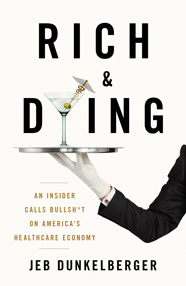
Jeb Dunkelberger: Rich & Dying: An Insider Calls Bullsh*t on America's Healthcare Economy
Read the full transcript
Jeb Dunkelberger
Jeb Dunkelberger is the CEO of Sutter Health | Aetna and the author of more than one hundred articles about improving the healthcare industry. With a career that spans from executive roles in Fortune 5 companies to building some of Silicon Valley’s most disruptive healthcare startups, Jeb combines experience with healthcare-related degrees from Virginia Tech, London School of Economics, London School of Hygiene and Tropical Medicine, Cornell, and the University of Pennsylvania. Outside of work, Jeb enjoys riding motorcycles, traveling, and relaxing with his wife, friends, family, and pets.
📚 Books by Jeb Dunkelberger
Transcript
[0:00:38] DA: Trillions of dollars spent every year with billions wasted, and all of that is at the expense of American families. This reality is the American healthcare economy. The industry was created by humans, which means it can be fixed by humans too. In his new book, Rich & Dying, Jeb Dunkelberger explains the problem with the healthcare industry and provides a framework for real, comprehensive solutions. Jeb looks beyond point-based solutions that provide episodic relief and instead proposes a new way of thinking about the system. The book also teaches on how to untangle the web of inefficiencies and discover the role you play in making healthcare effective, affordable, and user-friendly for all Americans. Hey Listeners, my name is Drew Applebaum and I’m excited to be here today with Jeb Dunkelberger, author of Rich & Dying: An Insider Calls Bullsh*t on America’s Healthcare Economy. Jeb, thank you for joining. Welcome to The Author Hour Podcast.
[0:01:28] Jeb Dunkelberger: Thanks so much for having, Drew.
[0:01:29] DA: Let’s kick this off, can you give us a rundown of your professional background?
[0:01:33] Jeb Dunkelberger: Yeah, sure. It’s definitely been a varied one. I started off in management consulting at Ernst & Young. I got to cut my teeth with some of the largest organizations in US Healthcare, was based out of New York and then transitioned to actually to one of my largest clients, McKesson at the time, and got to work within the provider space. So, I always look back at that time and think, that’s really what helped me understand the realities of the issues that we’re dealing with today. Through that work at McKesson, that actually led me into the Blue Cross Blue Shield family where I worked at Highmark. I oversaw our value-based strategy related to reimbursement and then worked with a number of teams around network, product, clinical services and even in the broker management realm. Again, another major milestone in my career, being able to understand the insurance or payer perspective. From there, I moved out to California and worked within two startups. One called Cricket Health, which is focused in renal care. Anybody that’s working in the healthcare sector knows that chronic kidney disease and in stage renal disease, there’s just a lot of opportunity for re-evaluating the clinical models and reimbursement models around that. I worked in a robotics company called Notable Health, which is really focused on intelligent automation. Thinking about clinical administrative workflows and again, really fun to just be in that startup world and see how they kind of just approach every problem, every day with absolutely no barriers or preconceived notions, like sometimes those big companies held back from. Then finally from there, I moved into my current role where I currently am the CEO of Sutter Health Aetna, which is a pay organization based in Northern California, servicing about 16 counties, which is just incredible because we’re in the backyard of Kaiser Permanente. We’re partnered with one of the nation’s leaders of integrated delivery networks, Sutter Health, and then there’s also some healthy blue on blue competition from Anthem and Blue Shield of California. It’s been a blast over the last decade or so, but I’m really excited about where things are heading within healthcare, promptly speaking.
[0:03:44] DA: Now, why was now the time to share these stories in the book? You clearly have so much experience in this space. Was there something inspiring lately, did you have an “Aha!” moment?
[0:03:53] Jeb Dunkelberger: It’s funny you pose that question. I don’t know if there’s ever a good time to sit down and write a book. If there is, it’s during a one-year shutdown in California. I had a lot of time and, you know, I think a lot of my friends and colleagues used that time to do different things. During this past year, I actually got engaged to my fiancé who is a trauma surgeon at USC LA county. For her, her life didn’t change, those 90-hour weeks remained the same and so there is also a little bit of guilt when I’d see her get up at 4:30 in the morning, I’d say, “All right, maybe I do have some time here.” I think it was the combination of a little bit of peer pressure or gentle guiding and then also, just the fact that you get to a point in your career where you think that you’ve seen enough to say, “All right, I have a pre-informed perspective” but I also wanted to make sure this wasn’t a book that I wrote in the last five years of my career where I’m too tired, I’m too, kind of, drawn out to really actually see this through. I like the fact that, God willing, I’ve got another 20 years in front of me to be able to see some of the ideas that we’ve talked about in the book into fruition.
[0:05:03] DA: Now, when you said, “Okay, I’m going to write this book,” a lot of times, authors will have the idea of what they’re going to write about in their head - you might even have an outline of beginning, middle, end - but during the writing process and just by digging deeper into some of the subjects you’re talking about, sometimes there’s major breakthroughs and learnings, did you have any of these breakthroughs or learnings along your writing journey?
[0:05:23] Jeb Dunkelberger: My gosh, yeah. Actually, part two of the book was originally part one. I started off thinking purely about what is the role of the insurance or payer within this broader value equation healthcare issue that we’re dealing with, right? You think about how do you create value in healthcare and I immediately thought, what’s the insurance company’s role within that? Then, it began to go back to, “Well hold on, people have been talking about this for years” and there’s this traditional kind of approach which is Medicare for all or free markets. For me, it was like, “Okay, that’s actually part one”. And, as I dug in deeper, you got to be a subject matter expert in a few areas and, trust me, I'll tell you right now, I’m not a subject matter expert on a lot of things that were discussed. It forced me to reach out to friends and other professionals in the sector and it was a humbling experience because again, as you ask questions and ask more questions, you learn more and more and for me, I try to include a lot of that in the book, but the same time, yes, the book definitely took a different course as I began to put pen to paper.
[0:06:30] DA: Now, when you started writing, in your mind, who were you writing this book for? Was it for people inside the healthcare industry or is it for the average folk just really wanting to learn more about the industry?
[0:06:42] Jeb Dunkelberger: Yeah, originally, I started with the audience of being folks that are within the insurance industry that are probably 10 to 15 years into their career, they’ve seen some of the inefficiencies, they’ve seen some of the problems, they’ve said to themselves, “I know that we can do better,” but they may or may not feel like there is a larger forum to kind of go to with those ideas. I know what it’s like to work in a big company culture and sometimes feel like, when you have an issue or you see a problem, depending upon the company you work in, there might not be that opportunity to raise that issue or you might be in a culture where you’re told, “Hey, if you're going to present a problem, present a solution,” and that’s not good either. For me, it started off that way but then as we’ve written this book and slowly begin to start marketing it, I think that we found a lot of interest coming in from these other audience forums that I was not originally contemplating just due to the pandemic and the fact that healthcare has become such a big topic within everyone’s daily kind of banter. Then, on top of that, I think the fact that the pressure that the economy is now creating for most people’s jobs, you’re looking at what are the cost structures within most organizations and health insurance tends to be one of the leading cost structures within any employer organization. Again, I think it was just an alignment of a lot of unique stars that’s now bringing in other audiences into this, which is great and hopefully, I’ve kept it simple enough and kept it jargon-free but we’ll see how that goes.
[0:08:19] DA: Now, you gave us a bit of a rundown of your professional background earlier but I really want to dig into one part. You were named one of the youngest vice-presidents in history at one of the largest health insurance companies in the United States. How did you pull that off? How did that happen?
[0:08:36] Jeb Dunkelberger: I honestly – the people I worked with. I’ll tell you right now that I was very fortunate to work on great teams, be surrounded by great mentors and people who are willing to take a chance on me. You know, I always think back to these senior vice-presidents and executive vice-presidents that I was working with on different projects and they were literally willing to take a chance. I definitely think that I put a lot of my time in. I always think that, you know, luck favors the prepared, but at the same time, it was certainly more to do with the company, the people and the fortunate circumstances that surrounded my career ascension. You know, I always look back and I count a lot of the good things that have happened in my career to those leaders who gave me the chance to step into that role but also provided the guard rails to ensure that I didn’t slip when I was taking those first few steps in this first few steps in this first few months.
[0:09:28] DA: Now, you got that position and you had a lot of success in that position early on but something didn’t sit right with you. Can you talk about what that feeling was and what it led to?
[0:09:40] Jeb Dunkelberger: Yeah, you know, I think it’s not an uncommon feeling that a lot of industry executives have, which is looking at the broader paradigm and this kind of consistent ask from the constituents of healthcare, right? The employers, the employees, the broker community to really evolve and change and deliver higher quality for lower cost. It wasn’t like I woke up one day and had this epiphany that no one else has ever had. I think what I realized though was that, I reached a point in my career that for many years, I always said, “You know, once I get to that point, then, all these things are going to make sense.” I always joke with folks that, it’s like when you’re in your teenage years and you think that 30-year-old’s got it all figured out and then you become 30, and you’re like, “Maybe it’s 40 where things become a little bit more clear” and then it’s still a little bit foggy when you get there. For me, it was the exact same thing. I got to a position, I was given purview into more of the organization, I was given the opportunity to look under the hood of a few different parts and really see that, “You know what? It wasn’t clear.” There wasn’t some master matrix that I wasn’t privy to before. In reality, there was just still a lot of opportunity for change. For me, I said, either one, I can stay on this path and this trajectory that is rather fixed and static, or I can go out and blaze some trails and I thought, there’s no better place to go than Silicon Valley and join some disruptive startups where they really welcomed that type of energy.
[0:11:14] DA: Now, most people think that healthcare in this country is a broken system. Yet, you believe otherwise. Why do you feel that way?
[0:11:24] Jeb Dunkelberger: Yeah, I mean, I do not disagree with people when they say that it’s a broken system because I think that from the lens of an ever-increasing cost structure - we’re typically seeing anywhere from three to six percentage points a year in increasing cost and you’ve even seen that during certain recessions over the past couple of decades, healthcare is continue to increased its cost on the economy. That’s a very large percentage of the GDP, right? Upwards of one out of seven people are employed by healthcare. I mean, there’s a lot of really big pieces here to talk about. People say it’s broken because, when you start looking at the outcomes and you start looking at the membership or patient experience, I think a lot of folks say, “Am I really getting the value that I’m paying for?” For that reason, they say it’s broken. The reason why I say that that’s not the correct response is because when you look at something as broken, you start to fix certain areas that you think are paramount or weight-bearing or priority when in reality, if you just shift your perspective, you might start to see areas of opportunity that you wouldn’t see if you caught it broken. For me, I said, “Is there a different way to frame the question to create more thought-provoking responses? Can we say that it’s not broken and, in fact, when you begin to look at it as a program that supports our broader economy, creates great jobs for our local communities, allows for our economy, broadly speaking, to continue to grow and move forward, you begin to see that healthcare isn’t broken.” In fact, healthcare actually responds to many of the incentives that are built into it. We might call them perverse incentives in certain context, or we might think about areas where that should not be happening in an ideal state, but at the same time, there is very few things in healthcare that happen that can’t be explained as to the causal factor. For that, I started looking at things in a different lens and it gave me all these ideas that I wanted to share. When I shifted that same problem statement to some of the colleagues and friends that I was soliciting feedback from, while writing this book, it was the same thing, right? Once you said, “Hey, I’m going to challenge you to not call the system broken. What does this system do really well, right?” That became the impetus for a lot of the strategies and ideas that I shared in part three of the book.
[0:13:51] DA: Now, you’ve been in the insurance system for a long time now. Can you just give us a little peak of really what happens behind the curtain that the average person wouldn’t know?
[0:14:03] Jeb Dunkelberger: Yeah, I think most people look at insurance and think about one thing, which is the little card that sits in their wallet, right? I think the layman that is checking out the insurance industry, it’s also not sexy, there really isn’t much zeal to it. As you begin to look around, you start thinking to yourself, “Wow, Cigna, Aetna, Humana, BlueCross, BlueShield, United” you start thinking about all of the other regional health [inaudible 0:14:35.7] I mean these are some of the largest employers in local economies. You know, I even state in the book that if you look at the largest employer in most states, it is either Walmart, a health system or health insurer, right? Folks, I think, don’t even realize just how big these organizations actually are and how important they are to the local economies that they support. Now, if you were to peak under the hood, some things that I don’t think folks typically think about is that the insurance industry has a massive clinical angle to it. There are a number of providers and clinicians that work directly with an insurance industry that are really helping to ensure that the care that you receive is adequate and necessary. That’s something that a lot of folks always think, “Oh doctors and nurses they work only in hospitals and facilities.” No, they actually work inside of insurance companies too. I think another thing that people don’t realize is how complicated it is to contract with employers and to contract with hospital systems and so the network management side is fairly large. Another thing that would surprise a ton of people would be the fact that that insurance card has a lot of different mechanics behind it. There’s a lot of different benefit structures. To give you an example, for just one state, a Blue Cross Blue Shield plan that I was affiliated with had over 10,000 product variants within that just that state. Now of course, Blue Cross Blue Shield isn’t the only payer in that state. You actually have multiple payers in a state with multiple product variants going into the thousands, right? It is absolutely wild to think about the complexity and you also have other parts of the organization that are really fun, so these analytics department that are doing predictive analytics, looking at social determinants of health, trying to figure out how to find patients before that simple illness becomes chronic, right? Before that episodic issue grows into something that becomes a life impairment. You know, I always like to remind people if there’s nothing you know about insurance, remember this: the insurance company has the most aligned incentive to that of the human, right? A healthy human is a great part of a business model for any strong insurance company, so helping people stay healthy, helping them to be preventative in their actions and doing extra things around that as you think about the housing, the labor, the education, things that fill into what makes the body healthy, the insurance company has a vested interest in that as well. Again, those are just a few areas I think people typically don’t even think about when they look at an insurance company.
[0:17:19] DA: Now, we’re in a time of disruption. Is there anything going on in Silicon Valley in the field of insurance and healthcare?
[0:17:26] Jeb Dunkelberger: Oh yeah. I mean you can just look at the past year and look at all of the IPO’s that have come out with some insurance companies. You know, you look at Oscar, right? You look at Alignment Healthcare. There is some exciting stuff coming off of a company called Oak Street, which is focused in the managed care arena around Medicare advantage. Clover Health is another company that has a really fun leader in Vivac who’s doing a lot of interesting things, you know pushing the envelope in different ways, which is really important for the insurance industry to continue to see these disruptors come out and then develop a public presence, which allows them to do even more within the market.
[0:18:06] DA: Now, how urgent is the issue to fix healthcare right now and what does the future look like if things continue going as they are?
[0:18:15] Jeb Dunkelberger: How urgent is the problem? Well, I think let me put it you like this, during the time it took you to ask that question, we probably spend about a million dollars within the US healthcare system and roughly 40% of that arguably could be attributed to fraud, waste and abuse. We spend about a $115,000 on healthcare every second in that, in the US healthcare system and so there’s also a lot of documentation and research has been done to say that roughly anywhere between 25 and 40% of every dollar spent is potentially wasted or it’s avoidable. From that perspective, you know, I look at it and say, as we look at this broader economy, what the US was going through, and you look at what employers are going through post-pandemic, this has to be top of mind. I mean there is such a large material opportunity for improvement that I would say that the need is quite urgent and that we can’t rely upon some of the powers that be because I think that’s what actually gets us in trouble. That’s kind of where the book goes is that we look to the demigods of the insurance world or the provider world, of the regulatory world and we say, “Okay, please fix our problems” but through regulation, through continued innovation, from companies that may or may not be profiting off of the status quo, you have to ask yourself, “Are we doing enough? Are we acting quick enough and are we even asking the right questions?”
[0:19:46] DA: Now, what is the solution and, I know you talk about it in the book, can you give us an overview of the core elements of a solution? And, do you see it potentially being implemented anytime soon?
[0:20:00] Jeb Dunkelberger: Wow, well you know the solution for healthcare is going to be very complex. I mean anyone who’s even taken a look at the Patient Protection Affordable Care Act will know that there is 2,000 plus pages written all about this exact topic, right? I think that when you are talking about solution, I am not sure that I can give you a succinct pithy response on that. What I would say is this, I think there are some fundamental building blocks that are needed. First and foremost, I think that we just have to realize that the American healthcare system is a major component of our economy. When folks talk about containing cost, when folks talk about reforming the industry, they typically don’t talk about the fact that one in seven Americans is employed by this industry and so that also means that one in seven Americans is employed by arguably 30 to 40% waste, right? You have to think about the macro level impacts that are going to happen there. Two, I think that when you’re approaching this problem, you have to realize the entangled alliances that we have. If as we said before, an insurance company or a health system is one of the largest employers within a local community that also means it’s one of the largest bodies of working constituents within a local community, meaning that the political side of the house is going to be very interested in this exact same topic of reform, so you have a lot of entangled incentives that I think are also important to call out. Three, I think that a lot of folks are scared to speak out and scared to speak up and that’s not because we have a culture of silencing, or this kind of new wave of cancel culture. I think really, what it is, is folks are just trapped in their silos so they don’t have the ability to look at the macro view from a number of different perspectives to confirm what they feel is wrong is actually wrong, right? What they feel as an opportunity for improvement is actually a real opportunity for improvement. Many folks just aren’t given the opportunity, so when I think about what it looks like to be successful and moving into the future, I am not going to claim that I have the panacea for fixing healthcare but where I think it starts is, one; realizing that we have some fixed variables that maybe uncomfortable but we need to swallow that pill. We can’t just layoff millions of Americans simply because we have a cost problem. We also have to think about the quality problem that we have in America, right? We have to think about the fact that we’re ranking in the upper 20s to mid-30s for a number of our clinical outcomes compared to other countries that are very similar to us and a number of economic terms. From my perspective, it’s making sure that you understand what’s fixed, you feel comfortable to talk freely. I mean that is the reason why I put ‘bullshit’ in my title, I want people to know that free your voice, come out and talk about the problems you see. You don’t have to have a solution but let’s continue to create that forum to at least identify the opportunities and then three, I think the most important thing that’s going to come out of this is that we can’t be afraid to start anew. You know, we have this fallacy around fixed cost and hey, we’ve already made investments into certain things and so we can’t move away from that and that’s just not true. We might have to start anew. We might have to run a bimodal process that allows folks to go from the current status quo and then shift into an entirely new model and I am encouraged by some of the things I see happening in the market. Olive is a great organization that is doing this and building out a Medicaid plan in the Philadelphia region. You know, I’m really excited about that. Some of the things that my own company is doing also kind of outlines that. I think that we have to be unafraid to step into areas that are going to be completely moved for the sector and not be tied to this iterative innovation off of the status quo. I also think that we need to be more welcoming to bring other folks and other industries in. You know, we create these large barriers and it is so difficult for industry executives from other applicable industries to step into healthcare because it is too complex, too convoluted, right? You’re just not going to get it, you don’t have an MHA, an MPH, an MD and all these big terminal degrees that people have that makes us feel like, “Hey, you really can’t talk to us” but in reality, that is just siphoning off the more intelligence that should be infused into our problem solving. Then in the book, as you said, you know, I list out some very specific points that I think that we can begin to consider in the near and long-term as ways to take some material steps forward.
[0:24:52] DA: Well Jeb, you know we just touched on the surface on the book here, but I just want to say that writing a book, which is really going to help a lot of folks understand the insurance system in the United States is no small feat, so congratulations on getting your book published.
[0:25:04] Jeb Dunkelberger: I really appreciate that, thank you so much. It’s definitely been a labor of love.
[0:25:07] DA: Now, I do have one question left, it is the hot seat question: If readers could takeaway only one thing from the book, what would you want it to be?
[0:25:15] Jeb Dunkelberger: I think that the literal response that I would give is if there’s one thing that people could take away from this book is that this book should hopefully serve as a rallying cry to individuals across the country. If you are looking at reading this book, you have a little bit of curiosity, you got a little itch that you can’t scratch or something, your stomach rumbling around, it’s like, “I think there’s a better way.” I hope this is the opportunity to read a book, see that there are other folks just like you, and I can promise you, I’ve lived in 12 cities over the last 13 years and I have met people from all walks of life in all parts of the industry, payer, provider, technology, advisory and there are so many likeminded folks that share these perspectives. I want to just encourage people to come together, and we’re going to do a lot with this book moving into the future in terms of taking real action around the transformation and evolution of our sector. Then, you know, the second response that I’d give you if there is this one thing to walk away is I have infused things like Tupac quotes and Allen Iverson quotes into this. I made this thing real, I made sure that I stayed true to who I am and so if you’re looking for just the synopses on the sector, you know, somebody that’s really unafraid to go out and say, “You know, this is absolutely bullshit! We can do better,” then look no further. I hope this book gives you that.
[0:26:40] DA: Yeah, it’s an extremely readable book, and Jeb, this has been a pleasure, and I am excited for people to check the book out. Everyone, the book is called Rich & Dying and you could find it on Amazon. Jeb, besides checking out the book, where can people connect with you?
[0:26:53] Jeb Dunkelberger: LinkedIn, it’s the best place to go. Find me on LinkedIn, I’m always available there through direct messages. Then, also Rich & Dying has a LinkedIn group page as well, so if you want to connect with other people that are reading the book, it’s a great place to go as well.
[0:27:06] DA: Awesome. Jeb, thank you so much for coming on the show today, and best of luck with your new book.
[0:27:10] Jeb Dunkelberger: Thanks so much Drew.
[0:27:12] DA: Thanks for joining us for this episode of Author Hour. You can get Jeb Dunkelberger’s new book, Rich & Dying, on Amazon. Also, you can also find a transcript of this episode and all of our other episodes on our website at authorhour.co. For more Author Hour, subscribe to this podcast on your favorite subscription service. Thank you for joining us, we’ll see you next time: same place, different author.
Want to Write Your Own Book?
Scribe has helped over 2,000 authors turn their expertise into published books.
Schedule a Free Consult