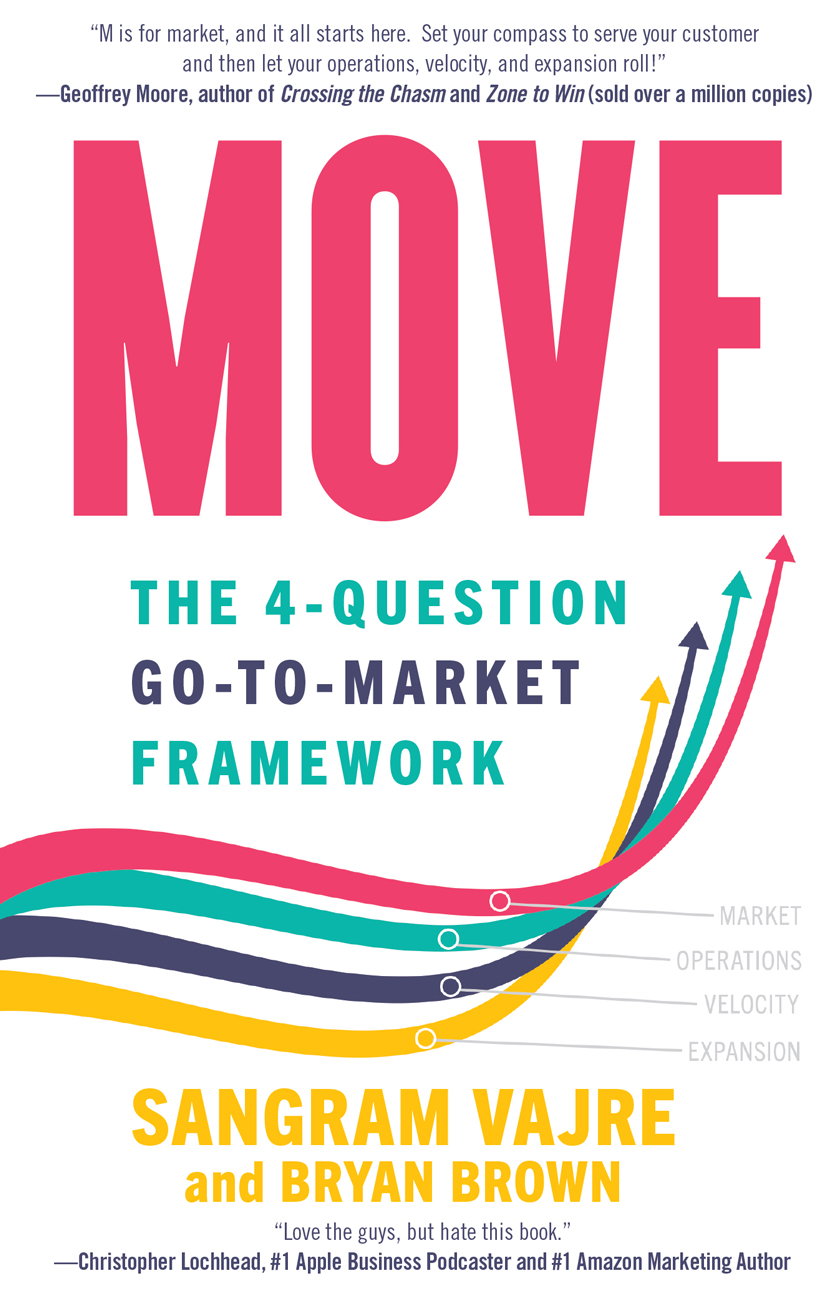
Sangram Vajre: MOVE: The 4-question Go-to-Market Framework
Read the full transcript
Sangram Vajre
Bestselling author Sangram Vajre co-founded Terminus in 2014 and ever since has been teaching the business of marketing with his signature frameworks. He’s an international keynote speaker, was named one of the top twenty-one B2B marketing influencers in the world, and is the host of a top-fifty business podcast called FlipMyFunnel.
Bryan Brown is Chief Strategy Officer at Terminus and an SaaS visionary in the marketing and sales tech industry. From co-founder to scale with multiple exits, he has envisioned and brought to market software that has shaped the way thousands of businesses grow and communicate with their customers.
📚 Books by Sangram Vajre
Transcript
[0:00:34] DA: There are stages of business growth that every C-suite leader must navigate throughout the life of their company. Surviving each stage, it’s not good enough. You want to thrive, evolve and, when necessary, transform. Who do you market to? What do you need to operate effectively? When can you scale your business and in which areas can you grow the most? As most markets change, so will your answers. These four questions will help you focus on the who, what, when and where of your business and they remain the same. In their new book, MOVE, experts Sangram Vajre and Brian Brown, provide you with a four-question framework that will reveal your next steps and propel you forward no matter the size of your company or the stage you’re in. The book aims to take your business from ideation to execution and predict your next move more confidently, it’s a go-to market blueprint that provides you with a confidence and clarity to get unstuck and level up your organization for long term success. Hey, listeners. My name is Drew Applebaum and I’m excited to be here today with Sangram Vajre, author of MOVE: The 4-question Go-to-Market Framework. Sangram, thank you for joining. Welcome to the Author Hour Podcast.
[0:01:46] Sangram Vajre: Drew, excited to be here. This is my third book and when I think about writing books, this is the one book when I feel that this is the one that would hopefully, I would love for it to be what I would be known for coming forward. I’m really excited about this book.
[0:02:00] DA: Well, you’ve written books before but let’s reintroduce you to the world. Can you give us a little bit of a rundown of your professional background?
[0:02:09] Sangram Vajre: Sure thing. I think probably most interesting professionally is that I ran marketing at Pardot and then we got acquired by ExactTarget and then ExactTarget got acquired by Salesforce and I spent a couple of years at Salesforce. That was the biggest acquisition of the time in 2010 about 2.6 billion. I went from a hundred people company to an iconic brand like Salesforce and I learned a lot just being there so it was fantastic, it was a mini-MBA for anybody who wants to learn about SaaS and business world. Then, I started Terminus about six years ago, again just with a couple of folks. Since then, we’ve grown to 300 plus people, we hit a million revenue the first year, five in the second, fifteen in the third. We’ve had a pretty hockey stick growth as a business and really what led to all of that was the introduction of the two books I wrote around account-based marketing. Just a completely different way to do B2B marketing and sales and those two books really helped us anchor the movement that we greet over the canvas marketing.
[0:03:10] DA: Now, you didn’t write this book solo, you did have a co-author, Brian Brown, can you talk about what he added to the project?
[0:03:18] Sangram Vajre: Big time. Brian is a marketer, product, he’s an innovator guy. To me, I’m a framework guy, I love grabbing over frameworks and I will talk about the MOVE framework, we’ll talk about the three P’s framework that we have in the book in a second but he’s the one who would really connect the dots. He helped come up with, “All right, when we think about transforming a business, what questions should we be asking? What assessment can people do?” A lot of the back-end research and when people go and get the book and download the templates, the playbooks, the scorecards, he had a big hand in creating that detail level where you can really say, “Okay, I’ll get it, but how do I do it?” I’m the one who is trying to get research to say, “Well, this is important and he’s the one who actually helped, like, here’s the data, why this is important and here’s how people can implement it.”
[0:04:07] DA: Now, why was now the time to share the stories in book number three? You said, books number one and two were super successful for you but was there anything that really inspired you or did you have an “aha moment” that you really wanted to write on the subject?
[0:04:21] Sangram Vajre: Well, when I wrote the first two books, Drew, it was to help this whole category on ABM. We did that, it really did work, it’s probably the best direct mail that you could ever send but we never thought it would be super successful just in the wild like they’re in China, people are buying into this. It just became really crazy successful the last book has been but there was a point where I sat down and I heard this that less than 0.04% of the companies even hit 50 million revenue, they die even getting there. You think about that for a second. So many companies start and then they hit a million, maybe five but then they die. Even worse, you see companies that hit 15, 20 million and then they die. The fact that only 0.04% of the companies even make it after all that and do see more significant milestone like an IPO or 50 billion plus or exit is ridiculous. Then I looked at it over the last few years, it has been a constant thing that I’ve been thinking about is we have been building our business to the extent that we have. It’s like, well, this does not make sense and it really, what I realized is that companies don’t die because there is a vision issue. Vision is still there, it doesn’t die because a lot of times there are bad founders, no. There are a lot of really good founders whose companies died and I know a lot of them. They die because of the unsexy part of the business, which is how do you go to market. They die because they haven’t figured out how do you transform your business on whatever stage you were in, into the next stage and then again, you have to retransform your business from that stage to go to the next stage and then we’ll get into stages in a minute but that part really bothered. I’m on a literal mission to help transform a thousand companies in the next five years to go through these motions. I don’t want to see anymore great companies dying purely because they don’t have a good market process.
[0:06:22] DA: Who is this book for? Now that we’re on the subject, is it for smaller businesses, is this for larger businesses? Who could really have the most takeaways from the book?
[0:06:30] Sangram Vajre: I think it’s for any business but, this will be most valuable, will be the owners, the CEOs, the founders or the head of functions. Those are the people who actually would benefit the most from. It doesn’t matter if you’re an SMB or a large enterprise, as a matter of fact, I’ve been with Brian Halligan who is the CEO of HubSpot and he gave a quote for the book. It’s a public company all the way to Nick Mehta who is the CEO of Gainsight, it’s a hundred million in revenue company to Scott Dorsey, who got an IPO size company to make it who has been advising 25 different startups to get a powerful exit. Across the board, we have, I need, Brian and I have been into VCs, CEOs, CMOs, CROs. This book is for the leadership team who wants to see their business move forward and they have to make decisions, they have to transform the business. If you have the authority to do that as the head of department over the C-level executive, I think this is the book for you. It wouldn’t really matter at what stage you're in because as we get into it, you’ll figure out that, “Okay, yeah, I’m in that stage or I’m in that stage” but you want to get to the next stage. The book, the reason we call it MOVE other than the fact that it stands for something, Drew. Is also to help companies think and answer the question, “What should be my next move? What should I do?”
[0:07:49] DA: You mentioned it before and it’s a major focus of the book go-to market strategies and marketing. Can you actually just set the foundation here and just define for us what exactly go-to market means and maybe a little bit why it’s so difficult to perfect?
[0:08:06] Sangram Vajre: Oh man, that is the heart of the whole book, that will help define that go to market because it is one of those terms where people won’t have an idea around it but nobody’s really taking the time to fully look into it and look at it and say, this is it. First of all, it is not a strategy or project, it is a good market, it is a transformational process and I want us to super emphasize that, it’s the transformational process, it’s the intuitive process. Brian Halligan, the CEO of HubSpot, I was talking to, he gave a quote that we put it on the back cover of the book that to him, go to market is like a product, it’s an integrated process. He’s like, “We don’t go on an offsite and come over the go-to market process. No, we do that for vision and mission and where we want to go.” Go to market is a daily, a weekly, a monthly change that we need to identify what we need to do. First and foremost, go to market is not a strategy, go to market is a transformational process and then you can layer on other things like who is involved in it. This is what high performing revenue teams. Which is why we’re saying, this book is for t he executive team and the revenue team typically is your customer success, marketing and sales and product, that’s your go-to market, the leaders of those group are your revenue teams and it’s ultimately in the service of creating a connected customer experience. Customers wants a frictionless experience but you can’t create that unless you have the revenue team that is fully aligned, unless you’re creating a transformational process that it iterative.
[0:09:34] DA: Talk about what some companies are many companies are doing absolutely wrong with their go-to market strategies, what are the no-no’s that you’re constantly seeing out there?
[0:09:47] Sangram Vajre: Well, let me phrase that a little differently. How do you know that your go-to market is broken? Because, if you don’t know that this is broken or have upon this book, you were like, “Well, I don’t know if it’s for me or not, of course we need to have a good market, I think we have it pretty good.” Here are a few things that, if this is happening, this book is for you. If you and your team right now, you guys are, we’re having conversation and recognizing that, “You know what? It doesn’t feel like our entire companies align with the way the executive team looks at it.” If that’s what’s happening, your go-to market is broken because there is misunderstanding. Maybe this is happening in your organization which is, “Oh, our customers are excited about our vision or product but towards the end of the year, when we want to renew them, they have questions because they haven’t seen the ROI.” Your retention sucks, maybe you have your own issue like your turn is killing you, your top line growth is great but your turn is killing your business. Maybe you’re right now and one of the way to look at your go-to market is broken is it’s not predictable yet. You still have a couple of sales people who somehow miraculously closed a couple of big deals at the end of the month or in the end of the quarter, that gets you into the business and say, “Oh we met our numbers” but it’s not predictable. They are heroic sales players that are doing that or maybe, you’re getting pulled into a lot of feature or pricing wars with your competitors which means, you don’t really have a go-to market that you can dominate. If any of that conversations are happening at the executive level, your go-to market is broken and you need to figure out who owns it and how to fix it.
[0:11:22] DA: Well, let me ask you. You say it’s broken so exactly what happens when it’s broken, what can go wrong? Can this actually sink the whole ship?
[0:11:32] Sangram Vajre: Totally man, this is exactly the reason why there’s so many great companies who hit five, 10 million and then they just die. One of the frameworks in the book that you talked about is three P’s. Problem market fit, product market fit and platform market fit. Problem, product, platform. Think about this. A problem market fit company is a company that is trying to figure out if the problem is big enough or the problem is a real problem and if the market is big enough, can we solve this and will people pay for it? Let me tell you what I’ve learned in this research, Drew. We learned that you can have a 30-million-dollar business and still be in the problem market fit. How? Well, because, you may still have a lot of the retention issues. You must still have this big deal that somehow gets you over the finish line but you still don’t have a repeatable process. A lot of businesses do really good at problem market fit and die. The other one is product market fit, which is, okay, you figure out that you’re able to sell it a specific segment industry, vertical, region, whatever it is that market is just right. You know exactly how to sell it and you get a product market fit, you have a repeatable scalable. Guess what? After a few days, months, a year, you’re going to have competitors show up, which means you’re going to have to innovate again. You have to figure out, “Oh, the customers are now asking for more things” than what you have already delivered, which forces you to again innovate and become what we call platform market fit, which is you’re going to create more products so you can service your existing customers as well as get new customers and even your market expands this time because you have more products. Maybe you can go after more personas but each one of them is not a straight line up into the right. It is a squiggly line. Companies transform and thrive or die in between these transitions. A lot of companies won’t be able to go from problem to product, they just don’t have that and that’s what you see a lot of times companies change their entire management team but why? Because the new management team is to help transform the business because the old management team got stuck into one of these buckets. That is literally the whole book about is how do you get out of this one stage that you’re in for so long and sometimes maybe it is the team that you have to change but I believe and I’m betting on the fact based on the research that we have done for the book that it is really your good market process and the framework that you can use to move to a different stage.
[0:13:57] DA: Okay, so let’s say those are things, you know, those are issues. Those are things that can go wrong but what question should you be asking yourself or of your team to create a really successful framework for your go to market strategy?
[0:14:10] Sangram Vajre: Well, there are literally the four questions Drew because when we started the research, I had about 50 questions and Brian and I were going through these initial inquiries and we’ll have assessments and we’ll ask people all these questions and we realized it’s really the four questions and that book came the who framework that every company should be asking and regardless of the stage that you’re in, problem, product or platform, the questions are the same that I am about to share but your answers will be different. For example, the four questions are on market, operations, velocity and expansion question. The market question is, who should you market to? Now, that changes based on the stage. It might be the early stage of going after everybody. In a product market stage, you will actually go after a specific segment. In a platform market fit, you will actually go after your existing pool horse, the customers that give you the most revenue, so your market a little bit changes. Operations, what do you need to operate effectively? That’s the O, this is with revenue ops. We talk about revenue ops in the book, a new completely different template, how do you create a good market scorecard so your entire executive team is aligned on it. You not only look at acquisition but you also look at product usage so you know is your customer sticky or not but we have early identifiers to see when our customers are going to return or how many comp percentages or attention you’re going to have, so you really figured out the operations. This is where you get the queues, are we ready for the third question, which is the velocity question, when can you scale your business? This question is asked almost every day in every company and the answer is, well, if you are able to have some of these ratios that we talked about in the book, then you know you can hire more people. For example, the ratio could be how many reps do you need to have this much quota in order to drive business. Well, if you can drive that for three quarters in a row, now you know you can do that again so you can hire more people because now it is a number spark. You will know how many marketers you need in order to create demand and pipeline. If you can drive that much pipeline, you get more budget to hire more people. The velocity question is about how can you scale the business faster and the fourth one is my favorite, it is Scott Darcy who is the CEO of Exact Target. He literally gave us this question, he said, “What kept them up?” and they went through Public and that amazing exhibit, Salesforce as well but what kept them up Drew was this one question, “Where can you grow the most?” Where can you grow the most? He’s like, “Look, HubSpot, they still have 40% of their revenue comes from agencies.” They grew international and all of that stuff, some companies you have startup and sales team in the early problem market fit but in product market fit, maybe you go get an agency that can support you and get more customers for you. Maybe you can have a partner program, maybe you can have an OEM strategy, maybe you have a channel program and then later on in the platform market fit, maybe you have an ecosystem play like Salesforce did with Green Force and their whole app exchange like Apple does with all of their ecosystem. Expansion is a way to drive the revenue, way more acceleration wise so that you can move the business forward faster than what few people on the team can do. Those are the four questions, who should you market to, what do you need to operate effectively, when can you scale your business and where can you grow the most.
[0:17:29] DA: Now, let’s say you choose to, you answer these questions, you decide, “Okay, this is how we’re going to move forward” you’re going to implement the move plan. Can you talk about what the first steps look like and maybe how much should a company expect to transition and to completely formulate their go-to market plan?
[0:17:48] Sangram Vajre: Oh man, that’s a great question so two things on that. One, this is as I said before, it’s a transformational process. This is not an overnight process, even if you’d figured out a plan, the beauty of this is you have to iterate on it and look at it. I’ll give you an example of a company that I think we all can know or can see it. Look at HubSpot as an example. HubSpot started with focus on marketers and SMB owners. They focused their entire business model was all about leads and then their whole goal market theme was literally inbound leads, right? At some point, they figured out, “Oh” in 2009 or something, they figured out marketing automation is really where they can make money. This is what people are buying because they have Marketo and a lot of other companies already existed, so that became really their product market fit and then now, you can look at them, they have a whole flywheel where they have products for marketing, sales and customer success so they have the whole suite. They have the entire flywheel. It took them to go public, it took them over 14, 15 years. Is the transformation process take that long? It could take longer, does it have to? Absolutely not. We look at our company right now, we are 10 or plus people company, we think there squarely in a product market fit because we have a really great business that runs right now but we have acquired four companies and we are moving into a platform market fit and figuring that part out. We are right smack in the middle of this transition right now. This is more real to me than anything else that I have ever written because it is so real time. What I would challenge everybody is to think about look at the framework, have the courage to do some self-assessment and we have assessment and all that stuff on the movebook.com but you need to do with your executive team sales assessment and ask this question sitting around the table, what stage of the business are we in? I tell you, Drew, just that question would bring so much clarity among your team to realize, “Okay, well somebody says I’m in problem market, somebody says I’m in product, some things that we’re already in the platform” then you know you have a problem and you’re able to fix it because your team, your goal market team, your executive team needs to be on the same page.
[0:20:02] DA: I love that you just mentioned some of the additional resources because you know, the questions themselves they’re not just black and white answers, right? They’re thorough, you really have to think through them, so you actually provide additional resources for readers in the back of the book and then also like you mentioned, on the companion website so maybe you could talk in a little bit more detail what readers and people browsing the web can expect to find there?
[0:20:25] Sangram Vajre: Totally, so one of the biggest mistakes I see people make is they look at companies or websites like SaaStr or some analyst website and say, “Oh, okay. We should be starting gross retention rates” or something like that. Well, you don’t even have a 100 customers, that’s too early for you to be doing that, right? It’s like, don’t kill yourself. I want to empathize with people, you are just in a different stage of the business. When you go to the movebook.com and hopefully we’ll have the book by then and you read it or you can just go on Amazon and get it but on the movebook.com, you will get scorecards for each stage of the business so that you know, “Okay, if I’m in a problem market fit, this is the scorecard to look” with literally filled out example and you can adopt it for your company. You will see how you actually create a revenue ops, what does the organization look like. All the people who should be reporting into that to make it really cool. You will see examples of the entire MOVE framework applied to the stage of your business. If you say, “I’m in the product market fit” you will see what questions you should be asking within what type of answers you should expect and one of the transformational things that you could do to go to the next transition point for you. All of these resources are available and ultimately my goal as I said earlier is to help transform a thousand companies because I am sick and tired of seeing companies fail, not because of a bad vision or bad team but because their go-to market is broken.
[0:21:49] DA: Well, Sangram, we just touched on the surface of the book here but I just want to say that writing a book like this where you’re just helping businesses thrive and you are helping them introduce new products into the world is no small feat, so congratulations on book number three being published.
[0:22:04] Sangram Vajre: Thank you so much, Drew. I’m excited but I’m even more excited to see companies thrive using the framework in the book.
[0:22:11] DA: I do have one question left, it is the hot seat question so prepare yourself.
[0:22:15] Sangram Vajre: All right.
[0:22:15] DA: If readers could takeaway only one single thing from the book, what would you want it to be?
[0:22:22] Sangram Vajre: I was saying, and I have it in the book, that says being intentional is more important than being brilliant. Let me say that again, being intentional is more important than being brilliant. Companies start with dreams and they think that they have the most brilliant idea and they probably do and so do a lot of people but what makes them successful is by being intentional about it. This whole book is about intentionality, are you intentional to move in a different. Are you intentional to stay put? Are you intentional to be patient in that area? Are you intentional to start asking and moving in direction that is going to challenge you at the time that you need to so that you are not waiting for somebody to push you and moving in the right direction or you need to? The goal is to become intentional and not just to be focused on being brilliant.
[0:23:11] DA: Well, this has been a pleasure and I’m excited for people to check out the book. Everyone, the book is called, MOVE, and you could find it on Amazon. Sangram, besides checking out the book, besides going to the website you mentioned earlier, where else can people connect with you?
[0:23:24] Sangram Vajre: Well, I’m on LinkedIn. I post something interesting or try to be interesting every day of the week, so people can follow me on LinkedIn and if you like this one, I’ll send you a signed copy of the book if you just literally DM me on LinkedIn and say you enjoyed it or something that stuck out to you, I’ll send you a signed copy of the book.
[0:23:42] DA: Wow, well, we’re ruining your own sales but we’ll keep that in the buck. Thank you.
[0:23:47] Sangram Vajre: Thank you. I would give away this book to everyone, then you do buy into it.
[0:23:51] DA: Well, Sangram, thank you so much for coming in the show today and giving us some of your time, and just wish you the best of luck with the success of book three just like you had with book one and two.
[0:24:01] Sangram Vajre: Thank you so much, Drew. I appreciate the conversation.
[0:24:05] DA: Thanks for joining us for this episode of Author Hour. You can get Sangram Vajre’s new book, MOVE, on Amazon. Also, you can also find a transcript of this episode and all of our other episodes on our website at authorhour.co. For more Author Hour, subscribe to this podcast on your favorite subscription service. Thank you for joining us, we’ll see you next time. Same place, different author.
Want to Write Your Own Book?
Scribe has helped over 2,000 authors turn their expertise into published books.
Schedule a Free Consult