Ben Moore: It's More Than Your Foot
Read the full transcript
Ben Moore
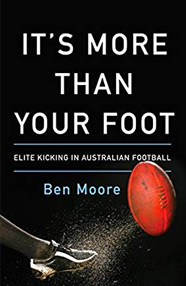
Ben Moore is a skill acquisition coach who formerly worked with the Sydney Swans in the Australian Football League, where he ran the goal-kicking program for individual players and advised coaches on player development. His background combines a foundation in sport and exercise science with years of playing and coaching. He is the author of It's More Than Your Foot: Elite Kicking in Australian Football.
📚 Books by Ben Moore
Transcript
[0:00:22] Charlie Hoehn: You’re listening to Author Hour, enlightening conversations about books with the authors who wrote them. I’m Charlie Hoehn. Today’s episode is with Ben Moore, author of It’s More Than Your Foot. For six years, Ben directed the learning experience for the Sydney Swans, one of Australia’s top professional sports teams and during his time the team ranked second in the AFL for set shot goal kicking accuracy. Kicking is a critical skill to master in Australian Football but while he was coaching, Ben started to notice that a lot of the methods that are being used to train kickers actually contradicted how some of the most successful players kicked. In this episode, Ben offers his holistic approach to learning and improving kicking technique. Specifically, he’s going to talk about the important movements in the kicking process and the mental aspects behind practice and just a quick note before we start the episode, Ben and I actually recorded this conversation over the phone so it sounds a little different from other episodes but don’t let that dissuade you, alright, let’s keep going. Here is our conversation with Ben Moore.
[0:02:02] Ben Moore: I grew up in England, although I got an Australian passport courtesy of my dad. I grew up in England and played sport growing up, did sport science at university, then dropped out of that, sort of, the sports field for a number of years, mainly because of debts from university, worked in the city, got sick of that and then ended up moving to Sydney, Australia to go back in to the sports world to do full time masters or a one year masters course at University of Sydney, fortunately, managed to, through a contact, got put in touch with the Premier Australian Rules Football Club in Sydney, Sydney Swans. I sort of managed to talk my way in to short-term consultancy contract was it, I guess you call it, where I was – my [inaudible] was to watch training for a number of weeks and come up with ideas based on my background both from playing sports like cricket in my youth and also sports science, come up with a number of ideas for the coaches to implement in their trainings. So I had watched about three games of Australian Football. I had – but when I was very young, I didn’t know the rules over the need to kick it through the goal. There are a lot of goals scored during a game. I just, basically, was just standing there where at a training you think having seen that coming up with ideas based on the experience of playing cricket in particular and having growing up playing and coaching cricket. Although the two sports down sound particularly aligned. Cricket, if you look at cricket it looks very much like a two planed activity so up and down the pitch. You’re trying to get the bat the move in a straight line to hit the ball, well, my view is that’s a totally incorrect way of doing it. You should look at it as a rotatory of activity, around the location of the hit, lift the arms and the shoulders all controlling that rotation. Likewise, kicking, from what I heard in the first few weeks of listening and watching training. Kicking, particularly kicking for goal was approach for other coaches as a two planed activity as if the kicking leg just the main torque was the swing as straight as possible striking the ball down as straight as possible in line with the kicking leg so that everything moved straight. Well, in actual fact you know that the hips obviously rotate, the upper body rotates and the shoulders rotate during the kicking process, so it was coming up with ideas for the coaches based on looking at from that perspective rather than you know, just straight up and down. CH: So Ben is this role that you had of being a person who just comes up with ideas for the coaches they find your background, is that a role that a lot of teams have available for people like yourself or was this pretty unique? Was this like, were you the only one doing this in the league? It may be one other person at another one of the clubs but as far as I’m aware it was unique in the sense that, there was no defined role for me within the coaching team or within the sports science team. Paul Roos was the head coach there at the time and he was very open-minded in terms of trying to get as many ideas as possible from anyone within background really if you can do it in order to improve his team.
[0:05:36] Charlie Hoehn: And so, he just said, just give us any ideas that you have that will make us better.
[0:05:42] Ben Moore: That was pretty much it. I mean it was – I’d come from a skills background in the sense that my sport science undergraduate and postgraduate degrees were around the science of learning from the perspective of motor skills and cognitive skills so the type of motor skills for example, hitting a ball, kicking a ball, cognitive skills as in decision making and also my background, all this playing and coaching in other sports. So it was to use the idea coming out of those to help him and help the team of coaches and the team of players get better.
[0:06:17] Charlie Hoehn: Yeah, so tell us about the first big idea that you have or maybe the first one that made a noticeable impact.
[0:06:25] Ben Moore: Well, I think speaking to the coaches and the players, there were obviously some tips and pointers which everyone seemed to use in helping them get better at the process of kicking. Well, kicking a ball, which is quite a complex activity when you’re dropping an oval ball out with your hand onto obviously the convex shape of your foot. So, the players had a number of principles that didn’t seem to be a guiding set of overarching principles or an entire process around which kicking program was structured over a period of weeks, months or years. It was, a little tip here, a little tip here, “You might try this, you might try that.” And my perspective of coming from coaching batting in cricket was that process of jumping around from tip to tip doesn’t work in the long run in terms of maximizing learning from a speed perspective or maximizing learning from in terms of how far you get to.
[0:07:31] Charlie Hoehn: It makes me think of the Bruce Lee quote that’s like, “I don’t fear the man who knows 10,000 kicks, I fear the man who knows one kick whose practiced it 10,000 times,” right?
[0:07:43] Ben Moore: It’s something like that, yeah, I mean I’ve got a Bruce Lee quote in the start of one of my chapters I think and certainly having the structure around which to face the figure process as well as to practice discipline that was my first idea and I need to come up with something around that.
[0:08:00] Charlie Hoehn: Tell me more about your book. What is like the biggest take away that you want football players to take away from it?
[0:08:07] Ben Moore: I mean I think to me, there is not an ideal technique that applies or an ideal of movement of pattern that applies to every single player but for me there are series, there are a series of principles which can be used by any player or any coach with any player in practice over a period of weeks, and months, and years which can help each individual player improve their own kicking, ie. their own style. Everyone is going to look slightly different based on how tall they are, how fit they are but there are a series of principles which can be applied to every player, that’s my view, and so the book comes at those principles and then on top of all an umbrella, has an umbrella of practice disciplines which help learning and feedback. To me, the book covers the physical process of kicking, aiding, performance and improving performance as well as a series of practice disciplines which assist players and coaches with the learning process and feedback on the learning process.
[0:09:20] Charlie Hoehn: We know now it seems most people practicing kicking they go from tip to tip and you have a more holistic approach. Can you talk through what some of those principles are that you layout in a book?
[0:09:36] Ben Moore: Okay, it starts with the physical method or the method of kicking the football and if you watch an Australian Rules Football player or indeed Rugby League player or indeed any player kicking a ball. You got a, there is something an approach before you reach the ball and impact the ball with your foot there is obviously that period where the foot impacts the ball and then there’s a period of with so I’ve just broken in down in the book and in the coaching that I did into three principles of momentum, alignment and follow through. M, A, F – momentum, alignment, follow through. The momentum is created by a player or an individual kick either by running up really fast or at the other extreme by using massive hip rotation if you’re kicking off one step. So Charlie if you were kicking a ball and you’re trying to kick it as far as you could, maybe, you could run in let’s say 15 meters and try and use all that speed to transfer into the ball or you can do it of one step and a huge amount of hip rotation, sort of twist your body around to create that momentum or obviously there is a blend somewhere between those two extremes and between the two extremes of running fast and extreme hip rotation you could obviously have a blend of the two, you know, kicking off two or three steps and using somewhere in between on each of those extremes, so that’s momentum. Then you’ve got alignment, so it’s important that the player is aware of his hips and his or her shoulder alignment at the point of impact with the ball and what I mean by impact obviously, the ball is dropped out from the hand on to the foot, so what alignment allows the ball to travel in a particular direction. Now, coaches tend to talk a lot about running up straight towards the target kicking with the aligned straight, so the kicking leg lined straight up and down and following through straight to the target. My perspective is that many players don’t do that and it’s quite acceptable to kick using a more curved approach or a curved run up. For an Australian Football player will cut it’s called kicking it across the body where you’re sort of not aligned with your target, you manage things of kick across in a strange angle.
[0:12:04] Charlie Hoehn: A little quickly Ben before you get the follow through yet I’m an American so –
[0:12:07] Ben Moore: Yup.
[0:12:07] Charlie Hoehn: - Tell me a great Australian Football Player who kicks really well so while you’re describing this I can kind of see the movement that you’re describing.
[0:12:17] Ben Moore: And describe what they do?
[0:12:19] Charlie Hoehn: No, what’s the name of an Australian Football Player who is a really good kicker so I can look it up on Youtube and watch so as you are describing this.
[0:12:22] Ben Moore: Oh, okay, so maybe try Lance Franklin or Buddy Franklin is his nickname, but yeah Lance Franklin.
[0:12:35] Charlie Hoehn: Alright, Lance Franklin kick, is his name Buddy Franklin?
[0:12:41] Ben Moore: Yeah, Lance or Buddy Franklin, yeah exactly.
[0:12:45] Charlie Hoehn: Alright, so “Buddy kicks 13 goals," I’ll be watching that on Youtube while you’re describing the alignment factor.
[0:12:54] Ben Moore: Okay, so yeah, I mean if you see someone running up and generally if they’re kicking at goal and they got plenty of time to run up, they will run straight to the target, straight at the target ie being the goal and then kicked in a, I’m just watching some of those kicks as well but again, its sort of if I’m talking from an extreme perspective, alignment, alignment from when players and coaches talk about it in Australian Rules Football traditionally they talk about running up straight, in inverted commas, at the goal or the other player that they’re trying to kick to and keeping everything lined up ie. they drop the ball straight down in line with the kicking leg, swing the kicking leg through reasonably straight and then follow through to the kick to the top after the impact straight again. However, you’ll see that most players, because of the dynamics of the game and in particular when they’re kicking out from further out goal they don’t kick with everything lined up at the target, so to me alignment doesn’t mean running straight at the target and following through straight to the target, it means being aware, the player being aware of the relative hip and shoulder alignment at the point of impact that allows the ball to travel in a particular direction. So even if I’m not, if I’m a right footer and I’m not running straight at the target, I can still kick the ball quite a long way over to my left, if you can imagine kicking a ball over to your left as a right footer or over to your right as a left footer. They don’t need to be perfectly aligned with the goals or the player they’re kicking to or having a perfectly straight approach but what they really need to do is have awareness of a relative alignment of hips and shoulders and, very importantly, they need to maintain that alignment in a split second before and after impact, ie. create a stable platform on the non-kicking leg, now what I mean by the non-kicking leg obviously one leg swinging through and kicking the ball, the other leg holding the player up creating a stable platform. That is incredibly important, creating stable platform on that non-kicking leg and that comes not only from the leg, the hip but also the upper body, so it’s a whole body activity. The legs are moving but also the arms and upper body is moving to provide stability as well as assist with the force of the kick.
[0:15:33] Charlie Hoehn: Right.
[0:15:34] Ben Moore: So there is some momentum and the alignment point, the final one being the follow through which is about maintaining physical form in the split seconds after a kick but it’s also remaining mentally engaged in the kicking process rather than just switching off at the point impact. What I mean by switching off is that, you know, if you’re kicking for goal, you kick and then just right after impact you’re mentally switch off, you look up where the ball is going towards goal it doesn’t seem like much it may not greatly impact the actual physical outcome of a kick but from a mental perspective it’s a practice tool for improvement and feedback as well as being a part of the physical process, ie. maintaining a physical follow through as well as a mental follow through passed the point of impact. The player needs to keep the momentum going through the kick after impact but he also as a say, he needs to be switched on in order to be aware of all the feedback that they’re getting not just where the ball is going but how they feel their body is moving after the impact, how the kick felt before, that you might not be able to do all of – or you won’t be able to do all of that consciously in terms of verbalize all of that, but being aware of the follow through process greatly assists in the feedback that the player has from perception and how the physical mechanisms. You can use some tricks to do that, so a player can do this by continuing to run after to the impact or if they just be kicking off one step or you’re just kicking off one step you can just keep bouncing on that non-kicking leg until it strains again. But the important thing is to wrap our mind physically strong in to the follow through and keep the force moving forward in the direction of the ball. So just to summarize that, the momentum, alignment and follow through to me is a physical process aiding performance after a particular point in time and it’s a physical and mental discipline which aids the learning process and feedback for all, the coaches, the players obviously and coaches.
[0:17:49] Charlie Hoehn: Alright, so while you’re practicing you’re focused on these three particular things. You’re focused on the momentum, alignment and follow through. Now, in your book you also talked about the mental aspects in practice. What do we need to know from the mental component of practicing?
[0:18:13] Ben Moore: Yeah, I mean I’m not a sports psychologist but I think there’s a mindset or a series of mental processes which greatly assist a player who is trying to learn a physical activity such as kicking a football. A skilled activity like kicking a football. It can apply to also hitting a ball, for example in baseball or hitting a cricket ball or even hitting a golf ball. I think there is some relatively simple mental disciplines which someone can adopt and I outline those in the book. I think the number one, in an activity where you are the person that’s doing the activity and fairly isolated from everyone else is that and particularly in practice you got to accept mistakes are going to happen in during the learning process, in fact that is just the fundamental part of learning anything, whether you’re learning to write, whether you’re learning to kick football, whether you’re learning to drive a car and most of those activities like child learning to write or a child learning to walk it is just unstated but you do accept mistakes but in Australian Football and particularly the elite level, if a mistake gets made during practice, the player, what I noticed when I first arrived was that there was a tendency of a player to do a lot of swearing at themselves and sort of make it known to everyone else that they’re upset about having made the mistake either kicking for goal or when they’re kicking to a teammate. Now, obviously there are times when you are going to get upset for example in the game, but I think a critical discipline in practice particularly in the off season when you’re trying to improve the activity that you’re focused on, a critical mental discipline and this cannot be understated is to not swear at yourself and to not laugh at another player that’s trying to do it or any other sort of negative reaction to a mistake. And mistake, I put in inverted comments because we have just got to accept that’s going to happen if you’re pushing the current boundaries of your performance level. And that might seem incredibly simple but I think if you go and watch practices in, particularly a junior level, yeah, 13, 14, 15, 16, 17 in any sport, anywhere in the world I can guarantee there will be people swearing themselves horse after, you know, missing a kick or hitting a ball incorrectly or whatever. I think for me, number one, for the coaches to make sure the players don’t do it first off and for the players to discipline themselves into doing that and effectively you’re trying to detach yourself from the outcome of the short terms performance because that greatly improves the odds that you’ll be able to obtain useful physical feedback from the overall process that we just talked, you know, in kicking we just talked about a momentum, alignment, follow through, but it also it greatly improves your mental approach for future kicks, so of course you learn how to be in an optimum mental position for you to kick whether it’s in a practice or a game.
[0:21:27] Charlie Hoehn: Yeah, you know, these reminds of The Inner Game of Tennis which, I don’t know if you read, but it talks about that exact thing. That practice improves dramatically as soon as you remove your own negative critical voice reinforcing your mistakes and instead focus only on positive reinforcement and how quickly you improve when you just turn that off and I totally hear you there.
[0:21:54] Ben Moore: But I think the opposite also applies. There is no point in just going through practice and patting yourself on the back for doing something successfully the whole way. I thinks it’s generally removing your attachment to the outcome during practicing is absolutely critical and sounds simple but is not easy.
[0:22:16] Charlie Hoehn: So Ben at this point, let’s say that I’m involved in playing and coaching in the AFL or I have a great interest in kicking but let’s say I’ve studied the topic, I’m familiar with it. What do you think is really novel about your book or what do you think is, distinguishes that from other tutorials, books, and literature on the topic?
[0:22:43] Ben Moore: Well, I think what we touched some a little bit early on in the sense that to me the book summarizes a physical process which is can sit above, a little bit what we discussed earlier. The book summarizes a physical process which applies to any individual player and which will assist his performance but also the practice, discipline for learning that. I don’t think that overarching set of principles has been put in place as far as I’ve seen or in a book or any other written forms even on other kicking tutorials. I don’t think when I’m saying that, that done.
[0:23:24] Charlie Hoehn: Yeah, I mean that just being almost a little bit sarcastic of that there being books on these topic because I can’t, I’d imagine you’ve got to be the first.
[0:23:34] Ben Moore: There are a lot of books but they take it, they take it from another perspective in the sense that they take from what I’ve seen they take it from the perspective of the isolated sort of tips. althouAlthoughgh they are structured together obviously into an overall book, yeah, I mean there’s only a few of those anyway.
[0:23:59] Charlie Hoehn: Author Hour is sponsored by Book in a Box. For anyone who has a great idea for a book but doesn’t have the time or patience to sit down and type it out, Book in a Box has created a new way to help you painlessly publish your book. Instead of sitting at a computer and typing for a year, hoping everything works out, Book in a Box takes you through a structured interview process that gets your ideas out of your head and into a book in just a few months. To learn more, head over to bookinabox.com and fill out the form at the bottom of the page. Don’t let another year go by where you put off writing your book. So, tell me about some of the transformations that you’ve seen in the people that you’ve coached, in the players. What kind of testimonials that you had from them about the principles in this book working for them in changing their game.
[0:24:58] Ben Moore: Yeah, I mean I think I was lucky in the sense that there are a few coaches at the Swans that really bought in to the ideas because they were novel and would be useful and that greatly assists obviously the players buying in because if you don’t buy into whatever practice process you’re going to be undertaking, it’s not going to work as well as it could. So the first year and on this day it was an excellent player who could already kick very, very well, he was one of these the senior goal kickers. He had a few down years probably in the years prior to that, kicked to something like 57 or 60 cents conversation at — in kicking set shots for goal and that’s probably about 10% lower than someone of his level ie. an elite goal kicker would be hoping to kick at. He really bought into the ideas and probably, you know, practiced and then critically obviously an application, you know, over regular practices and months. He did that to the entire preseason when I first arrived and his accuracy the following season jumped to 73% that was the most successful he’d being in his entire career up to that point which is a 13 year career, so he was coming towards the end of his career anyway. He really bought in to what he viewed a relatively simple process but had some layers underneath that sort of helped him explain some of the complexities of the kick. And also, all he’d ever done in learning to kick growing up or even when he had some problems kicking he received and what he tried to do was drop the ball down straight out of the hand on to the foot. I mean that sound relative — you don’t know the game sounds quite a simple bit of advice but it’s incredibly difficult — incredibly difficult to drop an over ball as you’re running straight down so that it meets the foot with the ball pointing upwards.
[0:27:07] Charlie Hoehn: You’re getting shoved around and stop by other players.
[0:27:11] Ben Moore: Well, yeah, and you’re having to run, you’re having to work out where, you know if you’re keeping to know the play and worked out well they are all what they’re going to there’s a number of complexities, so he had just focused on the ball drop and what he found is that, moving away from the ball drop and the impact, ie. the middle of the ride in the middle of the process that I was talking about. The momentum, alignment, follow through. My point was that, the ball drop and the impact lies right in the middle of that process somewhere so I try to pull him away from that into the other ends of it. Ie. the momentum aspect, keeping strong the alignment phase during the middle and then the follow through and he found that, he found that creating the overall process helped him just do the middle act part of the activity ie. dropping the ball and getting the contact on the foot. He did that automatically without a mental focus on that. I mean that was not only good for my perspective in that it works but it helped me get re-employed the following year. And that’s always good. And then over the years there’s been quite a few of those, where individual players who are struggling in in inverted commas or wanted to improve their kicking have done so. And then again, similar, towards the end of my time at the Swans and I was there for maybe eight years another player came from another club maybe he’d played from maybe six or seven years at another club again they came forward, so a guy that’s responsible for kicking goals for the team and is there, under pressure in terms of converting those goals three, four, five times a game. He hadn’t – again the only thing that he had been told was these kicks or feedback that I mentioned earlier about remaining straight or upright or having the leg swing through straight and following through straight. Now, that may sound simple if you watch a player kicking a ball in Australian Football that does seem like reasonable advice however it restricts the natural rotations of the body that are occurring particularly in the hips and also it restricts the player in terms of the force and momentum that they can get into the kick so he found again having the license to be slightly more relaxed about the rotation of the hip, not being so singularly focused on remaining straight up and down which is a term that we use, having a more rounded action for his kick helped him to execute it, in more he called, a more relaxed, what he felt was a natural, approach and again he’s kicking accuracy conversion in a two, three years probably enjoyed the day was the highest in his career, so –
[0:30:14] Charlie Hoehn: Wow, well I’m sure anybody whose listening this, who is involved in Australian Football is curious about reading the book, getting the rest of the practices and everything that you layout and I’ll tell you then I have no, very little knowledge of Australian Football I know just a little bit, so what I’d like to ask you now is what is a question that you really wanted me to ask you, that I’m not asking you because I just don’t have the knowledge?
[0:30:53] Ben Moore: Okay, that’s a good question.
[0:30:56] Charlie Hoehn: And maybe my first good question of the interview.
[0:31:01] Ben Moore: No, they’ve all been good questions, I mean it’s just difficult to talk about the subject like this without seeing it. Can you forgive-
[0:31:09] Charlie Hoehn: I know, I get it. Yeah, I’ve seen some of it and honestly I remember distinctly thinking like in the past like why don’t we play this in America? It looks more fun than both football, I’ve never played football, I played baseball and basketball but it looks more fun than football and it looks actually more fun than Rugby. It’s really dynamic and challenging but, yeah, I don’t have a ton of – I know none of the players, any of that.
[0:31:37] Ben Moore: I don’t think so, it sort of it would have to release specific stuff so a lot of my, the points I have mentioned so far is, you know, the kicking process, the overall process that I come with there. The physical process and the practice process, I mean to me just standing back — of the points I’m trying to hammer home as well, as well as those points where you know, kicking is a whole body activity so trying restrict one element for example trying to remain rigid in the upper body or trying to swing the leg through straight, which is quite that is like giving quite a lot which is what I’m talking about today, but that will — restricting one element will restrict other elements of the kick which then throw the impacts out and then the feedback from the coaches or the player whose seeing directly incorrectly, for example, to the ball drop so a lot of my points as well as the processes that I’ve talked about, reminding the players and coaches that kicking is a whole body activity and also allowing for the for the whole body to function as it should, so for example not trying to, when you got to drop the ball the temptation is — “Okay, I was going to try and drop it as close to my body or as low down as possible,” well doing that rather than extending the ball well out and some sort of the player all getting the ball relatively high up in front of you. So, trying to restrict one element to optimize another element is a dead end track from my perspective. So the whole body activity up or in lower body but also non-kicking side as well as the kicking side.
[0:33:25] Charlie Hoehn: Then can you give our listeners who do play Australian Football or who play a sport that involves kicking a challenge? What is one thing that they can do this week from your book that will improve their kicking ability.
[0:33:42] Ben Moore: I would say at the most simple level, do a single practice based on the physical process of outline there briefly. So follow through meaning finish the kick, every kick you do in the next practice, finish the kick, and in fact that could apply to hitting a baseball or hitting a cricket ball, so when I mean finish the kick — take the physical process and also your mental connection with that physical process take I through to the end on every single time you hit or kick the ball, the next time you do it. That might sound simple to do, that’s the best thing to work from do a single practice based on finishing the kick or the hit and then start to work back from the end. It sounds crazy to stay that but work back from the end point, ie. finishing a kick so the follow through, the alignment, the momentum so that you’re then practicing momentum, alignment, follow through and obviously at the end of the follow through you got to finish.
[0:34:47] Charlie Hoehn: How can our listeners connect with you, let’s say they want a private kicking session?
[0:34:56] Ben Moore: You could look me up on LinkedIn or happy to if you email me at benbalesmoore@mac.com.
[0:35:11] Charlie Hoehn: benbalesmoore@mac.com
[0:35:13] Ben Moore: benbalesmoore@mac.com perfect.
[0:35:15] Charlie Hoehn: Well, this has been great. Thank you so much for being on the show Ben.
[0:35:19] Ben Moore: It has been a pleasure Charlie, thanks very much.
[0:35:22] Charlie Hoehn: Many thanks to Ben Moore for being on the show. You can buy his book It’s More Than Your Foot on Amazon.com. Thanks again for listening to Author Hour, enlightening conversations about book with the authors who wrote them. We’ll see you next time.
Want to Write Your Own Book?
Scribe has helped over 2,000 authors turn their expertise into published books.
Schedule a Free Consult