Troy Redstone: Episode 782
Read the full transcriptTroy Redstone
Troy Redstone, CPFA®, CBFA®, CFEI®, AIF®, is the bestselling author of Repurposement: Experiencing the Financial Freedom to Start Living on Purpose Today. He helps businesses design retirement programs that serve their purpose and their people.
A thirty-year veteran of keynote speaking, he is recognized as a thought leader throughout the industry and serves as President of the Retirement Advisor Council, the top 401(k) advisors in the business. Connect with him at
📚 Books by Troy Redstone
Transcript
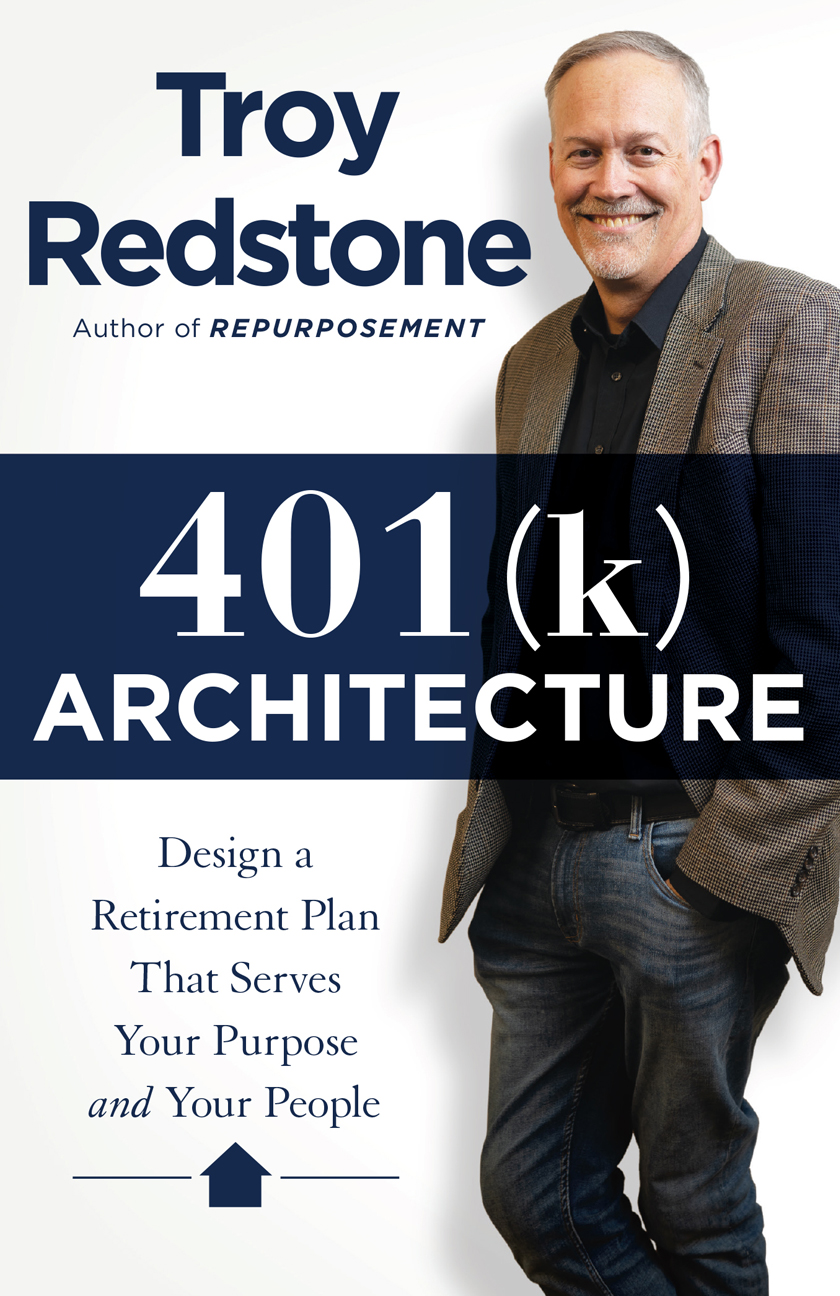
[00:00:34] DA: When employees feel appreciated, they go the extra mile, creating amazing outcomes for your business and your bottom line. The right retirement plan is a critical aspect of that human equation. Retirement plans are not all the same. Troy Redstone’s new book, 401(k) Architecture, aims to help you build a retirement plan that attracts great talent, takes care of them and helps them earn the retirement they deserve. When companies give a little extra, employees give a little extra as well. Instead of focusing solely on the financial aspects of your plan. The book shows you how to think about your company’s retirement plan holistically, including the elements of human behavior and just how to design a plan that will do more for your people and for your company. Hey, listeners. My name is Drew Applebaum and I’m excited to be here today with Troy Redstone, author of 401(k) Architecture: Design a Retirement Plan that Serves Your Purpose and Your People. Troy, thank you for joining us. Welcome to The Author Hour Podcast.
[00:01:42] Troy Redstone: Thanks for having me.
[00:01:43] DA: How about you kick it off for us and just give us a brief rundown of your professional background.
[00:01:48] Troy Redstone: Well sure, I’m a consultant and I work with the employee benefits space, right. I’m helping employers figure out how to provide what I believe to be probably the most valuable employee benefit, the financial benefit. That involves financial wellness, it involves retirement, it involves helping them figure out how to steward and build wealth and things like that. That’s what we do, we’re a consulting firm. And my background is actually behavioral psychology, behavioral finance. It’s basically just a study of why people do the stuff they do with money which isn’t by and large, really super smart stuff. Trying to help people figure out how to handle it, rather than it handling them and financial stress is real. We saw that a lot during the pandemic and so we’ve been helping people for years, pretty much all over the country, just try to reduce the financial stress in the workplace and help their employees not just live paycheck to paycheck but really, to kind of get ahead and that’s kind of our heart, we’re super passionate about everybody getting across the finish line and retiring well.
[00:02:57] DA: Now, why was now the time to write the book? Did you have an “aha moment”, was there something really inspiring out there for you or simply, did you have some time on your hands due to COVID?
[00:03:08] Troy Redstone: Well, that’s a great question and there’s probably a couple of different ways to answer it. I started writing the book a number of years ago. I mean, my heart was trying to figure out how to help employers, how to help companies build a healthy benefit that can produce healthy outcomes and healthy retirement for their employees. That’s kind of where we started and somewhere along the way, I realized I was really writing two different books. I wrote a book that was everything we know about how to help people build money and build wealth. We called the book Repurposement. That was really for the employees of the company, this second book - Repurposement’s been out for several years - the second book here, 401(k) Architecture is kind of for the employers. Employees and employers is kind of a different audience. I’ll tell you that a little bit of the pivot. I mean, I’m in the retirement plan industry but I realized somewhere along the lines that I’m not even really sure I believe in the idea of retirement. Just this idea of sitting back and doing nothing. Retire is a military term, you cash out, you fall back, you do nothing and I guess I’ll say, I think part of the retirement issue we have in our country is retirement is about as inspiring as a lazy boy and a remote control. Most people do nothing but sit on their couch and watch TV when they retire. Maybe, if you don’t love what you do nine to five, the idea of cashing out or moving back or getting out of that clock and hitting the clock or the time sheet. That maybe sounds exciting like sit just doing nothing but watching Netflix all day. But then the pandemic came along and people realized, wait, that’s really not as fun as it sounds. It’s because we find purpose in what we do, I think we were created to create. We were created to have purpose. Rather than retirement, we want to be promoters and advocates of repurposement, not retirement. The first book is, we want to help you experience the financial freedom so that you can start living on purpose today and be repurposed rather than retired. This second book, yeah, pandemic and downtime over COVID and whatever, it did provide us extra time to really work on the second book. But the second book, I guess has kind of been in process almost from the beginning of the first book. That’s my long answer to the question.
[00:05:33] DA: Now, when you were writing this book, who in your mind were you writing this book for? Is this for HR reps, is it for the higher-level business leaders, is this for employees to understand a little bit more?
[00:05:44] Troy Redstone: I think it’s probably going to relate more for those who are decision makers. It’s not just for the employees that are in the plan. In fact, one of the things that we say - it’s buried deep in the footnotes - but we basically say that if you’d like to have a copy of Repurposement for all of your employees so that they get this also, we will send you a copy for every employee you have at our cost with zero profit margins so we’d love to just get that resource in their hands. But yeah, this second book, 401(k) Architecture really is for the folks that are decision makers about the plan. That could be a benefits coordinator, it could be an HR director, it could be the CFO, the controller, the owner, it’s whoever has to try to figure out how to make the 401(k) work. By the way, it’s called 401(k) Architecture and I keep saying 401(k) but I should probably say, that’s just a generic term for your employer sponsored plan because obviously, it applies also to 403(b)s and you know, governmental 457 plans as well.
[00:06:43] DA: Let’s talk about that. For the layman out there, how are any or all of these plans different? How are specifically, there’re different 401(k) plans out there. I think a lot of people sort of see what’s provided for them. Some are better, some are worse but for the most part, do they, is people, does the layman know what kind of options they could have at different companies?
[00:07:05] Troy Redstone: I don’t believe so and I believe there’s probably a huge learning curve. The idea basically, even the term 401(k), we get the number, the letter, whatever, because it falls under IRS code section 401(k), there’s a 401(a), 401(b) and there’s 401(k). That’s where the name comes from. It’s part of the internal revenue code for taxes and it’s fairly complex and it’s undergirded by some really fairly steep regulations and fiduciary laws and stuff like that. It was kind of codified when the Employee Retirement Income Security Act of 1974 was put in place. This is, it’s affectionately referred to as ERISA but this is basically standardizing all the fiduciary laws in the land. Fiduciary laws, by the way, are the highest standard of law in the land. It basically means that you’re responsible for these assets that don’t belong to you. If you’re an employer that sponsors a 401(k) for your employees. Whether you’re the owner or the chief executive or whatever, if you're sponsoring a 401(k) for your employees, you have an incredible amount of fiduciary responsibility to basically provide this retirement plan for them. You’re basically just assuming a lot of liability in doing so, there’s a lot of responsibility that goes with that. Then you’re tasked with plan design like how you design the plan and everything like that and most folks that are in the business of whether it’s building widgets or whatever it is, you’re not in the business of designing a retirement plan. The only plan you know is probably the one that your company sponsors and it’s not something you do every day and you probably don’t have a great deal of proficiency in that. The guidance out there is – it’s challenging. Because oftentimes, it comes with some type of a sales pitch from an insurance broker or something like that. So, I think it’s more confusing than not, and it absolutely requires a lot of legal guidance and things like that.
[00:09:11] DA: What is a bad plan out there? Is that a plan where there’s no match and you’re just contributing and you just forget about it, is it a bad plan on the company’s side where somehow, where you’re losing money? What does a bad plan look like and what can both employers and employees look out for?
[00:09:29] Troy Redstone: Well, that’s a good question. I’m going to answer the question differently than how you might suspect because a lot of people would say, well you know, a bad plan is one that - based upon cost or based upon investor returns or something like that. It’s even easier than that. A bad plan is one that’s not producing healthy outcomes, okay. If your company sponsors a plan but only half your people participate, that’s a failure. Your plan’s not working. When you look at a university, sometimes people obviously want to focus on what happens on the gridiron or what happens on the hard court but you probably want to focus on what’s the graduation rate. Are they actually producing folks with diplomas? Well, here, are we actually producing folks that retire well? I mean, what’s the retirement rate, what’s the retirement outcome? And so, we look differently. We look at participation rates. We look at the average savings rate. We look at whether people are in guided portfolios that are actually producing the outcomes that they need to be able to finish well, and our goal is to help every single person cross the finish line to where they can basically replace their current lifestyle in retirement. We don’t want them to have a big lifestyle adjustment. We don’t want them to get to the finish line and say “wow, I just kind of live beyond my means and now I’ve really got to tighten the belt” or worse yet, get a second job because they haven’t provided well for the future.
[00:11:00] DA: As an employer, how do you go about designing that right plan for your company?
[00:11:06] Troy Redstone: Well, that’s a lot of what the book is about, really. How to design a plan that serves your purposes and also serves your people, but also balances people, purpose and profits. And it doesn’t have to break the bank, so to speak, to have the right plan. There’s a lot of design and it’s something we could possibly get into if this podcast was hours and hours long. But there’s a lot of behavioral science that goes into designing the right type of an employee engagement. I will say, the interesting thing about this book, is we started out simply putting together kind of a 401(k) manual. I don’t know if that sounds terribly interesting to you. It sounds terribly interesting to me but not everybody would find that interesting just to do a 401(k) manual. But here is what is unique and it really does kind of come back to the pandemic. I started noticing that there were some companies that didn’t just barely survive, but they actually thrived during the pandemic, and they were companies that did a really good job of taking care of their people. They took care of their people in spite of these challenges and the employees were willing to kind of give a little extra and help the company get through what was really a challenging season. Regardless of your industry, it’s been an interesting 12 to 18 months here. It’s been an interesting period of time. Well, we talked to a lot of companies that were known for being great places to work and over the last 12 months, I started checking in with some of these companies and I said, “You’re always on that list of great places to work, how’s it going?”. The stories I heard were really interesting and things. The things that they were doing to take care of their employees, I was inspired. Just listening to the hearts of some of these owners. If you’re a business leader that really really cares deeply about your people and you don’t just see human resources as a means to an end but actually, your most valuable resource. This is the kind of book to help you figure out how to make the most – I think the most important benefit of your benefits package just really kind of hit all the notes and do everything it could possibly do. We were really seeking out, talking to business leaders that were passionate about their employees and really balancing the people and the purpose and just being responsible corporate citizens. That was an important, kind of a thing for us during the process.
[00:13:32] DA: What have you seen comparing a company’s overall values and value systems and basing that on their 401(k) plan and compensation, and have you heard from actual employees who can see this correlation?
[00:13:51] Troy Redstone: Well, no, absolutely. I think the employees, a lot of employees would say that if they’re at a good place that they feel appreciated. They get a paycheck and sometimes they get a few pats on the back. By the way, a paycheck is not showing appreciation. A paycheck is simply your fulfillment of a contractual obligation. If your employees work for you, you owe them a paycheck. That’s not showing appreciation. Pats on the back, showing appreciation. I actually talked to employees and employers that were saying - and this is just crazy - but they were things like, “I’m working at a place where I really feel – I kind of feel loved. I feel like they really care about me here”. And that’s not the kind of stuff you hear in a lot of business classes. I think that those business leaders who can find a way to communicate, that their people really matter, just get a little extra out of them. I know one of the folks we spoke with, he is the president and CEO of a huge regional bank but he also has been doing double duty. He stepped into the role of the secretary of commerce in his particular state and he just mentioned that he really feels like people, when you're taking care of them, they find a way to give that little something extra. That little something extra is what is a differentiator in their business and they feel like it goes right to the bottom line in terms of being one of the fastest growing banks in the United States and one of the most highly rated financial institutions and incredibly successful, even though they’re incredibly generous with their people. There’s a direct correlation between values and purpose and then people as well.
[00:15:38] DA: For a company that maybe hasn’t thought about this, they want to really invest more in the long-term financial health of their employees. When they do so, what can they expect to find? Is it just better retention? Does it help in recruiting? Is it just an overall morale boost?
[00:15:57] Troy Redstone: Well, I definitely think that if you want to draw it down, go down to the ROI, the return on the investment. Although I also enjoy talking about the VOI, the value of the investment, but the ROI, it goes right to the bottom line in terms of just retention. When you think about the cost of constant turnover and then retraining, there is a huge cost savings in having people stick around longer. Folks stay at a place because they feel cared for and I think sometimes there’s a misperception that people move from one job to another because of a difference in pay. Most people when you ask them why they left such-and-such place they say, “I just had trouble with the person I was reporting to, my supervisor, trouble with management”, whatever. It’s not always dollars and cents, it actually is more culture. And so, we found a direct correlation between healthy cultures and really profitable businesses. Some of the fastest growing businesses and several different industries we looked at, were those that really went out of their way to take care of employees. I guess the hope is that when folks look at the book that maybe they would be inspired to want to be one of those conscious capitalists, they want to be – there is a whole movement called conscious capitalism where they just want to be responsible citizens, good corporate citizens. They want to take care of their people and understand that they’re stewards. They’ve been given this responsibility to lead this company but it impacts so much. It impacts their employees, it impacts their employee’s family, it impacts the community and the earth, the environment, everything. Just really saying “I want to be a good steward of what I’ve been given and a responsibility to lead”.
[00:17:44] DA: This could actually be good for both parties, right? There are 401(k) retirement or beneficial investment plans for employees that really do balance the company and employees, right? If a company hears this, they might be shaking their head like “we can’t spend all this upfront and expect that ROI”.
[00:18:06] Troy Redstone: One of the points that we make in the book is that there is not always a direct correlation between cost and increased benefits. We absolutely talked to some companies that have ridiculous benefits like free breakfast and free lunch and onsite massage therapists and workout facilities and just all kinds of crazy perks you couldn’t even imagine. But it doesn’t have to be always be expensive benefits. It really comes back to the culture, what’s in the DNA of the company because you really have to – it starts with the heart of taking care of your folks. It starts with how are we going to care for these people and are they really family? That is probably even why, as a firm, I mean, we have over the years found that we gravitate most towards those employers where it is kind of like family. If the guy running the company now, let’s say that company was started by - not even his grandfather, but his great grandfather – and he grew up in the company and the people that worked there are like family and so he really wants them taken care of. Those are the kind of people that we’ve always really found that are really a great fit with. Because if their people matter to them, they matter to us, and that’s kind of the folks that we resonate with, is helping employers that really want to love on their people. I know it didn’t sound very businesslike, but I think there is a correlation between that love and then that profitability as well.
[00:19:35] DA: I don’t mind if it sounds un-businesslike. That sounds wonderful, right? I think anyone hearing that is actually – whether I’m an employer or employee - that sounds like a wonderful place to be.
[00:19:45] Troy Redstone: Yeah.
[00:22:59] DA: Now you also have a website to go along with the book, so can you tell us what the address of that website is and potentially what readers and listeners can find there?
[00:23:11] Troy Redstone: Well, sure. I mean, there is a location on our website so I should probably reference feeonly401kadviser.com is our company website, feeonly401kadviser.com because I would say that I am a fee only fiduciary consultant and they’re at feeonly401kadvisor.com/401k-architecture. That’s going to be where you find information about the book. It is available of course as you know at Amazon, Barnes & Noble and a number of other locations as well so it is not hard to find. 401(k) Architecture, I would think a simple Google search would lead you to the book as well but there is a lot of information on the website about the book and about other things that we do in the area of financial wellness and fee only 401(k) consulting.
[00:23:59] DA: I have one last question. How has the current state of the country, of the world, how is that affected, one these in plans and how employers look at employees? The other is how employees are saving these days and you have a funny part in the book where you list all of these catastrophe’s month by month that have happened, and that the world is a pretty crazy place. I mean people are recognizing this now, so I would love to hear your thoughts and what you’ve observed in the change in people and both again the employer and the employee side.
[00:24:33] Troy Redstone: I would say from an employer standpoint, anyone right now who is tasked with trying to hire - good luck. It is really hard trying to fill positions of any type it seems. Everybody’s hiring, everybody is need of additional folks in their labor area. So, I would think benefits like these are probably more important than they’ve ever been. To answer where the employees are kind of seeing things with their plan and so forth. There is a direct correlation between how much employees touch their company 401(k) plan - awful the plan does. There was a study that was actually done by Fidelity and they looked at all of their different employees and they’ve got over a million. They looked at all their different employees within the 401(k)s – I don’t mean Fidelity employees but I mean plan participants that are within 401(k)s that are at Fidelity. They looked at all of those folks that were account holders and they looked at who is the most successful and you would never guess the group that was the most successful. It was actually dead participants, like literally the accounts of folks that were now deceased that had not been touched at all in years. The accounts that have not been touched at all in years were actually doing the best, followed very closely by people that simply forgot they had an account at Fidelity. The point of it is, those people who are self-directing are generally making a lot of mistakes and I’ll just say it’s not because you’re not super smart at investing. That is actually not it. I was speaking with an attorney earlier today and he was saying, “I’m in one of those guided portfolios too. I am not smart enough to figure it out.” I said, “No, it’s not about smarts. I mean, you’re a really smart guy. It is not about smarts, it’s about the fact that that we cannot trust our emotions when it comes to money.” Think about what the stock market did last year. I mean, it hit a high in February before diving in March. As the market dropped all during March because of this crazy little thing called COVID, there were people who were taking control of the wheel and driving their 401(k) into a ditch. The way we say it is “they were moving everything to cash” because they were nervous about the market. They were overreacting. Well, what happens if you have an asset that’s valued at say $10 a share and it drops to $3 a share and you sell it? You lose $7. I mean, moving everything to cash when the market is low and when it is going low during March was a really, really expensive mistake. Those folks who didn’t touch their account did just fine last year because the market actually rebounded by the end of the year back up to the high it had been at in February and it is now well beyond that into this new year, so the markets are doing just fine and a lot of our clients are doing just fine because they’ve heard it said time and time again, “This is a marathon, it is not a sprint”. Don’t try to micromanage your account, don’t try to time the market, don’t grab hold of the wheel, just sit back and just understand that this is going to be a process. So, from an employee’s perspective, I think a lot of employees are doing just fine if they had that type of behavioral coaching. Not a lot did, I mean certainly some employees didn’t have that kind of encouragement. Some employees took what was called a coronavirus-related distribution. A CRD, which is kind of part of the CARES Act, congress and society to let people tap into their 401(k) and take money out if they wanted access to their money. There were some people that were taking money out of their 401(k)s and it is going to take them years and years and years to replace those funds and it might change their retirement someday. But fortunately, some folks left it alone. I guess it depends on if you are on the employer’s side of things or the employee’s side of things. It’s been a unique test lab for how 401(k)s work and how purpose and profits and money are all tied together. It’s been a really interesting study in behavioral dynamics over the last 18 months.
[00:28:51] DA: Yeah, those are really, really great points and people tend to panic it will happen. Well Troy, we just touched on the surface of the book here but I just want to say that writing this book, I know it’s not your first but in this one you’re just helping companies win by valuing employees and making it just an overall win-win situation. It’s no small feat so congratulations on having this book published.
[00:29:14] Troy Redstone: Thank you, I appreciate that. I hope this is inspiring to business leaders to read as it was for me to write. I was inspired as I interviewed different business leaders all around the country because I saw that many of them were making great decisions to invest in their people and it was inspiring. It was inspiring for us to do what we do what we do every day.
[00:29:35] DA: Now, if you want to share which companies has a massage therapist, we are all ears here and our resumés are ready.
[00:29:43] Troy Redstone: Well, it’s in the book but I will say, even that company is interesting because I was talking to somebody there who said, “If I wanted to advance and I couldn’t advance within this company, I know that I can go to the owner and say, ‘Hey, I really kind of feel like my next step career-wise is to look at this other place’ and they would say, ‘Great, how do we help you get there?’”. Whereas, a lot of – or some companies at least, well, if they saw your resumé out there online and they knew that you were looking around, they’d say, “What are you doing? Why are you leaving?” That’s not a company that’s normal unfortunately. You know that is a company that basically says, “Look, we wish you the best”. I mean, wishing the best for their people and really caring about their people even wishing the best for their former employees - that’s not normal. There was a tweet that went out from the New England Patriots, I think it was sincere that basically was wishing the best or congratulating Tom Brady. It stood out to me because how often do we congratulate people that have left us and moved on because normally we say, “Don’t let the door hit you in the butt” right? You left us so we hope you are a complete failure now. But they congratulated him on his Super Bowl win and I think more business leaders having that kind of a mindset and holding loosely and stewarding properly what they have been entrusted with, which is not just the company’s bottom line but the employees, the families that worked there, is part of what they’re stewarding as well, so that’s an important responsibility.
[00:31:19] DA: Well, Troy, this has been a pleasure and I am excited for people to check out the book. Everyone, the book is called, 401(k) Architecture, and you can find it on Amazon. Troy, besides checking out the book and your website, which you mentioned earlier, where else can people connect with you?
[00:31:34] Troy Redstone: Well, they can find us on LinkedIn, they can find us on Facebook. I’m on Twitter @repurposement, which is the name of the first book @repurposement, so I’m probably not as hard to find as I should be sometimes but we have a blog out there and different things on the website as well. When we are not busy consulting with companies, we’re busy trying to help raise the bar and just help others figure out how to do this better as well.
[00:31:59] DA: Well, Troy, thank you so much for giving us some of your time today and best of luck with your new book.
[00:32:04] Troy Redstone: Thank you.
[00:32:09] DA: Thanks for joining us for this episode of Author Hour. You can get Troy Redstone’s new book, 401(k) Architecture, on Amazon. Also, you can also find a transcript of this episode and all of our other episodes on our website at authorhour.co. For more Author Hour, subscribe to this podcast on your favorite subscription service. Thank you for joining us, we’ll see you next time. Same place, different author.
Want to Write Your Own Book?
Scribe has helped over 2,000 authors turn their expertise into published books.
Schedule a Free Consult