Evan Ryan: Episode 810
Read the full transcript
Evan Ryan
Evan Ryan is the founder of Teammate AI, helping entrepreneurs scale their businesses using artificial intelligence. Teammate has launched and powered businesses such as Lede AI and ContentX, which use AI to write, edit, and publish content—all without human intervention.
Over the past five years, Teammate has helped hundreds of businesses save millions of hours by using AI in everything from small tasks to complex, multi-day processes. Evan spends most of his time showing entrepreneurs how to save time with AI and designing solutions that help teams stop being human computers and start creating bigger, more dynamic value. Learn more at TeammateAI.com.
📚 Books by Evan Ryan
Transcript
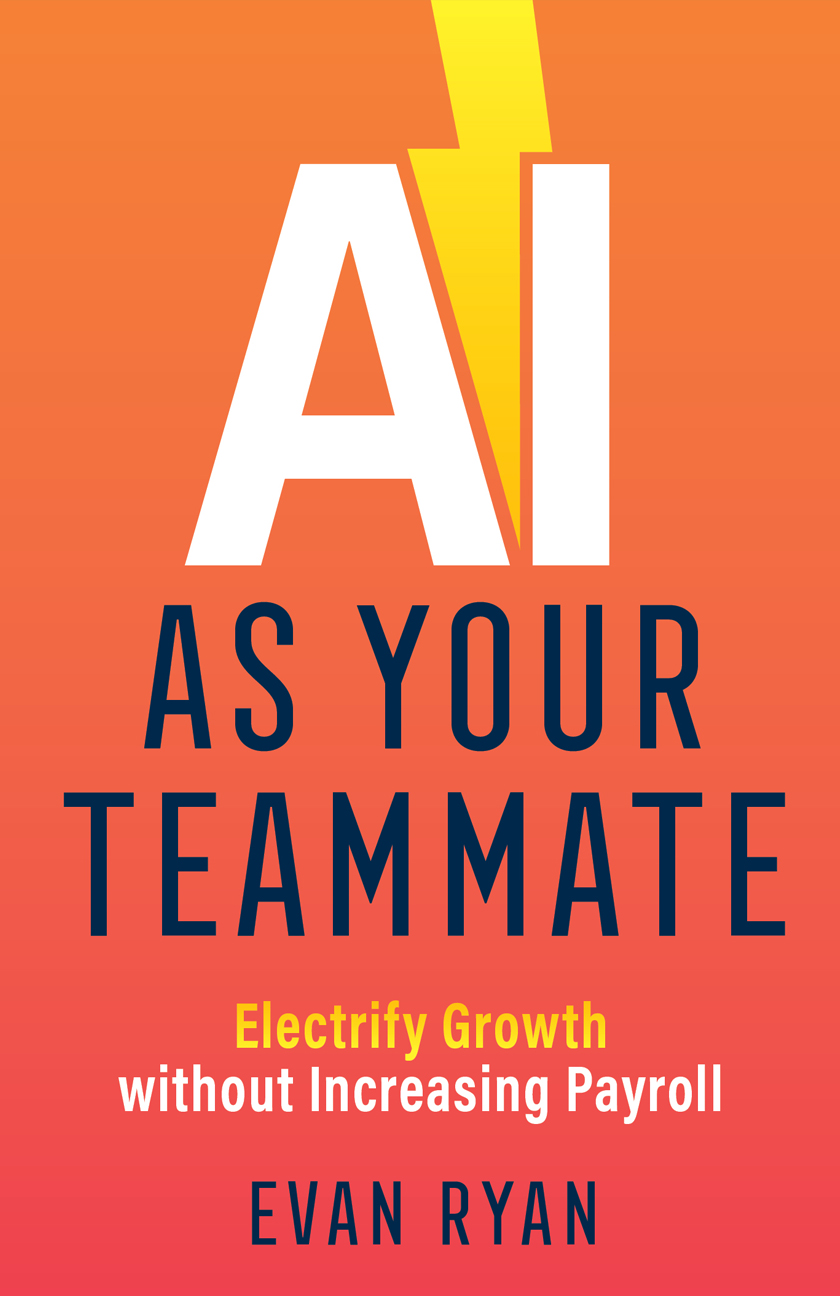
[0:00:31] BB: What if you could transform your business without increasing payroll or you could improve reliability, consistency and profit while reducing employee turnover? Artificial Intelligence (AI) makes all that possible and more. It’s the fastest, easiest way to scale your business. Successful entrepreneurs learn early on that growth isn’t linear. Scaling up means hitting one ceiling after another. All too often, breaking through requires drastic changes in payroll or infrastructure that the company isn’t prepared to float. AI as Your Teammate, written by Evan Ryan is your manual for transforming ceilings into opportunities and outpacing the competition through the power of technology. Learn how to get started quickly and easily following a proven step-by-step process to grow from simple automation through full AI. This is Author Hour. I’m your host Benji Block and today I’m honored to be joined by Evan Ryan. He’s just penned a new book. The book is titled, AI as Your Teammate: Electrify Growth without Increasing Payroll. Evan, we’re so glad to have you here on Author Hour today.
[0:01:42] Evan Ryan: Thank you for having me.
[0:01:43] BB: Absolutely. Evan, for listeners who may be new to your work and unfamiliar with your background, could you tell us a little bit about yourself and what led to the releasing of this book?
[0:01:52] Evan Ryan: Yeah, I have a penchant to not do anything that I really don’t want to do. I only like to have fun and I only like to do things that are fun.
[0:02:02] BB: That’s awesome.
[0:02:04] Evan Ryan: In order to sort of do that, I found AI as a way to automate a lot of tasks that I find boring in my day-to-day. After talking to lots of people, there’s just so much confusion about digital technology, there’s so much confusion about AI, I decided to write a book to really teach entrepreneurs how they can get started with AI and how they can transform their business with it.
[0:02:26] BB: Was writing a book something that sounded interesting to you, or did you also even use automation in the process of getting this book out into the world?
[0:02:35] Evan Ryan: Truthfully, I used automation to get the book written as well.
[0:02:38] BB: That’s great.
[0:02:39] Evan Ryan: I had many Zoom meetings with friends and family members where they would just ask me about my book outline and then we transcribed that using AI and that really formed the first version of the book.
[0:02:52] BB: What made now the right time to write and release this and I guess, who, as well, is your kind of imagined reader, who is the ideal person to pick this up and get something out of it?
[0:03:05] Evan Ryan: You know, I hear a lot that entrepreneurs really want to grow their business 10 times or a hundred times or a thousand times. They have more energy than they’ve ever had before and they’ve gotten to this level of success that they’re at through a lot of hard work, but they can’t possibly imagine the idea of growing a hundred times, while increasing their payroll a hundred times.
[0:03:26] BB: Yeah.
[0:03:27] Evan Ryan: I thought, after the pandemic, once the real headquarters of almost every business became the Cloud. Wow, this should be a really amazing time for us to give every entrepreneur who wants to grow, the tools to be able to do it while increasing their use of automation.
[0:03:44] BB: Awesome. Let’s do this, let’s dive into some of the content of the book and I’m excited to get to chat with you about it but I want to do this first, take me back to what initially got you interested in AI. Was there a moment, was there a spark, what initially put you on to the power of AI?
[0:04:03] Evan Ryan: I was at a conference several years ago and there was a speaker at this conference, his name is Jeremy Howard and Jeremy, at the time, was the number one AI researcher in the world, they actually rank them. He was talking about how they had created an AI algorithm that could detect cancer, I believe it was both heart and lung cancer, better than a team of board-certified doctors.
[0:04:28] BB: Wow.
[0:04:29] Evan Ryan: I thought, “Oh my gosh, that’s absolutely amazing, I wonder what else you could do with AI?” and previously I kind of always thought that AI was sort of a lot like virtual reality, where it’s always about five years away, and we had now in front of us, real use cases to be able to help people with it. From there, really just started diving into, “Well, how could we help other businesses with that, that maybe aren’t trying to detect cancer, but are trying to increase the efficiency in their operations?”
[0:04:59] BB: Yeah, I mean, being honest when I think about AI, I think about IBM’s Watson, right? I think about some future that’s imagined, right? Where AI is going to replace us but it’s always years down the road, it’s almost like apocalyptic or something. I love that you’re – at this conference, you have this moment where you’re like, “Oh my gosh, AI can do incredible things.” What are some other maybe impressive advancements that we should be aware of that we’re seeing in the AI space?
[0:05:30] Evan Ryan: Well, you know, regardless of your feelings of the COVID vaccine, it was developed in three days after the genome was sequenced. A lot of that had to do with AI, which is unbelievable.
[0:05:39] BB: Yup.
[0:05:39] Evan Ryan: Outside of the healthcare space, a company founded by Elon Musk called Open AI created an algorithm called GPT-3. GPT-3 can write. It basically can just write like any human would write. Well now, there are companies that can use AI using this GPT-3 algorithm to write their marketing copy for them. We write our marketing copy for us. Some of the copy that’s on our existing website right now is written by an artificial intelligence algorithm. The actual development of our website was done by an AI algorithm. You can really use it in a lot of different areas of your business, not only for big things like website overhauls and for marketing copy but also for little things like just automating adding subscribers to your email list, after they purchase a product of yours.
[0:06:33] BB: When it comes to business and wanting to see growth, what would you say – is there a difference between AI and automation in your mind?
[0:06:40] Evan Ryan: There’s not. We define AI as data with a task. Right now, humans do a lot of tasks but what if computers could do those tasks for us and certainly, there are like small distinctions here and there, but to an entrepreneur who is looking to grow their business, no, there’s no difference between AI and automation. Ultimately, what you want is you want the job to get done as well or better than a human did, but at a fraction of the cost.
[0:07:06] BB: Exactly. One of the upsides is the leverage that it provides, right? You take time to discuss that in the book, can you explain what we’re talking about when we talk about leverage?
[0:07:16] Evan Ryan: Yeah, imagine you pay an employee $60,000 per year. That’s $30 per hour. Imagine that you have an AI that saves that employee 10 hours per week. Well now, you just saved $300 per week every week. It doesn’t matter if that employee leaves, you still save that 30 hours per week or 10 hours per week. Ultimately then, you also save the training time on all that time. Now, not only did you save 10 hours per week or $300 per week but you also save the training time of new employees. Now, imagine that you have 10 employees that all do that exact same task. You just saved $3,000 per week and you saved a hundred hours per week.
[0:08:04] BB: Yup.
[0:08:05] Evan Ryan: Every time an employee leaves, you don’t have to train the new employee on whatever the task is that the AI was doing. Over time, you can add more skills, you can add more capabilities to the AI so that can save 15 hours per week, 20 hours per week and this is for the rest of eternity, as long as you’re doing the task. Really, what happens is, you pay one time for a computer to teach a computer how to do a task, but you reap the rewards forever.
[0:08:34] BB: You personally, as an entrepreneur looked for leverage, right? You were trying to save – I believe it was 20 hours a week. Talk about some of the tools that you found and implemented in order to do that?
[0:08:46] Evan Ryan: Yeah, there are amazing tools that will allow you to save over 20 hours per week without writing a single line of code. Zapier is one of them where it connects pieces of software together for you to do tasks. You can connect Stripe, your payment processor for example, to your CRM or your email list to QuickBooks to do just little tasks that take place here and there, five minutes here, 10 minutes there. Well, over time, I was able to save upwards of 20 hours per week, right at about the junction where I didn’t have enough money to hire more employees, but I had more clients than I had time. So, it was really helpful to be able to give myself that extra time back, to build that slightly stronger foundation that I had in order to be able to grow the business as I wanted to.
[0:09:37] BB: I also love the idea that you laid out of a leveraged budget for team members. I think that’s such a practical way to say, “Hey, we want to automate what we can, and we want to save time where we can, and we’re willing to put some finances behind that”, right?
[0:09:53] Evan Ryan: Yeah, and you know, it creates a safer environment for your employees who might be worrying that their job gets automated away.
[0:09:59] BB: Yeah.
[0:09:59] Evan Ryan: In fact, I find that incentivizing automation creates a stronger culture around identifying the areas for it. I don’t want my employees doing boring stuff that they don’t want to do, just as much as they don’t want to do boring stuff that they don’t want to do. Why don’t we work together to identify solutions that we can put money behind that makes you infinitely more productive?
[0:10:23] BB: Yeah, it shows that you’re in their corner and I do think it takes away some of that fear that has just somehow been baked in around AI, I think partially just because of lack of knowledge. Okay, let’s say as I’m talking to you even, I’m getting excited about AI. Let’s say there’s business leaders listening, they’re getting excited about AI but they’re going, “Okay, where would I start and how would we find maybe in our company, the tasks we should work to automate?”
[0:10:51] Evan Ryan: Typically, where I start is I ask myself, what’s the highest turnover position in my company. Training is just an absolute nightmare for a lot of companies and it’s expensive and especially in high turnover positions, it’s just happening constantly. What if we could automate a lot of tasks in high turnover positions? I start with, “Well, what’s the highest turnover position we have, and why is it a high turnover?” Then, once we understand why it’s high turnover, create a list of all of the activities that take place. What are the tasks that take place inside of that one tiny little niche? Let’s say for example, you sell residential appliances, and your highest turnover team is your sales team. One of the reasons why is because it’s difficult to train pricing. Well, how could you work with technology experts to create automations around your pricing so that, instead of your sales team needing to schedule meetings with your product team or with your suppliers or your vendors in order to be able to understand how to price a particular appliance, they could just fill out a simple form, the form runs it through an AI algorithm that then provides three different options, most expensive, medium expensive and least expensive options for the client. Ultimately then the client can make the decision on their own and your sales team no longer needs to worry about how to price things. They can just worry about selling things.
[0:12:19] BB: We look for a high turnover positions, you also discuss an activity log as a way of figuring out what we could automate. Could you explain that a little bit as well?
[0:12:29] Evan Ryan: Yeah, so I do an activity log about once a quarter, which is for a week or so I’ll write down everything that I do and how long it takes and did I even like it and ultimately, what I find is I do so many tasks every single week that I have no idea that I’m doing. I just do them mindlessly almost, and the time just sort of flies by, and what I recommend is, I recommend everybody in the company do an activity log. Not so that big brother, big management can come in and audit how everybody spends their time, but so that everybody can work together to find better efficiencies. Maybe the solution isn’t even AI to start, but once you do have the activity log, now you can really understand, “Well, here are the opportunities for us to automate tasks”, because you can use those tools like Zapier to automate the tasks for you and save some of that time that’s spent doing stuff that you don’t even really enjoy doing. Really, it’s as simple as making a list of all the things that you do and sort of ranking them, “Do I like it, do I not like it?” and once you have that, then you can start automating.
[0:13:34] BB: I love the question, “Did I like it?” I just think that would even be a practical way to sell your team on it, right? To get them to have the vision of why we’re doing this and going, “Okay, what are the things that I’m doing that are taking up time that I don’t really like doing that we could do differently, and it would give me more brain power in other areas where I could be more creative.” Maybe walk me through just like a couple of examples, things that on your team is maybe you or other team members have done an activity log that came up and then how you automated them.
[0:14:06] Evan Ryan: Yeah, absolutely. One thing that came up very early on in our activity logs was lots and lots of testing of software. One of the divisions of our business builds software and we were spending just an inordinate amount of time testing software and overtime, we thought about hiring QA developers in order to be able to test the software. We thought about maybe just adding it to the job description of our existing development team, which it was right now, but it wasn’t formally, but we were able to do through the activity log, over time, we noticed we’re testing the same features and functionality over and over again. We were able to find a tool that costs $30 per month that will test all of our software for us automatically. It was absolutely phenomenal, it saved us over $60,000 per year for $30 per month.
[0:14:58] BB: Wow.
[0:14:59] Evan Ryan: That’s pretty good.
[0:15:00] BB: Yeah.
[0:15:00] Evan Ryan: Another tool that we found was scheduling meetings. We spend a ton of time scheduling meetings. You know, those email threads that go back and forth and they’re 10, 15, 20 emails long where you are trying to find a meeting time that works for everybody. Well, there is an AI now that was created by Microsoft and it works for both Microsoft and Google email addresses where you can CC Cortana, and Cortana will automatically find the meeting that works for you, whether that person is inside or outside of your organization.
[0:15:32] BB: Yep.
[0:15:32] Evan Ryan: It’s really, really helpful. It saves me over three hours per week right now and so those are just some simple examples.
[0:15:39] BB: Yeah, getting rid of that email thread is amazing.
[0:15:41] Evan Ryan: Oh my gosh, that email thread is so painful. Nobody has ever woken up in the morning and thought, “Boy, you know what I can do is just email all day about finding meeting times.”
[0:15:49] BB: Exactly. What’s a more complex example?
[0:15:52] Evan Ryan: Definitely using AI to write newspaper articles. We had a client approach us a few years ago asking, “Hey, could you use AI to write articles about high school sports?” so it was a local newsroom and the newsroom had more sporting events in their area than they had reporters, but for local sports, you have to cover high school sports because you’re engaging with the community and the community cares about high school sports.
[0:16:17] BB: Right.
[0:16:18] Evan Ryan: Six weeks later, we were not only able to build an AI that wrote high school sports articles, but we are also able to write twice as many articles on our first night than the newspaper had written and published the entire previous year. Now, that’s turned into a news wire service that serves news outlets all across the country, but that’s a bit more of a complex example than CC-ing Cortana. With that said, the impact has been absolutely unbelievable and the previous year before we had started, they had written five newspaper articles about high school sporting events on the particular night that we were talking about, and the night that we launched, we published 50.
[0:17:00] BB: When you start getting into the writing space, just thinking from a content creator’s perspective, should there be some fear or apprehension in the corner of writers, or how can AI kind of come alongside as a teammate in that writing kind of content creation space?
[0:17:17] Evan Ryan: Personally, I see absolutely no fear for writers. I think there are things that AIs will never be able to do. They’ll never be able to ask the tough questions in communities. They’ll never be able to really harness the essence of certain stories or certain people, but what they really are great at, is they’re great at communicating ideas that have been communicated over and over again. There are only a certain number of ways that a high school football game can go.
[0:17:44] BB: Yep.
[0:17:45] Evan Ryan: For journalists, I think, and for writers overall, it really helps them do what they’re uniquely good at and the AI can take care of the repetitive stuff.
[0:17:55] BB: I think that’s a great way of putting it to just let the repetition be something that’s covered – actually in my fantasy football app, there is definitely AI writing the content there and it’s helpful every week. I get like a breakdown after Monday night football and that content is written by AI.
[0:18:16] Evan Ryan: Right and I don’t know many journalism students who wake up in the morning wanting to write paragraph briefs for fantasy football apps.
[0:18:23] BB: Exactly, yep and it’s a great teammate in that way, and then long form, they can write about a specific player or what they’re going through and all of that in a different format. I love that you’re helping us get rid of some of that fear around some of these things. Okay, so we execute the activity log, we consider our best case, worse case, ROI for each activity. Talk about the next step being solution exploration. Explain what happens in that phase as far as a solution designer and some of what’s involved.
[0:18:57] Evan Ryan: This is a classic ‘begin with the end in mind’ scenario. Really looking into, “Well, what is the impact that we want to have? Do we want this task or this series of tasks to be completely done by an AI, or do we want it to be partially done by an AI? How do we want our new workflow to look? How much time do we want to save? Where do we want to repurpose our talent?” Solution design is really all about understanding what life will be like once the AI exists in your world because ultimately, if you know that, then you can make changes along the way to suit any changes that happen inside of the world. We think solution design is the absolute most important part of building an AI because it really allows you to start preparing for what life will be like when you’ve saved 10 or 15 or 20 or 40 hours per week.
[0:19:51] BB: What and I think as we start to conclude, I think this is where I would love us to kind of camp for the final couple minutes is, when we think about repurposing our team after AI has been implemented, maybe paint a picture of what’s possible when we start to go down this road. What excites you about the potential?
[0:20:10] Evan Ryan: What we found when we’ve worked with businesses is that the teams themselves know exactly where the business should expand. They know exactly how the business can grow. They know what the problems that the clients have are oftentimes better than the leadership does and when AI takes up a large percentage of the day-to-day operations that are happening right now, what happens is the team doesn’t get laid off. There aren’t mass firings that take place. Instead, your existing employees find ways to serve your existing clients better or they find ways to serve new clients better and ultimately, what happens is, your employees get really creative about ways that they can create ever increasing value in the marketplace. Really, the backbone of your business becomes one that’s run by AI and the growth in your business doesn’t take place from the top down, but it takes place from the bottom up because the AI has everything taken care of in your day-to-day, but your employees are the ones that are really expanding their impact, creating bigger value and ultimately, finding more fulfillment inside of your business.
[0:21:21] BB: Wow. Well Evan, thank you so much for taking time to work on this book. The book is called, AI as Your Teammate. Tell us a little bit outside of the book, where can people find you and reach out?
[0:21:32] Evan Ryan: You can find us on teammateai.com and you can find the book on Amazon.
[0:21:37] BB: Well, thank you so much for being on Author Hour today. I know this book is going to be a great resource to entrepreneurs and so many. Thanks for talking about AI with us here on Author Hour today.
[0:21:47] Evan Ryan: Thank you for having me.
[0:21:49] BB: Thanks for joining us for this episode of Author Hour. You can find, AI as Your Teammate: Electrify Growth without Increasing Payroll, on Amazon. A transcript of this episode as well as our previous episodes is available at authorhour.co. For more Author Hour, subscribe to this podcast on your favorite subscription service. Thanks for joining us, we’ll see you next time. Same place, different author.
Want to Write Your Own Book?
Scribe has helped over 2,000 authors turn their expertise into published books.
Schedule a Free Consult