Hazem Mulhim: Episode 837
Read the full transcript
Hazem Mulhim
Hazem Mulhim is an entrepreneur, philanthropist and speaker. A Palestinian whose family hails from Halhul in the West Bank, he was born in Saudi Arabia and grew up in Jordan, Kuwait and England. He studied medical electronics in Bulgaria and business management at INSEAD. In 1984, after working in Orlando, Florida, he founded a high-street computer store in Jordan modeled on Radio Shack. Since then, he has transformed this business, now called Eastnets, into a global software solutions company. Hazem also runs Rewell, a charity supporting women-run entrepreneurial projects in the Jordan valley. Hazem holds dual Jordanian-Belgian citizenship and divides his time between Dubai, Amman and Brussels.
📚 Books by Hazem Mulhim
Transcript
[00:00:01] Hazem Mulhim: Yeah. Actually, when I started back in ’84, that was the evolutionary thing that’s happened in Jordan and our part of the world, in the Middle East. Naturally, this is a way to democratize the awareness or the computer awareness to our store. Thankfully, we could manage to sell thousands of computers, mainly home computers to the Jordanians. But sad enough, in 1990, with the goal for and what took place in our part of the world.
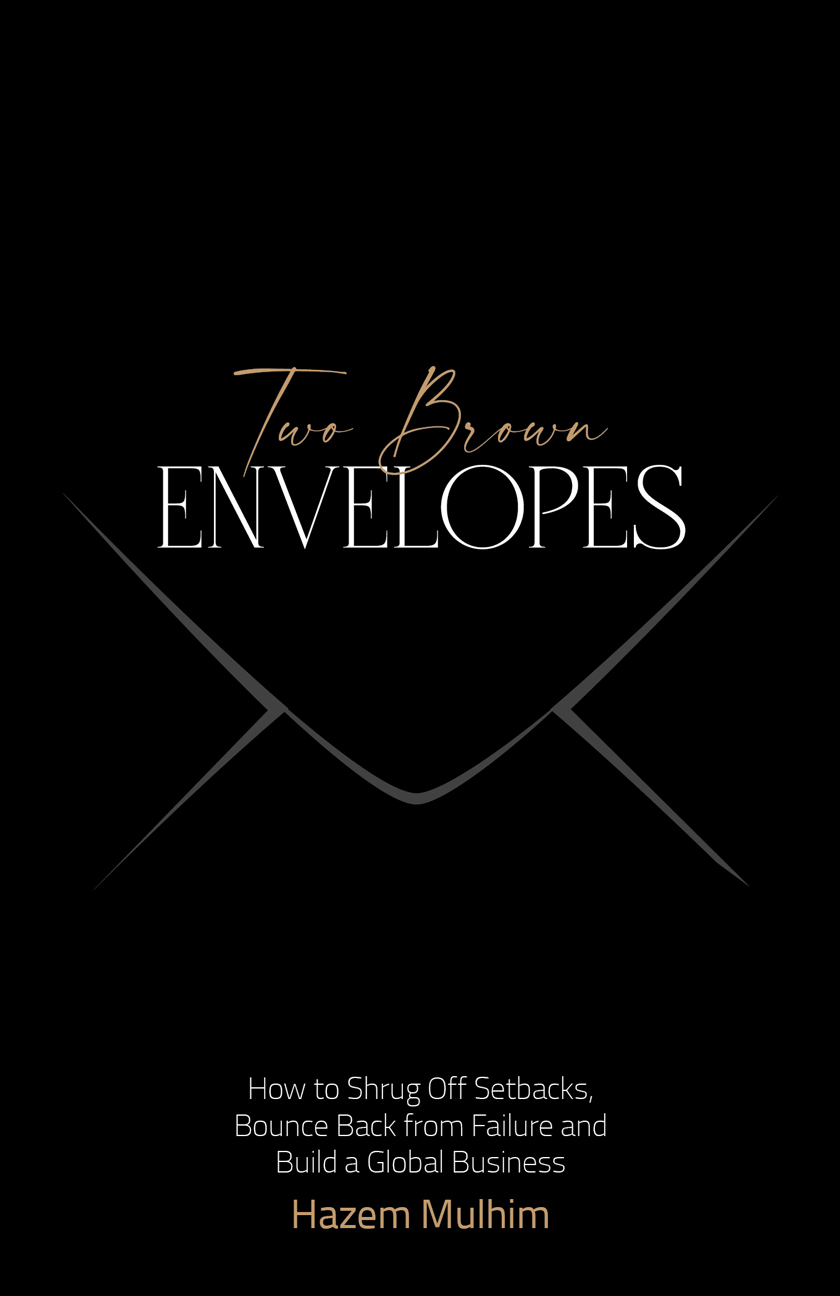
[00:00:35] FG: When Hazem Mulhim was starting out in life, his father presented him with two brown envelopes, one bulging with money. The other flat was some dollar bills. Only one and its contents would be his. After a brief but memorable discussion, his father made the decision that would influence the rest of Hazem’s life. Two Brown Envelopes offer a refreshingly candid account of the ups and downs of building a business in the age of globalization. Hazem started out as a shop owner, opening the first computer store in Jordan in the 1980s. Since then, he has built a global business that provides anti-money laundering and other technology solutions for almost 10% of the world’s banks. Unlike most business memoirs that only recount achievements, Two Brown Envelopes takes you on a rollercoaster journey, revealing the humbling lows of defeat and the highs of winning. Proving that what defines your future is how well you shrug off setbacks and bounce back from failure. This is the Author Hour Podcast and I’m your host, Frank Garza. Today, I’m joined by Hazem Mulhim, author of a brand new book, Two Brown Envelopes: How To Shrug Off Setbacks, Bounce Back From Failure And Build A Global Business. Hazem, welcome to the show.
[00:01:56] Hazem Mulhim: Hi. Thanks for having me.
[00:01:58] FG: Well, I’d love to just start by giving our listeners a little bit more about your background. Can you share a bit about your personal and professional background with us?
[00:02:07] Hazem Mulhim: Yeah, sure. As person, I’m Palestinian origin and like most of the Palestinians have been in the diaspora. I was born in Saudi Arabia. I lived in Jordan, lived in Kuwait, studied both in England and in Bulgaria. Then I worked in the US and Belgium. Currently, I am living and working in Dubai. For professional background, I have studied in the University and graduated in medical electronics. I work as an engineer, and then after that, as a technical engineer, back in the ’80s. In the beginning of the ’80s, I started my business as an entrepreneur in the technology.
[00:02:54] FG: Your new book, Two Brown Envelopes, I know there’s a story behind the title of that. Would you share that story?
[00:03:04] Hazem Mulhim: Sure. My father has sent me back in the ’70s to study in the UK. Two years later, I couldn’t get the grades to enter into university to do my high studies. The purpose that he has sent me there. He called me back where we were living in Kuwait at the time. When I went to meet him at his office, he had two brown envelopes on his desk. One of the envelopes was bulgy and the other one was a thin envelope. He pushed to me the small envelope, small brown envelope, which was rather empty. He told me that this is your choice in life, because the big, bulgy envelope had all the savings that he had put for me for my university. Since I failed and I couldn’t get the grades onto the university, he had given me no choice but to accept the little envelope. Naturally, the little envelope had only $200 at the time. That was the beginning of my life, to struggled with the $200. Since then, that was the fork and the river for me. Since then, I have learned how to live with little means, but to achieve big things accordingly. This is the story of the Two Brown Envelopes that I put as a title for my book.
[00:04:36] FG: That’s a great story. When you got that envelope from your father that day, how did you feel in that moment? Were you angry or did you immediately think, “Okay. This is a good thing and it’s kind of a turning point for me.”
[00:04:51] Hazem Mulhim: That’s supposedly the turning point, but it wasn’t. It wasn’t the happiest, of course. I expected that he will forgive me and he will give me a chance. But no, no, I wasn’t pampered at all. Of course, I was disappointed. Later on in life, I was happy that he treated me this way.
[00:05:15] FG: Right. Choosing this as the title of your book, was it kind of obvious that this is what you were going to go with or did you struggle with coming up with a title?
[00:05:25] Hazem Mulhim: Yeah, I had lots of choices, what to pick for a title. But then, after revising the contents of the story, and some of my friends helped me to revise also the text. They have suggested that Two Brown Envelopes is the right title for such a book. This is why, actually, the whole story is based on two brown envelopes, because it’s actually a fork and a river for me. It’s either. As I said earlier, as if you are pushed to the wall and you have to fight your way forward. With the little means, you have to achieve a lot and this has been all the time my motto. With the little means, you have to achieve. Of course, this helped me to be agile, to have perseverance and to carry on in life, because I have learned a lot from that incident going on forward.
[00:06:28] FG: Yeah. It’s great. I love the title. When I saw it, I immediately wanted to know, okay, what are these two envelopes about? I read that you started out as a shop owner, opening the first computer store in Jordan in the ’80s. Can you talk about why you started that business or how that came to be?
[00:06:49] Hazem Mulhim: Actually 1982, I was offered the job in Orlando, Florida. In that job, we were developing word processors, bilingual word processors, Arabic, English. That time exactly when I was in Orlando, Florida, IBM and Microsoft, they started the Microsoft or the PC revolution and Apple This attracted my attention, because the only way I could have access to computers was to visit these huge stores, like Computer Land at the time or Radio Shack, that there were all over the place. Immediately, I realized that in order to people have access to this kind of new revolution, or at the time was through computer stores. This is where I decided to go back to Jordan in ’84 and to start the first computer store there. Of course, when I started that, this is what I created, a whole access to the computer industry. I have created awareness in Jordan. I was also the first computer store in Jordan. There weren’t any before that.
[00:08:04] FG: That local computer store has transformed into what’s now called EastNets Global Software Solutions Company. That sounds like quite a transformation. Can you share how that transformation happened over the years?
[00:08:20] Hazem Mulhim: Yeah. Actually, when I started back in ’84, that was the evolutionary thing that’s happened in Jordan and our part of the world, in the Middle East. Naturally, this is a way to democratize the awareness or the computer awareness to our store. Thankfully, we could manage to sell thousands of computers, mainly home computers to the Jordanians. But sad enough, in 1990, with the goal for and what took place in our part of the world, we started to transform our business from being just a retailer, or shop owners into added value services. This is where I grew EastNets into several stages. The first was, of course, as I said, the computer store with selling computers. Then after the Gulf War, I started into – a SWIFT business partner in the Middle East, where I put countries in the Middle East on the SWIFT network, creating financial inclusion for these countries. Then after 11th of September, I realized that the world has to combat financial terrorism and this is where we have transformed our business from financial inclusion into creating softwares to combat financial terrorism. This is where today as we speak, as a company, we are one of the leaders in developing compliance software and anti-money laundering software to combat financial crimes. These are the three evolutionary steps that my company has grown from hardware reseller, into a global software company to promote anti-financial crime business.
[00:10:20] FG: In the book description, I’m going to read you a quote here from it and then ask you to comment on it. It says, “Unlike most business memoirs that only recount achievements, Two Brown Envelopes takes you on a roller coaster journey, revealing the humbling loads of defeat and the highs of winning.” Why was it so important for you to write a business memoir that covers the lows, just as much as it covers the highs?
[00:10:49] Hazem Mulhim: It’s a reflection of life and life like everything else, you have your good moments and you have your bad moments. You cannot just talk only about good things in life. You have to show that there are different milestones in everybody’s life in his journey. These milestones that there are the good things and the bad things. Likewise in business, not every business can just talk about beautiful things or about success stories. Businesses also have to talk about the low points, and lessons learned and how can you turn it around into something that can be good. It’s like, when you stumble, you can make it part of the dance, so people can think it is not the end of the world by the day.
[00:11:40] FG: Would you be willing to share an example of a low that you went through and what you learn from it?
[00:11:47] Hazem Mulhim: Okay. The 1990, when we had the Gulf War in the Middle East, my business, I was bankrupt. To be in bankruptcy and to be indebted to banks, this is the lowest thing that anybody can endure. Not everybody can endure to be highly indebted to have bankruptcy and to have responsibilities. Because being an entrepreneur, you are living all the time, and a risk, or at risk. But at the same time, you have great looking at the company, and let’s say, on the glass and half full away. Naturally, I had my moments. I was bankrupt. I was indebted, highly indebted to banks. But of course, I have learned how to endure, and how to be persistent and resilient, so I can get out of this and turn my business around and to continue. This is how I can describe your low point. But of course, like on life, you don’t look back, unless it’s a good view. This is where, even if you’re looking back at these low points that I pass through in life, there are lots of lessons learned and how I could take the positive things and carry on in life.
[00:13:15] FG: Yeah. I thought, as I was looking through your book, you kind of lay all of these low points out and how you recovered from until that narrative really well. I’ll save that for the people that go read themselves. In the last chapter after you kind of tell a good part of your narrative journey to today. The last chapter is titled The Eight Secrets for Bouncing Back From Failure. I wanted to just touch on a few of these. Number one is called, join the dots. Can you talk a little bit about what that means, why it’s important and then how you’ve applied it?
[00:13:55] Hazem Mulhim: Yeah, sure. The book, I started off the description of entrepreneur, or the definition of the word entrepreneur. Actually, it’s a word in French or it comes from French and it has two parts, entre and preneur. This is usually, if you’re going to just translate it, it’s an undertaker. But actually, entrepreneur is not only an undertaker. It’s somebody who creates things out of nothing. Then I can see it, that the word entre, which is between. It’s the bridge actually that you bridge things together. When I’m talking about joining the dots, as an entrepreneur, I managed to look at things, how can things meet and how can things be joined. My first business was connecting people to computers or to computer suppliers. The second business was connecting countries to the SWIFT network, where we created financial inclusion. The third journey in my business was connecting banks to the sources of information so they can combat financial terrorism. This is why all my business was joining the dots, and hence, I just put it as one secret so people can look at it and can apply it to their businesses all the time, how can they connect two things together and can make something out of it?
[00:15:35] FG: Number six, is develop a panoptic view. Can you talk about that one?
[00:15:40] Hazem Mulhim: actually, the panoptic vision is something that originally was for businesses that the manager or the owner of the business, he sits in the middle and he has a view to all the business that is going around, so he has this panoptic vision from left to right. But today in the digital world, and in the virtual world, there is nothing and that is physical, everything is virtual. Thanks to the technology, and thanks to the new applications that they are there. Someone can manage a business globally, from one central point. It is by having all the information to be from [inaudible 00:16:25] information turned into explicit information in these applications. Today, for example, I am sitting in Dubai, but at the same time, I can read all the information that is taking place in my business in New York, and London and Hong Kong, because I have all the information launched in one central place. Thanks to the applications that are available. Yeah. This is where I can read all the information in the dashboards. This is where nowadays, a panoptic vision, it is a digital view to all your businesses. Thanks to the new applications, and many, the cooperative applications that are available in business. This is where I’m applying it, although, it comes from a panoptic vision that is a physical view. Now, it is a virtual view and you can carry on and you can manage everything accordingly.
[00:17:27] FG: Well, Hazem. Writing a book is such a feat, so congratulations on getting that done. Is there anything else about you or the book that you want to make sure our listeners know before we wrap up?
[00:17:39] Hazem Mulhim: Well, I hope that whoever has the chance to read my book, they will enjoy the reading of the book and he will have the takeaways that he would really need to know in his life, so he can make a better offering than I have passed through and I have offered. The most important part of this that now, at this stage of my business, it’s very important to [inaudible 00:18:04] to anybody who succeeds in his business, again, to work on giving back either to his community or to the humanity. Also contributing to the humanity and give back in a philanthropic way also is very important. Like this, we feel that we contribute to the societies that we work with or where we come from,
[00:18:30] FG: Hazem, this has been such a pleasure. I’m excited about the book and what you’re doing. The book is called Two Brown Envelopes. Besides checking out the book, where can people find you?
[00:18:41] Hazem Mulhim: I am on LinkedIn. People can reach me out on LinkedIn and I can write back to anybody who ever wants anything from me.
[00:18:50] FG: Thank you, Hazem.
[00:18:52] Hazem Mulhim: Thank you. That’s been great and hopefully, we get beautiful feedback from everybody.
[00:18:58] FG: Thanks for joining us for this episode of Author Hour, you can find Two Brown Envelopes on Amazon. A transcript of this episode, as well as all of our previous episodes is available at authohour.co. For more Author Hour, subscribe to this podcast on your favorite subscription service. Thank you for joining us. We’ll see you next time same place, different author.
Want to Write Your Own Book?
Scribe has helped over 2,000 authors turn their expertise into published books.
Schedule a Free Consult