Marty Groover: Episode 844
Read the full transcript
Marty Groover
Marty Groover is a partner in the Industry 4.0 practice of C5MI, a firm that optimizes operational execution through the creation of live supply chains. Marty leads functional and technical teams to solve manufacturing challenges by merging people, process, and technology. With more than two decades as a surface warfare officer in the U.S. Navy, Marty is a recognized thought leader in the SAP partner base and is known for his extensive insight in production planning, lean manufacturing, and ERP systems.
📚 Books by Marty Groover
Transcript
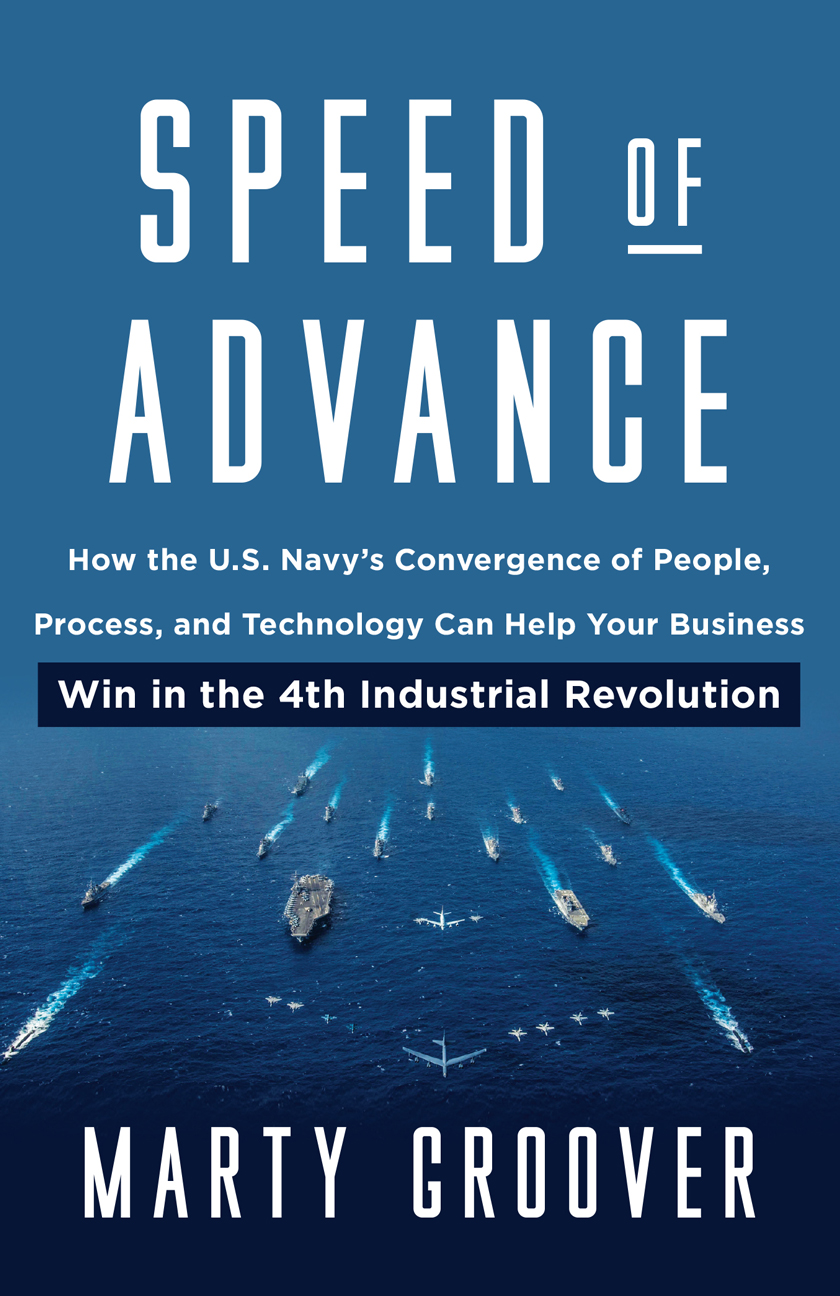
[0:00:42] DA: In the Navy, nothing is left to chance. Every strategy is tested, every resource utilized with minimal excess and remarkable efficiency. The streamline conversions of people, process and technology is the pinnacle of productivity and its benefits resonate far beyond military endeavors. As a surface warfare officer, Marty Groover spent more than two decades leading an intricate operational symphony of communications, processes, computer systems and weapons programs. Now, on his new book, Speed of Advance, Marty shares what he experienced in the Navy firsthand, how to harness the power of technology to drive untouchable results. By eliminating damaging silos and increasing skillsets, the book teaches you how to create an enhanced synchronized system between technology and the people who use it. A process that will lead you into the fourth industrial revolution: Lean, impactful and intersected. Hey Listeners, my name is Drew Applebaum and I’m excited to be here today with, Marty Groover, author of Speed of Advance: How the US Navy’s convergence of people, process and technology can help your business win in the fourth industrial revolution. Marty, thank you for joining, welcome to The Author Hour Podcast.
[0:02:06] Marty Groover: Hey Drew, thanks for having me, glad to be here.
[0:02:09] DA: Kick us off. Marty, can you give us a brief rundown of your professional background?
[0:02:13] Marty Groover: Sure. I joined the Navy as an E1, enlisted technician and work my way up to officer. I was in the Navy for 21 years and that’s where I really learned a lot about what we’re going to talk about in the book, seeing how the Navy converge people, process and technology. At the time, I’m not sure I fully appreciated that as much as I did after I had my career at Caterpillar so I retired in 2007, went to work for Caterpillar as manufacturing engineer and got into a whole new type of warfare on the shop floor trying to win every day, making our production goals and I learned a lot about how people use technology to drive processes there and I really started thinking of the connection between the Navy and what I was seeing on the shop floor. I was a manufacturing engineer, it was a factory manager so I got a lot of experience of having to deliver a full PNL so to speak, financial results in manufacturing and realized that we need these tools, we really need to converge people, processes and technology much better than we were doing. Fast-forward, I deployed SAP at the factory as a factory manager and did really well, better than a lot of factories and they decided, I complained about it enough, they put me in charge of all global deployment of SAP for the corporation and I really started driving that convergence, making it better, making – helping people understand how to use the technology to get better results. Did some industry 4.0 projects at Caterpillar and light house projects at some factories, I really liked doing that, really saw the value of what I learned in the military and how to convert it. About four years ago, we started this company called C5MI, which stands for Command, Control, Communications, Collaboration and Computers. The MI stands for Management Insights, we really understood that if we can converge all these data together, we could have much better business outcomes. That’s what I’ve been doing for the last 30 years or so and it’s been exciting but it’s gotten me to this point and because of what I’ve seen in the military, I kind of label myself as Marty McFly. I’ve seen the future, I’ve seen how it can work and now I’m trying to help companies do better at that and really leverage this technology that’s out there for the next industrial revolution.
[0:04:27] DA: Now, you bring this up in the book that the idea of writing this book has been in your head for a really, really long time. Why was now the time to share the stories in the book? Did you have an "aha moment" did you have a moment of inspiration, did enough people tell you, you just need to write this down already?
[0:04:46] Marty Groover: Yeah, I think it’s a combination of all those but ideally, I’m one of these people that don’t just go out and talk about something that I haven’t done and in my mind, I knew what I wanted to do but I needed to prove that theory out. I was actually able to go out and do many projects with customers and while I was at Caterpillar, that prove those things that I felt were important that are in the book that with people, how to manage them, how to bring them together with the technology and get them to have clarity in what you’re trying to do, so I felt like I got at that moment, I think what’s the author that does the book – Jordan. I can’t remember his name but 10,000 hours was it, it could be in there. You really got to do something for a while, I think, to be good at it and then to be able to articulate about it in the book. Tim Grover, how could I forget Tim Grover, jeez. Yeah.
[0:05:32] DA: When you actually sat down to start writing the book, I think a lot of people have the idea of the book in their head and they start to maybe outline the book but as you were writing, things often change. Did you have any major breakthroughs, learnings, maybe some pivots along your writing journey?
[0:05:50] Marty Groover: I did, I had this idea for a while. Like I said, many years ago, I started framing out wireframe of what the chapters would be and how they would be but again, as I learned and as I did things, those ideas morphed and I was able to better articulate what some of the things I learned in the Navy, how the really converted over and were very applicable to this. Yeah, I changed along the way and then even writing it, you start having those "aha moments” “Well, I need to add this” or “This is really important” and you know, when you really sit down and think about it, it’s one thing talking about it, it’s another doing it. I think the other thing that helped me is, I’m a big believer in vision boards, Annie Ferzella got me on that. I had this on my vision board for about three years before I wrote it. Finally I said, Jacko Willing, somebody that motivated me because I met him in his early career, we got him to come to cat and talk and he was a prior enlisted officer too in the navy so I said, yeah, I got to write this book, that’s the other part that motivated me.
[0:06:48] DA: Now, you mentioned your background, Navy background, moving into the manufacturing world. Who is this book actually for, is this only for folks who are in the manufacturing world or can all businesses have takeaways form the book?
[0:07:02] Marty Groover: I think when we look at where we’re going with technology, any business can really look at this. I try to keep it non-techy, the way I wrote it, even my mom was reading it. She goes, “You did a really good job of explaining things in here.” She goes, “I thought it was going to be so technical like you are all the time” and I said, “Well, I tried to make it where it made sense” because a lot of companies are struggling to understand how they’re going to leverage the technology, what benefits are they going to gain but you can’t leverage this technology, you cannot move forward with it, it’s not like buying Microsoft Word software or something like that, that’s not the way this works. You really have to understand how your processes are going to be digitally codified. It doesn’t matter whether it’s auto insurance or whether it’s a grocery store, whatever, there’s all sorts of things that are starting to happen that can replace and not replace but make people more productive and that’s really the goal for this. How do we use the cheap technologies in the cloud, the IOT, all these buzzwords that you hear, to make people more productive? That’s one way we’re going to overcome some of the inflationary impacts that we’re feeling these days is going to be to gain efficiency and quite honestly, it’s very interesting to see that in the last six years or so, if you go on The Bureau of Labor statistics, the multifactor productivity, which measures a productivity gains since the last industrial revolution, which started in the early 80s, right? They call it the Silicon or the PC industrial revolution. We actually, around 2010, 11, somewhere in there, we had too much data, we had too much technology. The productivity started going down because everybody had too much but it wasn’t working for them. Where we steadily got two to 3% gains in productivity every year during the last industrial revolution, we started losing those gains because we had too much data and too much technology that wasn’t properly converged and it was actually making people be less productive.
[0:08:58] DA: Let’s dig into the book itself and I think we have to start by building the foundation. Is the name of the book, I don’t think everybody’s that familiar with the term though? Can you define speed of advance for us?
[0:09:14] Marty Groover: This was one I knew that had to be the name of the book, it’s the name of my own LLC, even I have a boat that’s the name of it because it was so important. As a Naval officer in the bridge, one of the most important measurements you have during your watch when you’re on there for four or five hours, whatever it is that day is that speed of advance. Every time the captain comes on the bridge, he ask what SOA is. Speed of advance is your actual achievement along your intended track, so if I’m supposed to be at a certain point by a certain amount of time, I need to track my actual movements along that navigation line so that I get to that point where I’m supposed to be but there’s a catch. Ships burn fuel at sea and the most important thing is to be efficient. What you try to do is maintain an SOA, speed of advance under 15 knots or somewhere in there so that that’s the most efficient speed the ship can run at. Then, you would work up and down your SOA, you might have to stop and do engineering drills or replenish at sea and things like that. The whole Navy, everything on a ship is measured, actual versus planned because there’s no 7/11s out at sea. You don’t just pull up and get gas or pull up and get food, you have to manage that so when you really think about the power of measuring something and understanding how to be efficient with it, I love the speed of advance process and it’s an actual measurement. It’s in outage navigation book, rules, you know, speed of advance comes right out of there.
[0:10:44] DA: Can you talk about your transition from Navy to civilian life? You could tell that the Navy culture is sort of ingrained in you to bring it out but how easy was that transition from leaving the Navy and then becoming successful in business?
[0:10:59] Marty Groover: Well, I was super excited when I retired from the Navy because I was going to go to work for another world-class organization Caterpillar and in my mind, I always thought, wow, it’s going to be so amazing to go work for Fortune 100 company and their technology’s going to be so advanced, this is going to be great because we always thought, things in the military were behind but it was kind of eye-opening experience when I got there and I’m back to green. Because I use SOP in the Navy and my last role there, and I really learned to love it and the power of that system. Then I was back to an old IBM greenscreen system and I was like, wow. The transition was a little challenging but not too hard but all the things that I learned in the military like for instance, you become an officer in a ship, as soon as you get to that new ship, you’ve got a certain amount of time to qualify on all your watches and become a useful body, right? Of that crew. Those things paid off well for me at Caterpillar because as soon as I got in the factory, I just wanted to learn everything. I was like a sponge learning everything about the tractors that I was building, the assembly processes, about manufacturing and people were amazed like, “How long have you worked here? How can you learn all the stuff that fast?” I think my transition went well, I really enjoyed learning all the new things and transferring those skills I spent 212 years cultivating over to a very successful civilian career.
[0:12:20] DA: Now, you actually say that most businesses can’t measure their speed of advance. Why is that?
[0:12:27] Marty Groover: It’s very challenging to think about how to measure your actual versus planned on things and I would say, I say that generically, there’s pockets of brilliance everywhere but what I’ve seen mostly is, it’s like, here’s where the day started and here’s where the day ended and this is how much I made and I hope like heck I covered it and you can’t tell. For instance, my assistant – I’ll use a non-manufacturing business. She owned the ice cream shop. Now, she couldn’t tell during the day, other than, “Oh, I had to replace a bunch of cones, I’ve got a bunch of empty scoop containers” right? Out in the back, that’s like a tell during the day if I had a good day or not and then how long the lines where there’s certain indicators but there wasn’t something constantly clicking there saying, “All right, our plan today was to sell this much and you’re right now, you’re at this, neither ahead or behind and what are you going to do if you’re behind?” That’s really what speed of advance is about, how to know where you're actually at and then what are you going to do about it?
[0:13:22] DA: What are the foundational pieces of the Speed of Advance methodology that businesses should really focus on in order to optimize?
[0:13:31] Marty Groover: You should really understand what your business plan is. How do you intend, I mean, if you’re in a business even non-profits, I mean you’re there, you have some sort of business measurement or plan that you have to hit and even when I worked for I was on the board of United Way, we created metrics for non-profits to show us, “Okay, we’re going to give you this money, what are you going to get for it?” The hardest part is saying, “What should I be able to produce and how much of it?” and that type of effort and then actually measuring, “Did I do it or not?” because you hire people, you spend energy and you do things and you either leak money or you make money and a lot of times people make money in spite of what they do and they could make a lot more or that business model is never going to make money because they just can’t measure it or it’s a loser. There’s a lot of businesses that go in and out of business because they can’t measure it that way they just throw it all kind of big lump in the middle and hope like [cack 0:14:26.5] it works out.
[0:14:27] DA: Now, talking about working lean and you know, working lean in general, just nothing extra, not abusing any resources. In terms of workers, does working lean just lead to more burnout in anyway or is there some sort of perfect balance between headcount and efficiency?
[0:14:46] Marty Groover: Yeah, that’s a great question because that is a key thing. Just running your resources so hard that their burnout is not efficient, you can do it for short sprints, the Navy does it, the military does it for short sprints but things are very planned out on how many hours I should take to do something and things like that. What you want to try to do is build enough lean processes in there and what does lean really mean? The first thing that people think of when they think of lean is like, “Oh here, they’re going to come do a lean study and lay people off.” What they should really do is free people’s time up to be more productive, so get rid of the non-value add work or things that if it doesn’t provide value to your system, automate it, right? That’s the beauty of the next industrial revolution, figure out what to automate to make people more productive and let them spend their times figuring out how to continually improve the process to make it easier on them and also improve your productivity, like I used to tell the people in my factory, “What’s the best day at work?” and they said, “The best day at work is when everything works the way it’s supposed to.” I said, “Exactly, that’s lean.” You figure out what impacts you have to your speed of advance that day and you fix them and then now, you’ve created a constant improvement sort of methodology, so there’s a lot of opportunity coming towards us with this new technology.
[0:16:02] DA: Speaking of new technology, you mentioned the fourth industrial revolution before and I love that you call it industry 4.0 in the book. You say we’re in it or it’s coming really soon, so what exactly does that mean?
[0:16:15] Marty Groover: What it means is there’s a lot of systems out there today that are disjointed, so it’s interesting. I think our recent supply chain issues are a great example of what’s going to benefit from industry 4.0. I think the full visibility, full interconnectivity of the whole world is coming together because of cloud computing and what it’s going to drive, the improvements in our life and efficiencies are going to be amazing. You’re going to have a lot different supply chains than we do now and they’re going to have these monolithic manufacturing facilities that are huge and try to leverage scale to win. There is going to be a lot of nimble little distributing manufacturing systems that are connected to, for instance, Amazon is really driving where it’s going to go and how we’re going to change because they’re already ahead on the IOT, they’ve been ahead for a while. The way they’re setting up their distribution networks will drive big changes in our supply chains and what will it mean for people? People are starting to get used to it and because COVID has accelerated it that hey, two hours I can get something more, you know, two days or one day and I can buy things. Well, that’s all IOT technology that Amazon is using to drive but there is a lot in their background and supply chains but eventually their hubs because they want to go all electric, they’re going to have electric delivery vehicles that are going to be made by Rivian Automotive and everything that they do will be within so many miles of those vehicles being charged and I think what you’re going to see is a lot of change in automation. Factories are going to be automated and people are going to be operators-technicians that run them but you’re going to make your order, it’s going to go straight from your order point right to that machine that’s going to instantly make your product and ask within a matter of moments. There won’t be these huge supply chains anymore. It’s going to really change, which is good for our planet in a way because you know, hundreds and thousands and millions of ships a year in the ocean can’t be good for us either. It’s going to be a lot of change, it’s not going to be bad either. I mean, people are not going to lose their jobs, they are just going to be different jobs.
[0:18:21] DA: Just to clarify, this can be in any industry, right? Not just in the manufacturing world.
[0:18:26] Marty Groover: Right, in any industry. It is going to be connected. I think with blockchain, you are going to see instant, you are not going to see waving for checks to clear. You know, banking is going to be different, just everything you do will be totally connected online. You’re not going to have to, you know, it’s just a different world. It’s all interconnected.
[0:18:43] DA: In terms of bringing in the most up to date technology, what should a business or business owner be looking for exactly? How are they choosing the right tech stack for their business and what is implementing look like?
[0:18:57] Marty Groover: Yeah. See, this is a great question and this is where people struggle with that strategy because people get really enamored with technology so they start finding their darling so they do best and breed and really what you want to do is what capability do you have. One of the things I did is I put the mission of the Navy in there and I can just track everything in the mission of the Navy and what they’re doing. You want to have capabilities first, what are the capabilities I need to keep my company going, to have a competitive advantage? Then based of the capabilities, what technology do you need? Because if you just buy a bunch of hammers and look for nails, the results, there is just a lot of that out there that’s why we’re not as productive right now because there’s been a lot of technology bought without understanding what capability they truly need. Here’s the software, that’s all you need. It’s like snake oil salesman, right? You can do all this with it but if you don’t understand what capabilities you truly need to drive improvements in your business, then you are probably going to buy the wrong technology and there’s so much out there and it really is confusing for companies but if you understand what your core systems need to be and you build a system, not buy an application and you think about that, how does it all going to work as a system, you will be much better off. That’s what the military did, I mean, the Aegis weapon system on Aegis cruisers took all these siloed systems from the 60s and put it into one system where it all works together, feeds off from each other, provides data back and forth, that’s why it’s so powerful because it’s a fully integrated system.
[0:20:32] DA: What is the risk of a company for just being behind the curve on all of this?
[0:20:38] Marty Groover: You know, regardless of what you think of Jeffrey Immelt, he had a vision when he was at GE and he was trying to create a lot of IOT stuff and he said in one of his speeches, I think it was a TED Talk or someplace like that, he said, “If CEOs aren’t thinking about it now, in a few years they won’t have that opportunity to think about it” and once you get in a tail chase and this is what’s going to happen, I know I’m in this industry, there’s not a lot of talent right now. We’re growing some, we’re using some but what’s going to happen is once the people that get ahead and all you have to do is look at Amazon and what’s they’ve done to the retail world, once they’ve got far off ahead nobody can catch them. Walmart just hung on barely but if you look at how many retail companies have gone bankrupt in the last two years, that’s a trail of tears for sure but Amazon drove it because they got so far ahead and there’s nothing that anybody could do. They could spend the money or get the technology to keep up, so they just had to succumb to it and that’s going to happen in other realms too, in other industries going forward here. There is going to be companies that are going to be pioneers and they are going to go forward and win with this technology and once they get far enough ahead, you know, you just can’t catch them and even if you wanted to, there won’t be enough resources that can do it to get ahead and be there. There’s going to be an interesting journey in the next 10 to 15 years.
[0:22:05] DA: What impact do you hope the book will have on a reader and are there any immediate steps that you hope they’ll take after reading the book?
[0:22:16] Marty Groover: Again, my whole goal is to have people think about systems and process and technology, how to codify them digitally and I think if anything you take from the book, it’s not a how-to guide. If you buy this book and you think, “Oh, I’m just going to be able to wallop and win in the next and really win” it is not a paint-by-numbers thing but what it is, is a strategy to think about people and how you use them and how you win with them on your team because you are still going to need people. There’s a lot of misnomers out there that all the industrial evolution is out, there is going to be all these people without jobs and all that. That’s not the case, it’s not going to happen that way but what it will do is change how they’re skilled, what they do, how you’ll need them. There’ll be more integral to what you’re doing because they’re going to have to know a lot more about how your systems work and then the investment you’ll have to make and then will be hire. Also, you have to think, “How do I codify all these processes?” because if you go out a lot of places, processes aren’t really written down that well or codified and a lot of training programs have been cut and so when you look at how people get OJT in training like that, you can’t rely on people to pass down that information and a lot of companies, we’re seeing it now in manufacturing, it’s hard to find people in manufacturing and you got to train them. There’s not places to go learn how to do machining and things like that that need to be done, so we’re starting to feel it now. You’re going to have to figure out how to take your processes in your business regardless of what they are and use technology to codify those processes and automate them and take the man out of the loop where you don’t need them and then really, how do you maintain all those things and bring them together with the machines into one system. It’s not like there’s a separate system for those machine, so just if you figured out and thought about that with your business, you’d be better off before you just jump into buying a bunch of technology. That’s the goal of it is really think about that strategy and the foundation that you need and the culture that you need to build to do it.
[0:24:18] DA: Now besides the book, you offer more resources on your website. Can you talk about one, just let us know what the name of the website is and then let us know what readers and listeners can expect to find on your site?
[0:24:31] Marty Groover: I have a couple. I have my www.speedofadvance.com, which is for me to help just do consulting with companies based off what’s in this book but then also my larger company, C5MI is www.c5mi.com, that’s where you can go look at digital manufacturing, real-time location tracking, asset management, things like that, supply chain and manufacturing. Our company really understands how to integrate people, converge people, process and technology with the newest technologies that are out there. That’s really the difference too with new companies trying to figure out how to do it. We’ve been on the forefront of it and it’s not as easy as just go and install software like you would for maybe an Office 365. You really have to understand the processes that you are trying to codify digitally and then which tool to use for that, so the art almost but you really have to understand those processes.
[0:25:29] DA: Well Marty, we just touched on the surface of the book here. There is so much more in the book and on your website. I want to say that just writing a book to help business owners keep their eye on success ensuring it for the future is no small feat, so congratulations on getting this book published.
[0:25:44] Marty Groover: Yeah, I appreciate it. It’s been a heck of a journey and a learning experience but I’ll be excited to have people read it and see what they think about it and it’s kind of a scary thing but it is going to be interesting.
[0:25:53] DA: Marty, this has been a pleasure and I’m excited for people to check out the book. Everyone, the book is called, Speed of Advance, and you could find it on Amazon. Marty, besides checking out the book, besides finding your websites, is there anywhere else where people can connect with you?
[0:26:08] Marty Groover: Yes, on LinkedIn, I have a good profile on LinkedIn. A lot of people on there that connect with me that way.
[0:26:13] DA: Great. Well Marty, thank you so much for giving us some of your time today and best of luck with your new book.
[0:26:18] Marty Groover: Thank you.
[0:26:20] DA: Thanks for joining us for this episode of Author Hour. You can get Marty Groover’s new book, Speed of Advance, on Amazon. Also, you can also find a transcript of this episode and all of our other episodes on our website at authorhour.co. For more Author Hour, subscribe to this podcast on your favorite subscription service. Thank you for joining us, we’ll see you next time. Same place, different author.
Want to Write Your Own Book?
Scribe has helped over 2,000 authors turn their expertise into published books.
Schedule a Free Consult