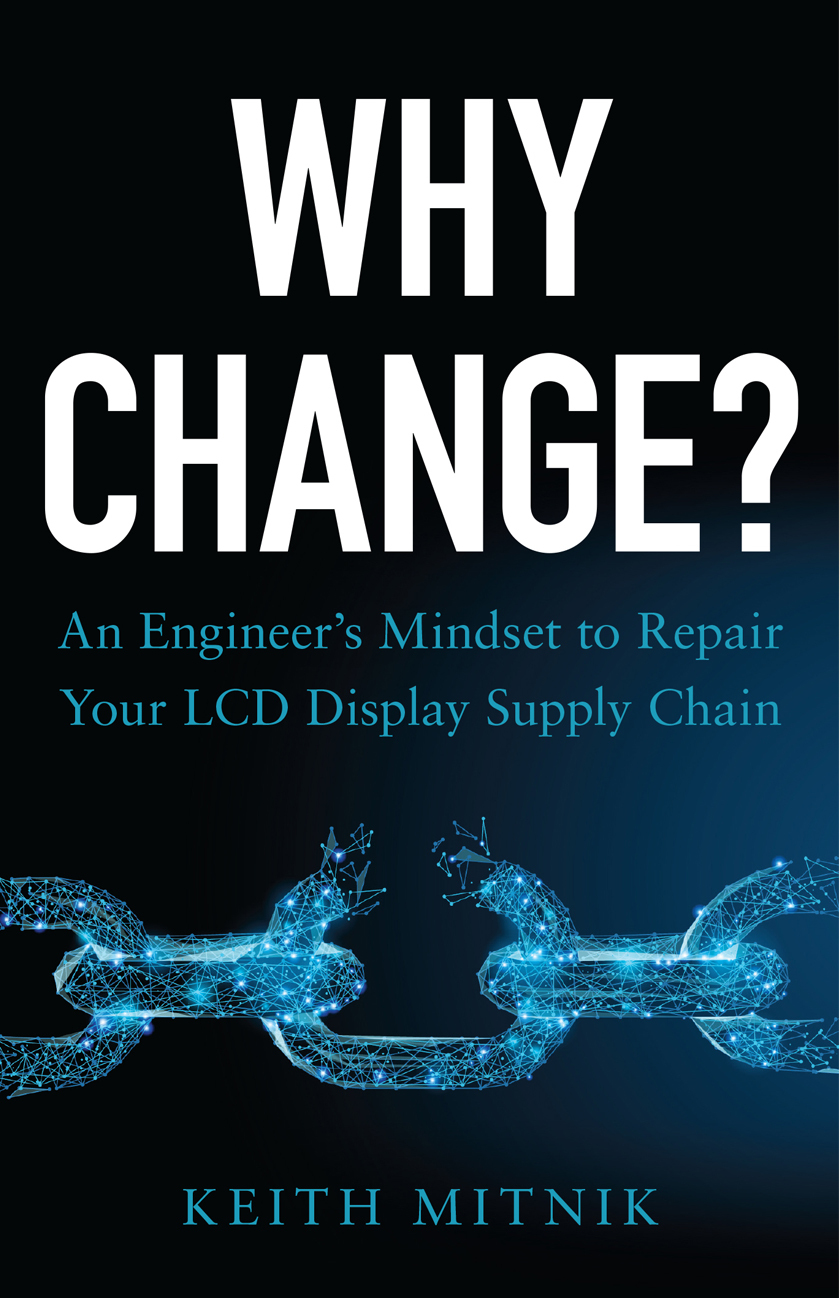
Keith Mitnik: Why Change?: An Engineer's Mindset to Repair Your LCD Display Supply Chain
Read the full transcript
Keith Mitnik
Keith Mitnik is the co-founder of Phoenix Display, an LCD display company. With a background in mechanical engineering and a master’s degree in business, Keith has applied his expertise to identify the patterns and solve problems in supply chain management for the past two decades. He’s developed a clear framework for customers to resolve issues with current suppliers, determine when—and how—to change suppliers, manage the transitional process, and ensure sustainable success.
📚 Books by Keith Mitnik
Transcript
[0:00:47] DA: Change is hard, especially in relationships. When cracks start forming at the foundation, you’re at a crossroads that demands decisions. What can you do to salvage the current relationship? When is it worth the risk to change, and how many conflicts in your current system are too many? The answers to these questions are particularly important when it comes to the buyer-supplier relationship. Making progress and achieving goals means knowing these answers and navigating each relationship with efficiency, clarity and confidence. To achieve this, you need a roadmap, one that will help you avoid any pitfalls in the future. In his new book, Why Change, engineer and electronic component manufacturer, Keith Mitnik, introduces his systematic approach for making smart decisions and supply chain management. In the book, he shares the five problems that derail supply chains, teaching you how to create your own customized solution to these issues through an in-depth understanding of each of them. From declining quality to rising cost, you’ll feel confident processing problems, recognizing risks and repairing supplier relationships or even building new ones. The book will be your new guide if you're looking for a systematic approach to make the right supply chain decisions and get results in your organization needs. Hey, listeners. My name is Drew Applebaum and I’m excited to be here today with, Keith Mitnik, author of Why Change?: An Engineer’s Mindset to Repair Your LCD Display Supply Chain. Keith, thank you for joining, welcome to The Author Hour Podcast.
[0:02:36] Keith Mitnik: Thanks, Drew.
[0:02:37] DA: Now, I think we could figure it out by the title of the book but if you will and help us kick this off, could you give us a brief rundown of your professional background?
[0:02:46] Keith Mitnik: Sure, yeah. As it says in the title, you know, my background is engineering. Shortly after getting my degree in engineering, I also got an MBA so that I could be more involved in business decisions but still, you know, my background is in the technical engineering and really, what engineering is, is solving problems. That led me to really the last 20 years where all we’re doing is solving problems and it became very repetitive and kept solving the same problems, repetitive sort of a negative word but it’s a pattern. We just wanted to really write this book to help existing or potential clients as well as, I mean, I can get into this later, we turned down about 90 percent of our – of potential clients because they’re not a great fit but we also want to help them. This is a really easy way of doing it, it is really helping people form a great relationship. I do talk about this in a book. I have gone through a divorce and that was about four or five years ago and it’s really fascinating how many commonalities there are between those personal relationships and these professional relationships. It's a lot of matching your needs, discovering your needs and then matching them with either your supplier or the other person. As in dating, you know, I’m not for everyone. In this world of supply chain, not every supplier is for every customer. The business I came from prior to starting Phoenix Display almost 20 years ago. Running a very similar business, you know, my background is engineering so I did design work, I managed an engineering teams and then I was running a business unit and we had 370 customers. That was really too many. I’m saying it’s too many because each customer had a unique product. It was way too much to manage. It was too much to manage because you couldn’t really make each customer important. Similar to – you know, I know you probably seen when you’re on hold and the recording says, this call is – your call is very important to us. Well, it’s not, you know? That’s why you’re on hold. They haven’t put in the infrastructure to put enough people and that was the same thing when we had 340 customers.
[0:05:10] DA: Right.
[0:05:11] Keith Mitnik: With this company, we took the 80/20 rule and we’re all familiar with that and really, how it applies to this is that 20 percent of your customers, most likely makes up 80 percent of your profit and now, I’ve actually heard the statistic around businesses to be 20 percent of your customer’s makeup 200 percent of your profit. That’s a staggering statistic because what it does mean is you’re losing money on the 80 percent, that you’re supporting so many customers that aren’t your ideal fit, that your infrastructure is so different than it really should be and you're not making these customers a priority. So once we started our company and we were able to really focus on just the 20, it really created great relationships. Just like you would see when you see a couple together and you’re like, “Wow, those two are great together” and when you are, it’s easy and that’s what we found and so, that’s what I am reiterating how to do this because this is what we did in business. For 20 years, it’s really try to figure out, like I said, we do turn down 90 percent we try to help them go somewhere else because they’re not a great fit. In doing that, we learned really what a great fit is. That’s what I’m trying to articulate here in this book and I don’t think that it’s really been done before in this way. How to treat this like a true relationship starting with your needs and then finding this great fit because what’s really cool is when you have this great fit and let’s just say it’s our company, which we make LCD displays, super specific, this book has actually more generic because this applies to everybody but in displays, when it’s a great fit, the relationship gets easy.
[0:06:52] DA: Right.
[0:06:52] Keith Mitnik: And that’s good for us. We’re turning down customers, when it makes it our business better and is better for our customers. If you're take one step even further like, how cool would it be if your customer had that great relationship with every single supplier and they had all the relationships were great for every component, then they could really focus on their business, focus on developing new products, focus on customer support, marketing, all the great things that make their company even more profitable. If our clients are more profitable, we’re more profitable. So, it’s this kind of win/win vision of what things could be like.
[0:07:33] DA: Now, you’ve been in the business for such a long time. When you really started writing the book and you dug into the topics a little bit more, did you have any major breakthroughs or learnings along the way? Maybe just by re-evaluating or by digging deeper into some of the subjects?
[0:07:51] Keith Mitnik: That’s a great question. You know, one of the biggest things and this was prior to the book, was really trying to talk about why did somebody call me? I’m always thinking about that, “Why are you on the phone?” I want to figure that out right away and figure out, are you a good fit, are you not, but it all comes to you know, what brought you here? Well, it’s probably 70 percent of our customers are coming because they have a problem, they already have a supplier but they have a problem and one of the big breakthroughs were, there’s only five problems, that’s it. There’s not a lot. There’s five and that really helped us to isolate exactly what’s going on and throughout the book when we go through what these five problems are and talk about how to fix each one. I think the breakthrough in the book for me because I love the five-problem concept, we call it five problems and there’s one opportunity, the opportunity is a client has a brand-new product so that they’re not having a problem, they have an opportunity but what the breakthrough for me was, customers don’t know how to really vet a new display supplier. It's confusing. I can say this because in the last 20 some odd years, they’ve always struggled with it and they default to a QA engineer going out and visiting the factory and doing a formal audit. This is more about relationships finding the right factory in which to do that formal audit. That formal audit is important but that’s not step one, that’s at the end. The breakthrough was, explaining these five problems and let’s just say, my go to book, I talk about all five but one of them is obsolescence so, your product went obsolete. Now, you got to find another one, that’s a problem. Your whole assembly line is shut down, that’s a big deal, it’s a problem, you come to me or any suppliers and say, “Hey, can you help me fix this and how do you do this?” That, I knew. Okay, that’s what we do but to vet a supplier, the recipe to vetting a supplier is to also address the other four problems. Well, the other four problems weren’t a problem. Okay, they weren’t but let’s make sure they don’t become a problem. Let’s not jump from one problem to another and that was how you vet a supplier, is by addressing all five problems. You start with the one you have, obsolescence. Again, we’re using that for an example. How can you help me through this, what is the solution? Great, got it, now, let’s talk about the other four problems and make sure that your partner, supplier has a solution for those four so we’re not running into just another set of issues.
[0:10:35] DA: Would you mind actually listing out the rest of those major problems that you focus on and maybe dig deeper into another one?
[0:10:43] Keith Mitnik: Sure. It’s really simple. I mentioned obsolescence, easy to understand. I’m going to jump to the last problem, which is cost. That’s number five on the list, it’s still a problem. I find this one fascinating because cost is always so important to everybody and cost is the first thing we talk about but it’s not the biggest problem. I think right now, we’re in this global, it’s a chip pandemic, it’s hard to get IC’s, it’s hard to get anything right now. I have seen so many situations that I’m going through right now where a customer will pay double to get their parts right now. So while cost is very important and you want to have – I call, throughout the book, the most efficient cost, you don’t want the cheapest because you don’t want to push cost somewhere else, save money in the display, pay for it in failures, you know, and the net result is you losing money. You want the most efficient cost. Another way for efficiency to look is maybe you add content to the display, it’s another printed circuit board onto it. Well, that makes a display more expensive but it saves you system level to build a material cost so again, getting back to the most efficient cost but, let’s go back to the example, the chip pandemic. We’re talking about cost and now you’re willing to pay double to get the parts today. That runs into our second most important problem, which is delivery. You’re building a product, okay? And maybe your company builds one product, it’s some sort of speaker phone or something. The company is building this product and you need to make $30,000 a month, it’s obviously very important and now you don’t get displays and we tell you, “We’re not sure what’s going on and we’re working on it, we’ll let you know.” Your whole assembly line stops. You know, all the people working on the floor aren’t doing anything, you lose all the efficiency but most importantly, you’re losing sales, your customers are probably going somewhere else, you're losing your reputation and yeah, so it’s – so delivery is very important and then we have quality. Now, you know your supplier is delivering the part, they are delivering it on time but you are having issues. Quality shows up typically in two ways, we call it an out of box failure, you build your product and doesn’t seem to work right. I mean, it is not working per the specification, so you have to send it back. It disturbs the assembly line and then the worst one is what we call field failures. So the product made it through your final testing but something was wrong, wasn’t robust enough, didn’t make it through it’s expected lifetime at the end customer. Now, you have a return from the field, far more expensive, far more expensive to get it back in the hands of the manufacturer again and also you have reputation damage there. So far, we’ve talked about obsolescence, delivery, quality and cost. The fifth one in there is what we call performance. So that’s when your component and this applies to everything not just displays but this is when your component isn’t getting the job done for what the market wants. Okay, that’s different than quality. So quality is where you define what the product is supposed to do and a product isn’t doing it anymore. Performance is to give you an example, it could just be brightness. Brightness is simple enough to understand, the product doesn’t work very well outdoors, it’s just not bright enough and the customers just don’t love it. So you know, you maybe talk to your supplier can they improve it and they really can’t. It could be a speaker and you only have enough room to put in this little speaker and it can’t perform. It just isn’t making the type of sound or maybe it is reproducing music not in the right way. You are just not getting the performance to capture the market share that you’re looking for as a manufacturer of an end product. So to summarize, we’re dealing with now in order obsolescence, delivery, quality, performance and cost and if you’re already building a product with a component, you’re coming with one of these five problems.
[0:14:52] DA: Now, no one is perfect. No vendor is perfect, no complete supply chain system is perfect so if and when things do go wrong, when is it the appropriate time to scale back and switch vendors?
[0:15:10] Keith Mitnik: That’s a great question and yeah, that’s another thing we wrote about because you know again in relationships, times get tough. You know things happen and in personal relationships that doesn’t mean you jump ship and you move to another one. You would be doing that every month, so that’s an appropriate question and what is the easiest thing to do? It’s to resolve the relationship you’re in. We actually spent time there because early on as a company, you’re aggressive, you’re eager and somebody comes to you and you want to sell them. What we learned that that’s not great if they’re already in a good spot but they just have a glitch. If you are with the right supplier, I am going to figure out through these five problems and then I am going to tell you I can’t solve your problems. You’re already with the right supplier, you are just having an issue right now. So the first thing you’ll do with your current supplier is run through these five problems. Run through their obsolescence mitigation plan, what are they doing for you? Are they looking forward? Do they have a way to deal with it when it comes up or are they just handing you a notification saying, “Hey, the product is done, end your product now and stop producing your…” whatever it is or do they have a plan to work you into the next closest thing? Delivery. How are they helping you? Your delivery to the customer is important so therefore your supplier’s delivery to you needs to be that important. So what are they doing to get this thing taken care of and there is all kinds of things to do, from component level stocking, sub-component level stocking, there’s all kinds of different expedite methods and you know, what are they doing and delivery is a great one to talk about. But your question was because I am sure a lot of people are struggling right now because supply chain is challenging with everything that’s happened with COVID. So you might be saying, “Hey, my lead time just went out from eight weeks to 56 weeks” that is not uncommon right now. So you could come to me and say, “Hey, is your lead time any better?” It’s like well, you have a specialty I see in here and that I see is pushed out. So I would say no, we are on the same boat. Your supplier is doing a good job, you know it is not any better. The grass isn’t any greener on the other side basically.
[0:17:35] DA: Now, what are the risks with vendor warehouse logistics change and what are those right questions to ask when you are vetting one of these new suppliers?
[0:17:46] Keith Mitnik: It is really going through the five problems. I mean it is that simple and even prior to that, so I will back up a little bit, it’s who are you so we can do, you know, go back to analogies with relationships. Okay, are you a college kid and are you going to get in a relationship with somebody in a different level of life than you right now? Maybe they have two kids in college. You know there is just so that analogy bringing them back to displays, you know, what size factory are you running and what are your typical customers? What is your industry? So you want to look at really as a supplier, who are they currently supplying? Who is their core competency? Is it aerospace? Is it automotive? Is it consumer? Is it industrial? Is it medical? They’re all different and what volume levels are they good at supporting. You don’t want to meet with supplier and their minimum order quantity is a 100,000 when you are doing a thousand pieces a year. It is not a good fit. So just like these relationship issues, you want to start with that, who are you and who are they and are you guys similar? So is it the right product. Again, you mentioned we’re niched. Our company is niche, we are LCD displays. So that’s niche into itself, sure. We’re also small format LCD displays, even more niched, small format to us means like 15 inches and below and even more, we’re mid-volume. You know, so we’re mid-volume, small format LCD displays, that’s our market. We do best in that market and we stay in that market. So when Apple comes to us on the next design for their phone, we let them know that we’re not the right fit. That’s kind of the way of vetting. At first the 10,000 foot level of this relationship and then you dig deeper and you dig deeper through the five problems. Let us solve those five problems today so that they don’t become a problem later, which makes you change suppliers.
[0:19:54] DA: Right and when you finally – you know, let’s switch gears. I think we have been looking for problems, right? But when you find yourself in a good place, what are some ways you could take your vendor partnerships to the next level?
[0:20:06] Keith Mitnik: That’s a great question. Again, I always ask this question, there is two things I like to do. One is to just tell me your wish list. Forget about all the constraints you have ever heard, just tell me what you would love to see because if I don’t get that without filters, I’ll never have it. You know, if they have in their mind is like, “You know, we’d really like a longer connector but everybody told us no so we’re not even going to bring it up.” You know, it’s like, “What? Tell me about anything going on” and one thing I love doing and this got cut off during COVID because we weren’t traveling as much is visiting our customer’s manufacturing floor and watching them build with these displays and talking to the operators. We learned so much and just things that will make their jobs easier. So any opportunity because if you’ve got an existing component and you are changing anyway, it’s easy for us to adjust. You know, our job is to make it drop in 100 percent compatible replacement but to tack on an improvement usually costs nothing. We’re already doing the work, let us throw in an improvement like lengthening a connector so it’s a lot easier. It saves time, improves the quality because maybe they are getting damaged, finding that. The other thing we like to do is look for opportunities to integrate components. You know, we have a few examples we talked about in the book where customers were just buying standard off the shelf products and then creating sort of an intermediary interface that could connect to the display, from the display to their main board and additional parts costs additional money. It is a whole other component to manage which costs overhead money. It is also an area you know, every single component is a point of failure. So the less components you have, the more robust your system is and it made it cheaper. So looking for opportunities to integrate things a little better and making it more efficient and the last thing we like to do is really, displays are tough to talk about in terms of specification and performance. We use backlight brightness and we use terms like NITS, what does that mean? Well, it’s a unit of measure of brightness. It is hard to understand and then we use contrast ratio, which we are more familiar with but again, what does that mean? What is 600 to one, what is a 1,000 to one? If we’re monochrome, what are 15 to one? Is that the right number? Instead of pinning down our customers to numbers, we use words and say, “Hey, what are you doing with this? Who is using it? How are they using it and let’s talk about the end user? Then we’ll take it upon ourselves to turn that into the appropriate specs. So we try to take the onus off the customer for being a display expert and we do that and we turn the words, the usage into a specification that’s going to work for your end customer.
[0:22:53] DA: Well Keith, you know we just touched on the surface of the book here and there is so much more inside of it but I just want to say thank you for sharing your expertise and putting it all on paper is no small feat. So congratulations on having your book published.
[0:23:09] Keith Mitnik: Thanks Drew.
[0:23:10] DA: I do have one question left, it is the hot seat question.
[0:23:14] Keith Mitnik: I’m ready.
[0:23:15] DA: If readers could takeaway only one thing from the book, what would you want it to be?
[0:23:20] Keith Mitnik: I would say to challenge your supply chain, to challenge your partners and have the mental mindset that things could possibly could be better. A lot of times you don’t ask, you don’t put in the effort and I would say put in a little bit of the effort to make sure you are in the right relationship because it really does make things easier when you are in the right relationship and I would say 90 percent of the time, we wait too long to make a change.
[0:23:56] DA: Well Keith, this has been a pleasure and I am excited for people to check out the book. Everyone, the book is called, Why Change?, and you could find it on Amazon. Keith besides checking out the book, where can people connect with you?
[0:24:09] Keith Mitnik: We have basically LinkedIn, I’m Keith Mitnik. You can reach out to me directly there, as well as, keith.mitnik@phoenixdisplay.com.
[0:24:20] DA: Well, Keith, thank you so much for joining us today and best of luck with your new book.
[0:24:24] Keith Mitnik: Thank you so much, Drew.
[0:24:25] DA: Thanks for joining us for this episode of Author Hour. You can get Keith Mitnik’s new book, Why Change?, on Amazon. Also, you can also find a transcript of this episode and all of our other episodes on our website at authorhour.co. For more Author Hour, subscribe to this podcast on your favorite subscription service. Thank you for joining us, we’ll see you next time. Same place, different author.
Want to Write Your Own Book?
Scribe has helped over 2,000 authors turn their expertise into published books.
Schedule a Free Consult