Mike Carpenter: Everything You've Never Tried
Read the full transcript📚 Books by Mike Carpenter
Transcript
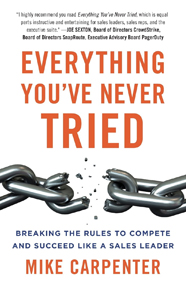
[0:00:27] Charlie Hoehn: You’re listening to Author Hour, enlightening conversations about books with the authors who wrote them. I’m Charlie Hoehn. Today’s episode is with Mike Carpenter, author of Everything You’ve Never Tried. Every talented sales rep wants to take their career to the next level. But if you’re only focused on meeting quotas and expanding your territory then Mike believes you’re doing it all wrong. Mike is the President of Global Sales and Field Operations at CrowdStrike. In this episode, he shares the best practices that will advance your sales career. Whether you’re a part of a corporation or a startup, this episode will propel you to star sales rep in your company. Now, here is our conversation with Mike Carpenter.
[0:01:32] Mike Carpenter: I mean, I’ve just come off of a strong year and had some great results on a turnaround of a business. My manager approached me and wanted to have a discussion. He started talking about the fact that he didn’t feel like I was going to be successful. It really became a discussion as I dug into it about style. He had felt that instead of saying, “Yah,” I should say, “Yes, sir.” He went through a lot of comparisons that were really based on the background of IBM management. That just wasn’t me. At that time, I didn’t have the long list of experience with a mentor telling me that I could be an individual, or that I could do something that’s clearly different than the way that people typically see leadership, and I could pave my own way. I spent a lot of time trying to get comfortable with who I was and trying to fine-tune and build the confidence internally to just continue down that path. Unfortunately, I was able to find the confidence to continue down paving my own way to do things a bit differently, in ways that I can relate more the employees I was managing, the way I could relate more and get involved so that I could get a heartbeat on the pulse of the business and understand how making decisions versus just making decisions based on how a book told me to do it. I think in that part, it brought me to the later years when I was wanting to write a book that I really wanted to come back and help solve some of those issues with stories, and give people an idea that you can be different and you don’t have to act like everybody else. If you find your inner confidence and you’re doing the right things and you’re tuning and trying to improve yourself that you should continue down that path. Hopefully, that value comes through with the readers.
[0:03:27] Charlie Hoehn: That’s great. You basically made this book. You wrote this book to help aspiring, or current sales people embody who they are, embody their self rather than trying to be the button up, tied up IBM sales person. Is that fair to say?
[0:03:47] Mike Carpenter: Yeah, absolutely.
[0:03:50] Charlie Hoehn: Could you give an example, a quick example, of what a typical sales person look like back then and what you were actually doing? I want to just paint the picture for the listener. Was this a radical difference of who you are versus everybody else, or not?
[0:04:09] Mike Carpenter: Yeah. I think I had, like everything in life, it’s about a lot of the variables about timing, about the given opportunity you have in front of you and how you deal with it. At this time, I was a sales leader, but I was very young. I was probably the youngest in the business and a lot closer to the age, even younger than the people I was managing. What I had recognized is that if I couldn’t get in and lead from the front, I wasn’t going to be able to get people to follow me. The typical relationship between a sales rep and their manager was teacher-student. Through my experience in life, I hated that relationship. I didn’t like it when I was in school and I certainly didn’t want to live with it when I was in the workplace.
[0:04:51] Charlie Hoehn: Why did you hate it?
[0:04:53] Mike Carpenter: I just never liked people telling me what to do and just saying that this is the reason you have to do it, because it’s always been done this way. I wanted to be able to express myself. I wanted to be part of the solution. Not just be the person complaining about the problem. In the sales place years ago, it was reps work for managers. The managers were the teacher and the reps were the students and they were just told what to do and they complain about it. They were never on the same side, and I felt like it was very rare that you saw managers and reps take down their guard and build a real relationship and be able to solve problems together. To me, that’s how I work best and I knew that from the leadership I had and from my managers, that that was the best way to deal with me. I just took that and as they say, treat others as you want to be treated, that’s what I did. I built great relationships and I got them involved in solving my broader management problems that gave them access to new experiences and challenging situations. They were able to understand what I was dealing with, the politics dealing with trying to get things approved, dealing with being non-standard. They appreciated that when we work towards a common goal. That was something that was so important through my career of building those relationships and changing the way people interacted with their leadership.
[0:06:23] Charlie Hoehn: Let’s say a sales person is listening to this right now and they are like, “Oh, man. I have contentious relationship with my manager. It’s not going well.” How did you get buy-in of your manager to change the way that you did things?
[0:06:37] Mike Carpenter: That’s a great question. I would tell you that a couple different answers. I remember a story when I had this manager who had just a massive case of ADD. I couldn’t start a conversation with him when I needed a problem approved, or a solution changed, or something. I couldn’t finish it. It used to drive me crazy. Every conversation went left and then went right, then went up and went down. By the time I was done, I never got anything accomplished and never got it done. Then he’d ask me a question, then he’d call my reps and ask them the same question and then I’d call the inside rep and ask them the same question. It never felt like we were able to have an interaction that was productive. In situations like that I would go for a run and I would say over and over “I love this person, I love this person, I love this person.” So that when I came back from that run, I could call them back up and have a productive conversation without that just inner anger that was driving me crazy, because I needed to be productive. I would do things that did work in that, what I’d share with them is you got to get to a good place so you can have the discussion without the frustration and without the frown showing through. When you have that discussion you got to say, “Listen, can I have a difficult discussion with you? I’ve always felt like you’ve been transparent with me. Can I give that back? Can we have a discussion that you don’t interrupt me for five minutes and I can tell you how I feel? Then you can tell me how we can work to this together?” I did that and it would work – there is no silver bullet. It worked for two weeks and we’d be back to the same problem. Eventually, you have to work through. Those leaders I do believe that there is a self-selection and they’ll be selected out. There is a time to value that you have to look at, that time to value is different than typically expect in technology. Well, when it’s personal time to value, it’s how long am I willing to wait until I’m in a place that I feel good about what I’m doing? In my opinion in my career, sometimes I’ve waited too long. I’d advise people to realize the impact that that stress has. When you find people, when you get into a career and leaders attach themselves to producers and producers attach themselves to leaders. I think you find those people and you just try to stick with them. It’s rare when you find that great relationship, but it’s something everybody deserves and I think that’s something you should continue on for.
[0:09:07] Charlie Hoehn: Agreed 100%. Now before we get into the specific content chapters in your book, I want to ask for a sales person who’s skeptical right now and they’re like, “Look, all these ideas are great, but all I care about is the bottom line, how many sales am I making? What was the change in your actual outcome when you started implementing the ideas you’re talking about?”
[0:09:35] Mike Carpenter: I think the changes were slow. It’s not something that you go out and you do and you get like immediate response the next day. I think it’s a platform change in how you’re going to deal with people and how you want to be managed and how – if you’re a leader how you should manage other people. I think the stories can put you in a position that give you the opportunity to think about that, to learn from experience versus process and be able to take your own judgment inside of it. One of the things that I got feedback on when I was working on the book was the stories were really entertaining and people were having trouble understanding, “Well, what should I have done? What is the right answer?” At the end of the book, we summarized it and give you a little bit more of that. The book isn’t to give you the answer. The book is to let you make a judgment on how you’d handle it, and to give you a little bit about what I did and how I handled it and the outcome of that. But everybody has their own style. They have their own pixy dust sprinkle on it. The book isn’t meant to be black and white. The book is meant to merge that relation between teacher and student. It put you in a place where you can solve your own problems.
[0:10:52] Charlie Hoehn: I love it. Let’s play a game with this book, with your book, which I’ve never played before but it’s going to be fun. Since your book is titled Everything You’ve Never Tried, I figured it would be appropriate to do it with you. Here is the game. I’m going to read a chapter title to you. I’m going to read a few of them and you tell me when you want to stop and focus on that chapter and tell an entertaining story from that section of the book. We’ll read off a few chapters, you say stop, explain what it means and then tell an entertaining story from that chapter. Makes sense?
[0:11:30] Mike Carpenter: Yeah, makes sense.
[0:11:31] Charlie Hoehn: All right. Well start from the top. I’ll read down, you tell me when to stop. Chapter one, The Road Less Traveled. Chapter two, Stop Doing it Wrong. Chapter Three, Planning for Success. Chapter four, Stop Covering Your Ass.
[0:11:50] Mike Carpenter: Stop.
[0:11:52] Charlie Hoehn: Okay.
[0:11:54] Mike Carpenter: That was one of my favorite ones, not only because I had to swear in it, which my kids keep reminding me. I have a 12-year-old.
[0:12:01] Charlie Hoehn: How old are your kids?
[0:12:02] Mike Carpenter: Nine and 12.
[0:12:04] Charlie Hoehn: There you go.
[0:12:05] Mike Carpenter: They keep reminding me that dad you swore in your title. It’s important to get the point across, right? I’ll tell you there is a lot of good stories and you see it every day in the workplace. I mean, I’ve seen it from when I started in Corporate America at 25 until, I think I’m almost 43 now and lose track of it as I get older. The point of it is that it’s everywhere. It’s embedded into cultures and it’s the opposite of what should be happening. When I was going through the business, I was always looking for the holes. I didn’t necessarily know how to solve them, but I wanted to identify areas that were perceived issues. Then I would expose it to my peers, to my leaders asking advice, “How would you deal with this?” The outcome was I got a lot of different solutions that would come back. I’d sit down with the team. I’d expose it to them and say, “I think we have an issue here. Why is everybody – why can we sell a lot of product A into this territory and we don’t sell any of it into – of product A into territory three? We sell a lot of C.” I’d go through and think about these things and try to figure out how can I get every one of those pistons hitting at the same time? I’d expose that to my managers. We’d come in and I’d say, “I think we have a problem. I think maybe it’s training. Maybe it’s an issue with the geography, maybe it’s the approach, maybe it’s the rep, maybe it’s something – maybe there is a bug that came out in the product and we aren’t aware of the impact on the customers.” There was always something I was trying to solve and my peers through the business would never do that. They’d always blame it on something else. It was always a problem with engineering, a problem with the product. They never came and held themselves and held themselves accountable to solving the problem and looking beyond and looking inward and saying “There’s a problem with me. There’s a problem with something that we’re not doing.” I think that is one of the most poisonous parts of a culture is two sides of it. One is a CYA culture, because CYA people are typically not just blaming everybody else for the problems, but taking credit for anything that’s good. That is a dangerous, dangerous combination. The reality of what should be happening is about altruism and promoting the good things that are happening in your business, holding yourself accountable more for the problems, trying to solve those problems and not look at them as a work, but look at them as an opportunity. To me, being able to spell that out and make those shifts and call up those leaders for poisoning the culture to adjust how they do things to change the way that they’re impacting the business and then recognize that it’s super important.
[0:14:52] Charlie Hoehn: Agreed. CYA is everywhere. It’s embedded in a lot of cultures.
[0:14:59] Mike Carpenter: Absolutely.
[0:15:01] Charlie Hoehn: Let’s continue down the line. This is fun. Chapter five, Bring in the Boss.
[0:15:08] Mike Carpenter: Stop.
[0:15:08] Charlie Hoehn: Chapter six. Oh, okay. Bring in the boss.
[0:15:11] Mike Carpenter: That’s definitely an important one. I think it gets – when I started out selling, everybody always talked about trying to get pair up executives. Bring your boss in on a deal. Don’t lose a deal by yourself. More fingerprints on the gun, right? It was always a different way to describe bringing your boss. At the beginning of my career, I never did it. I didn’t do it, because I didn’t have a lot of confidence in some of the bosses. I had confidence, maybe they were great operationally, maybe they were great at politics, but it was rare when I came across a high-level executive that was amazing in front of customers. I’m sure there is a lot of them out there. It just wasn’t the experience I had had. I didn’t bring them in and I knew I could sell and I knew I was great in front of customers. I take it on myself and try to pair myself up with that level. I realized along the way, I lost some big deals for doing that. It’s something that I try to explain with being able to relate more to my team and let them know that I’m not just saying this because it’s a cliché that you’ve heard it your entire career. I’m telling you right now I’ve done it. I have experienced what happens when you don’t do that and you lose a deal. I know that I’ve leveraged the opportunity to bring in your boss and I still do it today. I always look to bring in my boss. I look to bring in my peers, I bring in the CFO, I bring in the COO. I’ll do anything that I can to get to the right people and create connections. Sometimes I’m not the right person. Sometimes my personality isn’t the right match. Sometimes they want somebody with a different title and you have to really get to understand who your customer is, who the decision makers are, who the influencers are, and bring people in from the business that can pair off and make an impact. I recently as of last week lost a major deal. I was going through the postpartum on the deal of saying, “What happened?” Postmortem on the deal and say, “What happened?” The feedback that I would’ve given to the manager which I did, which was we got out sold. You didn’t bring in the right level of people and pair off. We won the technical side, we had great relationship with a couple of the influencers, you never got the executive stack. When you do that, you’re creating massive exposures. I can’t tell reps enough is that if you bring me out to a call, I’d still go on today. I’d go in and do one hour of call. It’s a lead gen calls, so you’re cold calling into a customer, and I listen. At the end of the call, I give feedback and give 30-minute session feedback to the team on things that I thought worked really well and things that I thought they should try to tune. Never ever in a session like that would I criticize somebody. Never ever would I tell them that they did something wrong. Never ever would I try to implement a correction on them. This is a process, selling is a process, and people need to be comfortable and the bosses need to make themselves available and be comfortable not judge people, right? The reason they don’t get brought in is somebody is afraid of being judged. They’re afraid of making a mistake. They’re afraid of presenting in front of their boss and getting nervous. They’re afraid of something. If you create a wider platform for them and make it so that you’re not judging them, there’s no moving up or moving down, you don’t do – you’re not going to get fired because the meeting went bad, or because it got canceled on the way there, because the customer yelled at you. We’ve all sold if you’re – in sales leadership, the one thing that’s unique about our roles is that we all started at the ground. We all know that calls get canceled and there are bad calls, there are good calls, there is good days, there is bad days. It’s tough to deliver a pitch in front of a big audience. It’s our job as leaders to make that an easier process for them to adopt, to make ourselves available and to go in and execute for them, to get your team comfortable taking you out, because as a rep you need it. You need to be able to do it, but I think there is a role in leadership and how we need to adjust to make sure that that it’s comfortable for them to do it.
[0:19:23] Charlie Hoehn: Author Hour is sponsored by Book in a Box. For anyone who has a great idea for a book but doesn’t have the time or patience to sit down and type it out, Book in a Box has created a new way to help you painlessly publish your book. Instead of sitting at a computer and typing for a year, hoping everything works out, Book in a Box takes you through a structured interview process that gets your ideas out of your head and into a book in just a few months. To learn more, head over to bookinabox.com and fill out the form at the bottom of the page. Don’t let another year go by where you put off writing your book. Mike, is this book also for leaders? Because it makes it seem a little bit like it’s primarily for the sales people, but I mean this is such a partnership that you’d want both sides buying in.
[0:20:22] Mike Carpenter: Yeah, the line is very blurry. I would say that it’s geared towards leaders; people that want growth for the business. Like you said and I was mentioning it earlier is that I believe sales reps are leaders too in the business. They need to hold management accountable to adjust and to change. That I’d recommend that they go and get their leadership to buy the book and to read it, because they don’t want to be part of those negative stories. They want to be part of the positive ones. I’m sure somebody else will write a book and they want to be the good story. Yes, it’s for both sides of it, but I would say it gears more towards adjusting the platform on leadership than giving you a sales process to follow that’s going to help you close a deal. There are nuggets in there that you can extract, but a big portion of it is changed in the methodology of how to sell and getting comfortable with being an individual and being different.
[0:21:18] Charlie Hoehn: Got it. All right, let’s go again. Chapter six, More than Success. Chapter seven, Manager Material. Chapter eight, Be Bully Proof and Bold.
[0:21:35] Mike Carpenter: Stop. As you can see I like the bold ones, right? Be bully proof and bold. I’ll tell you whether it’s in I think everyday life, or whether it’s in the workplace, you were going to come across a number of people that are just going to try to bully you into decisions. They’re going to try to bully you with the direction that you change, they’re going to want everything done the way that they would do it, they’re going to try to change your opinions and change who you are. I think you need to celebrate and have the inner confidence to you are individual, we are all unique snowflakes. You need to figure out what you are great at, like what are you naturally talented in that impacts your job and you need to put all of your energy into that. You need to stop worrying about the things that you’re not good at. You need to be aware of where your blind spots are and you need to cover them. When I say that –
[0:22:41] Charlie Hoehn: Okay. It’s easier said than done, right for various reasons. Can you give me an example of something that you are not so strong at, you are not so great at, that you worried about for a long time, or spend a lot of energy on?
[0:22:57] Mike Carpenter: Yeah. Naturally, I have a really difficult time creating structure and pairing things. I have ADD and dysgraphia, which creates – in the work day, in the workplace the way that it impacts me, is I have a hard time organizing my schedule and keeping things structured, but I actually thrive off of the structure. Then the other way it impacts me is I have trouble pairing things. The best way to tell you is if you threw 30 things in the table and told me to create an order around them into like groups, I would sit there for hours trying to figure out how to do it. For me, that does impact as a leader your ability to do the manage side of things, where you’re trying to help people create structure. What I did is rather than trying to go – turn myself into somebody that was organizationally elite, or somebody that had the ability to create a plan for people, I enlisted that support through hiring an EA, or the people I hired onto the team, the sales reps I brought in, I made sure I had a set of them that actually had that as one of their core talents, so that they could help me manage a team in that process. As an individual rep, it’s really tough to go find that support. It’s not like you can go hire an EA. As you move up in the business and move in the leadership, it’s a lot easier to do, but that skillset is also necessary as a sales rep. You have to really figure out what those are. You can’t let your blind spots come up and bite you. Your faults, so you need to be aware of your faults, but you need to spend all that time in where you’re naturally talented, right? I mean, if you’re – there are some people that are just really good at dribbling a basketball. They may not be good at swinging a bat. You have to know what you’re good at and just continuously fine-tune that. For me, that’s been one of the – probably the core strengths throughout my career is being really self-aware. I also did 360s through the career, 260s and 360s. What those are is 360s a full pair of view of people above you, people that you manage, people that are pairs, friends that are outside the business. They do an anonymous study, you can sign up for this. There’s a lot of different groups that do this externally and they give anonymous feedback. Then you can come in and learn how you’re perceived and where your talents are. Then you can get development plans and coaching. I signed up this on my own. It wasn’t companies that paid for. I’d sign up a coaching to when you’re on and when you’re off. The one you’re on was to learn and the one you’re off was to implement. Try to identify yourself. A 260 is just a one-on-one review. There is tests out there that you can take and figure out what your strengths are and what your weaknesses are. Then spend time on that. One good book that I read that was one of the I would say core influencers on me changing the ways and giving me the confidence to go do some of the things I did was first, Forget Everything You Know, I think it was called. One was called Strength Finder that post by the Gallup Group. I think those were in their early days some of the books that gave me the guidance and the confidence to be able to be different and take a different approach.
[0:26:28] Charlie Hoehn: Really. Those guys do nominal work, Gallup. Always some of the bestselling books in the world each year, it seems. Cool, so two chapters left. Take your pick, Leader of the Pack, or Planning for Career Growth. Or actually, the final chapter is technically Key Takeaways. Let’s do it.
[0:26:57] Mike Carpenter: Yeah, let’s do the key takeaways. I pick that one. The key takeaways, so this is the best part of the book. If you want to skip all the stories and you’re really just trying to get the meat out of it and the pointers, that’s a good place to go. It’s the cliff notes I created for the book. The reason I did that is that when I got through in the pair reviews was yeah, the stories were super entertaining, but sometimes they got so entertained by the stories they forgot what it was about. I wanted to give an outline for people that were experiencing that, so they could come back and say, “Yeah. Okay, that makes sense.” The important thing is that when you’re done with the book – it was always really hard for me as I was explaining earlier, to organize and create manuals on how to do things. For me, having a highlighter as I read a book was actually really hard to do and figure out what was the most important things to highlight. I provided that little trick for everybody, where they have their own play card at the end and they don’t have to worry about going through the book with a highlighter. If they want to come back and reference something, you just go to the last chapter and it’s quick and easy. They can pull the pieces out of it that you want and you don’t have to spend time trying to figure out was that on page 140, or was that on page 76?
[0:28:21] Charlie Hoehn: Very nice. Of the key takeaways, if you could only impart one to the listeners, what would you pick?
[0:28:32] Mike Carpenter: Only impart one of them. I would say that you pick up – I can’t remember what chapter it is, but what you’re picking up overall, something to take away with the book is you have to be yourself. You have to realize that life is short and there is no amount of money out there in the world that you should take to be unhappy. A lot of the core principles that you’ll see in the key takeaways try to reinforce that and send that message to you based on the experiences I’ve had that there’s nothing in the world more important than your happiness and feeling like you’re making an impact and having confidence in who you are. Hopefully the path I take you down with the book will reinforce that.
[0:29:19] Charlie Hoehn: That’s a message that applies to everyone. Not just sales people and managers.
[0:29:24] Mike Carpenter: Yeah.
[0:29:26] Charlie Hoehn: Mike, one of the ways I like to wrap-up these episodes is by giving our listeners a challenge. What’s something they can do this week from your book, something they could try out maybe that would have a positive impact on their life?
[0:29:42] Mike Carpenter: I would take whatever they’re doing, whether they’re a sales rep, or they’re a manager, an inside rep, vice president, CEO, take down things in the business that aren’t having the right outcome and try to brainstorm and find things that could be the issue that you’re responsible to fix. Don’t allow yourself to blame it on the engineer. Don’t allow yourself to blame it on marketing. What could you do to fix it and make the list out? How can you go after this? What could you do to impact the outcome without relying on another group? I think that’s a great place to start.
[0:30:24] Charlie Hoehn: That is a challenge I love. Take some ownership. I love it. Now, how can our listeners get in touch with you, follow you, that sort of thing?
[0:30:35] Mike Carpenter: That’s a good question. I haven’t figured out all the social media paths yet. I am on LinkedIn and I would be willing to publish my e-mail if somebody wants to have an exchange around it. I do plan on doing more and building a site and putting some more marketing, if you will, behind the message so people have some additional follow-on and ways to communicate with me.
[0:30:59] Charlie Hoehn: Cool. They’ll reach out to you via LinkedIn if they want to.
[0:31:04] Mike Carpenter: Absolutely.
[0:31:04] Charlie Hoehn: Excellent. Well, thank you so much Mike.
[0:31:07] Mike Carpenter: Thank you very much. I appreciate it. Take care.
[0:31:12] Charlie Hoehn: Many thanks to Mike Carpenter for being on the show. You can buy his book Everything You’ve Never Tried on Amazon.com. Thanks again for listening to Author Hour, enlightening conversations about books with the authors who wrote them. We’ll see you next time.
Want to Write Your Own Book?
Scribe has helped over 2,000 authors turn their expertise into published books.
Schedule a Free Consult