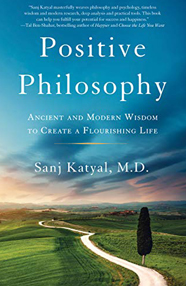
Sanj Katyal: Positive Philosophy - Ancient and Modern Wisdom to Create a Flourishing Life
Read the full transcript
Sanj Katyal
Sanj Katyal is a physician and the author of Positive Philosophy: Ancient and Modern Wisdom to Create a Flourishing Life. He holds a bachelor of science with university honors in chemical and biomedical engineering from Carnegie Mellon University and a medical degree from New York University School of Medicine, and he is certified in Positive Psychology and Positive Psychology coaching through the Wholebeing Institute. His book draws on psychology, philosophy, neuroscience, and medicine to offer a practical blueprint for flourishing.
📚 Books by Sanj Katyal
Transcript
[0:00:14] CH: Author Hour is about answering one question: How can you get the best ideas from great books without spending so much time reading? Every week, we take you behind the scenes with a new author, about the most important points in their book. So if you love to learn while you're on the go, you’re in the right place. All of our book summaries are 100% free and we do more than a hundred episodes every year. So please subscribe to and review Author Hour on iTunes. Today’s episode is with Dr. Sanj Katyal, author of Positive Philosophy - Ancient and Modern Wisdom to Create a Flourishing Life. This isn’t another self-help book teaching us how to be happy. Sanj believes that happiness isn’t the goal. While most of us spend our entire lives working hard in the pursuit of happiness, what we really want is a life of meaning and fulfillment. We want to flourish. But when we’re young, so many of us follow society’s path to success and we hope to hit these milestones of achievement and eventually be fulfilled. The good life isn’t built on wealth status and material goods and having it all. That only leaves you wanting more. In this episode, Sanj distills the discoveries from psychology, philosophy, neuroscience and medicine to give you a practical, easy blueprint for flourishing. By the end of this episode, you’ll have a personal operating system to lead an optimal life, where you can deepen your understanding of yourself and the cycle of materialism and achieve lasting meaning and fulfillment. Now, here is our conversation with Dr. Sanj Katyal.
[0:02:36] Sanj Katyal: I remember a day about 10 years ago, very clearly, I was driving in my car and I began to wonder why I wasn’t happier. I had really achieved pretty much more than I could ever dream of, you know? I was married to my best friend, we have a great relationship, we have four healthy beautiful kids who really mean more to us than life itself. I had a really good job as a radiologist and a physician executive at a growing startup company. Growing up, I had no real tragedy in my life. You know we always have plenty of money growing up. Both my parents and my in-laws are alive, healthy and live close by and I began to worry that if I couldn’t figure out how to experience more joy and happiness when things were this good, how was I ever going to deal with any real adversity when it would come? Which by the way it has since that time. I began really searching for answers and I was searching for answers to a single question. How can I learn not just to function but to actually flourish? And that really was the genesis of my journey and this book.
[0:03:45] CH: What is flourishing really mean to you?
[0:03:49] Sanj Katyal: Before we talk about what flourishing is, let’s talk about the word happiness because you know, I have a real problem with it. I think it’s overused but I think the main problem I have is that it’s used incorrectly. If I ask you, if you want to be happy. I’ve asked a lot of people. The answer is of course. If I then ask you, well what does it mean to be happy? The answer becomes a little less obvious. The problem with the word happy is that it denotes kind of an emotional state that it’s often changing and transitory. “Yesterday, I was happy but today I’m sad or I’ll be happy this weekend when I don’t have to work.” That type of happiness is not what the ancient philosophers , particularly Aristotle was referring to when he made the same quote, “Happiness is the meaning and purpose of life, the whole aim and the end of human existence,” that’s a pretty famous quote but the word that he and other philosophers used was Eudaimonia, which is really accurately translated as human flourishing or a state of optimal living over a longer period of time. That’s kind of the way I think of flourishing and happiness is this state of optimal living over a period of time rather than at fleeting and changing, minute by minute or day by day. Emotional state that many think of when they think of happiness.
[0:05:08] CH: The state of optimal living, let’s get a little more clear on that as well, is that relative to each individual?
[0:05:17] Sanj Katyal: I think it’s unique to each individual. What each individual does and what they perceive as optimal for them is different but you know, it’s really a state of living by principles, values and service and however each individual perceives the rank order of virtues and values that are important to them may change but the basic principle is the same.
[0:05:49] CH: You divided your book up into two parts. The past and the present. Why did you do that? I mean, your book is sectioned off as just those two sections, what’s the meaning there?
[0:06:02] Sanj Katyal: Well, when I began studying the answer to you know, how can flourish not just function, I really found answers in a combination of philosophy and positive psychology. You know, the goals of philosophy are to teach us how to live well, right? How to make sense of our place in the world, better understand suffering, figure out which goals to pursue, those were the original goals. In short basic, philosophy down to a single goal, it’s goal was to teach us how to flourish. The problem was, it didn’t teach us how to stay on the path of flourishing. What can we do each day to ensure that we’re on the right track? This is where the modern kind of tactical tools of positive psychology I think can really help. Positive psychology is often called the science of happiness because it offers evidence based strategies to improve our wellbeing, you know? As I deepened my study into both fields, I realized they both have their limitations and their advantages. You know, philosophy and ancient wisdom, you know, teaches us a lot of guidance but it’s ideas and concepts can be really challenging to integrate into our daily lives, right? For example, what does living a life of virtue mean and how can we live this way, how do I find my dharma or sacred duty? What steps can I take every day to fully realize my unique potential. Those are concepts of philosophy that are key to living a good life but you know, t here’s not often a easy to follow road map there which is what I think positive psychology offers us, it’s more of a functional blueprint, you know? They have evidence based research findings and strategies that can keep us on the state of human flourishing and so, I really try to combine the best of both fields into a personal operating system for flourishing and that’s why I divided the book into the goals of philosophy and age and wisdom backed by modern evidence based science to form this daily code of living.
[0:08:15] CH: Yeah. In the first part of the book, you dive into stoicism. Now, there are different types of philosophies. What drew you to stoicism?
[0:08:32] Sanj Katyal: Stoicism has an interesting concept. I think the thing that attracts me to stoicism, it’s its simplicity and its accessibility to everybody. You know, there are a few key concepts that are easy to understand but difficult to master. But these concepts can be really transformative, you know? The concept of focusing on what is within your control versus what’s outside of your control. That’s a concept that’s, you know, used by you know, alcoholics anonymous in the serenity prayer, it’s used by various religions, but if you get upset at a situation at work where somebody’s not giving you credit for something, you know, you have two choices, you can get annoyed, complain, gossip, all of which is in your control or you can focus on doing the best you can do and letting the results speak for themselves. I think this idea of focusing on what’s in your control is a big deal and stoicism. The other big piece of stoicism is that all you need to live a good life is virtue, which is when you kind of delve deep into virtue, it’s really excellence in character or character development. If you can focus on developing your best self, that’s really all you need in life to be happy and the stoics, you know, they live their lives this way and many were exiled, treated poorly and so forth but this philosophy really, I think, helped them stay the course.
[0:10:13] CH: Sanj, how do you feel on your current journey? I’m just curious on a personal level where you are with virtue, developing excellence in character. How have you transformed, since really diving into this?
[0:10:29] Sanj Katyal: I think that’s been probably my biggest area of improvement honestly and it’s probably an area that you know, many of us, when we were younger have a lot of room to grow. You know, virtue is kind of a nebulous term so you know, I like to think of living with integrity and the best definition I found for integrity is having complete congruence between what you think, say, and do. You know, I find myself in situations where if I can keep congruent between those three areas, things go a lot better. You know, when I get annoyed or when I have internal unrest, it’s usually when something is incongruent. What I’m thinking about is different than what I’m doing and so forth. I think you know, it’s a journey and I’ve got a long way to go but I think at least I’m climbing the right mountain if you know what I mean.
[0:11:23] CH: Could you give a personal example of how you behave now versus how you might have behaved in the past, thanks to incorporating positive philosophy?
[0:11:34] Sanj Katyal: Sure. You know, in the past, I was – you know, I’ve been fairly successful in medicine and the business world and I was very concerned with kind of getting my fair share of credit, making sure that I had a lot of influence, making sure that people knew, you know, who I was, what I was doing and you know, I often didn’t think about others as much and I often didn’t think about the consequences of some of my behaviors and actions. You know, not that I was evil or did anything evil but you know, when you’re out there, trying to succeed and climb the ladder in life, it can be difficult to remember that you know, the next promotion or the next title or the next raise in the end is all that matters. It’s how you acted on the way up the ladder, how you treated the people all around you, both above you and below you that really matters, you know? What’s the feeling when you come home at night and you’re hugging your children, do you feel like you did a good job and treated people the right way or were you just out there trying to take as much for yourself as you can get? I think I shifted from the former to the latter through the concepts and the application of positive philosophy.
[0:12:59] CH: Playing devil’s advocate a bit here, I want to push back on some of these ideas. One of my favorite quotes is, when the student is ready, the teacher appears. Do you think that you arrived at these philosophies at a certain point in your life because you – I don’t know, either matured or you went through experiences where you said, “Well, what I’m doing isn’t working,” right? You went through this – I’d like to think of it as like the spiritual sandpaper of feeling the pain of not being happy. That caused you to question in this all sort of unfolded. My point being is, do you think you would have arrived at this philosophy had things had been going well internally?
[0:13:48] Sanj Katyal: Yeah, I mean, that’s a good question. I think things were going pretty well. I mean, from the outside, I was really living the dream life, you know, I had it all and I believe I do have it all.
[0:13:59] CH: It’s such a common story in our culture, right? So many people experience exactly what you described at the beginning.
[0:14:06] Sanj Katyal: Yeah, I think it’s probably you know, just one of maturity rather than experiencing some deep discontent, I think it’s just an evolution in our being. You know, Carl Jung talked about the four stages of spiritual evolution, you know, when you’re young, you’re the athlete, you’re concerned about your body and you know, our appearances, you move to the warrior state where you go out and take what’s yours in the corporate world. Then you evolve more to the statesman where you’re more concerned with helping others than you are with helping yourself and then if everything’s successful, you eventually evolve to a spiritual state. I think I was probably somewhere between the warrior and the statesman when I made this transition. I don’t know if that makes sense or not but –
[0:14:59] CH: Absolutely. Part two is the present. Now, you have a chapter in here called Hedonic Adaptation - The Most Important Principle You Never Learned. Tell us about hedonic adaptation?
[0:15:14] Sanj Katyal: Yeah, this is an amazing principle and I really believe it should be taught in schools, you know? When I talk to students and I ask them, you know, what if I told you you’re going to get used to all the good things in your life? You’re eventually going to take for granted your great job, your new house, your sports car and even your family. They’re like no, some people call this human nature while others use more scientific terms like hedonic adaptation. I first heard about hedonic adaptation while studying stoic philosophy and the stoics believed it was precisely because of this process that we should be indifferent to any external conditions and events as they relate to our happiness. That’s what they thought the only thing needed for happiness was virtue, things that from a character development and how you act in life because you know, they knew 2,000 years ago, what modern research is now confirming, the new house, bigger salary, all produce temporary spikes in happiness but we quickly become used to these things and return to our baseline levels of happiness. You know, when I ask my son whether MLB 2018 is worth spending his money? Given that he’s got last year’s game at home, you know, like he replies with a lot of things he wants, he’s like, “Yeah, it’s going to be awesome.” Emphatically. Then a couple of months later I ask him the same question and he’s like, “It’s okay.” You know, he’s adapted to it. You know, we can’t think of this process going on in many aspects off all of our lives. I think the key thing to understand about hedonic adaptation is it’s an evolutionary survival technique. If we didn’t get used to stimuli that were constant, we wouldn’t be able to differentiate new and more important events or potentially threats from less significant ones, older events that should fade into the background. As we evolve, this adaptation process is really a huge obstacle in our ability to sustain or improve happiness levels. I mean, nature, she just wanted us to survive long enough to procreate. Didn’t care how happy we were along the way. I think this is a big issue in modern society for us. I see it everywhere from teenagers to very successful physicians.
[0:17:34] CH: What is the prescription? Once we understand that hedonic adaptation is built into us, what is the prescription with dealing with it?
[0:17:44] Sanj Katyal: Yeah, because we’re evolutionarily wired to feel this way, a prescription takes some intentional effort and strategy. But really, the key antidote to hedonic adaptation is basically learning how to pay attention to the good in our lives. That’s the key to stop taking all the positive things for granted. You know, as we think of our own lives, once that new relationship or higher paying job no longer grabs our attention, we have adapted to it. On the other hand, anything or anyone that keeps popping into our heads is going to be less prone to adaptation. So we need to learn to pay attention to the good aspects of our lives and I think the best way to do this and this is probably positive psychology’s greatest contribution is the study of gratitude. There is a lot of work on cultivating gratitude, it’s everywhere. It is on the cover of Time, many blog articles are written about it but as I was studying hedonic adaptation it become clear to me that gratitude works and is so popular precisely because it’s an antidote to this process.
[0:18:53] CH: Yes. I totally – I mean I wasn’t sure if I was quite with you necessarily on the hedonic adaptation but as soon as you said gratitude I thought, “This was exactly right,” I think because hedonic adaption, you can go in one of three ways. You can resist it and say, “This is bad, I need to stop desiring things. I need to check out. I need to become a Buddha.” Or you can be unaware of it and continue collecting things and adapting to them and being miserable and not understanding why. Or you can take the third path that you just mentioned which is gratitude, being thankful that you even have this hedonic adaptation that it’s allowed these things to unfold for you and like you said, all the research shows gratitude is one of the most powerful tools for flourishing, I believe, right?
[0:19:50] Sanj Katyal: Yeah and that’s exactly right and you know there are two really good methods for cultivating gratitude. One is a gratitude journal where you write down three things three times a week either in your notebook or on your phone. It helps to go beyond the big three, health, safety, family and to really delve into things that happened that you can appreciate and one thing I have noticed since doing that probably I have been doing the gratitude journal for five years now. One thing that I noticed is –
[0:20:18] CH: Wow, every day or how consistent is your practice?
[0:20:22] Sanj Katyal: Every day but I adapted to that right?
[0:20:24] CH: Yeah. How quickly did it take?
[0:20:27] Sanj Katyal: Probably about three months.
[0:20:29] CH: Yeah, I had the exact same thing happen but what was the first three months like for you? Did you have any profound moments?
[0:20:37] Sanj Katyal: Oh yeah, I think probably two months into it I was at work and I was noticing something that happened that I said, “I’m going to write about that tonight,” and what I realized was that I am not noticing things in real time and appreciating them in real time and that’s I think really powerful to be present and appreciative at the same time, in a moment and that’s what the practice of gratitude journaling did for me. I am not saying I’m a saint and don’t get upset or yell at my kids. That stuff - as long as we’re engaged in life that stuff is going to be there but one thing for sure is that the frequency and duration of feeling down or angry or upset has become much less for me personally as I’ve become more grateful.
[0:21:29] CH: That alone I find is one of the most simplest, easiest ways to dramatically improve your life if you stick with it. If you’ve never done it before, if you stick with it, man, it really transforms you from the inside and then eventually the outside. So you actually have a chapter called Inside not Outside. What is that about?
[0:21:52] Sanj Katyal: I think that chapter came about as I was thinking about how we’re raising our kids and I looked around and there was this cult of business. People wearing it as a badge of honor and they put it on their kids as a badge of honor. So it is not enough to be playing for your school soccer team. They’ve got to be on the travel team as well. It is not enough to play community baseball, little league. You’ve got to have private hitting lessons and pitching lessons on the side and –
[0:22:22] CH: Do you think that’s changing at all? It seems like more people are becoming aware that’s a problem.
[0:22:27] Sanj Katyal: Yeah, I think definitely the pendulum is swinging back but you know, when I was raising my kids and going through a lot of this baseball and soccer, this is the experience that we were all immersed in. And you know I think that’s a real problem and so focusing on developing good kids that are resilient, that are compassionate, that care about the world around them, that are curious those kinds of qualities that if you ask parents if that’s what they want they’ll of course say yes. But they’re not living and teaching their kids to do that, right? They are just teaching them to be not left behind or fear of missing out on this or that and so that’s really what that chapter goes into and really how to deal with it.
[0:23:20] CH: I love that. Just as a new parent my wife and I are going to read that chapter together.
[0:23:27] Sanj Katyal: I appreciate that.
[0:23:28] CH: Let’s talk about mindfulness. This is of course all the rage, I guess, right now both in the corporate world and in personal development. This is the final chapter of your book. Tell me about it.
[0:23:43] Sanj Katyal: Yeah mindfulness is almost like happiness, right? It is so overused right now but it is overused because it is really important. It’s like gratitude and I think attention to the present moment is probably going to be our greatest currency and I tell my kids this. So if you can learn to cultivate attention in your life, you are going to be so far ahead of everybody else and this is made worst by smart phones and social media and particularly Snapchat. But you know attention to the present moment is really the goal. It is how we experienced more fulfillment and more joy in our life and you know one of the best ways I found to cultivate mindfulness is through meditation and it’s interesting that the younger generation is far more likely to meditate than people in my generation in the 40s and 50s ever are. So that is another pendulum that is swinging back but I am really concerned about the – you can meditate for 20 minutes a day and sure, that’s going to help. But if the rest of your day is spent surfing the internet, checking Facebook, snapchatting your day away, it’s the equivalent of going to the gym to work out for an hour and then spending the rest of your day lying on the couch eating potato chips, right? Or the athlete who smokes. And that’s the piece that I think a lot of people are missing. So they may meditate but the rest of their day is just filled with distractions and poorly dispersed attention and that is a big problem and that’s something that I’m really focused on with my kids particularly.
[0:25:27] CH: Yeah, I mean you’ve got four kids. So I am sure you’ve seen it’s been sad to me and I don’t say this in a judgmental way of other parents but more on a broad society level seeing parents playing with their two year olds at a play gym or something and the two year old is coming up and giving them a hug or something and the parents literary playing on their phone behind the kid’s back and then the kid goes back to playing. They are still playing with their phone. And it’s crazy to me because I understand both the pull of the phone and the pull of paying attention to the child and it’s such a hard time that we’re living in, in terms of how addictive these technologies are and you talk about the importance of don’t miss life twice. So apart from meditation, is there anything else that you recommend for us to stay mindful, to stay present, to resist some of these technologies that are engineered to be super addictive?
[0:26:42] Sanj Katyal: Yeah, you know that is exactly right. They are engineered, they’re designed to grab your attention and I think one of the big things is to set constraints on yourself. Constraints create freedom, actually. If you are free to do whatever you want to do, surf the internet, check your social media sites as often as you want, it is really hard to fight that but if you create constraints in your life so for instance if you turn off all your notifications on your phone. So when you are working and you don’t get a new Snapchat or even better yet, what I’ve made my kids do is put their phone in a different room on the charger when they’re doing their homework. So turning off notifications, separating yourself physically from your phone when you’re doing something. I often leave my phone on the car. In fact I have a rule when you go out to dinner as a family, all the phones stay in the car and I think the other big thing is just one thing that I have done at work is I check email about probably 10 times a day at work. But before I do that, I’ve got to do a quick set of body weight exercises. So I may do 25 pushups or 25 squats or whatever and just adding that little bit of friction before you can check email or other things, I think helps. And then you end up being more intentional when you are checking those sites. So those are a couple of things that I have experimented with that seem to be working and it seemed to be working for my kids as well.
[0:28:13] CH: Yeah, the only concern is hedonic adaptation, right? You get used to it and you want to change things up again so.
[0:28:21] Sanj Katyal: Exactly right.
[0:28:23] CH: So let’s wrap up with a few more questions Sanj and I am curious, your book isn’t out at the time of this recording but have there been people in your life, apart from your loved ones, that you shared these principles with and it’s had a positive impact on them?
[0:28:40] Sanj Katyal: Yeah, I have been lecturing on concepts in this book particularly hedonic adaptation for three or four years to physicians and particularly radiologists and you know it is amazing, radiologists rank dead last in happiness among physicians but they have very high earnings and they have pretty good work-life balance. But I think the field is prone to hedonic adaptation. I think people forget the thrill of becoming board certified in radiology, getting your first job. Reading your first MRI and helping a patient. I think all of those things have become so habitual because of the number of cases that everybody reads per day, it is easy to adapt to that. You know one of the things for people that I found and people have come up and told me that this has really helped is negative visualization. And so I have friends and colleagues that have been fairly discontent and disgruntled with medicine and what I have them do is on their drive home from work and this doesn’t take more than one minute. Pick some aspect of their life and imagine their life without it. So an easy one would be imagine if your job no longer existed. Your group just fell apart, you lost your hospital contract, what would that be like? And actually visualize yourself going through that process. The process of looking for another job of interviewing around different places, you know having to undergo this change and contrary to what may seem morose, visualizing yourself without some of the good things in your life actually makes you really appreciate them much more. And it actually more powerful than even gratitude because we’re wired to react even stronger to bad than we are to good. So when we visualize things happening negatively, it has a better impact. So I’ve had many physicians come up and tell me that that single practice and the concept of hedonic adaptation has really helped them look at their work life and even their home life much differently.
[0:30:56] CH: Wow, I love that. That’s great and just to tie it unto something I’m familiar with is in marketing there’s a really powerful principle called the heaven and hell, where you have to communicate to the person what their hell will be if they don’t get this problem solved. And you really dig into what’s your life going to look like six months from now, a year from now, five years from now and it’s so powerful for the exact reason that you said. It can get them off the fence just by talking about that and so to think about that for a few minutes is I mean it really does. I can totally see that giving you a sense of gratitude, that’s great. I love that. So final two questions for you Sanj, this has been great, how can our listeners connect with you, follow you, that sort of thing?
[0:31:55] Sanj Katyal: Well I am on Twitter @sanjkatyal. They can also reach me via email at sanjkatyal@gmail.com and I also have a website. It is called positivepsychologyforphysicians.com, all one word, where I blog and post new articles that I’ve published as well as just a variety of different other media sources that are interesting to me.
[0:32:24] CH: Excellent and the final question, give our listeners a challenge. What is the one thing they can do from your book this week that can have a positive impact?
[0:32:37] Sanj Katyal: I would do negative visualization. When you’re in a car and you’re waiting at a red light instead of getting annoyed at the driver or reaching for your phone to look at it, I would take one good thing from your life and mentally subtract it and visualize what your life would be like for 30 seconds.
[0:32:54] CH: The book is Positive Philosophy. Sanj, thank you so much for being on the show.
[0:33:00] Sanj Katyal: Thank you, I really appreciate your time Charlie. Thanks.
[0:33:05] CH: Many thanks to Dr. Sanj Katyal for being on the show. You can buy his book, Positive Philosophy, on amazon.com. Thanks for tuning in on today’s show. If you liked what you heard, here is what I want you to do next. Open up the podcast app on your phone or iTunes on your computer and search for “Author Hour with Charlie Hoehn” and then click “ratings and reviews”. Take 10 seconds to rate this show or leave a review. It is a small favor but it’s really the best way to show your support and give me feedback and if you know someone else who’d love Author Hour, take another three seconds to text them a link to this episode. We’ll see you next time.
Want to Write Your Own Book?
Scribe has helped over 2,000 authors turn their expertise into published books.
Schedule a Free Consult