John Reid: Moving From Models to Mindsets
Read the full transcript
John Reid
Who are the JMRG Four?
Wherever authenticity and compassion have been forgotten…wherever curiosity is stifled or playfulness is banned…wherever resilience finds itself in peril…the champions of the JMRG Four will be there to answer the call. (Literally. They all have cell phones.)
Together, John Reid, Andrew Reid, Corena Chase, and Lynae Steinhagen have sworn to help restore the lost superpowers of humanity—and to have a lot of fun along the way. They hope you find this book as enjoyable to read as it was to write. You can find them online at jmreidgroup.com.
📚 Books by John Reid
Transcript
[0:00:19] CH: What’s up everybody, it’s Charlie Hoehn, the host of Author Hour where I interview authors about their new books. Today’s episode is with John Reid. He is the author of Moving From Models to Mindsets. Now, this episode is about rethinking the sales conversation. Now, John is the founder and president of JMReid group whose clients have included Ernest and Young, Pro Am Pack, Local Healthcare Change, Ryerson and Mitsubishi UFJ financial group. In 2015, JMReid groups work was featured in Training’s Top 10 Hall of Fame Outstanding Training initiatives. John was previously named a rising star in the Chemical Industry by Chemical Week and he earned Forum’s 1999 Rookie of the Year and 2000 Sales person of the Year titles. John believes that focusing on changing the sales person’s mindset is the key to successful selling. I’ve got to say, after talking with him, I agree. I’ve heard so many cookie cutter methods of selling and I’ve gone through training programs and John dismisses all of those, his approach is centered around context and mindset and listening and curiosity and these mindsets that John talks about really work. It’s not so much tactics, it’s more just simply being a person with another person and having a conversation. All the pressure that you might feel as a sales person to pick the best model goes away. If you’re a sales manager or a sales person and you need to perform at the peak of your abilities. John wants you to know that a one size fits all approach doesn’t work. There is a better way. That’s what you’re about to learn. Now, here is our conversation with John Reid.
[0:02:33] John Reid: I went to University of Maryland and I was a marketing major and I never had had a chemistry course in my life and back in those days, companies would interview on campus and one of the companies that I interviewed was Dell Chemical. At that time, Dell Chemical was looking for people that they thought were personable, that could build relationships and they had decided that whatever chemistry that was needed, they would teach them. I started with Dell Chemical having never taken a chemistry course in my life. I still haven’t to this date. The eighth grade, tenth grade, I never took a chemistry course in my life. Now I’m selling chemicals and I’m being wildly successful selling chemicals. I know I’m wildly successful because the rating system, they would have a Ray of Force ranking system, one would be high performers 234 and you had to beat one of those number sand I was pretty rapidly at number one in the rating the force ranking system of sales people at Dell Chemical. I think the reason was, I think I was very fortunate and very lucky because I didn’t know anything about chemistry, I was far more curious than my competition. Even my competition outside the company or my competition inside the company. Other people are people who are trapped by their, or cursed if you will, by their own knowledge. They gotten educated, they knew a lot and so the last thing they wanted to do is show up at a client and ask a question that they believe they should know the answer to. Meanwhile, I’m like pointing at tanks and going, “what’s that,” you know? “What did that do?” People, when they hear this story sometimes, go, “Wow, that’s kind of embarrassing” but people like to talk about what they do. I talk about that tank. It’s okay if you don’t know what the tank is because it gives them a chance, talk about the tank. I recently met a guy at EY, Ernest and Young and he’s a partner there and he has started with X on mobile. I kind of shared with him the story and he goes, “My gosh, you’re right, these people love their tanks.” I’m like, “I know. I started in sales from a place of genuine curiosity and that has served me well.” Most of my peers are cross eye curious. First of all, they’re self-limiting because of what they think they should know is the curse of knowledge. Second of all, they’re going to be vulnerable because they think that will look foolish and there’s a fine line between vulnerability and looking foolish. Thirdly, maybe one of the bigger draws is you know, they’re so focused on making the sale that their limited curiosity is around stuff that’s going to help them make the sale. Asking questions that have nothing to do with a line of site to the sale is not obvious to them and therefore they don’t do it. My journey started there, I think I’m blessed, lucky, whatever you might want to call it that I was able to start selling something of which I knew nothing about.
[0:05:18] CH: Why do you think you didn’t feel the pressure that a normal sales person might feel to make a sale. Why weren’t you worried about looking vulnerable?
[0:05:29] John Reid: That’s a good question. I think it’s because I’m the youngest of five and so when you’re the youngest of five, you got to survive, you got to show up, you got to make an appearance and I think my people skills, the idea that you could have a conversation with a total stranger. I felt very strong at that. Overlaying that I would ask them about that tank or that process or that machinery or who else they’re talking to or why they chose my company. That all just seem like a means to an end and you have conversations. There’s nothing authentic about doing those things. The lack of knowledge in one area wasn’t so scary that it didn’t allow me to lean on where I had some skill I think.
[0:06:11] CH: Could you kind of give an example of how a typical conversation might play our for you? A typical sales conversation and compare it to what a normal sales person does wrong because I really want to hit this point home. I know you kind of laid it out a bit but I want to get clear on how different you were.
[0:06:34] John Reid: I can probably start with the normal one and then I’ll do a contrast if that’s okay with you. I mean, I think the normal salesperson goes in, has an objective and is under the pressure to deliver a number, gets sales results, they come for that, there’s pressure from their management on that. There’s a short term sort of dynamic that takes over. All of their questions are around current business and what is your need now and who are you buying from now and how did that last order go and what are you looking for and it’s not very creative, it’s not very differentiated and it is focused predominantly on the short term. Either sort of tactical current questions or qualifying questions.
[0:07:13] CH: It’s about winning a game.
[0:07:16] John Reid: Its focus is short term and it’s about making a sale. It comes across that way to the other person. Sometimes they’re close ended questions, they’re not questions that allow the person to expand but they really are focused, tend to be focused on the here and now, the short term and they tend to have a rhythm of well, what really happens based on about 30 years of doing this and training people. They get one or two questions out before they start talking about themselves too. You can trap almost all sales people within 30 seconds of getting them to talk about themselves even when you’ve told them they should not, even when they know they should not, even though they want to be curious, you can say something and they will start to talk. That normal people I think get caught up in current short term questions and you know, rush to talk. Because the client said something. For example, what would that look like. Let’s say the client says we really – you have the client, what do you care about and then this client says, “Well one thing is quality.” Most sales people will take the bait and go, “Well we have quality. Let me tell you about our quality.” Rather than “Okay, quality is one, what else do you care about?” You know, they’ll go right to provide, they’ll go right to sort of that you know, they see it in front of them, they can’t help themselves. What I learned is that is powerful is that you can’t do that, right? What you want to do is go genuine curiosity, go long term. Go personal, “You’ve been here for two years, how’s it been, what’s it going? What do you like about your job? What have you learned? What’s different than you thought when you came in.” I mean, you can really get some personal stuff out rather quickly, really going to call. You want to make it a conversation so you do want to jump in a little bit but not jump in to provide but jump as say “Wow, I’ve seen that in other places,” you know? Later on, I want to get back to that because – but you want to make it a conversation not an interrogation. When sales people are taught, typically, they’re taught like an interrogation. Go in, purpose benefit check, setup the meeting, ask your questions, create some pain and then you know –
[0:09:16] CH: Acetate the pain.
[0:09:18] John Reid: You know, educate the client and then you know, it’s a conversation. It’s more like you know, setup the call, ask a couple of questions, provide some insight, as a couple of more questions. Really try to avoid talking about yourself as much as possible. Your solution for as long as you can. Does that answer your question?
[0:09:36] CH: Yeah it does. It takes a lot of the pressure off just hearing that of because I’ve had some sales training and all of the – very few of it that I’ve experienced has really resonated with me, you know? Because it’s like yeah, I have this ulterior motive that I’m driving toward and it never really feels like it’s going to work out because that’s just not who I am. I feel that it’s driving toward just this definitive end goal within one hour rather than authentically connecting like you’re talking about.
[0:10:18] John Reid: Yeah, I mean, it fascinates me, a couple of thing. When you’re talking about yourself, when you’re talking about your product, you have the risk of creating objection. Anytime you’re talking, you run the risk of creating objections. You want to talk less, just common sense, right? It’s part of sales is objection avoidance. If I say “Hi, my name is John Reid.” “I dated a guy named John once, I hate all people named John.” That didn’t work. Anything you say runs a risk so A, say less, this isn’t that complicated. B, you know, be the devil’s advocate for yourself so I do a lot of, "I don’t know if you need my help” or "you know what? I think you’re on the right track here.” I have conversations all the time that I know my peers are reluctant to have. Where I’ll say, “you know what? Given what you’ve told me, I think you’re in a good place” because that’s what I think. I’m not articulating it, I’m not being clever by half. I just honestly think based on what they told me that maybe they don’t need our help. I did this the other day in Chicago, these three executives just laughed, they’re like, “my gosh, nobody ever says that, but do you think you need me?" They’re like “no," I’m like – “strange kabuki are we going to play?" You know, what’s at the core of that is this belief that you want to differentiate people buy on differences, people how is this guy, this experience different than the traditional. You know, you could almost predict the traditional sales call. You’re not going to differentiate yourself if you follow that path. It’s far better to be authentic, far better to be genuinely curious and have conversations about stuff that doesn’t relate to your practice and service. It’s far better to do that just to differentiate yourself in the customer’s mind.
[0:11:57] CH: That’s such a great long term strategy because I’d imagine, based on your approach and knowing very little about you, John. I’d imagine you have clients that you’ve worked with for 10 years or more. Based on being long term.
[0:12:15] John Reid: Yes, what’s amazing about my firm that’s unusual for the training space. In the training space in general. Most training companies are selling content and so they sell it into a firm and that content is delivered for maybe a two or three year cycle. It runs its course and people get tired of it and then they look for the next best content. This plays itself out over and over again. You know, we were a miller high man shop and now we’re Wilson shop and then we’re going to be a Richardson shop and you know. I take clients for 10 years because I’m not selling a model when it comes to sales training. I’m selling the mindset, I’m selling the design, I’m starting a level of engagement and so – I’m trying to sell them how they want their sales people to sell. If you like what I’m modeling, if you like what I’m doing, this is what I’m going to teach your sales people how to do. That tends to resonate and yeah, the point in my principles has always been, I don’t have to sell you today, right? If I have to sell you today my behaviors are all bad. They’re all short term, they’re all pressure, they’re all what we think poorly about sales people. I just have to sell you eventually. Maybe I’ll not sell it at all, maybe there’s not a fit at all but I never had, if the pressures I got to sell you today or this week or this month. I’m in trouble as a sales professional. I’m not going to be at my best in terms of my behaviors and what really drives relationship.
[0:13:32] CH: Right. Just to understand your parameters, what size deal flow are you typically doing in terms of cost to the client, what’s the range, how many clients are you speaking with each week, that sort of thing.
[0:13:49] John Reid: That’s a good question. I mean, we’re in the training space, there’s large companies, there’s individual practitioners and then there’s people like me, there’s people like me or in the eight million dollar kind of range, right? That’s not just – we are a group, we have a group of facilitators, a group of people that do design, delivery, all that good stuff and so we’re sort of in that middle space. Our average deals might be, we like to see deals of 200 to 400,000, we’re not limited to sales, we also do leadership, we also do business writing. Once you believe in design and relevance and the type of things we believe in, you can go across content areas. We do content in a number of areas. We probably have active, 12, 15 clients, 20 clients at a time, you know, coming in and out of the company.
[0:14:33] CH: Excellent. Now, let’s shift the talk specifically about your book, Moving From Models to Mindsets, you touched upon what the title means but can you explain a bit more specifically what you mean by Moving From Models to Mindsets.
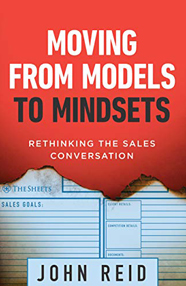
[0:14:51] John Reid: You know, my history, I mentioned earlier, I was in the training and a chemical industry and I grew up going through lots for different sales methodologies. These were, they’re content built in the 1980’s, 1990’s, still being used and popular today but I went through that content as a participant and the way that content works was it was always about the model. This training company, this training founder, the John Reid of that company had come up with a model. If you follow the model, you will be successful or if you fill out the green sheet or the blue sheet, you will be successful. You’ll notice the cover of our book has a blue sheet on fire because what I experience and I knew not to be true because I was successful. I knew I wasn’t doing these things that they said you should do because it was all modeled content driven rather than conversation and sort of mindset driven. It didn’t quite work for me or rather high performers and it looked like it was designed and I know it was designed in retrospect for lower performers. They design training for sort of a low performer, maybe mid performer but never for the high performer, that’s why most high performers bulk at training or the questions were asked back then, should high performers go do they have to go? Because it wasn’t designed for them. It was designed for sort of the low end performer and the belief was, we come up with a model, we come with a methodology, we’ve done some research, our research shows it works, surprise, surprise. Which is all interesting about my industry, right? We did our own research and it works. If you follow this, you’ll be good. Off they go. If it doesn’t work and often times it doesn’t work, what the training companies would do would be to blame somebody. They would blame the participants because they didn’t do what was necessary, blame the managers of participants because they didn’t coach on it or blame the company that bought it, the culture wasn’t right. There was no introspection, there was no – “maybe our green sheet is too complicated. Maybe our blue sheet has too many boxes. Maybe the practices we do aren’t relevant for these people.” There was none of that, right? In training, in the 80’s and 90’s and even today. When I look at that stuff and then looked at what I was doing. I thought, well the difference is, what they miss is the mindset, they miss having a conversation, what is your belief system have to be to capture value. What is your belief system have to be, when you engage with a customer, what do you have to believe about yourself, your company, your goods and services in order to be successful? They never have those conversations. It was either assumed that you had the right belief system but you know, behaviors are an outcome of a belief system and so I want people to behave differently. I’ve got to look at their underlying belief system.
[0:17:28] CH: How do you change people’s beliefs and set them up for success?
[0:17:32] John Reid: You can do it pretty fast and clever to be fair. I mean, the first chapter of the book has a powerful example of that. Most people’s belief is that they are trustworthy. Most sales people’s beliefs. I’m talking about like 90, 95% based on the work we’ve done. Believe that they’re good at building relationship, that they are relationship sales people and that they’re good at it. How do you teach people that they’re not good at something they think they’re good at, how do you change that behavior? Well, first we have them identify that they are good at it. We do this sticky dot exercise Charlie where they put a dot up, you know, what they think they do well, green dot if it’s a strength and a red dot if it’s less strong. They’re all green dot when it comes to relationship building, they get 90, 95%. We talk about trust and the fact that you have to have a personal relationship. Then we give them a scenario, it’s a quick scenario. “You have a new customer, you have an hour meeting and the customer says, I want to keep it to 30 minutes because I want to see my daughter’s soccer game.” Charlie, you’d be shocked but you know, maybe two out of 20 ask about the daughter. The other 18, we haven’t wait down what they would say. They write down, “I’ll keep it brief, I’ll keep the 30 minutes,” how do you want to use the time we have but only two actually hear the report queue and focus on that and realize the power of that and the power of relationship building. These are people who describe themselves as being great at it. In that activity which is 15 minutes 20 minutes in length, you have people start to think you know, I thought I was good at this, still think maybe I’m good at this but I got to do a little bit better. I’m missing report queues. We have a lot of activities like that, they’re not tricks, right? There’s not trick to that activity, you were forced into doing the wrong thing. You show up as you are, you make a choice, it’s a conscious choice and then we reflect on that, is that a great conscious choice. The other thing about training Charlie that people overlook is, you know, they’re not doing anything bad. I mean, not asking about the daughter is not bad. Saying, let’s focus on the meetings that have bad behavior, you don’t get fired for this behavior. It’s only a good behavior, it’s not the best behavior and so you respect them that hey, I’m not saying you did something wrong which is sort of emotional and defensive reactions. I’m just saying there’s a better reaction. You can bring the learner along much easier with that sort of thinking and that’s where the conversation.
[0:19:54] CH: Yeah, you’re helping them really to make a connection and this is all what the first part of your book is about in Moving From Models to Mindsets is having conversations that build relationships. You talk about creating trust and of course, staying curious which is one of your strengths in sales. Is there anything else in this part one that the reader might be surprised to learn.
[0:20:20] John Reid: I think the trust one is the big one, right? That they’re just not – well, the trust one in two ways, the one we just talked about, the fact that they think they’re good at personal trust and building rapport and they often miss it. The second part is that when they look at trust, the three dimensions of trust. One that you’re confident, one that you care about people personal trust like we just talked about and one that you’re credible, that you do what you say you’re going to do. Most sales people again, try to win on being credible, trying to being responsive, you know? They get back to people quickly, they’re always available, they take pride in this. It’s not something that have to be prideful about but it’s the wrong thing to be prideful about in our minds, in your mind and I ask them, they self-discover. We get them moving around the room, we get them talking about each of these areas of trust. We ask which ones they want to win on. They all go over to, we’ll have them go over 70% go over to this idea of being incredible and doing what I was going to say I was going to do and then being fast and responsive and then we ask the big question: What are the department in the company might describe themselves that way? And they quickly go, “Customer service” I’m like, “Yeah, you guys are trying to win on being glorified customer service people”. You are sales people, you are sales professionals. You are not customer service professionals. If you want to be that go do that but if you want to be a sales professional this is not how they win and they realize that what they need to win on is bringing insight, is being competent, is really knowing the industry. So they know this internally. In fact with one group we did that. We said, “Well what do you think the customers care about?” and they all went across the room. So they knew that what they were trying to win on was not the most valuable to their customers but they didn’t know how to get out of that trap and they didn’t know the consequence of that trap. So I think that is powerful in the open chapter as this whole idea of curiosity. I talked about genuine curiosity so we have that in here too. Curiosity is clearly a law super power. You know as kids we were curious, we were wildly curious and we lose that for a variety of reasons and so we have them recapture that. We put them through a couple of activities but one thing that still surprises me is the difficulty people have in being curious. You know I can show you a picture of something Charlie. Let say it’s a meeting, it is a picture of people in a meeting. This happens in the workshop, we show them this picture of people in a meeting and what questions you have and I’ve had people go, “No”.
[0:22:47] CH: What are they meeting about, yeah.
[0:22:48] John Reid: Yeah, so it’s like what are they meeting about who is the boss, who is speaking, where is this meeting being located, how many other meetings are there? I mean I can ask 20 to 30 questions about it. I can’t find that sales people that you can ask more than two or three the initial time they see the picture because it is all self-edited, not that curious and so if that is happening with this picture, they are going out every day going into clients that they have known. Calling on people that they know, what do you think is happening? They are not being that curious. It’s just them, you know if the picture proves my point that you are not being as curious as you can. You can’t turn around and say, “Oh no, no, no on a call I am much more curious and I just was there” come on, stop. You’re not. Now that is solvable, right? We can get much more curious and so we talk about that in the workshop and in this section in the book about relationships.
[0:23:37] CH: So when you put sales people through this training and they are able to amplify their curiosity, their ability to create trust and make connections, what kind of transformation do you see? What kind of results do they typically see?
[0:23:52] John Reid: Well we can get a lot of the anecdotal self which is great. What we get to know is we get, “That changed my life, I am much better now.” I can’t believe we get the notes from sales manager saying that they are seeing more of it. We do a lot of sustainment so we just don’t do the program itself. It’s not an event where usually we get clients for not only the event but webinars and all kinds of support. The management support going forward. They expect to see what we are usually focused on is larger bigger deals in the pipeline. So the customer measures it that way, are we getting value from this in that regard and they are saying that because that’s why we have been working here for 10 years. So they must be seeing value in this process and because we are not limited. So these people call us too Charlie. Once we have done this work of course they’re like, “Well do you have something on dealing with procurement?” Yeah, we can figure that out. We have stuff on it, we can get that. Self-presentations we can do that. Negotiations, sure we can figure that out. So over the 10 years I’ve built all of these content because I got in with a client with a monolithic approach focused on their needs and they liked it and it worked. So then all their needs came to me and I was able to build my content out.
[0:25:00] CH: That’s really cool. Well we are not going to have time to cover everything in the book but I do want to get into part two and part three. Part two you talk about conversations for opportunities. What is the meat of this section? What do you really want to impart listeners with here?
[0:25:19] John Reid: I think a couple of things would be I love the model of Real Win Worth It which is simply looking at an opportunity and always assessing and I do this all the time. Is it real, can I win it, is it worth it? I mean that is just the gold standard of how to quickly assess something because high performing sales people use their time well, right? They either want to lose early or they’re going to invest the time, the resources and the company resources they want to win the business. So constantly asking yourself those questions I think has made the difference and being honest with yourself, right? We can always tell ourselves a story. There’s not a sales opportunity that I have come across that I couldn’t tell myself a story about why I was going to get it and why it was worth our time. You know why do we go after the business and most of that stuff is just nonsense. If you have to work really hard to convince yourself you should go after it and it is going to be worth it. You make an investment and you start to use words like that, you just got to check yourself in the door a little bit. So I think Real Win Worth It is powerful. I think the other one is that people pay for insight and so you want to be insightful and you really want to look at how do I grow this opportunity to be as big and robust as possible. I had sales people that I manage, they could take a $100,000 opportunity and make it a $10,000 opportunity. That’s easy, any sales person can do that. What you want is people that can make 10 into a 100 by asking a few questions, by being curious, by identifying problems the customer wasn’t aware of and by doing that.
[0:26:45] CH: How do you that? I mean people pay for insight, how do you develop the ability to give them that insight?
[0:26:52] John Reid: Well you read right? I mean you just read stuff, you listen to clients. Clients tell you stuff. You learn and listen and learn and listen so you are constantly learning and reading so you can be insightful. You take some risks so you’ve got to be willing to go, “You know you didn’t mention this but if I were you, I’d be worried about this”. So you’ve got to be well read and be willing to take some risk. Most sales people because their relationship oriented are worried about taking the risk and they make that calculation and they don’t want to risk the relationship. But it is a false choice because you can have both. Now when you take the risk sometimes it strengthens the relationship because this person is bringing more value to them and so they are really happy to see you. You know one point I make early on is that no customer ever has spoken up and said, “Wow I hope a sales person calls me today and I hope I really like them and I hope we become friends” that’s never happened. So the idea that I want people to like me that’s nice but I want them to respect me. If they want them to like me that’s one set of behavior. I’d bring donuts, I’d bring pizza, I send notes to them about their kids, that is all good stuff maybe, maybe not but that’s not what I want to win on. Respect suggests that I offer value and I have insight. Now we have a competitor company who challenge our selling which I think goes way too far because they go into this idea that you want to educate your customer and you want to rationally drown them. These phrases, these are these phrases Charlie. “You want to irrationally drown your client”.
[0:28:23] CH: Rationally water board your client.
[0:28:26] John Reid: Oh yeah because the idea being you’re going to go off, you are going to get a team together, you are going to create some insight, you are going to have something the customer doesn’t know and you are going to go in and you’re going to be the smartest person in the room and your customer is going to be so impressed by this they are going to surrender and you’re going to win the day. I mean it’s just nonsense. I think to do that you have to have a relationship. I think the challenge you have to deal is humility. There’s a reason people say they are more persuaded when you show humility. There’s a good Harvard stuff that is out there that if I say, “Hey I am not sure about this but if I were you I’d think I’d be doing this” you know that is more persuasive than, “I had a meeting with my team and this is what you should be doing” and when you repeat it back it is obvious because one sounds threatening. And I am right you’re wrong and so humility, authenticity, all of that matters in this conversation for opportunity.
[0:29:13] CH: Yeah, I am just reflecting now on conversations I’ve had that have gone terribly wrong because of that exact dynamic. I am curious John, what kind of books do you read? Are you reading industry specific or general big picture books?
[0:29:30] John Reid: I read everything.
[0:29:32] CH: When I say big picture books I don’t mean big picture books, I mean big picture books.
[0:29:39] John Reid: Well I read stuff on neurobiology, on neuroscience. I read some really heavy hard to read. On economy, the upside downside of expertise, 500 pages, dense but you know science based valid stuff how our brains work, how we process information.
[0:30:01] CH: Have you read The Elephant in the Brain?
[0:30:02] John Reid: No, I haven’t.
[0:30:04] CH: Oh.
[0:30:04] John Reid: I think I have heard about the book but no, who is it? Who is the author?
[0:30:07] CH: It escapes me but it is the most recent neuro book that I have read and the first part of it is not so mind blowing. It is laying the ground work for what’s to come and then it’s a doozy, yeah you would enjoy it.
[0:30:23] John Reid: Okay, I would love it. I love Pink, I am. I like Pink, I like Lead, well I like all of those guys because they are easy to read on and they usually have some research done by somebody else who they have leveraged and made a point and that’s cool. So I like all that stuff and I get reference. I mean I would read The Elephant in the Brain now because I will order. I will get them on Amazon and I’ll read it. I mean that’s what it takes. I don’t read a lot of books on Selling because I have read so many and they all say the same thing and I always believe I am a guy with an answer not the answer. So I do have an answer, I think my answer is legit. I think you can read the book and you go, “There’s an answer. This guy has an answer” I am not a zealot where I think this is the answers. Most sales books I read this person thinks they have the answer and that there is one right way and there is so much art to this that’s to say most of these books are about the science. And it did, it dozes it to science and engineering companies and accounting companies they like this training but they miss the art. I think with the neuro science and all that’s going on, I think the art is going to be even more prevalent like how am I in relationship with somebody, how do I demonstrate empathy, how do I demonstrate humility, why don’t I demonstrate humility? I think all of these “when do I… when don’t I” I think there is a lot of art here that we can explore that I think is fascinating.
[0:31:42] CH: Yeah, I mean it is the humanness that you are emphasizing rather than the outcome, winning the outcome.
[0:31:49] John Reid: Yes.
[0:31:50] CH: So I am with you. I love that that’s the spirit of this book and it is really refreshing and like I said, it does feel like the pressure if off when you hear this as somebody who’s used to being handed “Here is the superior model that you need to try in sales” so I love it and there’s one more part to your book. Again, your book is three parts. This one is called conversations for commitment. What’s this about?
[0:32:21] John Reid: So this is I say there’s three conversations in sales. There’s relationship, there’s opportunities, relationship that conversation should be five minutes or it could be five years. The relationship is answering the question, “Do I trust this person? Do I admire and respect this person? Would I possibly do business?” and once this question or these questions are answered then okay, we have some opportunities and again, it can happen quickly. It can happen overtime and now these opportunities, how do we make these opportunities meaningful, have impact, lead to other opportunities, what do we need to do around that conversation and then finally commitment. Not only commitment in terms of negotiation sense of getting a commitment but just commitments at the end of every meeting and getting the client committed to our approach. The most unique thing in the whole book if you say what’s unique. What is something you know nobody has ever said or done? That’s about it Charlie, but how do you ask that? Well it was in chapter seven. If you read nothing else, if you want to know what blow your mind, blow your customer’s mind, it is chapter seven. Chapter seven is storytelling and storytelling is being taught to sales people and it’s being taught all over the world and it is about telling – guess who’s story that we’re supposed to be practicing Charlie? Whose story do you think sales people are being taught to tell?
[0:33:36] CH: Their own?
[0:33:37] John Reid: Yeah, once again can you imagine its 2018 and we are teaching sales people how to go in and talk? Like that’s the problem you have to solve. So this just show up and throw up in a fancy dress. I say tell the client’s story. Get great at telling the client’s story and when I do this on a sales call it is magical. When I am at my best and it is something I discovered a long time ago was rather than just summarize to the client like, “Okay you have been here two years and you are looking at changing providers”. “You currently are buy it from Richardson and Wilson but you are looking to another supplier because you have it globally” and blah-blah-blah, facts and data, facts and data. You can do that same summary in story form. You can say to a client, “Well let me tell you what I heard you say. So two years ago you joined the company. You’re excited, you took on this role, you thought there was a lot of opportunity to make a difference and so the first few years you walked around and really took that listing tour”. “And you met with managers and you met with these people and in doing that walk around you come to a conclusion and that conclusion simply is that what we’re doing today is not going to serve us going forward and now you’re at that point of choice. Well what do I do? Because on one hand you want to change things. On the other hand, you have a sense that there is inertia in the organization to change. So how can I get the change I want but respect the judiscion I have?” “Is that the story you’re involved in?” that is what it would look like and when I do this on a call people are blown away. What have I done? I have made them the protagonist. I have made them the hero in the story. It is their story that matters not my story. Buying is a point of choice right? There is conflict, there is opportunity, there is something going on there and I am able to put emotions in. If you have noticed the example I gave Charlie is you were excited, you were optimistic. I can weave in emotions and surprise, surprise people make decisions on emotions and cognitive reasons but emotions drive decisions. So I want to be able to verbalize those and check those. When it is done well the customer says, “Wow you got it” now if the customer feels really understood and feels they really got their situation they trust my solution. There’s not a lot of push back on my solution. There is not a lot of negotiation on my solution because you got it, right? But if I don’t feel that you have it then I got to pick part your solution then I need a discount. I mean I could argue I think it’s a silly argument but it is a fun argument that discounting is simply the penalty you have to pay for not fully understanding your customer’s needs but if somebody feels really understood they trust your solution and we all want to be understood. It is why we want to talk because we want them to understand us. That is why we are teaching our sales people storytelling because we want them to understand us. I say stop. Yes, I am being dramatic to make a point as I always am. Storytelling is fine. It is okay to teach sales people storytelling. It’s not going to win the day in my mind. It’s not teaching them a better story. It’s teaching to be more curious. It’s teaching to tell the clients be a better listener and playing back the client story in a very compelling and powerful way. That is far better use of everybody’s time than storytelling. That’s chapter seven.
[0:36:47] CH: Chapter seven and there are nine chapter and I want to save them for the listener who is still with us and is in sales or has to do sales and I want them to pick up the book Moving From Models to Mindsets. John I have a couple more questions for you. The first one is what is the best way for our listeners to either get in touch with you or follow you if you’d like that online?
[0:37:17] John Reid: You could always send me an email. I’m sure we have a web presence. We have everything on our website. We are on Facebook, the company, we do blog post all the time. It’s just at john@jmreidgroup.com. www.jmreidgroup.com is our website. Lots of ways to find us, we’re out there talking about the book, obviously talking about other subjects as well. Since now we do lead sales, we also do leadership and other content areas.
[0:37:42] CH: Excellent and the final question I have for you is sort of a quick answer about 15 seconds or so, give listeners a challenge. What is the one thing they can do from your book this week that will have a positive impact?
[0:37:58] John Reid: Wow, I mean the one thing that they can do differently is just ask better questions. They could ask better questions so they could really reflect on the questions they’re asking and ask themselves, “Do these questions really make my client think, evaluate or speculate. Are my questions differentiating myself?” and really come up with some questions that they think are unique that the client will react to. I mean you should hear as a sales person once every call, your goal should be once every call for the customer slow down and go, “Wow that’s a good question. I haven’t thought of that. Nobody has asked me that question before” there is huge value in helping the customer think differently and worry less about trying to tell your story or position yourself differently. Really focus on asking questions to make the client think differently. It will give you additional insight. That will do it.
[0:38:45] CH: Do you have a favorite go to question that falls into that category?
[0:38:49] John Reid: Well you can always take a question in third party meaning you could always take a question and put a third party in and it will force the person responding to have to think. So for example, if I ask anybody any executive “what’s your strategy?” that is an open ended question. It sounds like a good question but they don’t have to think. They know their strategy. That’s their job to know their strategy. So there’s no thinking but if I ask them, “What would your middle managers think of the strategy?” they have to then put themselves in the middle manager. “What would your predecessor think of your current strategy?” so you could put a third party in the question and they have to do this mental gymnastics of no longer just answering autopilot or as common we’d say this one but they have to engage system to going, “Okay that person, what do I know about that person?” “How would that person feel about my strategy?” I constantly am just taking any question throwing a third party in and again, it just slows down the response and it makes the person think deeply.
[0:39:50] CH: Oh my gosh that’s genius. I love it.
[0:39:54] John Reid: It is a sort of genius. I’m glad you like it.
[0:39:57] CH: It really is that’s wonderful. This has been awesome John.
[0:40:00] John Reid: Charlie it’s all teachable, right? There is nothing I do that’s like, “Well nobody can do that” or you’re born that way. It’s all stuff that I believe because I got taught along the way.
[0:40:12] CH: Well this has been awesome John. The book is Moving From Models to Mindsets. John Reed thank you so much for being on the show.
[0:40:20] John Reid: Thank you Charlie. I really enjoyed it.
[0:40:23] CH: Thanks again to John Reed for being on the show. You can buy his book, Moving From Models to Mindsets, on amazon.com. Thanks for tuning in on today’s show. If you liked what you heard, here is what I want you to do next. Open up the podcast app on your phone or iTunes on your computer and search for “Author Hour with Charlie Hoehn” and then click “ratings and reviews”. Take 10 seconds to rate this show or leave a review. It is a small favor but it’s really the best way to show your support and give me feedback and if you know someone else who’d love Author Hour, take another three seconds to text them a link to this episode. We’ll see you next time.
Want to Write Your Own Book?
Scribe has helped over 2,000 authors turn their expertise into published books.
Schedule a Free Consult