Jonathan Siegel: The San Francisco Fallacy
Read the full transcript
Jonathan Siegel
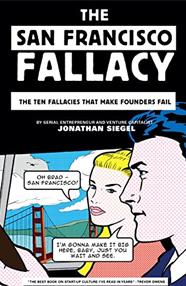
Jonathan Siegel is a serial entrepreneur and investor who founded RightCart, RightSignature, and RightScale. He is the chairman and founder of Xenon Partners, which specializes in acquiring, accelerating, and exiting software-as-a-service companies. Earlier in his career, he spent ten years as founder and CEO of ELC Technologies, a Ruby on Rails consultancy that was acquired in 2010. Siegel is the author of The San Francisco Fallacy: The Ten Fallacies That Make Founders Fail, in which he examines the biggest misconceptions that run through startup culture.
📚 Books by Jonathan Siegel
Transcript
[0:00:25] Charlie Hoehn: You’re listening to Author Hour, enlightening conversations about books with the authors who wrote them. I’m Charlie Hoehn. Today’s episode is with Jonathan Siegel, author of The San Francisco Fallacy. How many entrepreneurs have experienced an embarrassing failure? All of them. How many talk about those failures? Basically, no one. Except Jonathan. Jonathan Siegel is the founder of RightSignature, a service that millions of people use to get their documents signed online. He’s been really successful as an entrepreneur and he attributes his success to learning from his failures. Jonathan believes that a lot of startup founders set themselves up for failure, simply because of their mistaken beliefs. In this episode, we talk about the most common fallacies that cause founders to fail and how to avoid those traps. Now, here is our conversation with Jonathan Seigel. Jonathan, if you had to pick the perfect meal or drink to couple with your book, what would it be?
[0:01:47] Jonathan Siegel: Perfect meal to go with my book is ramen.
[0:01:50] Charlie Hoehn: I love that answer.
[0:01:50] Jonathan Siegel: It’s inexpensive, it’s filling and it’s really tasty.
[0:01:54] Charlie Hoehn: Yes. It is the fuel for the startup community.
[0:01:58] Jonathan Siegel: It really is. It really should be.
[0:02:04] Charlie Hoehn: If you had to lay down, you know, actually what would be funny is if ramen sponsored like an incubator day or a VC, a startup showcase day, that would be pretty appropriate.
[0:02:16] Jonathan Siegel: It would be really appropriate. When we talk about living on ramen as a thing that we do on our startup days when we’re being thrifty and no time to eat and no time to cook, it is now less and less of a reality if you go to san Francisco, it’s more of food delivery services or Uber eats. Maybe being catered to the needs of the developer but not worrying about the cost.
[0:02:39] Charlie Hoehn: Yeah.
[0:02:40] Jonathan Siegel: When I travel in Asia, they really are still on the ramen.
[0:02:43] Charlie Hoehn: It’s huge in Asia.
[0:02:45] Jonathan Siegel: They still are. You know, just working late at night and really just living on ramen so I think it’s a good idea that we might think about bringing back into our overly catered to startups.
[0:02:59] Charlie Hoehn: How much better is the ramen in Asia than it is in the United States?
[0:03:05] Jonathan Siegel: Well, I actually found in Las Vegas, an incredible ramen shop and it’s comparable to what I can get in Tokyo but outside of that ramen shop, I’d say, the best ramen is – maybe it’s like a Texas barbecue done in Japan would just – I’m going too far with my illusion here. I give it a three in the US and it’s excel in canon in Tokyo.
[0:03:34] Charlie Hoehn: Very nice. Is that your go to meal there?
[0:03:38] Jonathan Siegel: It was for the first few months that I was living in Japan and then I ended up just probably overdoing it but if you come to visit, when you come to visit, it will be on the list of places to go to and it’s not just one meal, it’s seeing all the probably half a dozen varieties to try. There’s even Michelin Starred ramen.
[0:04:00] Charlie Hoehn: Really?
[0:04:01] Jonathan Siegel: There’s a Michelin starred ramen.
[0:04:01] Charlie Hoehn: What did they mix it with that makes it so much better?
[0:04:08] Jonathan Siegel: The making of a ramen starts the day before and it was originally a – you got it. If you can imagine, it was a lot of leftover meat that was put into the soup, this bone broth craze in the US, that’s what Ramen is, it’s Bone broth. And each shop has their own recipe and take on it. Some are chicken based, some are pork based, some use more vegetables and it just gives an incredible variety of the soup, some shops make their own noodles so just the mix gives enough variety that you can really get many different meals from the same exact bowl of ramen soup.
[0:04:53] Charlie Hoehn: Now I want to try it. My wife and I just watched an episode of Anthony Bourdain where he was trying ramen in Japan, it’s very top of mind for me.
[0:05:03] Jonathan Siegel: Yeah, well, he’s known, he unfortunately, comes to Japan, find a great place and then it becomes inundated with tourist and I can never get there. Hopefully he’ll stick to more of the meh ramen.
[0:05:18] Charlie Hoehn: Yeah. It’s a unique problem that he’s causing. If you had to lay down a soundtrack for The San Francisco Fallacy, what song would you pick first?
[0:05:31] Jonathan Siegel: Great question. I would pick, I want to be free by Queen.
[0:05:36] Charlie Hoehn: I like that. How come?
[0:05:38] Jonathan Siegel: When I was beginning to entrepreneur, I did things because they were a creative outlet for me. I wanted to program, it was something I enjoyed, it was something I was good at and I actually got a creative energy out by programming. I don’t think that I intended when I started to create companies, I really just enjoyed creating things. The industry that has grown around people that start companies is really focused on making returns for investors and you have these two competing interests, the investor interest and that founder who just wanted to create something and I got stuck in between those two interests. Kind of pulled into the investor’s world without intending to and keeping my perspective became really hard and only 20 years in to being a technology professional do I finally have the perspective to see what I might want to focus on and what I’m being pushed to focus on by the venture community that us startups live in.
[0:06:48] Charlie Hoehn: I want to break free, do you think it’s I want to break free to create what I want to create or do you think it has a different meaning for you?
[0:06:58] Jonathan Siegel: Yeah, a little different meaning. We can’t – when we build stuff, and I’m a technology creator, I can create technology products. My peers are using those talents to create technology to then raise money and because I associate with those peers, we all start thinking in the same way.
[0:07:23] Charlie Hoehn: Yup.
[0:07:23] Jonathan Siegel: It’s this thing called group think. It’s really what happens is I end up with ideas in my head that I think are my own like I can’t wait to raise money or if I raise money, I’m successful. They were never my ideas in the first place. It’s really a call to find that authentic driver for me and hold on to it even when my mind and everything around me pushes me in another direction.
[0:07:48] Charlie Hoehn: Love that. Now, final warmup question, then we’ll start talking about the meat. If you liked blank, you’ll love The San Francisco Fallacy. What book or documentary TV show would you put in the blank?
[0:08:05] Jonathan Siegel: I’d put a book called The Hyponamic Edge, have you read that?
[0:08:08] Charlie Hoehn: No, never heard of it.
[0:08:10] Jonathan Siegel: It’s a brilliant book, it’s one of a handful of books when I read it, I saw on the page, my internal narrator, that voice in your head that’s always talking to you and my internal narrator was there on the pages of the book and things that only I had had in my head were written right out on the pages and the way that I thought them. The premise of the book is a little bit of crazy can get you a long way when you’re bringing companies to life. If you look at what most entrepreneurs go through, they have unrealistic expectation to success, unbridled bouts of energy, sleepless nights, you can actually give them a psychological questionnaire for I think it’s dementia, maybe it’s – for being manic depressive and we can check off almost every box. We basically present as insane but the peak performers among us, really ride that edge.
[0:09:10] Charlie Hoehn: Do you remember if there was a particular thought or section in that book that really grabbed you that’s stuck with you?
[0:09:19] Jonathan Siegel: It was describing this creative drive that spans across technology, this is artists and authors and musicians where when you get a problem by the tail and it starts running away, you must hold on and keep pushing and pushing. If I had a project, if I was bringing a website to life and I thought it was nearing its launch. I’d stay up through the night and really wouldn’t even feel it and then if it needed more work the next day, I’d work through the day and sleep under the desk and keep going. It feels completely normal, it feels completely engaging, although, in hindsight, it’s kind of bizarre but it articulated that drive that I had and gave me perspective on it and in a really tangible way.
[0:10:11] Charlie Hoehn: I was just speaking with the CEO and president of Book in a Box, JT McCormick, this morning about that and how staying up is – if you’re doing a constantly and chronically, it’s not a good thing but we both related to what you just described of like the ease of staying up through the night, being in flow with something and in just being so excited and filled with adrenaline.
[0:10:42] Jonathan Siegel: Yeah, it really is a rush. The Hypomanic Edge suggest you read it. It is – it gives a framework for understanding it and also knowing when you’re more aware of the things that you do, you can get the most out of them. You can decide like you say is it building unhealthy habits or is it just giving you that unbridled feeling of flow that you get energized and cherish from your projects.
[0:11:07] Charlie Hoehn: Yeah, super interesting. I’ll definitely check that out. Jonathan, can you tell me the story, the first time when you became aware of these fallacies that you talked about. When did you first become interested in this?
[0:11:22] Jonathan Siegel: Well, the first time I became interested was just right around 2000 and I had my own startup at the time and it didn’t fare well. What happened was, I ended up in a position where my investors were really upset with me and I was someone who had always done well in school and I like to do a good job and finding out that somehow, I didn’t do a good job in the thing that I set out to do depressed me. I felt like I was alone, I was the only entrepreneur that had ever failed.
[0:12:00] Charlie Hoehn: What was the situation?
[0:12:02] Jonathan Siegel: I had started out of college a video game company with two friends and in order to support us, we raised a very small amount of money, like five figures. We then used that money for the next 18 months to stay alive, grow our team and build a game. During that time, when we’re building our game, the industry changed and what we had started out building was like a two-dimensional game. But the industry released three-dimensional technology, a real shift in what people expected. We realized halfway through our development, we’d probably be launching something that had no chance of survival. But if we try to move to this 3D, maybe we could just make it work anyway, just work harder and harder. That’s what we did, we made a switch to 3D, we started working really hard, we burned out one of our teammates, our likelihood of succeeding continued to go down because we were focused so much on work, we neglected the communication with our investors and that led us up to a final showdown where we finally came clean. We accepted that we weren’t going to give our investors a return and our investors were incredibly surprised to hear it because we had done such a poor job of communicating with them as we worked and worked.
[0:13:29] Charlie Hoehn: And for investors, I take it that if they don’t hear from you for a while, they assume everything’s going well.
[0:13:36] Jonathan Siegel: That is exactly right. When you don’t communicate, investor think things are better and usually you don’t communicate when things are getting worse. Your ability to meet those expectations, just lowers and lowers. Part of it is, when you start a company, no one really gives you this advice, there’s no requirement when you start a company and take investor money that you get any education on how do you communicate with your investors or when do you call it? When do you say, “It’s not going to work?” Because when you’re running a small business that’s taken investor money, they say, if you aren’t upbeat and optimistic, it’s really hard to raise more money. You often go around with rose colored glasses, everything is fantastic, Whatever money we have, great, whatever money that’s coming in from our customers, that’s exactly what we wanted and we’re going to double it next year. Even if you have no idea how you’re going to do it you create that optimistic perspective.
[0:14:40] Charlie Hoehn: That showdown led to you having this confrontation with the investors who are disappointed and surprised and how did that lay the foundation for exploring what all of these different fallacies are that people in the startup community constantly find themselves ensnared in?
[0:15:00] Jonathan Siegel: I think that that fallacy, this investment fallacy was – it plagued me, why I was the only person had to go through this experience and have unhappy investors and not meet their expectations. I carried that with me a long time, it wasn’t until years and years later that I started to come in contact with other founders, much more regularly and I saw that I wasn’t alone and because I had gone through the experience of failure, I was able to give that advice and feedback to other founders who were looking at their options. It’s not a rare case, the number of startups that take VC money and then fail to meet the VC expectations which means they’ll either liquidate or not get another round of financing, it’s 80% of companies that take that VC investment. I wasn’t say, outlier or the unlikely outcome, I was actually the expected outcome, the expected outcome, the minute I took that money was that I was going to have this conversation where I had to come to terms with failing with the business. That theme, seeing it unaddressed and years and years and over all the years, just made me motivated to capture that and put it into the book where it could be digested and shared with my peers. As I looked at one fallacy that sort of getting investment is going to increase my likelihood of success when it really doesn’t, taking investment decreases my likelihood of success. It opened the door to look at the other fallacies that I carried with me and that my community shares and I was able to see a way to get maybe open the door, crack the – give a different perspective on a number of ideas that the tech community especially takes for granted and in my experience, they’re often just wrong.
[0:17:03] Charlie Hoehn: The investment fallacy, I can totally see being a valid thing, right? Just because someone’s written you check does not mean that you have a higher chance for success, what would you say is the number one fallacy that you see people running into time and time again that if you could only impart one, because there are 10 in the book, if you could only pick one to warn people about, what would that be?
[0:17:32] Jonathan Siegel: The one I would warn people about is the passion fallacy, the passion fallacy, it’s the idea that having passion is the key ingredient to success behind your idea and turning it into a product and having that product becoming a thriving and successful company. Passion to me is a wonderful thing, a great driver and motivator to unleash creativity but it can also be blinding and it often makes me avoid looking at the market and the realities of the market and being able to decide very early on. “Am I doing something, because I have a passion for it or am I doing something because I wanted to be profitable and successful.” Making that, really getting your mind to make that decision helps to know what your path should be. If you’re motivated entirely by passion then raising a lot of venture financing who expect, people who expect profit, that’s probably not a great idea.
[0:18:34] Charlie Hoehn: Can you tell me a story about a company or an individual who was strongly motivated by passion and you just wanted to warn them that they were blinded?
[0:18:49] Jonathan Siegel: There’s so many stories. It’s the norm unfortunately. I found this out as I became a small angel investor and I would see a number of pitches, these are presentations, passionate founders talking about their idea or the progress on their idea. For me, all of their businesses started to look the same. They had customers, they would acquire the customers and would cost something, they would make some money from those customers over a certain amount of time. Because all of their businesses had the same shape to me, I almost didn’t need to know what the actual product was or what the service they were selling was, because all the other numbers around their business just gave me most of the insights I need. The most unproductive conversations were when an entrepreneur would spend all of the time talking about how passionate they were about the idea or trying to ask me to mirror their passion and specifically that became a blocker when my focus would be, “Hey, have you talked to customers? Have you seen whether a customer would actually validate your idea, would they give money for your service? Would they give money for your product” and a passionate founder will often go out of their way to avoid getting that feedback. Because they don’t really want that feedback in the first place, rather than pick on a particular entrepreneur’s idea, my passion fallacy where I still fall prey to it, my wife and I, we have a lot of children and around birthdays and holidays, we were inundated with gifts so we’ve tried to be creative with avoiding that. My wife came up with this idea of giving our kids tickets, a gift certificate that we can print off ourselves and say things like, “You can stay up an hour late” or “You can have a popcorn party” or “Afternoon tea with mom” and for our older son, because we’ve been doing this for some time, we now have one that says. “I don’t want to tell you” or “Go to school late.” These tickets can be really powerful for a kid, they’re great and they’ve been able to replace our gifting and I thought, well why don’t I take this great idea and commercialize it? Because clearly we love it, other people would want it. I built a website around it and this is me falling prey to my own fallacy. I built a website, it generates these beautiful tickets on demand, I hired the designers, we have multiple, different templates for the tickets with graphics and then I finally, after making all this investment and getting everything to work and adding QR codes, I then went to the market and I try to advertise the service. I created landing pages and only then did I find out that nobody was willing to pay for this service or at least not pay enough to make any of the business models we came up with, viable.
[0:21:47] Charlie Hoehn: I really appreciate you sharing that by the way because your resume makes it seem, in a lot of people’s resumes who have gone through, who have had these big successes, it makes it seem like they don’t fall in to the normal traps that all of us do but all of us fall into these from time to time, it’s human nature. How do you recognize, before you get too far down the rabbit hole, that you are falling into the passion fallacy or the investment fallacy. How do you, Jonathan, specifically hold up that mirror to yourself to prevent yourself from going too far down?
[0:22:27] Jonathan Siegel: Yeah, for some fallacies, it’s really easy because the words we use to describe are motivation, lay the fallacy right out like the passion fallacy will often, I’ll often hear someone say it or I’ll say, “I’m very passionate about this idea” and then I look around if I’m in my team and I tell everyone, “Hey, that’s a warning, I’m really getting passionate about this idea. Let’s make sure we sprinkle enough market validation in early so we avoid getting driven by this passion only.” It doesn’t have to be a bad thing either, just the case of the passion fallacy, I don’t mind spending money with no return on this ticket product. It makes me feel good to know that it exists. We’ve made it free and occasionally get a free user and I love that we’re able to share this, it’s something I’m very passionate about. It gives me a switch in my brain to say don’t get confused and go raise money for this.
[0:23:26] Charlie Hoehn: Right, keep it a hobby.
[0:23:28] Jonathan Siegel: It’s just my passion. The point is not to be passionate, I don’t want anyone to drop things that they’re passionate for. But if you are passionate, just recognize that as a risk and either embrace that it’s your passion and try not to get it connected to a commercial outcome or be weary that you bring in that market validation early to limit the- so that you don’t get driven by passion on its own. Other fallacies are a little bit more subtle and they just take time to learn and embrace but the first step to recognizing a fallacy is to becoming aware that it could exist. Another one, this is sort of the great outcome fallacy is this Loreal fallacy and that’s the fallacy that you’re worth more than what might be presented at the time. There’s this very weird thing in the technology community but when people hear about someone selling their company or having an exit to their business, the things that make news really are ridiculous, there are things like, “So and so mad hundreds of millions of dollars” or “So and so’s company got bought for billions of dollars.” For the few people that that happens to, that is amazing, that’s really wonderful but there’s a vast majority of exits that do happen and they’re at much lower numbers but those exits don’t get the same amount of publicity and because these are really infrequent events and I mean, most people, it just never happens. Because they’re infrequent, there isn’t a lot of feedback for someone who’s contemplating an exit for what should be what is a good exit and what is a bad exit.
[0:25:13] Charlie Hoehn: Yeah. One of the things that you said in your book that I just loved is that effectively an exit is a good thing because you get to move on into your next idea to pursue something else and add even more value into the world and I thought that was so liberating to hear because my mentality with exits or based on the group think around a lot of exits is that if you are not having this massive number then an exit doesn’t get any glorification whatsoever.
[0:26:34] Jonathan Siegel: Yeah and part of that we self-reinforce it. Like I said putting only the massive exits into the news and then if it’s not that massive maybe we don’t want to say the amount and so no one knows and then there’s ambiguity and the reality is if you start a business you’re probably not thinking, “Wow I can’t wait until I sell it”. When you start a business it’s an immensely creative endeavor and going through that process of bringing the business to life. Seeing how it impacts the people around you, making people sight a more efficient, better, the things that you achieve along the journey that is what the successful entrepreneurs I speak with, that’s what they take with them. That’s actually what we get from building a business and that’s what we think about when we start building a business and we’re almost surprise when we do have this exit opportunity because we’re completely unprepared for it. And I’ll often get a phone call or an email from an entrepreneur and it says, “Hey Jonathan, do you have a few minutes to talk?” and I pick up the phone and they say, “Yeah, you know we got this offer and I don’t know if it’s a good offer” and they say that because they’ve never done this before and there’s no book that you look up to see if it’s a good offer and so just knowing that the good offer is going to be the right offer for you and my advice is, always take the offer. Like you said, it was fun to build the company wouldn’t it be more fun to build the next one with a little bit of money in the bank account this time?
[0:28:06] Charlie Hoehn: Right, especially if you are an ideas person or a creator, that’s what I loved about that advice so much and I’m curious Jonathan, what did you think when A Snap for instance turned down the $3 billion exit offer from Facebook?
[0:28:22] Jonathan Siegel: Well first off, if the word billion comes up in a conversation I have nothing to add. I have no idea how to build a billion dollar company. I don’t know how people do it. I have nothing to add but if it were me, I probably would have sold it when there were a lot less zeros on the other side of it and you know this is something that most people don’t bother to look at but if you were to just do a quick search, there’s some really nice reports, ones by Exit Round. And they look at what is the amount of exit value for a company and then how often does that size of an exit happen each year and these things go up and down overtime but consistently what you see is that the billion dollar outcomes they happen a few times each year. The $100 million outcomes, they happen monthly but if you look at outcomes that are in the 20 to $80 million range, those are actually happening all the time every week and under that, they’re even more frequent. I heard that Google ventures or the Google acquisition team at Google that acquires companies, they actually do two acquisitions every week. So I mean you don’t hear about them. These are just quiet deals, maybe they are acquiring teams or they are acquiring the strategic product or an asset but they just happen all the time and for me, my advice is I’d rather be part of that really frequent event even if it’s a much smaller outcome because I wasn’t motivated by the money in the first place when I started.
[0:29:58] Charlie Hoehn: So what are some of the other fallacies that creators run into? So they started up a company, they realize, “Okay, it’s not just passion that’s going to get me through this. It’s not just investment money” what are some of the fallacies they run into later on down the line when they’re a few years into their company and they’ve gotten some traction and they’re making seven figures? What are some of the big ones that they run into then?
[0:30:28] Jonathan Siegel: So that’s a great question and I am getting more experienced to that stage of a business but most of my advice is for a little bit earlier than that. It’s for when you are making those critical decisions in the early stages of the business. For example, we often create companies and again, we don’t have a good guide for how do we cut up the equity pie. How do we cut up the ownership among the teammates? And sometimes it’s done just split everything equally and that equal splitting is often not the right approach for instance.
[0:30:59] Charlie Hoehn: Right and they do that because they want to nice basically right?
[0:31:03] Jonathan Siegel: Yeah and it’s just a lack of experience. This is not something that they’ve done before and unfortunately, I think attorneys often feel like they should not be giving business advice. So they don’t give business advice when maybe they actually should but from my perspective for instance, if you’re three founders rather than splitting it equally, you may look at who can leave the company and the company will still succeed or at least it won’t fail right away. But if one of those three people left the company and it failed right away then that individual needs to have a much bigger upside because they are fully committed and if the other two can leave and the company doesn’t immediately fail then they aren’t as required for the business and there’s simple ways of thinking through what that impact is today rather than waiting many months down the line having one of the founders leave and then struggling with whether you even want to keep the company existence because the equity has become such a poor shape into the future. It sounds like a problem that you wouldn’t hit often but it’s a problem that happens all the time. The things that will show up in the future sometimes can be thought through much easier at the beginning. You don’t see the problem and deal with the future so that’s a great example where being aware now on how you structure things can create a much less friction into the future.
[0:32:39] Charlie Hoehn: So before we start talking about the effect that your book has actually had on people’s lives I want to ask you what do you think the result would be if every founder, before starting their company, read your book?
[0:32:57] Jonathan Siegel: So the biggest thing that would happen would be giving entrepreneurs this feeling that it’s okay to fail because most of my book, I chronicle my own failures and you said it before but you tend to only hear about the successes when if you look at entrepreneurs, everyone from Elon Musk to Soichiro Honda, the founder of Honda they consistently credit their failures with in failing quickly and getting back up with their ability to be around for their successes. But when you are underneath that failure, when you have to call up a family friend or an investor that you respect or call a partner or tell a teammate or tell a spouse that you’ve failed that your business is going under, that you cannot make payroll next month, those are really tough emotional places to be and if you feel like you are all alone and that you have done something wrong, I feel like it’s unacceptable to let entrepreneurs feel like that. So the biggest take away that they would get reading my book would be to know that they are not alone and then that’s the majority outcome and that they don’t have to be delighted about it but they shouldn’t let it weigh on them as heavily as it often does.
[0:34:21] Charlie Hoehn: I think that’s such an important distinction you just made which is there was for a while, I don’t know if it’s still the case but for a while there was a thing that was basically called failure porn which was people trying to fail and celebrating failure and treating it like it was a good thing and I don’t think you should think of failure as a good thing but I think recognizing that it is more common than not, labelling it as part of the journey rather than the stopping point. Taking it as the opportunity to see how quickly you can get back up and get going again as an opportunity to test your resilience and build up your resilience, failure is so important. It’s not to be celebrated but it’s so critical to everybody’s journey to become their best-self.
[0:35:18] Jonathan Siegel: I completely agree. I think they’re saying that failure is not an option leads to terrible decision making and in a technology startup and any startup where there is a high likelihood that you are going to fail, really recognizing that failure, setting out what the criteria is for failure helps you know when you were succeeding. If you don’t accept that that failure is an option then you can put ridiculous amounts of effort and really hold to yourself to a standard that’s unrealistic and unhealthy.
[0:35:53] Charlie Hoehn: I’m really thrilled in your book that you choose to share your failures and those stories that I find more motivating. Well maybe not more but just as motivating as the successes because they hearten you through hard times and that vulnerability is really important. I think more and more men should, men in particular I am saying that just because it’s a male dominated scene but should share those stories. So alone I think is worth the price of admission for the book. Now Jonathan, tell us some of the stories, some of the feedback that you have gotten. I’m looking at the book now on Amazon. It’s got 77 customer reviews of those. 99% are five stars and one percent is four stars. So the people who are reading this book love it, what have been some of the emails maybe or the stories you’ve heard of people who’ve used it to make better decisions for their startup lives?
[0:36:59] Jonathan Siegel: Most heartwarming feedback I’ve gotten has actually come far outside the bay. When you live in San Francisco, you’re so surrounded by the startup community that things like failures, if you were in San Francisco you were actually most likely to have met someone who has had a failure and actually understanding about it but I had lived in Europe, in Ireland and at that time there really wasn’t understanding that you could fail and then the next day start a new company and do something new. The community was really small. There wasn’t any experience with this type of failure and what I have seen from the book is that the communities that are not in San Francisco that I’ve seen the most emotional impact where someone has written to me saying sort of I have echoed the experiences that they’ve gone through and they felt like they were in a coma until they read the book because they didn’t have access to those. Someone who could share the same pains they were going through and make them feel like they weren’t alone. The book only came out early this year. I hope if we talk again next year, I will also be able to share stories where someone says, “Because of the book, I was able to become more successful” but I think it’s too early to call those. If you are not an entrepreneur, I’ve had great feedback from people that are in my greater circle but weren’t necessarily in the tech community themselves. For them, I think they found the anecdotes, the stories of the struggles that I went through that reflect my industry, I think they found that I gave a bit of a personal phase to those struggles as you have seen. I talk about sort of the very intimate things in my past where I have gone after something that made a lot of sense to me. I had a business project that as a younger, as a teenager might be any teenagers dream only to find out that it was destined for failure and I was able to share that with a broader community. That wouldn’t care about the technologies that we use in our tech companies but could still appreciate the struggle in that journey and that’s been surprising to me as I wasn’t sure how well it would resonate with people that didn’t have a technical startup focus in mind already.
[0:39:38] Charlie Hoehn: If you could only print off one copy of your book and give it to one person in the world, who would you pick?
[0:39:49] Jonathan Siegel: Well I had said at the beginning of writing the book that the audience was me when I was –
[0:39:57] Charlie Hoehn: So you’d give it to yourself?
[0:39:58] Jonathan Siegel: When I was 19 and I actually have six boys and two girls and I will be amazed if my kids don’t end up at some point in their life looking at a company to join or to start one and it warms my heart that I would be able to share with them and not that I was successful but that I tried so many dumb ideas and I had all these learning and it would be better for them to have it than for my old self.
[0:40:33] Charlie Hoehn: How did you decide or end up with eight kids? Are any of them twins?
[0:40:39] Jonathan Siegel: No, I moved to Ireland because I married an Irish wife and we reached a point in our lives where we were able to continue to have kids and someone once asked me they said, “Aren’t you worried?” when I had less kids they said, “Aren’t you worried having kids that it would be harder to support them?” and I can tell you having done startups at the same time as having my children that there is nothing more motivating than when your wife is pregnant that the amount of productivity that happens during that time is just amazing.
[0:41:22] Charlie Hoehn: The reason I asked is I just had my first baby daughter which I mentioned to you over email a couple of weeks ago.
[0:41:28] Jonathan Siegel: That’s right, congratulations.
[0:41:30] Charlie Hoehn: Thank you and you are so right about that and this is something I’ve never heard in Silicon Valley in the Bay area which is having a kid is very motivating. It can actually make you work harder and it puts your feet to the fire in the way that a boss never can.
[0:41:53] Jonathan Siegel: Yeah, I’ll tell you this much, every distraction I have, any sort of gaming or chatting or just cruising random news all of it disappeared and I became laser focus when you see your wife supporting your family and going through all the changes, you are the worst task master or the best task master that there ever was to get you focused and achieving.
[0:42:24] Charlie Hoehn: Yeah, so you heard it here first on Author Hour. The ultimate productivity hack is to have eight children from Jonathan Siegel. So what does the rest of this year look like for you? Are you promoting the book ongoing or working on investing, what are you doing?
[0:42:45] Jonathan Siegel: Yeah, so what I do now and what I keep hearing more data points about these rakes in the grass along the way of entrepreneuring is I buy startups which are either bootstrap side projects or companies that have taken investment and then those companies at some point the owners are looking to sell them. For a side project, it might be because it’s outgrown what the original sort of the entrepreneur had set out to do and they want to see an outcome for venture. Unfortunately more often than not, it’s because the company didn’t achieve a billion dollar bound outcome but it still might be a beautiful product with a reasonable potential and I found it fit in the market who work with the entrepreneurs, figure out a way to give them an exit in their road to success and then I get to focus on a product that already has some product market fit and probably keeps me from my own passion fallacy which I keep falling into and that’s what I do. So I’ll continue to maintain my portfolio of those companies and I had started to think about maybe another book or a companion to what I’ve written that captures some of the tactics that I use to take these companies that have started to slowed in growth or small and how do I get them to take that next step and become cash flow positive, profiting businesses.
[0:44:26] Charlie Hoehn: That’s so cool. That is such a fun job, I love that. What have been some of your favorite products that you have been able to acquire and help grow?
[0:44:36] Jonathan Siegel: My absolute favorite product is a company called Earth Class Mail and this is a business where I mention in the book. I tried to compete against this company 12 years ago and my competitive product was something that allowed you to send real physical mail right from your computer. So when you went to print you could pop up an envelope, put in an address and then whatever you were trying to print would actually get turned into real mail and sent out to someone. And Earth Class Mail did the other side of it. They give a postal address or a street address where you can receive mail and they will receive that mail, open it up and scan it and deliver it to you by email. They do a few other things but that is the core service. When I saw them launch their service, I realize that my service I had really not – I picked the wrong side. They did such a great job. I stop working on my product which wasn’t validating in the market anyway. And I became a customer of their product and I think I am one of the their first couple hundred customers and I believe I’m their highest personal customer, sort of lifetime value because I’ve been with them for this ten years and that company ended up raising a lot of money thinking it was going to be venture bound. There is even a startup junkie, this was a TV show documentary about it, it’s fascinating and years later, after they’d raise their money, the original thesis and the original investment was no longer being validated and I ended up being able to step in and acquire that business which I had been a customer for so long and I’m a complete advocate for. I was able to see it from behind the scenes and I was able to sort of replay the 10 years of history since I had stopped working on that exact same product area and then seeing all of the steps along the way that this other company went through. It was fascinating for me, it was rewarding, I learned so much and was also able to grow the business in the end after acquisition. It really worked out well.
[0:46:47] Charlie Hoehn: That’s so fun. Really, exciting, you know what’s funny about Earth Class Mail, I could be wrong about this but when I was working with Tim Ferriss, I believe he had me research solutions like this and I think I ended up recommending Earth Class Mail to him and I’m looking at their site now and Tim is on there as the person endorsing Earth Class Mail.
[0:47:13] Jonathan Siegel: I think he actually mentioned it in Four Hour Work Week.
[0:47:18] Charlie Hoehn: Okay, there we got. He probably found it before me.
[0:47:21] Jonathan Siegel: Okay, it’s a very small world.
[0:47:24] Charlie Hoehn: Yeah. Very cool. Well, Jonathan, what is a parting piece of advice you have for aspiring authors, you’ve given a lot of great advice to people in the startup community and outside of it. What would you recommend to people who are thinking of writing a book or even, what would you have told yourself before you wrote The San Francisco Fallacy?
[0:47:47] Jonathan Siegel: Well, I don’t know if I’m allowed to give a pitch for Book in a Box here.
[0:47:51] Charlie Hoehn: You can do whatever you want.
[0:47:53] Jonathan Siegel: Well, the first thing I’d say is, if writing is not your strength and it was such a struggle for me that finding a good partner to help you get the thoughts that you want out and across the line, that’s critical. For me, that was finding book in a box and before I did that, I struggled with my book for seven years and when I met and was able to work with book in a box, it got me across the finish line in a way that I just couldn’t do myself. I would say, maybe if you were like me, you may have incredible information to impart but maybe your days are busy or writing isn’t your strength like it wasn’t for me and you might need that helping hand to guide you through and take those next steps. If that’s your blocker, go find that partner and you’ll be amazed that the difference it makes because it certainly did for me.
[0:48:55] Charlie Hoehn: Jonathan, what’s the best way for our listeners to follow you or connect with you?
[0:49:04] Jonathan Siegel: I don’t do a great job at giving a public blog so –
[0:49:11] Charlie Hoehn: That’s okay.
[0:49:13] Jonathan Siegel: What I would say is first, I would be incredibly appreciative of anyone who ends up reading my book which you can get on Amazon, The San Francisco Fallacy and I replied to every comment and if you read my book, you will see, I am active in the startup community and you can find me on things like LinkedIn and when you do, again, I respond to everyone who reaches out to me on those channels.
[0:49:42] Charlie Hoehn: Fantastic. Well this has been great Jonathan, everybody check out the book, it’s excellent. Thanks so much for being on the show.
[0:49:50] Jonathan Siegel: Thank you Charlie, have a great day.
[0:49:52] Charlie Hoehn: You too.
[0:49:53] Jonathan Siegel: Bye-bye.
[0:49:54] Charlie Hoehn: Many thanks to Jonathan Siegel for being on the show. You can buy his book, The San Francisco Fallacy on Amazon.com. Have you had an embarrassing failure in business? Tell us about it at Facebook.com/authorhour. Don’t forget to rate and review the show on iTunes. It’s a huge help. Thanks again for listening to Author Hour, enlightening conversations about book with the authors who wrote them. We’ll see you next time.
Want to Write Your Own Book?
Scribe has helped over 2,000 authors turn their expertise into published books.
Schedule a Free Consult