Chris Duffin: Episode 320
Read the full transcript
Chris Duffin
Chris Duffin is the co-founder and chief engineer at Kabuki Strength, an organization devoted to optimizing human performance through strength. Known as "The Mad Scientist of Strength," he was ranked number one in the world across several powerlifting disciplines for eight consecutive years and holds a Guinness World Record for a three-repetition, 1,000-pound deadlift. Before his career in strength, he worked as a corporate executive turning around manufacturing operations in the automotive, aerospace, heavy equipment, and high-tech industries. In his memoir, The Eagle and the Dragon: A Story of Strength and Reinvention, he tells the story of his unconventional life and his rise from a childhood deep in the Pacific Northwest wilderness.
📚 Books by Chris Duffin
Transcript
[0:00:26] RW: Hi, everyone. It’s Rae Williams, host of Author Hour, where I interview authors about their new books. Whatever has happened to you, it’s not who you are. The world may know our next guest Chris Duffin as the Mad Scientist of Strength but you wouldn’t have ever guessed that if you saw the scrawny kid skinning rattle snakes and chasing dragon flies in the early 1980s. His new book, The Eagle and the Dragon, is a story of his unconventional life and takes us from the gripping tales of murder, trauma, heartbreak and survival in the Deep Pacific northwest wilderness, all the way to an idealization of the self-made man, still flawed but never broken. Chris is going to talk to us about the human spirit and how it can either be shackled by circumstance or freed from it and help us ask ourselves if we’re willing to walk through the fire and make our visions a reality. Here’s our conversation with Chris Duffin.
[0:01:21] Chris Duffin: I essentially grew up homeless and we’re talking like homeless in the mountains, homeless where you’re foraging for food, killing animals, living in tents and that was much of my younger years through the Northern California and Pacific Northwest, was spent growing up in that fashion. So, obviously, that gives you a little bit of disconnect from society as a whole, right? My growing up experiences are definitely – I can’t reflect back on other people, “yeah, you remember this TV show? You remember that?” Just a lot of things that I just don’t have that level of grasp but I had to learn how to interact with people much later in life as growing into these things and becoming more comfortable. Dealing with a lot of insecurities and things of that nature based off of that. But from there, you know, I went through, it’s pretty successful, academic, athletics, those sorts of things and ended up putting myself through college on a full ride academic scholarship and during the course of that, I left home and things at home were never great. I mean, there was a lot of alcohol abuse, drug abuse, fights and people going to jail and just it was traumatic as you would imagine it would be. You know, living in those sorts of circumstances. Things got worse, like much worse when I moved out, went to college. I ended up taking custody of my three younger siblings and I ended up raising all of them while I put myself through school, I completed, I ended up finishing top of my class for engineering. Actually, almost had two engineering degrees when I graduated but decided I wasn’t going to be an engineer, continued raising my sisters while I worked full time, worked on getting my MBA. And then I developed you know, like did really well in the corporate world. I worked in that kind of the industrial sector for about almost 20 years and during the course of that, grew to where I was a corporate executive and kind of sought after for what I did. I was – I’d be hired to come in and like turn a company around, get it prepped for sale, come in and take over a division for our company, again, reinvigorate it. Whatever needed to happen. I would come in and take a company from like a regional presence. Develop their manufacturing processes, their quality systems, everything. I was either like general manager, director of manufacturing, those type of roles and grow a company to larger presence in the US to an international, competing on an international level. So, my degree actually – my degrees don’t align with it all with what I do today. As I said in high school, I was pretty active on the athletic standpoint and pretty successful there as well. I continued lifting weights and enjoying the physical nature of things over the entire course of all these activities that we talked about. I ended up getting into competitive lifting around the 2000s and ended up opening my own – kind of my own home gym I guess you would say, which continued to grow and finally opened a commercial gym and I was competing at a very high level. I was competing – I was ranked number one in the world for almost a decade and still hold Guinness World Record for the dead lift. There are a lot of records, a lot of things that I’ve done in the physical side of it while I did that and I owned the gym the entire time I was pursuing this corporate career and competing. In the course of that, I started interacting with a lot of people on more of the clinical and rehab side of the world. I was doing a lot of continuing education and there’s more like continuing education that a physical therapist or a chiropractor would be going. I would just sign up for these courses and go to them, meet the person putting it on, meeting the person that writes the books that are using the colleges and somehow I ended up forming relationships with basically most of the key industry players, all the people that you know, basically developed the curriculum that’s used in the schools and next thing you know, I’m like, speaking with them or speaking at these prestigious events. Getting invited to speak at physical therapy, chiropractic colleges, symposiums that are very high level. A lot of credibility was established while I did that and I ended up creating a lot of my own equipment. I saw a lot of things wrong in the field and so a number of years, I was doing this on the side, I was creating all the equipment for our gym which is kind of specialty stuff that I used for my own advancement as an athlete. I reached a point in my life that I realized something was going to have to give and so I’ve got a high level corporate executive career, I’m married with a couple of kids, I’m competing as one of the best strength athletes in the world, I’ve got some other hobbies that consume a fair bit of time. I’m like, “something here has to give, especially my kids are getting older, they’re going to be going into sports.” And I’m like, “it’s time I quit my job.” That’s the lowest on the priority list. I walked away from an extremely successful career that I was sought after for and established Kabuki Strength which is the company that I co-own today. It’s an authority in the strength and conditioning world and we work with basically all the top and major league baseball and NFL teams, we work with all the top colleges, we work with all the best athletes, we work with tons of clinicians around the world and so it’s a very unique company that is corner stone is education. We educate people on proper movement principles, a lot of information around biomechanics, some of the gray areas around rehab and return to play and then we develop and manufacture products that improve biomechanics. So they improve the strength training process, reduce injury rates and so it’s – that’s where I sit today in the space is this world that is exactly what I want to be doing. Having an impact on the world exactly the way I want to be doing it, you know? Basically, my passion, my fun, everything that I enjoy is this community that we’ve created. And I call it a community because it’s a very mission driven organization and it’s literally, we don’t like – we don’t’ even have to recruit people. People are drawn to it, they want to be part of this and so it’s a matter of it’s just an incredible environment of likeminded people, all trying to do the same thing and help people and live better through strength to be able to get out of pain, to be able to move and adapt and live a better life, that’s what we’re doing today.
[0:08:41] RW: All right. What is in your opinion the kind of crux of your book that can people can take action on. Not necessarily what it’s about, but what is the thing that people can take from it and take action on and that you are going to teach them or share with them or give them from your experience?
[0:08:58] Chris Duffin: A big part of it is actually just more on the inspiration part. There’s definitely a lot of – there’s a lot of – every – the way the book is laid out, every chapter has a theme. There’s a theme like the –we just spent a bunch of time about talking about adaptation earlier in this podcast, right? It being a positive thing having stressors in your life and so one of the chapters is around basically seeking or not being afraid of fear that it’s a good thing if we learn how to harness it. But I never tell people how to live their life. There’s I don’t know what your goals are. Not necessarily even goals, just move a step further back because I think there’s a big miss in a lot of goalsetting that people do. Is understanding like what your values are. A lot of the book is like getting people to really recognize what their values are and then from that, establish goals and then use from that, use the themes in the book which they don’t tell you what exactly to do but they pose the question for you to contemplate on what – “how would I go about attacking this?” We talk about – I brought up the chapter on fear, okay? A lot of people, you know, they kind of want to run from fear, there’s this – “hey, I’ve got a difficult conversation with someone,” and you get this little pit in your stomach starting to knot up and you’re like, “god, I just want to kind of avoid that conversation” and you never end up having it and you never end up having it. And what I say is, that’s a signal that that’s actually what you need to chase and that’s how we – Because that is our opportunity for growth. You know, trying to identify those signals in our life that maybe we’re making the wrong choice when we see those. And so the story I used to articulate that is me at six years old, living in the mountains in Northern California, I was taught to catch and manage with my hands, live rattle snakes and that was because we lived, next to a couple of rattle snake dens and we were just like living, this wasn’t a house. We had beams latched to trees, up in those, we would have our beds so that the snakes wouldn’t get us at night. But I needed to be able to – as I’m walking around with my brother and other things, you know, running through the forest, if I encountered one, I needed to know what to do, otherwise my life was in danger. I’m sitting there, you know, in the book, I’m sitting there holding a rattle snake in my hand. I’m six years old, I’ve got this live rattle snake and I’m looking at it, it’s in my hands, it’s coiled around my arm and you can feel like that cold, slithery skin as it’s like moving around your arm. It is little rattlesnake coils like whipping around a little bit and you are looking into its eyes. You know its fangs and everything is sitting in there looking at you. Every instinct in your body says “danger, danger run away.” And you know learning to manage fear, you don’t want to be reckless. You know that doesn’t mean completely disregarding fear. But in the fact of if I did that I would die in this situation right? To be able to understand that if I stay calm, cool and collected and know exactly what I need to do in this situation it puts me in control and allows me to handle that, which is an important thing to do because again, I lived in a world with those snakes running around. You know the story goes on to continue to tell in the same situation there is a gentleman that lived another mile away up in the woods. You know he had a tent that he’d been living up there for maybe a decade or two. And me and my step father would go hike over in the evening and they would drink beer and hang out and then after a few of weeks of that I wasn’t allowed to go anymore and a day came we borrowed a car from some people that had a house nearby and we drove down into town and we just hung out in the parking lot of the store, picking cherries and eating them and that’s what we did in the afternoon. We came back and my parents said, “oh yeah that guy that we visited that we stopped allowing you to visit, he is no longer there.” And so, it turns out that in one of those late-night drunken conversations he admitted to my stepfather that he had killed someone a couple of decades earlier that is why he was living in the forest. It was to hide out from going into prison and so he treated that man just like the rattlesnake. So, he kept it close, he kept it comfortable and pretended everything was okay until there was a time to eliminate that threat, which was getting into town, getting the police and telling them about this gentleman. That had apparently had tied somebody into a tree and beat him to death with a tire iron for $20. So anyway, I am a little off track of your question but there is a lot of themes through the book that pull out the philosophy. It is for the listener or the reader to be able to take what to do with that message. So, there is a general framework around understanding what your values are in life, how you established goals and then from there, how you use those lessons to basically learn to live the life that you want to live. To be able to do the things that you feel are going to allow you to contribute best in this world along with a lot of inspiration and things along with it because if this poor little guy, a six year old living in the mountains is mounting full handling snakes at six years old can go from that to becoming a world champion athlete, a business executive and then retire all of that from before he’s 40 to chase his life’s passion I think you probably can too.
[0:15:32] RW: All right, so tell me a little bit about the title because I am very curious for you to jump into The Eagle and The Dragon especially since you are talking about rattlesnakes. That is kind of turned into The Eagle and The Dragon. Why exactly those metaphors and I have a good idea of why from what you said but tell us a little bit more about that.
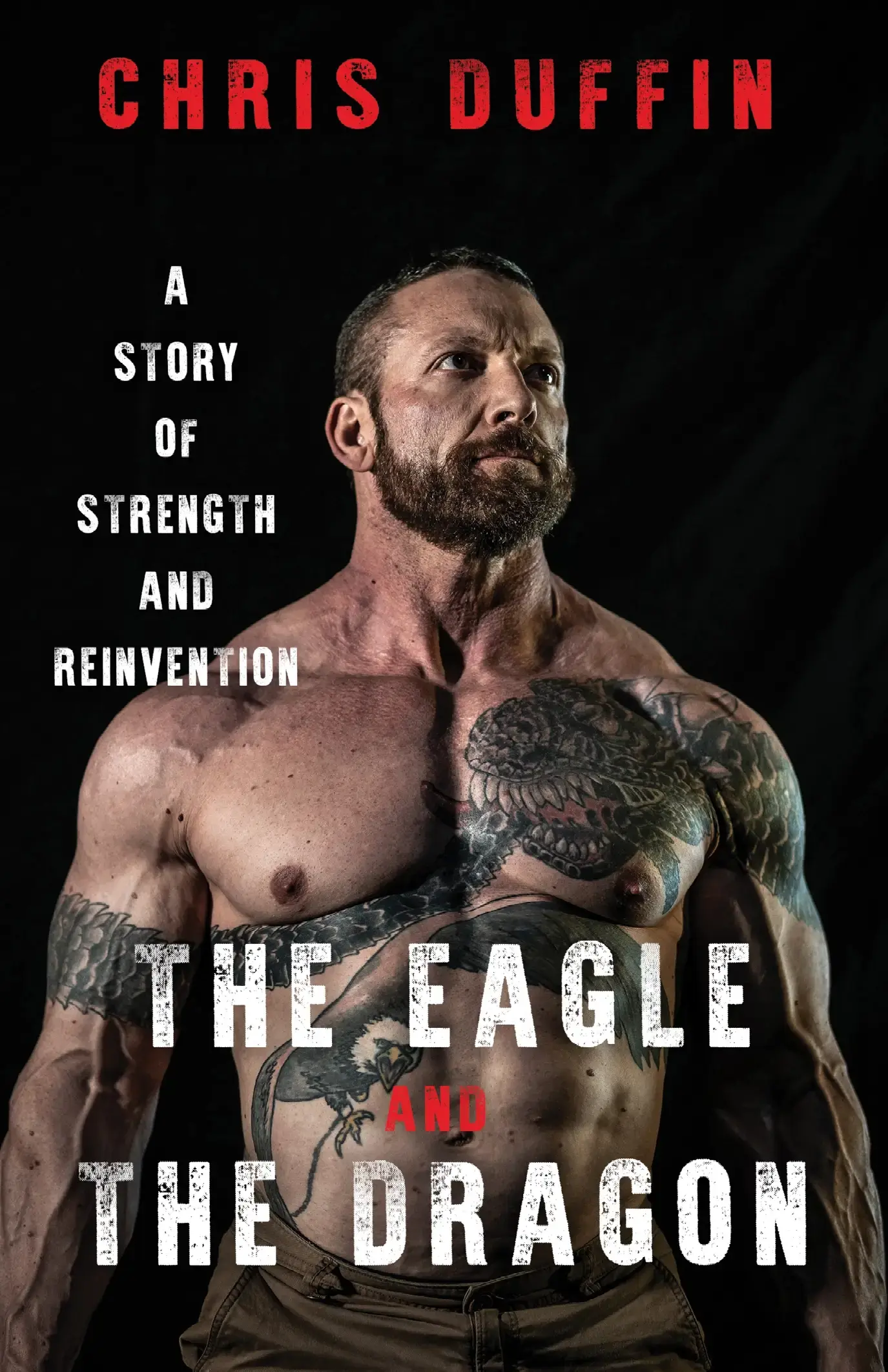
[0:15:50] Chris Duffin: Yeah, well one and you can see it if you see the cover of the book, I’ve got two tattoos that basically cover my entire body and one is two eagles. One covers my abdomen, one covers my back and both of them are shackled to my ankle. So, this is the first half of the book and really what it is saying is you can accomplish whatever you – you can realize whatever your capabilities are, accomplish whatever you can think that you can achieve in life. The only thing holding you back at the end of the day is yourself and so the first half of the book is really about overcoming those things within yourself to realize your full potential and that’s really the first 20, 21 years or so of my life and that is the first half of the book and that is about the time that I got that tattoo done. And so that covers basically again from my ankle all the way up through my torso. The second piece is the dragon and the dragon is what’s called an ouroboros. Which is from some northern European mythology and it’s either a dragon or a snake that’s in a circular fashion and its mouth is consuming its tail and so in my case, this ouroboros encircles my entire upper body. The head and the tail are across my chest and the dragon wraps completely around my arms, my shoulders, my upper back and basically encircles my entire upper body. And so the ouroboros, it sounds maybe gory or people may have some mixed perceptions when you say what that is. That that is eating itself but isn’t, it’s more than that. It is the continual renewal of life. It is creating yourself from yourself. It is the – I use the words for the book, the purposeful reinvention of one’s self. So, it is deciding exactly who you want to be and becoming that person. So, a lot of people and this kind of may tie to the first part of the book as well but you know if you ask them who they are, they’ll tell you a story around some tragedy or something that is created, some story. And I could definitely be that person, right? The story that tells it is about events that happened to them around them. That’s not who you are as a person. Who you are is what actions that you take, okay? What happens, what are your choices? What are your actions? And so, you have the decision to become a different or better version of yourself as well and so the first part of the book if we talk about the eagle is just like moving beyond those environment. Those circumstances, those other things that tell you here is the definition of who you are, okay? The second part is basically not just realizing what you are fully capable of once you remove those set of restrictions that you have mentally around yourself is deciding exactly who you want to be, how you want to be contributing in the world. What impact that you want to have? And just becoming that person through specific dedicated action and so that is the second half of the book. And I got that tattoo done basically around the time that I founded Kabuki Strength and walked away from all of those other aspects of my life, which was more than just quitting my job. There were some relationship changes, other things that happened over the course of that where I said, this is where I’m moving forward in my life and these are the things that are not fitting that and the things that need to change which included some significant changes in my personal life as well.
[0:20:14] RW: Awesome, okay. So, if you had to then issue a challenge to other people. Whether it’s people that are just reading your book that are listening to us right now that are looking to make a transformation in their lives, what would that challenge be?
[0:20:28] Chris Duffin: So, the challenge I have for anyone listening to this podcast, I’ve got a series of questions I’m going to ask and you need to break out a pen, whatever you need, write the questions down, write down your answer but it’s really easy to cheat yourself and you’ll know it if you’re doing it. If you’re not being honest with yourself in answering these questions, you’ll know it. And the only person you’re cheating if you do that is yourself. Really be thoughtful and give some thought to these questions. The first one is, just asking yourself, what excites you in life? Next question is, what value can you add to the world, what contribution can you make? Next question, what do you want to learn? Got three more questions, this is an important one, what type of people do you want around you? Second to last question, how do you want to spend your time? Then the final question, in your life, what challenges do you need to overcome? These are great questions to be asking yourself if you want to sit down and really take an effective stab at goal setting for life.
[0:21:39] RW: All right, how can people contact you if they would like to learn more? If they’d like to – we’ll give them links to get the book and everything but if they like to get in touch with you specifically, for coaching purposes or just to learn more, reach out with something similar, how did they get you?
[0:21:53] Chris Duffin: The main website for my company is kabukistrength.com. My personal website is christopherduffin.com. My full name. I am pretty active on social media so you can find me on LinkedIn, it was a great platform, Instagram is another great platform, my handle there is mad_scientist_duffin and my email, if you need to email me is chris@kabukistrength.com.
[0:22:26] RW: All right, awesome. Thank you so much Chris. Amazing conversation and of course, The Eagle and the Dragon is available at now on Amazon.com. We’ll pick up next time with a new author here on Author Hour, see you soon.
Want to Write Your Own Book?
Scribe has helped over 2,000 authors turn their expertise into published books.
Schedule a Free Consult