Christopher Creel: Episode 343
Read the full transcript
Christopher Creel
Christopher Creel has helped clients build leading research and development teams since 1995, working with major companies such as Hewlett-Packard, Perot Systems, and CSC.
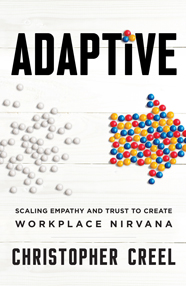
In 2013, drawing on eight years of prior research, he launched a six-year experiment to test whether collaboration technologies could enable new, crowdsourced organizational designs. Three independent studies over the course of the experiment found gains in engagement, productivity, operational efficiency, and risk mitigation. He shares what he learned in his book, Adaptive: Scaling Empathy and Trust to Create Workplace Nirvana.
📚 Books by Christopher Creel
Transcript
[0:00:21] CH: Today I’m joined by author Chris Creel who recently wrote the book, Adaptive: Scaling Empathy and Trust to Create Workplace Nirvana. After years working for huge companies like Hewlett Packard and Pro Systems. Chris dedicated eight years of research and development and six years experimenting the creation of what is essentially workplace nirvana, that is a work environment that is not only successful, productive and scalable, but also allows individual employees to thrive and in an environment they love. He calls this the adaptive workplace. In his book, Chris explains how incorporating technology and to the structure of our companies and new ways can create a more human work experience. He shows readers how ruling out the adaptive model can instil many of the tribal elements that makes successful startups so alluring into larger, more established companies. He lays out for readers a clear plan for attracting, retaining and utilizing the best talent out there today. Most of all, Chris explains why the old way of running businesses simply won’t work anymore. All of this is your competitive edge.
[0:01:38] NVN: Chris, let’s not beat around the bush here. Can you start by explaining to me what’s missing or wrong in the workplace today?
[0:01:49] Christopher Creel: So, I have always found it so interesting that everybody is so miserable at work. It has like this endemic problem that we all suffer through, we all joke about it, we all have this gallows humor about how terrible it is, we joke about our bosses, we joke about our colleagues and it’s just this thing that we all seem so resigned to. I think it’s so hilarious that we’ve put so much creativity into everything else in the world to help us all live happier lives. Technology, food, travel and yet, throughout it all, work has remained this constant misery. You know, we call it work, a friend of mine always, we would joke and say, “you know, they call it work for a reason, you’re supposed to be miserable.” I thought to myself, “is that really true? Is that really true? Are we all just resigned to this?” I started thinking really hard about that years ago. Years ago, I started thinking about this and I didn’t really understand why it was this miserable experience but as I began to think more about it. It occurred to me, it’s just a dehumanizing process. And I don’t know if it was always like this, but I know that it began to become this way back in the 1800s when manufacturing really began to become a more obvious trend in American life and around the world. And when this guy Daniel McLelo was looking for a way to better organize and in his case it was the train with the railroad systems in the northeast, he was looking for a way to organize humans in order to get the most efficient rail system he could. And he came up with the org chart, that’s where this all comes from so when you think about why do I even have a boss? Why do I have a reporting chain. It’s because of some Scottish dude in the 1800s, 1854 who was trying to organize a railroad. And we’ve been living in that world for over a hundred years and not long after that, this other dude comes along. His name was Frederick Taylor and if you look up Taylorism, he’s the granddaddy of the scientific management method. He created this thing called the scientific management method. It was all about measuring every little hiccup and squeak out of every employee to maximize productivity. These two things together, the scientific management method and the org chart, these two things together began this dehumanizing process that lasted all the way up until current day. We’re all expected to behave like cogs in this machine. It’s dehumanizing so of course we’re going to be miserable to some greater or lesser extent.
[0:04:46] NVN: That’s fascinating that the world has changed so much and yet, our work is still based on this antiquated system.
[0:04:54] Christopher Creel: Yeah, it’s really fascinating that we haven’t stopped and asked this question like, “why is it like this again? Can somebody remind me why we do it like this?”
[0:05:02] NVN: Totally.
[0:05:04] Christopher Creel: Well, just goes back to where we were. We’ve been businesses have been organized in the same basic way since the 1800s. Org chart, the scientific management method and none of us ever stopped to ask why it was like that and if it made sense anymore. And what I think is the most fascinating about that is, during the .com boom, from the late 1990s to the early 2000s, everything changed. The internet changed everything and we all began doing new kinds of businesses and completely new industries were created out of like nothing. Amazon and Netflix, streaming, it creatively destroyed huge swaths of our economy and created new swaths of our economy and yet through it all, we retained this antiquated organizational mechanism that again I believe is kind of at the root of why we’re all so miserable because we’ve all been so dehumanized by the whole process.
[0:06:10] NVN: In your book, you talk about this one sector of business that seems to be able to avoid this dehumanization at work which is startups. Why do you think that is?
[0:06:25] Christopher Creel: Because I think it starts with a human endeavor, it starts with passion, it starts with friends, it starts with people who just got to do something. I mean, now that I’m the founder of two startups, I see it live in action and I started another company, gosh, back in the 1980s and it’s always the same thing, there’s a human endeavor in the very beginning. And so when you're in a startup, you are in a tribe of people who are all focused on something that everybody’s excited about. You don’t join a startup like you join a corporation. When you join a corporation, you’re going to get a job, you’re not going to join a family. When you join a startup, it’s high risk, you got to know who those people are, you can’t just jump in because especially if you have a family and you got to think these things through, maybe different for a younger person than an older person, but regardless, it’s higher risk. And so, I think startups when they’re small avoid this dehumanizing process and that organization is important because it’s small and you’re working with people you know.
[0:07:33] NVN: That makes perfect sense. With that in mind, how can established businesses broach that gap, once they are not a startup anymore, how do they retain some of the elements that makes startups more human friendly?
[0:07:50] Christopher Creel: Well, the reason – there’s a tipping point. When the startup is successful, they’re successful and they begin to grow and you need to hire employees and you need to do it fast, there’s really only a one organizing principle that we know of to scale your company and that’s the org chart. The challenge is, the minute you introduce that or or a scientific management method like six sigma or TQM, you immediately begin to strip away that familial, tribal, human experience of the startup and now you got a machine on your hands, that’s what you’re doing and you introduce the org chart into the organization, you introduce a machine. That org chart is meant as a passive control mechanism, so you’re the CEO, therefore you do CEO stuff, you’re the vice president of operations, therefore you’re going to be doing vice president of operations stuff, right? So you’re now expected to operate at a very specific role and so that org chart is designed, is a passive control mechanism and then you have enforcers in that mechanism like managers, a manager, one of their role is to play the enforcer of the org chart. One of the areas of research that I write a lot about in this book is what if, that org chart could be administered by bots? And I got this idea because having been a manager now for decades, a lot of managerial work is very repetitive, it’s very rote, it’s very dehumanizing. You are expected to behave in a very robotic way, you know? You fill out this form and you notify HR about these things. It occurred to me, gosh, what if I could begin to automate a way, the administration of that org chart using chat bots? Having a chat bot, responsible for strategic execution, how you’re using a chat bot for project management and on its surface, that sounds crazy. It really sounds like you couldn’t even do that but it turns out that there has been this fundamental shift in technology where the power of the technology is so incredibly great, like AWS or Microsoft Azure or Google compute engine. These elastic platforms have ever single technology you could possibly need to take down almost any company that’s not in like manufacturing first. If you’re in an information technology company then you could be a threat from somebody digging around in AWS and find out the components to bring together to destroy a business. I’m doing it right now with one of my startups. So with the power of platforms like this, then you can do a lot. There’s powerful machine learning algorithms in those platforms. There’s this incredibly powerful databases of computing technologies and so, you can bring all that to bear to completely automate, well not completely but you can largely automate a lot of the raw administrative work that managers do to administer the org chart. Now, as soon as you do that, suddenly, the org chart begins to become a little, like this purpose, you start to wonder what its purpose really is. That’s where I got into this idea where you could organize a business in a completely different way if you had something as powerful as chat bots that could shoulder the administrator burden of it.
[0:11:27] NVN: it’s so – it initially seems like such cognitive dissonance here that the way to bring more humanity into a company is through technology. Can you speak to that a little bit?
[0:11:40] Christopher Creel: Yeah. This was I think one of the biggest discoveries I had. When I first – I’m a technologist, I’m a programmer, I’ve been writing code since 1979. The internet was born three days before I was on December 9th, 1969 and I was born three days later on December 12th, 1969.
[0:11:59] NVN: That’s very fitting.
[0:12:01] Christopher Creel: Yeah, my book, my life is kind of book ended by this technological explosion. So what I found was, when I first got this idea, I thought to myself, okay, this is just going to be a fun thing for me to do. I did it surely purely for joy. I had no real pressing business demand to do to build a chat bot to manage my projects or help me with strategic execution. I just did it for fun, and then when I did it for fun and I started using it in practice, what I discovered was that I was no longer the nag, I was no longer the pointy haired boss because it was the bots that were doing all the nagging, it was the bots that were like, looking at people’s schedules and making sure everything was lined up properly and everybody had marked their issues correctly and updated their issues correctly. All of that gross stuff, I didn’t have to worry about that anymore. The bot was handling it. Suddenly had a lot more time on my hands and the question became, “what am I going to do with that time?” And so what happened was I transitioned into more of a coaching role. Instead of being in the task master, I became the sport person to look for ways to help my team become just more effective and efficient. That with some really fascinating transition for me and that’s where I realized that these bots can take over all the stuff that makes us miserable, leaving us with the opportunity to actually work and strengthen our relationships. Become a more effective team because you know what? If I have a project manager who is really great and filling out some kind of a project management report, that is really not going to help us as a team. It’s not going to help us be a more cohesive, more effective team. If I were to outsource all that to a robotic administrator and give us the time to actually connect with one another and talk through the issues of learning each other’s strengths and weaknesses, that’s a way more productive use of human time.
[0:14:04] NVN: Talk to me a little bit about how empathy and trust play into all of this and specifically, how they trickle down to an impact that cogs in the wheel now no longer cogs in the wheel obviously.
[0:14:23] Christopher Creel: Yeah, this is a really fascinating subject for me because I believe that we do not do ourselves any favors with collaborative technologies at the workplace like email or Slack or Microsoft Teams. I actually think that these technologies can do more harm than good, which is ironic because a lot of my book is about why you as a company should deploy Slack. The reason I say that is because look at Twitter. Or look at Facebook or look at any platform where the primary model of communication is through chat or something other than a face to face conversation. When you take that face to face component out of communication between two individuals, it can get nasty really fast. In fact, there’s old internet rule called Godwin’s law. It was this guy’s, I forget his full name but you can look him up on Wikipedia and he wrote about how if you look at any forum, regardless of the topic, it will eventually devolve into somebody calling somebody else Hitler
[0:15:40] NVN: That sounds accurate.
[0:15:42] Christopher Creel: It could be like about chocolate chip cookies and the next thing you know, it devolves into Hitler. Case and point, I’m looking up a chocolate pudding recipe the other day because I wanted to make some chocolate pudding with all these eggs that I get from my chickens and I swear, six comments down, somebody said, “hey, you know, don’t talk to me like that.” I’m thinking to myself, guys you’re talking about chocolate pudding in a forum and what got you talking, they’re all typing. Anyway, here’s what happens. Is that kind of communication strips away opportunities for building empathy and trust because you can’t read the other person’s facial expressions? You’re disconnected, they could be anonymized and this happens in companies I think all the time. With flaming emails and people who detect a slight from a colleague which isn’t really a slight or maybe it is a slight. I think that the kind of communications that we largely deal with in corporations today is dehumanizing. And it gives us lots of opportunities to not trust one another. And so that lack of empathy and trust, dehumanizes us even more. It breaks down the social fabric that we as humans really crave. This was actually something that I decided I was going to try and tackle with these chat bots and so what I did was, I began using some very simple natural language analyses when people would interact with the bot or when people would interact with the bot and that bot was facilitating a conversation between two people. Let’s say about an issue or a strategic objective or the progress update on an initiative. This bot that I built would facilitate that communication between the individuals and when it would detect things like negativity or irony or somebody who was saying something that you know, was maybe kind of a little of kilter, the bot could simply step in and attempt to correct the conversation because if the bot was confused then the person on the other end was probably be confused as well. Once I did that, I noticed this extraordinarily powerful transition in the way that people were communicating with one another. Not only in chat but also in meetings. It actually –
[0:18:10] NVN: Interesting.
[0:18:11] Christopher Creel: Yeah, it actually translated into spoken communication in meetings and people would actually pick up on it, they would actually make reference to well, you know, the bot would probably be upset because of the way I said that so let me try again.
[0:18:26] NVN: So just to make sure I’m clear on this. Basically, the bot is integrated with Slack or whatever communication technology you're using and then it just pops up and says hey, that’s a little snarky or whatever it is the bot says. And the user has the chance to correct it.
[0:18:43] Christopher Creel: That’s right. When you're talking about like for instance a project update or an issue update or collecting feedback about somebody to help them level up their game, it’s really easy, it’s like super easy for us as human beings to be very tone deaf in our written communication, especially if you have certain assumptions about your relationships. So if you assume that you are friends with this person or whatever else, you might say something in written communication that you think is funny, if you throw a little irony in there, but then the person on the other end reads that and they might not get the joke. And this happens constantly. As a result, it begins to fray at the edges of our social network and it impacts business results. And so one of the things we were doing, one of the areas of research that I pursued with this bot is looking for ways that I could detect language that would impact empathy and trust.
[0:19:51] NVN: So basically, what employees are getting now is coaching for multiple directions so the managers are freed up, they have more time to coach and then also, there are these little nudges from the bot every now and then just to be more aware or whatever else they might do based on how they’re integrated?
[0:20:10] Christopher Creel: Yeah. Then, what we did was we programmed this bot to then going to like 360 degree feedback from everybody in the organization. So they would go off, the bot would go off, it would fan out and poorly basis and say hey, “you guys have been working together on this initiative or this project or this issues. You know, would you be interested in providing feedback to this person on how they can do better next time?” Now, typically, this kind of feedback only ever comes from your manager and this actually goes back to our earlier discussion about how these bots really changed the way the companies organize. So, historically, all of your feedback came from your manager. You’re basically putting your entire career in that person’s hands. Which if you think about it is kind of crazy.
[0:20:57] NVN: Yeah, I mean, also, because for a lot of reasons but as you explained it, it sounds like a lot of manager are presumably over tasked by all the mundane details and nagging they have to take care of. So you’re already at a disadvantage.
[0:21:11] Christopher Creel: Yeah, what’s interesting is that your relationship with your employees is heavily colored by this relationship, this managerial relationship you have with that person. So there’s that, there’s the fact that this person might have 15 direct reports and so they can’t really give quality feedback to each individual. Furthermore, a lot of times, those managers don’t actually know what that person is doing on a daily basis and yet, here we are as companies expecting the manager to provide all of that person’s feedback is if they’re somehow the authority on this which is just patently not true. The people that are the authority on how well a colleague performed or how well an employee perform, are the people that person’s working with. And so what we did with the spot was say, “okay, at the end of the quarter let’s gather up feedback from everybody in the organization.” So that is a pretty straightforward thing to do, but then what we did was as we were collecting the feedback, the bot would look at the feedback and run some natural language analysis to say, “hey, this particular comment might actually damage this relationship with this person, you might want to rethink it.” You might want to think about writing this in a different way. So what’s cool about that is that now, people have this opportunity to not just provide feedback, but provide really powerful productive feedback with this constant coaching from this bot that is looking at their language and giving them tips on how to improve it. No manager could ever have the bandwidth to do that, but bots do. Bots can do it all day long.
[0:22:53] NVN: It also strikes me that you in doing things like this are shifting from a culture of obligation to a culture of accountability.
[0:23:06] Christopher Creel: Ooh yeah, that is a really cool way of putting that. Yeah, so accountability is ironically something that most corporations are terrible at. You know having been in corporate America now for gosh, 30 years I can tell you that my experience in general with companies big and small has been accountability is uncomfortable. Holding somebody accountable for a thing is uncomfortable. Holding a person accountable for a thing also requires a lot of discipline. You have to know in the moment that that person needs to be held accountable. Accountability is just this generally difficult thing for corporations to actually drive through their organization. A lot of people talk a good game about accountability, but they do a very poor job of actually driving through the organization. A lot of this I think it goes back to a lack of empathy and trust. It is hard for you to hold somebody accountable if that person doesn’t trust you. Some of them are going to see it as a front and so it becomes uncomfortable. Bots on the other hand they don’t care. They can hold somebody accountable and you can design that bot to do it in such a way that it is productive and healthy, a pleasurable experience. But they are always there. They are always on task and they can hold each individual accountable for following through on whatever it is that the bot is working with them on and in doing so, now what you can do is again, you can begin to create this extraordinarily cohesive organization, where everybody knows that they are being held accountable by a bot. They are doing this in the spirit of creating a cohesive team, they are being coached. Their language is being coached in their interactions with their team members in such a way that they are always looking for the most beneficial powerful positive psychological effect they can achieve as per the bots’ guidance and so in the end, what you end up with is a group of people who have much deeper relationships with one another. In fact when we ran this model, one of the things that we found in our engagement surveys was that the degree of responsibility that each individual employee felt for one another was so much higher in this model using these bots than outside of this model where you are using more traditional techniques.
[0:25:38] NVN: Let’s talk a little bit about the impact this has on individuals. Are there any stories that stand out in your mind? About a person or individual people who you have seen transform by implementing this.
[0:25:55] Christopher Creel: Oh goodness, I’ve got dozens of stories like that. So here I’ll share a very specific example. So there was an individual on our team who when they came to us, they were institutionalized. They come from a large corporation, when they joined us they were shell shocked by this approach that we had taken because in the absence of a specific organization that we ran these bots in had no reporting structure. There was no manager. Everybody it was this very fluid, flexible organization, no hierarchy, no reporting chains, everybody had accountability to a particular thing, but there wasn’t a boss per se. And so this individual came to us and it was very unusual for them and they struggled. They struggled really quite mightily for the first quarter of their experience with us. So the bot fanned out, collected the feedback on this individual and they did terribly but what was interesting was all the feedback came to them saying, “you have so much potential, there are some things that you are clearly struggling with. We want to help you.” So there’s that degree of empathy. The team members saw the potential of this individual and provided them with feedback with the bot coaching them on how to provide the best feedback in real time through in this case, Slack and so that person when they read that feedback, we were then able to work with them to come up with very specific targets for them to pursue. That person went from having some of the lowest scores in the organization to literally having the highest score over the course of about six months. Most people in that situation either would have quit, they would have gotten fired, maybe they would have been sidelined because it would not have been clear exactly what was going on and they might not have realized how much faith the organization had in them and they would just have felt isolated. But in this case, because the team was supporting them and the bot was facilitating that communication that individual ended up just doing great and I just have story after story of like that of people who came to the organization, went through this experience and walked away telling me that they themselves felt as though they had learned. In fact one person told me that they have learned more in three months than they had in three years, prior.
[0:28:20] NVN: What really strikes me about what you just said is workplaces can be incredibly isolating even though you’re surrounded by people a lot of time. and I think it is a tendency of human beings when we feel isolated to make up stories in our own head and to react to those scenarios as oppose to reality. What I love about what you are talking about is letting people know how their perceived and valued. Of course also how they can grow but I think that there is so much to be said for letting people know what they are doing right.
[0:29:00] Christopher Creel: Yeah that is a really interesting perspective. I think you’re right and I think that this is especially true as companies begin to realize that remote workers are more productive than in office workers, that is just a scientific fact. But remote workers also are incredibly isolating and so as a remote worker, you’d feel doubly isolated but even people who are in the office I think you’re right. I think they also feel isolated and what is interesting about the way that most people get through their days is they just assume that everybody is doing a good job. They don’t assume that they need to give somebody a pat on the back or whatever. The bot that we developed what it would do is it would regularly go out to collect this information. It was constantly probing the organization to see how things are progressing, how things are going and so what it would do is it would give you evidence of the organization’s either strengthening or weakening. It would give people this constant feedback of how they’re doing relative to everybody else. And so all that to say that I don’t think we spend enough time checking in with our colleagues to see how they’re doing, to give them a pat on the back, let them know the good things that they are doing and the things that they could be doing better. I just don’t think that we are good enough about that nor I think that anybody expect us to be like that because again, we just get our blinders on. We just go. What this bot is doing is it is taking over the responsibility of collecting this information incrementally along the way and trying to look for ways to push the trend upwards of everybody’s performance, always looking for ways and nudge somebody who performs a little higher and again, it is an administrative task but it is an administrative task that I don’t think many of us are very good at. But the bots are great.
[0:30:55] NVN: I have to imagine that in addition to the benefits the individuals experience from those business results have to see a positive impact too. I know you already mentioned higher engagement. Is there anything else there?
[0:31:10] Christopher Creel: Yeah, so we ran that experiment over the course of six years and so over the course of six years, we ran three independent engagement surveys that were independent of the experiment. They were just a corporate wide engagement survey. So the great thing is that we had a control group. The control group is the rest of the organization and we had this group it was at any time range between 50 and 200 people and the engagement scores. Just the engagements scores were in the high 80’s low 90’s for those groups over the course of that six years for those three separate engagement surveys. That all by itself was amazing even our CEO said, “I have never seen any engagement scores like that before.” In addition to that though, we also produced first that this model that team operating that model was responsible for creating the first data analytics practice for my previous company, that eventually a year or two of me starting that with this team yielded a billion dollar buy out because of the team that we had pulled together, the capability that we have built up and that then translated into a billion dollar buy out. That work was them parlayed into a new team. So we took that team, we said, “okay, go off and do your thing.” We started off a new team with this model and they produced three very powerful market transforming technologies that the rest of the company had been unable to produce for as long as they have been around. So the output, the innovation, the creativity from groups operating this model it’s clear. I have seen it now at least four or five different times, enough that I realize that I have to go do something about this and the engagement scores along the way are always sky high. The thing that I think a lot of companies miss is why any of this stuff is important like why is engagement – let’s say engagement is great, fine. Let’s say you got a team really producing stuff and that’s great too. But at the end of the day, it all has to focus on strategic execution, right? All of this stuff has to roll up to a strategy and that is actually another place where companies fail is they can’t execute against their own strategy. You know there is these big consulting firms that spend millions of dollars, helping customers create a business strategy and then when they go to execute it, they just fall over. Why do they fall over? Because strategic execution of strategy that is like the motherload of administrative overhead. It is trying to get the entire organization to align themselves with a corporate strategy and focus all of their energy then on driving that strategy to completion that is an administrative nightmare. There is just no way anyone human could ever do it, which is why the vast majority of business strategies either fail to some, they all fail some greater or lesser degree. And in 30 years I have been doing this, I have never seen a company big or small, name brand or not be able to actually execute to completion a business strategy, most of them get forgotten along the way. What we found here was these bots could orchestrate the execution of that strategy across the entire organization no matter how incredibly complex that execution model looked like because it is a bot. It knows, it can do all of that stuff, then it could offload all that administrative work to the bot and let the humans focus on the important work of making that change happen.
[0:35:01] NVN: So speaking of rolling out strategies, business owners were listening to this and who are intrigued, this is a lot to change in a business. What would you tell them is the one thing that as soon as they finished listening to this podcast, they can go out and do to get headed down this road?
[0:35:24] Christopher Creel: Okay, so a lot of people actually are on this road they just don’t know it. So Slack, Microsoft Teams, these technologies are already out there. I have actually spoken to a number of companies, big and small who already are using Slack probably quietly. I actually talked to a large financial organization and whether I was in a meeting, we were talking about this adaptive work and he said, “well, we wouldn’t do this because we don’t use Slack.” And the guy sitting next to him at this table looked down and he chortled a little bit and I looked at him and I said, “let me guess you have it on your phone right now?” And he said, “yeah, I totally have it on my phone right now. I use it to communicate with my family and I am also using it to talk with people here at work about different things.” That to me was like I get it, right? This stuff is already happening. People crave this kind of collaboration and communication. Where most companies are screwing this up is that they roll these platforms out and they’re like, “godspeed everybody. Good luck. No training, no roll out strategy, no rules around how we’re going to use this thing.” And so people just fall into it but I guess my advice to business leaders is look, this stuff is already happening. It is already out there, trying to stop it is like trying to stop water, you are going to fail. The best thing to do would be to embrace it and embrace it in a big way. Come up with a communication strategy around it. Come up with some rules of the road, update your employee handbooks so that the employees know what the rules are for using these technologies and its appropriate use. Just doing that, forget about the bots, forget about all these other stuff, just do that and suddenly what you are going to see is a breakdown in the silos that people are complaining endlessly about because those chat platforms, they don’t care about your damn silos. They are going to let people communicate and work with one another to solve problems, independent of the silos and so I would say the one thing you could do is just implement a chat platform, but do it in a very mindful way with an eye towards empowering employees to solve problems with one another regardless of where they are in the organization.
[0:37:39] NVN: So for most companies, does that mean moving away from the email we’ve all become so comfortable with and basically shifting all internal communication over to Slack or whatever their collaboration platform of choice is?
[0:37:53] Christopher Creel: Well, yeah and I don’t know that we’re all that comfortable with email. Honestly, if you have ever had email trail of like 50 cc’s and you got an email thread that lapse for like 50 emails and you are thinking to yourself, “please let me go off of this thing” –
[0:38:12] NVN: Let me switch that word to a custom too.
[0:38:14] Christopher Creel: Yeah, I guess a custom too would be good. But it is I think high time for companies to completely reconsider their communication platforms. Email is horribly insecure. It is horribly insecure. With one email you can forward an entire thread of intellectual property outside of to another person. You know, think about how many times that has bitten companies where some disgruntled employee says, “screw it, I am going to forward this spreadsheet or this flaming email thread to my personal account and then I am going to post it on a forum someplace.” The email is one of these technologies that its time I believe is coming to a close and in fact when I was with my last company, one of the things that we did was we just said, “look, we don’t need email addresses for this team.” They are not communicating with people on the outside. They are not sales people so they don’t have to talk with customers. This group is entirely internal. If you have a group that’s entirely internal, ask yourself why they need an email address. Almost always it’s because of compliance reasons. The company has to deliver training notices to employees through their email system. But you can do that just as easily through something like Slack and it will be way more effective, way more secure and you get this incredible collaboration platform to side benefit.
[0:39:42] NVN: Perfect. Chris thank you so much for joining us. I think that all of us have at one point or another had an experience in a dehumanizing workplace. So this information is really incredible to hear and it is wonderful to imagine what work could potentially be like.
[0:40:01] Christopher Creel: Well thanks for taking the time to talk with me. I am super excited to see where this is going to go. I see the trend is already there, it is already happening and my message to executives is, “stop and step back and look at this trend for what it is because you can leverage this. You can harness the power of these trends that are already out there and that will be way more effective for you as a business than just letting this wash over you.”
[0:40:34] NVN: Beautiful. Is there anything I didn’t ask you that you want to make sure we get in here?
[0:40:41] Christopher Creel: I just want to make sure that we get the right material in there so that they realize that this is already happening. This trends are already in place. They are only going to strengthen over time and you’d have some choices to make as a business leader. Your choice is to either ignore these technologies, which you are going to do at your own risk because I promise you, your employees are already using this stuff. You could choose to do a limited deployment of these kinds of technologies. And say, “okay, I am just going to have a chat platform.” And that’s fine too but unless you do it with an eye towards empowerment, people simply aren’t going to use these platforms. They are just going to stay in their cow pads of their daily work life, which is email and whatever else. What I am suggesting is see this as a turning point in your company’s way of competing in a market place. They use these platforms and use these bots as a way to harness every single available cycle that your company has to offer to execute against their strategy. That’s where I think there’s this big shift because the problems that companies have to solve these days they are getting bigger and bigger. Competitive landscapes are changing, the technologies are changing, workplace demographics are changing, all of these things combine to create really big problems for companies. Smaller startups, they are able to solve these problems quickly because they are small, they are nimble or agile or whatever but they are going to run to the same issues themselves as they grow. And then they implement a work chart. My point here is big corporations need to be able to solve big problems. They can’t use traditional techniques anymore because those traditional techniques were never very effective in the first place and even when they were enabled them to solve smaller problems. Here, in order to solve these big problems you need to think about something differently and the point of this book is all the tools are sitting right there in front of you. They are not that hard to use, if people are already using them. So just recognize that the power is within your grasp, you just got to think about this new ecosystem of technologies as a competitive advantage, not in some kind of a threat to your organizational stability.
[0:43:10] NVN: All right, thank you Chris.
[0:43:12] Christopher Creel: Thanks.
[0:43:14] NVN: Thanks for joining us for this episode of Author Hour. You can find Chris’s book, Adaptive, on Amazon and a transcript of this episode as well as other podcasts at authorhour.co. For more Author Hour, subscribe to this podcast on your favorite podcast service and if you’re feeling it, we love reviews. Thanks for joining us, until next time –
Want to Write Your Own Book?
Scribe has helped over 2,000 authors turn their expertise into published books.
Schedule a Free Consult