Jedidiah Yueh: Disrupt Or Die
Read the full transcript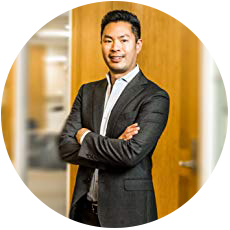
Jedidiah Yueh
Jedidiah Yueh is a serial entrepreneur and the bestselling author of Disrupt or Die. He founded Avamar, a pioneer in data de-duplication that was acquired by EMC in 2006, and later founded Delphix, a data platform used by a large share of the Global 100. He graduated Phi Beta Kappa and magna cum laude from Harvard University, and in 2013 he was named CEO of the Year by the San Francisco Business Times. In Disrupt or Die, he shares the innovation frameworks he developed over two decades in Silicon Valley to help companies survive and thrive in the digital era.
📚 Books by Jedidiah Yueh
Transcript
[0:00:21] Charlie Hoehn: You’re listening to Author Hour, enlightening conversations about books with the authors who wrote them. I’m Charlie Hoehn. Today’s episode is with Jedidiah Yueh, author of Disrupt Or Die. Jed is like the Mohsen Taleb of tech. He believes a lot of the people who teach innovation in books like lean startup or the innovator’s dilemma don’t really know what they’re talking about. Jed has the resume to back it up. He’s invented and shipped software products that have done over four billion dollars in sales. He has over 25 patents, he’s found a two software companies that created thousands of jobs and are used by tens of thousands of companies around the world and he’s super smart too. He graduated from Harvard where he was a US presidential scholar. Which means he was one of the top academics in the country. And before his first company, he wrote an 800 page epic fantasy novel that he never published. In this episode, you’re going to hear him tear into Elon Musk, Google, Facebook and a whole bunch of others, it’s very entertaining. Now, here is our conversation with Jed. I started out as an English major in college. Like many people, I didn’t know what I wanted to do in life, I didn’t know that I wanted to be an entrepreneur, I didn’t know that I wanted to work in technology. In fact, if you ask me, I would have said that I would have become an author or an academic, maybe a professor in English. When I started working for a technology company down in Southern California, I took a consulting gig for one summer. I really felt like a fish in water. When I first started to learn about technology, the way I learned about it was through Yahoo searches. At the time, Yahoo was still the dominant search engine for the internet and I just use Yahoo to fill in all the blanks I had about how technology worked. Everything from operating systems to file systems, to software itself. The amazing thing with the internet today is all the information that is there. You just have to have the desire and the perseverance to get the information and make sure you understand it at a foundational level. One of the things I tell people who ask me about how to get started with their businesses is that you must understand things all the way down to the root principle. You have to understand things to the point where you can create with the concepts. You’ll know you’ve reached the right level when you can take these concepts. Abstract, architecture and design that make up technology products and software products and you can start inventing with them. You’ll know you’ve hit the right level when you can create a product and you know it will work, you don’t have to ask another expert, you don’t have to talk to software engineers. You understand the concepts well enough that you can assemble the Lego blocks and you know they will work and that they can be built into a product. Yeah, Jed, so tell me about the first time you did that. When was the first time that you invented a product?
[0:03:45] Jedidiah Yueh: The first time, I was actually sitting in a coffee shop in Irvine California, Deidrick Coffee shop in Irvine California. I was really thinking about some of the big trends that were happening in the data protection market. Back in 1999, companies used to back up the same data over and over again on to tapes. In the consumer space, you could see that TVO had already launched and MP3 players were everywhere. These consumer products that we’re taking concepts, that we’re taking tapes from video cassette, you know, these consumer products that we’re taking video on tapes and audio on tapes and moving them into disk and dramatically improving the user experience. I had the idea that if you applied that same concept, take these consumer concepts like TVO and MP3 players, you could apply it to the enterprise tape backup industry and you could have a similar impact on user experience and quality. Once I had that idea,, it was really just a matter of breathing life into it of finding the right team that could really architect the solution the right way and then build out a product that we could start selling to customers. At the time, the enterprise tape backup market was roughly five billion dollars in hardware and software and over the next decade, we actually completely transformed that market.
[0:05:08] Charlie Hoehn: How did you know that that was the right opportunity to jump on? Right? I imagine a lot of people feel that they have these ideas of combining this one thing with another or seeing something that’s working in another industry and applying it to theirs. They don’t know if it’s the right idea or how do you know, “this is a good idea, I need to pursue this.”
[0:05:38] Jedidiah Yueh: I call it a process of thinking big and small. The first thing you have to do is you have to take a look at the overall market, what’s happening in user experiences and you have to find what I call a value seam. A value seam is this big opening gaping hole that’s developing in the market that just needs to be filled by the right product and the right solution. I’ll give you an example of the first value scene that I came across. Back in 99, all these companies were backing up the same data over and over again on the tape media, French fry’s data protection. You could see that the cost of disk was plummeting on a per gigabyte basis versus tape on a year over year basis. This goes getting cheaper and tape was a terrible media for enterprises used because it’s hard to recover the exact data you want, it’s a highly fallible media. A lot of backups and a lot of restores would fail. Because of these high failure rates and because disk was catching up to tape in terms of per gigabyte pricing, you could see that there was a big opportunity, a big scene opening up in this five billion dollar hardware and software market.
[0:06:44] Charlie Hoehn: Well you noticed the change in the pricing. Most people that change is happening too slowly or it’s not right in front of them, they’re not monitoring. How did you notice that pricing change, apart from the fact that obviously, technology tends to get cheaper over time?
[0:07:03] Jedidiah Yueh: It was pretty highly publicized and I was working, before I started my first software company. I had a consulting gig where I was working at a startup that was building optical disk juke boxes as network attached storage devices. Juke boxes for storage for enterprise data storage. At the time, you could see that disk was the most expensive but the fastest access media, optical is cheaper and faster than tape which was the cheapest and the slowest. If you just charted out the pricing, you could see the disk was falling faster than these other two media types. Because I was already working in that industry, it was natural to do a little bit of research about what was happening with the media economics of the market. The key thing is to understand what are the big things that are changing within markets. If you find something that’s really big, that’s really compelling, then you found the value seams. The value seams are very compelling. Once you see them, they change the way you look at the world and they open this opportunity for you to fill with the right product.
[0:08:08] Charlie Hoehn: Can you give an example of a value seam that you see right now?
[0:08:16] Jedidiah Yueh: A few months ago I met with the president of a top 10 bank and he mentioned that one of the biggest things they worry about today is this enormous demographic shift that’s happening with millennials. Millennials today don’t want relationships with banks and relationships are the mainstay of the power of banks with all the wealthy and all of the people who invest in incredible amounts of capital in the market today. But millennials today, the just want an app. They don’t want to talk to wealth advisers, they don’t want to talk to bankers. They want to have a transaction through an app. What’s happening is there is this generational divide that’s changing the world in the financial services market, one of the biggest markets and one of the biggest industries around the world. As millennials changed their behaviors and turn away from human interactions and human relationships, it’s opening this enormous opportunity for new companies to come in and change the financial services market. That’s a really big change in the market, a really big value seam that’s emerging over time that one or many companies can take advantage of if they ship the right product.
[0:09:25] Charlie Hoehn: Just out of curiosity, do you see any products coming out that are filling that or taking advantage of that value seam?
[0:09:34] Jedidiah Yueh: You can see a lot of the biggest tech companies, what I call the tech super powers, they’re already adding payments into their platforms, it’s just a short leap from there, for them to add in things like savings and checking and the other elements of banking that are required to become a full-service bank. A lot of the big banks feel like they’re insulated, they don’t see these big tech companies signing up for the regulations of becoming a big bank. If you look at what happened just recently. When Amazon bought Wholefoods, they change the threat landscape for companies around the world. Today, companies don’t have to just worry about bottom up disruption from startups. They have to worry about the tech super powers coming in and buying a significant company in their industry and instantly leaping into the frey at a really large scale and with their entire massive user bases and platforms. When you look at companies like Facebook or Apple, they already have more, Google, they already have billions of users so they have an incredible platform and an incredible advantage. If they put out a banking app, the could instantly take over banking for billions of people in the world. I don’t think the regulatory issues are stopping the tech super powers from moving in to new industries. I think right now, they’re still focused on their core markets. They still have room to grow and their core advertising and search and social media markets. When they run out of room and they’re looking for new avenues to grow, that’s when they’ll start looking at markets adjacent.
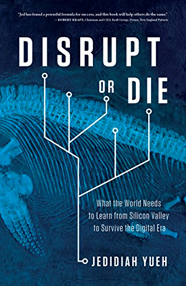
[0:11:13] Charlie Hoehn: Interesting. Let’s talk about your book, Disrupt or Die. What is the one thing that people need to know from your book? If you had to pick one, I know there are many.
[0:11:27] Jedidiah Yueh: I think really the key is that the world is changing very quickly and that anybody can be an innovator, many people feel like they can’t go out and build an app, that they can’t go out and start a technology company and I wouldn’t have thought that it was possible for myself either except that I actually manage to do it. The key thing is, we have in our minds what I call the innovation glass ceiling. We believe that innovation, being a founder of a software company that these are the things that are reserved for the techie lead. In reality, it’s getting easier and easier to disrupt just about any industry, easier and easier to build an app that can take down enormous markets and build huge user bases. People forget that if you dial all the way back to the beginning of Facebook. It only took Mark Zuckerberg one week to code up the Facebook platform, put it online and it went immediately viral across the Harvard campus. From there, he attracted so much attention that a lot of resources, a lot of big executives, people like Shawn Parker and then Peter Till. They all came to Mark Zuckerberg to help fuel the digital avalanche that he had created. It’s a very small spark that’s necessary to create the right kind of digital avalanche. You need to have the right product in the right value seam that’s emerging in the right market and if you have that, you can trigger that digital avalanche.
[0:12:52] Charlie Hoehn: Do you think that Mark Zuckerberg was sort of in the right place at the right time? Or do you feel that his success could be replicated much more across all these different industries and it just simply hasn’t happened yet because people aren’t realizing how easy it is to innovate?
[0:13:17] Jedidiah Yueh: Mark was clearly in the right place at the right time, there will be these value seams and the prime moment when you can fill a value seam with the right product and he was there at the right moment for one of the biggest value seams and in the history or mankind or in the history of capitalism. The reality is that you could still invent these products to take on new markets in almost every industry. Even in the social media world, if you look at Snapchat, they came quite a bit later and it was a simple idea, you know, Evan Spiegel and one of his – Evan Spiegel was with one of his frat brothers who had just sent a picture to a female and he wanted to get the picture back because it was self-incriminating and when he mentioned that to Evan Spiegel. Spiegel jumped up and said, “that’s a million dollar idea.” That’s all it took for them to come up with the idea for Snap which is a decillion dollar company in the market today so even many years after Zuckerberg built Facebook, you still have the opportunity to build incredibly sized, incredibly fast growing companies like Snap.
[0:14:26] Charlie Hoehn: You know this industry better, far better than many of the tech people I’ve spoken with. People in the startup world and you have some really strong opinions on some of the biggest companies in the world, some of the most well-known founders, can you give your personal perspective on this because I found it fascinating what you think of the founder of Facebook, Evan Spiegel, Elon Musk, can you kind of just share your perspective on this because I think it’s really valuable.
[0:15:05] Jedidiah Yueh: One of the interesting things that’s happened in the world is, we’re seeing a lot of unintended polar consequences. When you look at a company like Facebook, Zuckerberg put a mission in place to connect people and to bring people together. But his platform has actually been incredibly divisive, it’s created this filter bubbles that we’ve heard over the news over and over again. That really divided the United States into red and blue country and you really have to think about what is happening in the world, why are platforms like Facebook, why are social media platforms like Twitter and Facebook, having their incredible effect on the world around us. The first thing to remember is that the internet and the rise of the tech companies destroyed the power of centralized media. A few decades ago, everybody gathered around in their living rooms and watched the evening news and you had highly respected TV broadcasters who would disseminate news that they had highly vetted and that ensured was truthful and accurate. Just 20 years ago when you had Bill Clinton and Tony Blare in office, centrist politics were really at the helm of the global political landscape and yet today, the world is really being dominated by populism. It’s not just Trump that we have to worry about, it’s a world of Trumps. What’s happened is the power centralized media was completely fractured by the internet and the tech giants and then what’s replaced it is the millions of voices that appeared on Twitter and on Facebook. Millions of people who could influence their tens, hundreds or thousands of friends in networks that they build on social media. With all of these voices, how do you sort out which voices are going to be heard by the largest population. It ends up being a problem that’s best handled by algorithms or by AI. What happened is, Facebook and Twitter, they put it in these things called feeds that we all look at every day compulsively on our phones and these feeds, they decide what people will see, what we’ll get propagated across all of these mobile devices, all of these phones or all of these web browsers. Based on what’s likely to trigger a real response from the users. Things that will create an emotional response, positive or negative and so they end up preying upon the biases and the worst parts about human nature. People tend to want to hear things that they already believe in which makes them fall further and further into their own camp and they also respond very heavily to things that really create indignant outrage. Things that really make them angry and that forces them even further into their camps. These feeds by preying upon things that will create a reaction within users and get users to keep coming back to these feeds, keep scrolling down to these feeds, they’re dividing people further and further into these filter bubbles. It’s that combined effect of dividing people further and further into polarized camps and the fall centralized media that’s created this situation where companies like twitter and Facebook can actually influence the outcomes of our political elections and put people like Trump in office. It’s the exact opposite of what they wanted to achieve. Instead of trying to bring the world together, they’re dividing the world into more and more polarized camps. If you look at somebody like Elon Musk, he’s another person who really can have an incredible impact on the world. He’s built amazing companies. If you look at companies like Tesla. Well, they’re trying to solve global warming by pushing out electric cars, by replacing gas driven automobiles to electric cars. But by adding self-driving and automation features into all of their vehicles, Tesla actually makes it possible for AI to use vehicles against mankind. We don’t know when super AI or general AI will emerge, it might be 10 years, it might be 20 years, it might be 30 years from now but if there’s a huge population of automated vehicles on the road, AI could potentially take control of all of t hose vehicles and use them as the vehicle for mankind’s destruction. When these innovators, when they create their solutions for the world, when they create their platforms, they might have an intended goal but they might actually have the exact polar consequence on the world around them. Another great example is Google. You look at the founders of Google. One of their motto is don’t be evil. It’s part of their code of conduct and they really pus that out when they first went public. They really publicized that when they first went public. Don’t be evil. Yet today, the core of their strategy is all center ground AI and if they build AI, if they actually create general or super AI, what if that AI wants to wipe out humanity, what if that AI is the same AI that’s depicted in movies like the terminator? They Skynet of the world that want to create thermal nuclear war and eradicate mankind? In their pursuit of being the top technology company and the top company in the world, they might actually do the ultimate evil upon the world which is very ironic given their motto.
[0:20:13] Charlie Hoehn: What I’m really curious about with your perspective on this is how do we avoid these dynamics? If we are innovators, how do we innovate carefully in a way that isn’t going to damage the world more than it could help?
[0:20:32] Jedidiah Yueh: It’s a great question. I think if you look at companies like Facebook. Today, they’re still using algorithms as their primary method of trying to solve the problem but you can’t delegate these problems to algorithms and AI because you can’t have full control of the unintended consequences. Facebook for instance, if they really wanted to make a difference, if they really wanted to bring back truthful news and centrism in the world, they could go buy the New York Times or they could go buy the Wall Street Journal and they could buy Twitter as well and they could disseminate that content from these dedicated editorial boards to all of their users for free. That would be something that they could do that could really change their impact on the world today. They could actually provide enough excellent content that it also could help their business. It doesn’t even have to be contrary to their business. For people like Elon Musk, it’s easy. As he’s finding a plan B for planet earth and creating space X and trying to get rockets out to Mars, it’s really a matter of thinking, how can these things be used against mankind? What if AI hijacks the rocket ship to mars? Then AI would be able to colonize Mars as well, what if AI took control of the boring machines that the boring company has built and uses it to tunnel beneath all the major cities in the world? One of the things Elon Musk has started is this company called Neural Link where he’s trying to create a neural lace that turns humans into cyborgs. Well, wouldn’t that give AI the opportunity to potentially take over humans as hosts? Once AI has taken humans as hosts, then they can really impact the world. Because otherwise, AI is limited to the physical gap that can’t actually handle things that require a lot of manual and human intervention. But with Neural Link and neural lace, they could actually jump the physical gap and solve on the last bastions of defense for humanity. If they’re evil AI emerges.
[0:23:09] Charlie Hoehn: That’s like The Matrix sequels which were horrible in many ways. Yeah, I’m just wondering, like this is making me think of a concept I recently learned from Tim Ferris which is this steel man which is basically whatever argument you have. Whatever viewpoint you have, you want to take your strongest opponent’s viewpoint and attack yours and then argue back basically against yourself between these two viewpoints. You basically attack yourself as hard as you can verbally or in the written form until you have the strongest possible view point you can possibly have and it sounds like that needs to be done in the tech world when the stakes are enormous. Enormously high and the temptation of a lot of these young founders is to be bright eyed optimist, to want to put it then in the universe so to speak, following the footsteps of their heroes without really considering the ramifications of what they’re doing and how it could potentially hurt. That just doesn’t seem to be a part of the startup culture, it rarely seems to be examined and to be fair, what you said about Elon Musk, although he is working on neural link which as you said, it could break the physical barrier and turn humans into host. He more than anybody else, it seems is paranoid slightly about the future of AI. He seems to be genuinely worried and yet he’s still spearheading a large part of the movement. Is that your read of him as well?
[0:24:59] Jedidiah Yueh: The great irony of Elon Musk is that he could be our savior and our destroyer all in one person. He’s really the world’s first true mad scientist or the modern version of a mad scientist. The interesting thing about Elon Musk is he really is grappling with these issues but a lot of his conclusions don’t make sense. For instance, one of the things he’s pushing for right now is regulation. He really wants to regulate AI. The problem is that government regulation works at a really slow pace.
[0:25:29] Charlie Hoehn: Right, there’s no way the government could even touch that.
[0:25:33] Jedidiah Yueh: And the innovation cycle around AI is much faster and it’s happening all over the world. Even if you did push through these regulations and countries all over the world began to adopt regulations to safeguard their practices around AI development. Countries like China or Russia, the companies we really need to worry about, they’re not going to fall underneath these regulations, they’re not going to follow these regulations. There’s also no way to see all of the AI experiment and secret projects, they’re happening all over the world. There’s no way for regulation to really get its hands around the problem. The cat is out of the bag, the genie is out of the bottle, there’s no way to stuff it back in.
[0:26:13] Charlie Hoehn: What do you most wish that people were innovating? What do you most wish people were tackling? What are some of the industries or some of the big problems that you see mankind really needing more people jumping in and tackling these issues.
[0:26:31] Jedidiah Yueh: We don’t know when AI will emerge and whether or not it will think of us as pets or as prey. I’m actually an optimist and I think AI might be enlightened and think of us as pets that it wants to keep around just for entertainment value. The reality is that technology is already having huge negative impacts on the world. If you look at Facebook and Twitter, the social media companies have changed the nature of democracy and politics all over the world for the worse. One of the other problems that’s clear and present, another clear and…
[0:27:02] Charlie Hoehn: Hold on a second Jed, a lot of people would say, “boy, Facebook and Twitter have done such a great job giving a voice to the unheard. Twitter especially in certain countries.” Can you explain what you mean a bit more with Twitter hurting governments around the world?
[0:27:17] Jedidiah Yueh: While Facebook and twitter have given voices to the millions, the problem is there’s no way for the millions to all equally sort out their voice, equally have their voice reach all the people in the world. Its feeds and algorithms and AI that are really deciding what’s getting shone to the biggest audiences. Those feeds are again, they’re preying upon the worst in human nature, they’re looking for things that either confirm what you already believe or further polarize us by showing us things that trigger our anger and our outrage and so they’re praying upon human emotion. Facebook and Twitter, social media companies have had a pretty big impact on the world but there is an even bigger looming threat. It’s what I call the digital divide. Today, software and AI has the power to automate just millions of jobs around the world as much as 20, 30, 50, 80%, their reports all across the board of how many jobs can be automated by software AI and automation. Once upon a time, you had the invisible hand. Adam Smith’s invisible hand which everybody who is acting inside a capitalist economy is helping the welfare and the wealth of everyone. Our contributions are driving wealth and prosperity for the rich and the poor. But today we have instead of the invisible hand, we have the digital hand. The digital hand does two things. It concentrates more and more wealth into the hands of the very few while it automates away the jobs of the very many. If you look at the top 10 richest technology titans in the world today, the billionaires who really have the power to reshape the world around them, they’re worth as much as 50% of the world’s population. 10 people are worth half of the world’s population. It’s just an incredible divide between the top of the technology pyramid and the rest of the world and that digital divide is accelerating. The digital hand is concentrating more wealth in fewer hands and automating way more jobs. I think it’s really the automation apocalypse that is the number one present threat that the tech titan should be addressing. It’s the creation of jobs in the middle classes around the world that is the top priority. If we don’t have a sustainable way for people to feel like they’re contributing or they feel like they have the opportunity for the American dream around the world, then you can really dislocate a large body of people and things like revolution are possible again.
[0:29:53] Charlie Hoehn: What companies do you think are doing a good job, potentially creating those middle-class jobs? For the people who are going to be displaced by automation?
[0:30:04] Jedidiah Yueh: There are small companies out there today like free code camp that are teaching the world how to code for free but what we really need is the might of the true tech titans. People like Jeff Bazos, Elon Musk, Larry Page, Mark Zuckerberg, we need them to really push these kinds of efforts. When Amazon’s considering where it’s going to place its new headquarters, place it somewhere where it can have a real impact at the heart of the American economy, in the center of America where jobs have been lost and people are getting dispossessed. That’s where these companies can really make a big difference, it’s not necessarily the criteria in the way they’re thinking about the world today but if they made it a criteria, if they made it a priority, then they could make a real difference. All of these tech titans, many of them are philanthropic. They spend a lot of time and a lot of money on far flung causes around the world and there’s nothing wrong with their causes, they’re all lettable, impressive causes. It’s really a matter of what do you prioritize, what are you focusing on? In order to stabilize the country for the long haul, in order to stabilize economies, countries, politics, you really need to have the opportunity for prosperity for the body of the population for the middle classes around the world and so I think that really is the number one priority that the tech titan should be focused on.
[0:31:27] Charlie Hoehn: Let’s talk about the future then for that – for the heart of the country, let’s say we’re looking at it five, 10 years from now, Ideally, what would you love to see there when you go into that city or those suburbs. What do you want to see there in the future that’s not there now?
[0:31:50] Jedidiah Yueh: Instead of having all of the technology concentrated so heavily in Silicon Valley. Like Amazon, all the big tech titans should be pushing out, all the big tech companies, the tech super powers should be pushing out their headquarters all across middle America and turning them into vibrant cities that have hope and the possibility of prosperity.
[0:32:13] Charlie Hoehn: I love that. In the event that these tech luminaries decide not to make that their reality. What can we do as individuals who are maybe in the middle class now who are afraid of losing our jobs and working for robots rather than being the ones who are building the robots and helping with innovation. What can we do even as business owners, knowing that these disruptions are coming?
[0:32:47] Jedidiah Yueh: The innovation cycle is turning faster than ever which means the world is changing faster and opportunities are opening up faster than ever before and it’s really about driving the innovation that will take down the new markets. Even the big tech super powers, even the big tech titans, eventually they’ll get grounded in dust by new innovators and by new products and by new companies. I think the key is for people to innovate, to find their products, to find their value seams and to build their companies. It’s time for them to disrupt or die.
[0:33:19] Charlie Hoehn: It’s a great title of your book and I want to talk a little bit about other books on innovation. I know you have some strong opinions as well on the Innovator’s Dilemma. Eric Reese is The Lean Start Up. What is unique about Disrupt or Die? What are you bringing in to the mix that The Lean Startup in the Innovator’s Dilemma are lacking?
[0:33:44] Jedidiah Yueh: Over the years, I read a lot of books on innovation like the Innovator’s Dilemma and Lean Startup. They’re written by people who have studied innovation but they’ve never built multibillion dollar software products in their past. They don’t know what it actually means to make the lightning leap of creating an incredibly innovative product. When I read these books, they never resonate with me. They don’t map to my own experiences as an innovator and when I sit down with founders of other technology companies. Invariably, their experiences don’t match with what’s depicted in these books as well.
[0:34:18] Charlie Hoehn: Can you give an example of that?
[0:34:20] Jedidiah Yueh: Eric Reese’s Lean Startup Method really has companies treating and pivoting based upon a series of customer reviews. The problem is that however many reviews you do with customers, you’re subject to small sample bias. The error that happens when you have a small set of customers that doesn’t represent the general population because you’ll never reach enough customers to really be able to understand whether or not they represent the entire market. The Lean Startup is really set by two problems. Small sample bias and the survivorship bias. There are a lot of companies that apply the concept of lean where they’re iterating and pivoting. And some of them succeed and some of them survive but there is a large number of startups that fail and if you just look at the survivor is you end up with survivorship bias, you miss the fact that there are tons of these other companies that iterating and pivoting and failing and so I think it is really a siren song that’s calling entrepreneurs for it to dash their heads against the shores of reality because iterating and pivoting and experimenting to find your product isn’t the right way to build a product. The fastest way to build a great product is in the mind of the entrepreneur instead of trying to delegate the responsibility for innovation outside to a series of customer interviews what you really want to do is sharpen your instincts as an innovator. You don’t see companies like Facebook get started through the lien startup way. Mark Zuckerberg just sat down coded up the Facebook platform in a week and put it online ad it worked. It created that digital avalanche. When you look at companies like Google, they don’t sit around and go through iterations and pivots and a series of customer reviews and customer interviews. They put Google online, it attracts an incredible following and they will launch the rocket ship right from their garage. Eric Reese’s Lean Start Up fails to really capture what the experience really is to build these multibillion dollar software products.
[0:36:22] Charlie Hoehn: I remember reading that one of Steve Jobs’s favorite books was The Innovator’s Dilemma. Now I know you take some issue with that book as well, what’s wrong with The Innovator’s Dilemma?
[0:36:35] Jedidiah Yueh: It’s ironic that Steve Jobs looks at The Innovator’s Dilemma as one of the great books for innovation because he actually doesn’t follow the bottoms up disruption method at all. In The Innovator’s Dilemma, Clayton Christiansen talks about how new startups form addressing niche markets or niche segments of the market with simple products and then eventually move up market overtime. So it is from the bottom up with simple products that they eventually build upon to win over large markets. But if you look at Steve Jobs and what’s happening in the market in a lot of company with a lot of disruptors, a lot of these companies come right over the top. So the iPhone for instance didn’t go after a niche market. It went after the top of the market. It didn’t come out with an inferior product or smaller product. It came out with a product that had incredible features and functions. It did have a simple UI but it is feature rich product loaded with sensors, loaded with technology and they went over the top as oppose to bottom up. The problem with The Innovator’s Dilemma is it really depicts a very narrow branch of how disruption occurs in the market today. The bottom up method of disruption but there are many different ways that disrupted technologies get built today and they are highly repeatable and so companies and executives and startup leaders who read The Innovator’s Dilemma they are really only seeing this tiny window of what is possible in repeatable innovation today. In my book I talk about the tree of innovation and there are many branches of innovation that are highly repeatable. In the tree of innovation there is a branch of imitation for instance and this branch involves companies that take their ideas directly from other companies. A Xerox park is a great example where they invented the gooey and the mouse and Ethernet and all these companies like Sony and Apple and Microsoft emerged taking those ideas. They just imitated the ideas from one place and then put them to the market. Another branch that’s driving an incredible amount of disruption today is the branch of technology transference. So you take technology from one place and you apply it to another place and my first idea for a software company, I took an idea from a consumer product and I applied it to an enterprise market. There are a lot of companies that will take a technology like server virtualization. That was pioneered by VM Ware and they will reapply it to other industries. So VM Ware virtualized servers but other companies came out and use the same concept and they virtualized networks or they virtualized storage or they virtualized other components of the stack and so you can take one technology and transfer it to other domains. Another branch on the tree of life is the branch of regional convergence. So in China, they have variants of all the major apps that we have in the US today. So China is an isolated region. They are protected by the great firewall of China. So China can look at the US and see the Uber’s of the world, the Facebook’s of the world, the Google’s of the world and they build companies that imitate the US companies in a case of regional convergence. So in their own region, they build apps that are similar to the apps that exists in the US and those apps are converging in features and functions across these separate regions. Regional convergence is another branch on the tree of innovation. My book is really different than these classic texts on innovation because it really shows the entire breath of how innovation is happening in the market and is very specific guidance for entrepreneurs and executives and big companies and how to think about markets, thinking they go about finding value seams and then very specifically how do you build products that take control of those value seams.
[0:40:19] Charlie Hoehn: So Jed your book at the time of this recording is not out yet. It’s about to come out, I’m curious what are you hoping happens because of this book on an individual reader basis on company, the effects it could have on companies that use it even industries, what was your dream when you wrote this book?
[0:40:45] Jedidiah Yueh: My goal with the book is to democratize innovation. It is really to help people all around the world find their inner innovator and disrupt industries and build the companies that they want to build that they believe they can build. One of the problems today is there is a huge concentration of innovation in Silicon Valley and Silicon Valley has this diversity problem. It’s been highly publicized over the last few months. To solve that problem you need a diverse set of founders who are successful all over the world and that’s one of the goals of the book.
[0:41:18] Charlie Hoehn: Wonderful. If you could give our listeners a challenge, something that they can do this week after listening to this podcast and maybe after reading your book, what would you challenge them to do?
[0:41:31] Jedidiah Yueh: Find your value seam, find the innovator inside of you. Don’t let the digital era happen to you.
[0:41:37] Charlie Hoehn: So how have people that you know Jed been transformed by the ideas that are in your book? How has it affected their life?
[0:41:47] Jedidiah Yueh: Five of the early employees who work closely with me at Dell Fix have gone on to become founding CEO’s of their own companies and while we’re sad to see them leave the company, it’s great to enable people to really pursue their dreams to provide them with the frameworks that really allow them to act upon an idea and take it out to market. I’ve also worked with a lot of the world’s biggest companies and help them drive their digital transformations. At Malina, we help them triple their business while really maintaining a flat IT department which is very difficult to do in the world today. They were able to drive the revenues form a couple of billion to multiple billions of dollars and they’re a fortune 200 business today. At stub hub, we call them grow from hundreds of millions of dollars to billions of dollars in transactions a year. They’ve worked with my software at Dell Fix for five, six years now and they’ve increased sales by 30% a year on a compound basis. Another example of a company that’s really benefited from the ideas in the book and from the software that I’ve help build is beach body. Beach body went from a company that was selling DVD’s to an online streaming and content provider providing streaming video for millions of users so they’ve really gone through an incredible transformation.
[0:43:05] Charlie Hoehn: Jed, another question I’m personally curious about, we have authors that listen to this podcast. Do you have any advice for them on how to be more innovative if these are people who have great ideas that they want to share in books? Do you have any specific advice for them?
[0:43:24] Jedidiah Yueh: For authors, a book really is a business in and of itself. One of the things that change about marketing is what I call the marketing rabbit hole, the digital marketing rabbit hole. Today marketing is becoming heavily digitized and they’re this new marketing stacks that are being built that even authors and bloggers can really take advantage of and it’s really using all the methods that are available in the digital world and tying together all software driven products with software driven API’s that will give you a disproportion advantage in pushing your product, your book out to market.
[0:43:59] Charlie Hoehn: How can our listeners stay in touch with you, follow you and watch the book’s journey?
[0:44:05] Jedidiah Yueh: They can find me at disruptordie.net and signing up for the email list.
[0:44:10] Charlie Hoehn: Perfect. Jed, this was awesome. I am going to be one of the first people to read your book, give it to my friends and everything, this is really fun exciting stuff so thank you so much for doing this. Many thanks to Jedidiah Yueh for being on the show. You can buy his book, Disrupt or Die on amazon.com. Thanks again for listening to Author Hour, enlightening conversations about book with the authors who wrote them. We’ll see you next time.
Want to Write Your Own Book?
Scribe has helped over 2,000 authors turn their expertise into published books.
Schedule a Free Consult