Alan Pentz: Winning the Long Competition
Read the full transcript
Alan Pentz
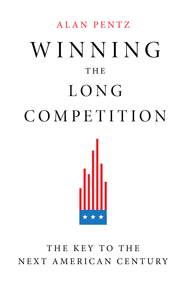
Alan Pentz is the author of Winning the Long Competition: The Key to the Next American Century, which examines how the United States can meet the economic and technological challenge posed by China. He is the founder and CEO of Corner Alliance, a consulting firm that supports government innovation and research, where his work has included helping establish the FirstNet public safety network and expanding broadband access in rural communities. Earlier in his career, he served as a speechwriter for Senator Max Baucus.
📚 Books by Alan Pentz
Transcript
[0:00:28] DA: For the first time since the space race, the United States is facing a serious competitor with a plan to achieve technological dominance: China. Between China 2025 and The Belt and Road Initiative, it’s been clear that the Chinese government is determined to capture the economic power that new technologies like AI, automation, 5G, and the cloud represent. In his new book, Winning the Long Competition, Alan Pentz lays out a roadmap to win this competition by increasing our investment and innovation in core areas. He shows government managers virtue in death, and point innovators to areas where funding will be plentiful. As we move into the next American century, the only way forward is to harness all the resources and creativity of both our public and private sector. Hey listeners, my name is Drew Applebaum and I’m excited to be here today with Alan Pentz, author of Winning the Long Competition. Alan, thank you for joining us, welcome to the Author Hour Podcast.
[0:01:21] Alan Pentz: Thanks for having me, sounds great.
[0:01:23] DA: Let’s kick this off by – why don’t you give us a rundown of your professional background?
[0:01:27] Alan Pentz: Sure, I started out my professional career really working on Capitol Hill and spent about five, six years there working in the house and then for senator Max Baccas from Montana, who later became ambassador to China under the Obama administration. That really got me my background in policy, and trade policy, and foreign affairs, and those sorts of issues. Then I decided, working on the Hill is kind of a miserable existence. I abandoned Washington DC and moved to Austin, Texas to get an MBA, and Austin’s a fantastic town, loved it down there. That kind of – I went from policy into the business world, and then I kind of brought those back together after school, ended up coming back up to DC and working in government consulting, so then helping sort of, on the administration side, implement a lot of reform and policies and new technologies. And then, about 11, 12 years ago, I started my own firm called Corner Alliance and that’s led me to where I am today.
[0:02:33] DA: Great, was there an inspiration for the book and why was now the time to write it?
[0:02:42] Alan Pentz: Well really, I think we’ve seen as far as – the time to write it. I think regardless of how you feel about the Trump administration, the bloom is off the rose in our relationship with China, and I think that’s been building over several administrations. I think it is very bipartisan and most likely continue into any future administrations. Really, what had happened is China had grown so significantly in the early 2000s and really, I think the inflection point was probably somewhere around the great financial crisis, to the point where China became a competing economic and soon to be, as a result, military computing power to the United States. I think that’s become blatantly obvious in the last three or four years, and that this competition is sort of inevitable, and that the United States needs to kind of wake up to the threat it’s seeing from this competitor. What really brought it home for me was, I was doing some research for a client on price challenges, that’s a government funding mechanism, and came across a story of the first driverless car challenge that was conducted by the Defense Advanced Research Projects Agency, DARPA, of internet fame. Basically, back in the early to mid-2000s, they sponsored a competition to try to get manufacturers to develop autonomous vehicles. This was largely in an effort to help create autonomous military vehicles that would not need drivers and crew that would be in danger of being killed. They put out this challenge and the first was, I believe, was a million dollar prize, and all sorts of people came out of the woodwork, beyond the traditional military contractors. In the first, they set up a track in the desert, in Nevada I believe, and no competitor in the first challenge out of 10 or so teams was able to finish the course. Every single one of them burnt down. DARPA went back to the drawing board, kind of redid the challenge, updated some of the requirements, and re-ran it as a two million dollar challenge and in that case, a couple of teams finished and somebody won, right? What came out of that? Well, almost every single autonomous vehicle program that you know of today, from Google’s Waymo to people who started the program at Tesla, to Ford, to you name it. Almost all of those people came out of the teams that competed in that driverless car challenge. We went from a two million dollar prize that DARPA leveraged into what people are saying is going to be a trillion plus dollar industry in the future, and that was crucial to have the government be involved in that process. They use a very small amount of money to convene people together to get the best and brightest, to get beyond the defense contractors, to people in universities, and start up companies that had new ideas. Now they had a military governmental purpose but obviously the autonomous vehicle industry has gone far beyond any military application. In my mind, this is really what I call the American formula, where government comes in and build either infrastructure like canals and roads and the internet. Now 5G. And/or funds, very speculative, innovative programs, like, push the boundary that might not make that much sense for a private company to do. When the government has a special convening power too, like winning a government prize is a huge benefit to a company. They can attract a lot of people even with a low amount of money. To me, this kind of came together with this China competition. Where, ever since the Cold War, we’ve been steadily divesting from RND and infrastructure spending in the United States, as China has been ramping up. Now I see a need for us to move back to that former model that we’ve had since the founding of the country, or our government partners with the private sector, to build innovative technologies, to build infrastructure. I think it’s crucial now because of the threat in the competition that we see from China.
[0:07:04] DA: Yeah, let’s dig into that, you talk about the America formula, being the American formula for innovation, which is you know, finding an opportunity, the government’s spurring interest with resource investment, and then handing things over to the private sector which makes total sense, it was very successful. What has changed and why have we diverged from this?
[0:07:24] Alan Pentz: Yeah, really, the peak of government investment if you measure it as a percentage of our growth semester product, was in the 60s, in the mid to late 60s. What was happening then? We were facing increased competition from the Soviet Union and we saw things like Sputnik, the first satellite, you know, the Soviets beat us to space, right? That launched a huge push in Washington that led to the creation of NASA, huge amounts of funding went there but also, large amounts of money went into education, engineering, STEM education kind of programs, and in addition, we gave a lot of money and really help build Silicon Valley, to create the computer systems, and semiconductors, and chips that allowed us to create advanced weapon systems, right? And also, let us to create the computer and create the internet and all the things that came with it. We were very motivated when we had an enemy, and I would contrast the Soviets as an enemy versus just a competitor which is what I really call China. That’s spurred us to action and really, as soon as the Cold War ended, that investment, although the dollars are more today, the percentage of GDP has dropped, to the point now where we’re around like it’s like 0.6%. Private sector RND has gone up, and gone up as a percentage of GDP, while the government investment has gone down. Even as we’ve seen China pump a lot more money into their investments under their program called China 2025. Actually, I was just going to point out that the real thing that kind of hit me, that story I tell in the book, is back in the 80s and 90s, we were investing in this The Large Hadron Collider, which was, we were building in Texas, I believe, in order to advance physics partial research, right? That’s where this, in the end, it was that kind of machine that found that Higgs Boson that everyone talks about. As the cause mounted in that and the Cold War ended, we actually abandoned that project and left it unfinished. Meanwhile, the Europeans invested at CERN, and it was there that the move to all advanced physics moved over – the concentration moved over to Europe, away from America. To me, that’s a perfect encapsulation of how we kind of gave up on investing, large resources into this, under the cutting-edge technology.
[0:09:55] DA: Right, essentially, we have a two billion dollar hole in the ground, right?
[0:10:00] Alan Pentz: Yes, I have not been there, so I don’t know what it looks like today but I assume, not that great.
[0:10:06] DA: Let’s dig in to 5G. Because there’s a bit of silent war of sorts going on, and who is going to setup the global 5G network between USA and China. Can you talk about the implications of a 5G world, with its potential and its challenges, from the American perspective?
[0:10:24] Alan Pentz: Yeah, the way I look at it and talk about it in the book is, if you look at – you can go look on Wikipedia, look up the top 10 companies by market cap in the United States or globally in 2009 to 2010, right? You’ll see, most of them are energy and finance companies, right? You have like GE in there, and some others, Berkshire is still there. That’s sort of a signal of where the investment and growth is, right? Now, fast forward 10 years, it’s all these FANMAG, whatever acronym you want, Facebook, Apple, Alphabet, Google, Amazon, they’re the companies that have driven to the top of the market cap price, right? Why is that? Well, a lot of these companies were driven by 4G, which is LTE, long term evolution, which is what we’re using today. It was those companies that harnessed the power of those networks and the mobility that that created, right? That was a rise of the smart phone and people started using Yelp and Uber and Airbnb and all these things, right? A lot of the companies that I mentioned are some of the infrastructure core providers behind this. That really drove the growth of our economy for 10 years, and you’ll notice, if you look at those charts, you start seeing Chinese companies end up in them, right? Now we have TenCent, Alibaba, others moving up the charts and competing with our companies. I say, look, the US really won the 4G race, it’s our companies that are dominant with a strong competition from China as they came up. Now we’re moving to the next generation, 5G, which will give us speeds up to a hundred times as fast, throughput, and very low latency that will vastly increase the capabilities we have available to us. Things that people talk about often with 5G are true autonomous vehicle driving, right? Because now we’ll have so much more processing power, so many more sensors, so much less latency that you can really see that vision in the city, right? A car driving itself in a city, or people talk about remote surgery, right? You could have expert surgeon who can put his or her hand in a pair of gloves in Boston, and operate, through a robotic machine in India and have the same tactile experience they would have were they in the same operating room, right? You know it goes on and on virtual reality and augmented reality. The kind of things that will happen with 5G are equivalent to the revolution of the smart phone and the rise of the cloud, but I think even more and more accelerated. So obviously the countries that build that 5G and make it available consistently, cheaply, and quickly, they’re the countries that will develop the companies and the businesses on top, that will drive the use of 5G, and will drive the next generation of wealth and, as result, drive the next generation of military and economic power globally. So to me 5G is just a critical core infrastructure for the future of our country, across health, education, all of commerce, and the faster we got there and the better we got there, the more likely we are to maintain our economic leadership.
[0:13:58] DA: What is the current state of how America’s doing in this 5G race versus China, and have we convinced our European allies to join us or are they still on the fence?
[0:14:08] Alan Pentz: Yeah, so I would say it is hard to get a real actionable state of play because 5G is really just a marketing term. There are a set specifications there but each carrier implements them on their own, and what level of 5G you get is sort of up to some interpretation. So, I would say China has the ability to direct vast resources very quickly. They also have the ability to override environmental concerns, and I know in Washington DC or here in New York or in most cities across the country, people do not like having their streets ripped up. It is very inconvenient but that’s what it takes. In China, they don’t really have to deal with people’s concerns about things like that. They’re also able to subsidize the equipment providers. So we have seen with Huawei has quite a bit of state subsidies. So I think it is inevitable that China is going to get 5G faster and get to those speeds much more quickly than we are or anybody in the west will but I don’t think that is a disaster. I think it is just based on their system they are always going to have that sort of lead, but it is crucial for us, I think, to be a fast follower there and to get there quickly, right? So what can we do to that? I think in the United States, we need to have first a really concerted effort at the policy level to streamline 5G implementation, given the environmental and other local concerns. I mean the FCC has done quite a bit on that but we need to understand why it’s so important in order to speed the process. Second, I think we really need to understand that there are large areas in the United States that are going to be underserved, and that includes even in urban areas, particularly rural areas, there is just not an economic case for the carriers to build significant amount of infrastructure there. So we really need to focus, the government really needs to focus plugging those gaps. As a public good we need to create. Then, I think there is a great deal of investment we need to make, not in creating another Huawei, I think that is the long approach. You know, I think, there is no American like equipment, big international equipment supplier for cellular networks right now, because it is not a very good business. No one wants to be in it. That is why it has to be subsidized. If you look at profits of Ericson, Nokia, that kind of stuff, it is a terrible capital intensive hard business, right? But I do think that there’s a lot we could do, you know, given that, to really commoditize that entire sector and turn it into a more cloud based. There is a big movement around open ran so that we can open up these proprietary parts of the system and make it available. So we could have multiple different suppliers that are kind of – we could kind of commodify the suppliers. I think that is something where the United States and Europe could cooperate to lessen their dependence on companies like Huawei, and I think that is really where we need to put a lot of investment. Then the last thing you asked about was is Europe following along. I think Europe is in a really odd place. They are seeing United States pull back, you know, the United States is really focused on China now. We are not as focused on Europe. They have significant trade relationships with China, but problems with China. So I think you are going to see a – I call it a spectrum of allegiance across Europe. So I think England, very clearly, has made moves to fall into the US camp. I think you are going to see countries like Germany probably drawn a little bit more towards China, but nervous about it, and I think it’s going to be an evolution over the next decade or two to see where Europe lands, and there is going to be some sort of hybrid in between the United States and China, on trying to play both sides. So I think it is an open question.
[0:18:12] DA: So because you’re a DC insider, how will the election change the path of the USA here? Do the candidates have positions on this and how has the Trump year has been compared to the years when Biden was the vice-president?
[0:18:27] Alan Pentz: Yeah, I think really what we are seeing, if you cut through the rhetoric and the style of policy and speech, it is really one continuity of relations with – of China going down, right? I just think it’s inevitable. I think we have seen Biden and Trump try to out-China each other? So I just don’t see a Biden administration thinking that they are going to go back and embrace China like we did in the early 2000s. I think it’s very clear that China is drawing the lines. I mean they’re in conflict with almost every neighbor of theirs who are either allies or semi-allies of the United States. So I think the competition is inevitable. It’s driven by market, geographic, demographic forces, and they are really beyond the control of any administration. So I think maybe the tone changes a bit and some of these done behind the scenes more. We don’t get quite the headlines that we have now, but I think the inevitable march toward this competition has happened. There’s no coming back from it.
[0:19:37] DA: Now you mentioned a few items earlier but set the agenda for us, how does America really win this?
[0:19:43] Alan Pentz: Yeah, so I think I always go by I was a history major in college. I always go back to what we’ve done as a country to grow, from 13 colonies hugging the shoreline to global spanning economic power right? There has been a formula that we have used to do that, and even in the earliest days of the republic, you know Hamilton’s third report after the bank and the credit was on, there was report on manufacturers, which was about a tariff policy to protect this domestic manufacturing, and bounties, payments to American companies to produce manufactured goods. So the United States has always since then had a good deal of government investment trying to spur innovation here at home. We saw that happen throughout the canal, building of the canals, post-civil war, really quite a bit of government subsidy and involvement and helping the railroads be built. Quite a bit again with the road system and then obviously the computer and the Internet, and all of that was developed with a lot of government grant money. A lot of government as a primary customer. In fact, you know, the computers and audio and everything we are doing today with this podcast, a lot of that was funded. The initial technology was funded by government grants and funding. So, to me, the real lesson here is that we need to go back to what works well. We need to invest more of our GDP into productive investments, RND, and infrastructure, and particularly, right now, I think the infrastructure we need is 5G infrastructure, the 21st century digital infrastructure. If we make those investments, and then rely on our private sector, I mean, we are blessed with deep, very liquid capital markets that can direct venture capital, private equity, as much as people may hate all of that stuff, and the tax breaks they get, they are very effective at funding innovation. Look at every company that dominates the market caps in the world and they are VC funded from Silicon Valley. I think we need to embrace the fact that we have a very productive system, but the one player that’s walked away from the table has been the US government, and making that investment in the infrastructure and RND side. To me, that’s the key. If we can do that, we have other structural advantages that will allow us to overcome any disadvantages we have against the Chinese.
[0:22:24] DA: How do you convince the government and the people to have a balance between what the current state of the economy versus the many investment needs we need in ourselves?
[0:22:37] Alan Pentz: Yeah, I think this is probably the biggest challenge that we have as a society. I say that like republicans never met a tax cut they didn’t love, and democrats never found a social program they didn’t want to fund, and nobody wants to build a road, right? So it is always second choice for everyone. Part of the reason I wrote this book is about that, right? Starting to make the case, and there are many other books out there now that have started making different aspects of this case. Like Loonshots, and How Innovation Works, and all of these different books that have been coming out. We have seen, time and time again, that the only way we are going to be able to grow the economy is by creating productivity gains, and by defunding our infrastructure and investment, we have seen a long term stagnation in those productivity gains. I think one, the threat from China needs to be clear. We need to understand that competition. Hopefully that creates a Sputnik-type moment, where we decide to make the investments we need to like we did in the 60s, that really drove another generation of prosperity on this country. If we could make that kind of investment now, we would create untold wealth, new jobs, in particular in our blue collar, middle income sectors. I think that kind of investment is what’s needed and I hope that we understand that’s the response to China that we need to have.
[0:24:09] DA: Alan, writing a book especially one like this one, which is super interesting, it is full of history of the revolutions in the US and our race with China, it’s no small feat, so congratulations.
[0:24:22] Alan Pentz: Thank you.
[0:24:23] DA: And it’s been a real pleasure. I’m really excited for people to check out this book. Everyone, the book is called, Winning the Long Competition, you could find it on Amazon. Alan, besides checking out the book, where can people find you?
[0:24:34] Alan Pentz: Yeah, I run a company, as I mentioned, founded here in Washington DC and actually in Denver, Colorado. We are called Corner Alliance, so our website is corneralliance.com. You can always get me on LinkedIn or Twitter @apentz. I am always available to talk and debate.
[0:24:54] DA: Thank you so much Alan. I appreciate you coming on the show today.
[0:24:58] Alan Pentz: Thank you, I appreciate it. It is fun.
[0:25:02] DA: Thanks for joining us for this episode of Author Hour. You can get Alan Pentz’s new book, Winning the Long Competition, on Amazon. Also, you can also find a transcript of this episode and all of our other episodes on our website at authorhour.co. For more Author Hour, subscribe to this podcast on your favorite subscription service. Thank you for joining us, we’ll see you next time. Same place, different author.
Want to Write Your Own Book?
Scribe has helped over 2,000 authors turn their expertise into published books.
Schedule a Free Consult