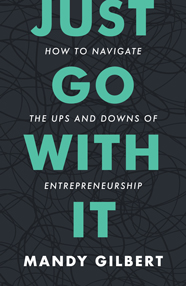
Mandy Gilbert: Just Go With It: How to navigate the ups and downs of entrepreneurship
Read the full transcript
Mandy Gilbert
Mandy Gilbert is the founder and chief executive officer of Creative Niche, a staffing and workforce management firm she launched in Toronto in 2002 with eight thousand dollars and grew into a multimillion-dollar company that has placed thousands of creative, digital, and marketing professionals across North America. She is also a speaker, investor, and columnist for Inc., and she completed the Entrepreneurial Masters Program at MIT. In Just Go With It, Gilbert shares the lessons of her own journey to guide and inspire both new and established entrepreneurs.
📚 Books by Mandy Gilbert
Transcript
[0:00:31] DA: When you start your own business, it’s a liberating feeling. However, now, the burden to bring in clients and grow the business is on your shoulders. But know this, you’ve got this and you’ve got help. In her new book, Just Go With It, entrepreneur, CEO and innovator, Mandy Gilbert shares her journey to guide and inspire both new and established entrepreneurs alike. She shares hard-earned lessons on how to strike that perfect balance between managing your personal life, developing your people and maintaining a healthy bottom line, all while making time to care for yourself. To Mandy, entrepreneurship is definitely an adventure worth taking, even if the path is rarely a straight line. Hey listeners, my name is Drew Applebaum and I’m excited to be here today with Mandy Gilbert, author of Just Go With It: How to navigate the ups and downs of entrepreneurship. Mandy, thank you for joining, welcome to the Author Hour Podcast.
[0:01:20] Mandy Gilbert: Thanks Drew, happy to be here.
[0:01:23] DA: Let’s kick this off. Can you give us a rundown of your professional background?
[0:01:27] Mandy Gilbert: Sure. I dove into entrepreneurship at a pretty young age, in 2002 is when I started my company, which is a recruitment firm purely focused in advertising, marketing tech, digital, and design. So, I’ve been doing that for well since 2002, prior to that, I was in a number of, kind of junior to intermediate level marketing roles within different organizations.
[0:01:54] DA: Now, why was now the time to write this book? Did you have some free time because of COVID? Was there an “aha moment” or an inspiration out there for you?
[0:02:03] Mandy Gilbert: That’s a great question. So, this book has been in progress for over a year now, and my motivation for writing it really was to share my experiences. I think that being an entrepreneur can be incredibly isolating, you can feel incredibly vulnerable and the highs and lows are quite extreme. So, through my speaking career, I’ve connected with so many entrepreneurs who thank me for being so honest about not only how I’ve had to overcome challenges but really sharing the depth of the challenges themselves. Because there’s that relatability component that I think the audience and fellow entrepreneurs benefit from.
[0:02:44] DA: Now, did you have any major learnings or breakthroughs that were unexpected while you were writing the book? Maybe through doing some research or just by looking back at your journey?
[0:02:54] Mandy Gilbert: I did have some – I don’t know how many breakthroughs I had but I certainly had some micro-breakdowns. Definitely going through the past and reliving and really kind of opening up memories of challenges and mistakes that have been part of my journey. And, really kind of digging deep and sharing that and talking about how I was – well, to kind of overcome them or not. It was a really interesting journey to go through that timeline and kind of revisit the main events as well as just my own growth and development throughout my entrepreneurial life thus far.
[0:03:32] DA: Now, who is this book for? Is it only for entrepreneurs and executives?
[0:03:38] Mandy Gilbert: This book, I think definitely talks to entrepreneurs or individuals, thinking about being entrepreneurs, whether it’s a side hustle or if it wants – if you want it to be your main focus. But it also can really connect with people really taking on management leadership positions. It is woven through the book, definitely is my – kind of my development and some of the mistakes that I’ve made as a young leader and how I’ve kind of had to grow in that area to have a sustainable team, to have a sustainable business, and one that’s solid enough that you could build on.
[0:04:13] DA: Now, a lot of people write the book, almost for their former-selves, usually because there were some adversity along the way. Can you tell us about a few of the issues you ran into, earlier in your career and maybe some of the lessons that were learned?
[0:04:28] Mandy Gilbert: Sure, I think a lot of people like myself, take the plunge of entrepreneurship. Maybe it’s for reasons that include, you know, you have something to prove in life. Whether it be to yourself or to others. I mean it could be, you’re incredibly passionate about what you are doing or your idea and you want to innovate on it and do something and drive that and have control over the outcomes as much as you possibly can. And so for me, my motivation for writing it and some of the outcomes are - I guess, some of the challenges I’ve had to overcome earlier on, where I was a great salesperson and I was a great recruiter. And that’s great when you first start your business because you get some traction and you’re great at what you do. And the complexity and the challenges that are layering on, when you have to think about “Oh goodness, finances. How do I scale at technology?” And all of those things you can navigate through hiring various expertise or consultants. But the tricky one was, “Well, how do I lead a team? How do I lead a team, how do I curate some type of vision and goal for the company that connects everyone who is part of it? And really foster a culture that is going to be something that sticks and grows and builds on?” And so, some of the things that I stumbled on were how it was showing up as a leader. I wasn’t sharing a lot of my worries, I wasn’t sharing a lot of my concerns and things that were just keeping me up at night, as well as my own insecurities. And so, I was carrying it all on my back and so I was also having a very difficult time at that point in my life, is having and embracing difficult conversations and giving direct feedback. And so, how that started showing up is that you know, I was becoming a little bit passive-aggressive, I would say one thing and do something else. And I also have like a quick start, I’m an idea person, I get a lot of energy from ideas and so, I was also starting a lot of initiatives and then dropping the ball and not completing them. Or worse than that, I was delegating my ideas and then not following through and I was wasting people’s time and I think overtime, that really hurt my leadership brand, internally, certainly. And, as a result from that, you know, I had some pretty significant culture challenges as well as some turnover in the earlier years for sure.
[0:07:03] DA: You also talked about in the book that you are given a leadership position earlier in your career but found yourself like you’ve just mentioned, afraid to speak up, not getting the respect you deserved and even a victim of harassment. So, you decided to open up your own shop. Can you talk to us about the decision to leave that job you had and what the transition to business owner looked like for you?
[0:07:25] Mandy Gilbert: Sure. For me, the motivation was, hey, I knew at a young age that you know, for me, at that time, it was probably the right time for me to take the plunge and I had thought about it for a long time. I was someone who always just worked incredibly hard and posted great results and numbers. And, because of that, I would have the opportunity to join committees and be put up for promotions which was great. But the downside of that was also when you get hurt by working for certain leadership styles or somebody’s inappropriate with you, or you just see things that are happening within an organization that are not aligned with your own values. For me, it really woke up my desire to really go and do something on my own because I was tired of building success for organizations that I didn’t really believe in and that I didn’t really feel aligned with. And so, that’s what really inspired me to open up my business, and really, what that involved was getting a personal line of credit for $8,000. And, that funded my startup. I had enough to keep me afloat for six weeks. So, my journey started with a computer, I had a hundred and fifty square foot office slash closet if you will, and a phone. And I had 200 pieces of letterhead and a Splash page on my website. For me, it was just, I was really energized by the accountability and the pressure and the risk that I was taking because I believed I could do it and I wanted to have the opportunity to try something on my own and build something that is lasting and in a place that fosters and attracts great talent, and it has a culture that is all about growth and collaboration and creativity in entrepreneurship. It really was inspired by working with companies that didn’t really have those characteristics or have that kind of energy to it because that was lacking. It was just something I really wanted to do and I wanted to focus on quality over quantity and relationships. And having a recruitment company that’s not competitive. We are not pinned against your colleagues, instead, you collaborate and you win a lot more together and you can accomplish a lot more. So, that’s what really kind of inspired me and you know, in the earlier years, that’s really what it was all about was me, at a desk with my computer and doing cold calls all day and interviewing candidates to build up my database if you will, and my network or my roster, you know, in the evenings, until 9:00, at least every night. So, it was a lot of hard work, and certainly a lot of hustle. But, at the same time, it was incredibly energizing and rewarding.
[0:10:20] DA: It’s such an inspirational story. Like you just mentioned, you started with $8,000 and working by yourself out of a closet of sorts. Fast forward to now, how many companies are you in, how many employees do you have, what does it look like now?
[0:10:37] Mandy Gilbert: Sure, so I’m still the founder and CEO of Creative Niche which is my recruitment company that I started in 2002. And, that business does north of 10 million, we’re a team of 20, in our time and business, we’ve done over two million dollars of impact work and we have been behind more than 14,000 successful placements with all kinds of companies and sectors, ranging from advertising tech, design, products, yeah, e-commerce and digital. And so, that company continues to do great things, I have a fabulous team, it’s made of – all of the team contribute to an incredibly positive and productive and collaborative culture. That, being so solid has allowed me to also invest. And so, five years ago, I co-founded a digital school. So, it’s a tech design digital school, which was high growth, I really didn’t play too much of an active role in it but I did contribute a lot and it was all hands on deck, it was also very boot-strapped and it managed to do incredibly well and thousands of students graduated from it. That went on to do amazing things in UX Digital Marketing, web development, and design. Sadly, that school actually really struggled with COVID-19 and the implications of bricks and mortar education and sadly, it didn’t survive, that operation closed in April. That was incredibly tricky for sure, for a number of reasons obviously, as an investor in something. Financially, it’s a big hit. But equal or more than that, it was really sad to see it because it was a pretty incredible place, it was a very special place where the outcomes in student’s lives were so profound and we had the ability to attract and work with so many amazing instructors, we worked a lot with community and as part of the curriculum for students, they worked on not-for-profit organizations, branding and websites. And so, it did a ton of great impact. Millions of dollars of work done, pro bono or for impact organization, not-for-profit. It was amazing and I wrap it up with a bow of, it made a tremendous amount of impact in a lot of different lives and there was a ton of learning in my experience in that. I talk a little bit about that in the book, because it was my first time having a business partner and having investors, there was a lot of outcomes from that for sure that I would do differently next venture, for sure. Also, as an investor, I’m a proud investor to two great Canadian tech companies that are doing wonderful things and any opportunity, I have to support. The CEO’s of those companies, I’m all in, I believe in them a hundred percent, and it’s really great to be an investor and an adviser versus having to actually drop in and do the work yourself. It’s a way of supporting entrepreneurship and working in different sectors without having to be accountable for all of the outcomes as well. So, I’m an active – yes, I am an active investor and I do some speaking as well and I’m also a columnist with a .com. We have a weekly column where I talk about entrepreneurship, leadership, management, culture and in all of those important things, which I really enjoy as well.
[0:14:06] DA: Well, I’m sorry to hear about the RED Academy but it sounds like you’re still doing very, very well. I mean that they did a lot of good in the community and that’s really great to hear. I love to bring this back to Creative Niche and the book. And, in the book, you talk about your original employee handbook that you made, and I was wondering about that original employee handbook and maybe how it has evolved over the years?
[0:14:32] Mandy Gilbert: Sure. Yeah, you never think that something would be so helpful when you’re starting and building a company. I think it started because I know it was probably a funny story of an employee I hired, a young employee who – couple of obvious things, you know? That you with if you had any experience, he would have thought of when he showed up to work and I won’t detail them but, that tends to be when we put in policies, right? Is when somebody makes a mistake or did something ridiculous and so that’s when I really built that out, it was really in my early days. I just wanted clarity, you know? I mentioned earlier, having difficult conversations was not like a great thing that I really – it wasn’t a strength of mine that I really was comfortable with in my earlier years. And so, I liked having clarity and having something to point to. Because, when you have something to point to, “Hey, I’m not being the bad cop, and you know what’s expected of you, right?” I built it out because it was needed and I just thought, it’s a really professional way to onboard new employees too, to talk about what are the values of the company, how are you differentiated, how are you expected to show up? And you know, how am I expected to show up and how do we treat our equipments and how do we spend our time. And, what does success look like for the company and what does success look like for your role? I just thought, in my experience, if I were starting a company, that would be a really impressive way to you know, understand exactly what the company is all about. And then, as an employer, it’s a great thing to have in place, you could say, “You know what? Actually, we did talk about this and it is in the handbook so why don’t you have another read?” It kind of helps mitigate things that normally you might have to have to be addressing on a regular basis. And it’s evolved, you know? Policies change, procedures change, rules change. So it is something that we take off the shelf, the digital shelf if you will, once a year. And, as a leadership team, we look at it and we talk a little bit about, “Is there anything in here that we need to update or remove quite frankly?” And we do that. We do it on an annual basis and that way, it’s just kind of a living document and so we all kind of refer to.
[0:16:50] DA: What are some of the tough questions that entrepreneurs should ask themselves? To make sure they’re providing a great experience for their employees?
[0:17:00] Mandy Gilbert: You know what? That’s such a great question. And, sometimes I do ask entrepreneurs, “Hey” Because oftentimes, we think we’re amazing, we think our companies are incredible and that we’re the best and you know, nobody else is going to care as much as we do for our employees and for our clients. And, we lose sight of actually, “What are other companies offering?” and “Are you that amazing?” and “Do your perks that you offer really matter to your employees?” and you know, how much bias is there? I always recommend that, unpack your employment or your kind of your employment experience, for everything from your job posting when you’re recruiting to your offer letter, to how you onboard new staff and now especially, how are you onboarding virtually to keep them engaged and being part of the culture? So, once you kind of look at every step, there’s always opportunities to revisit. And, there’s a lot of creative ways that entrepreneurs can change their offering because we have the flexibility and we can be agile and we could be creative. So really, just spending some focus time and thinking about you know, “How can I be an incredible employer?” and “How can I have the best employer brands?” so, when my employees and my team are out with their friends and out with their colleagues in the industry, and they’re talking about the company. “How can I make that, that they’re saying great things about how they’ve been able to grow, how they’re supported, how they’re acknowledged, some of the benefits and perks they have”. All things that are part of that whole experience. So yeah, I just think it’s an interesting project, you know? Just as I was talking about the employee handbook, it’s to kind of unpack the employer, the employee experience. How they are onboarded, how they grow within your company?
[0:19:00] DA: One of the hardest things to do is look into the mirror and really see what you as an entrepreneur are bringing to your own company and what your role should be. So how could entrepreneurs find out the value and their unique role they’re supposed to be providing to their companies?
[0:19:18] Mandy Gilbert: Yeah, that’s a big one. Because I think our roles really change. And, in the earlier years, when you start your business, you might have to be incredibly executional, you know? You might be part of delivery, you’re getting, you’re rolling up your sleeves, you’re doing the work, you’re hiring, you’re managing, you’re having to wear multiple hats and figure out a number of different things as you go along. And I think, that’s just the norm. Unless you’re really funded when you start, where you can have a dream team out of the gate, which would be awesome, that’s certainly not what I had. So, you know, in the earlier years, you’re definitely hands-on, you’re part of the team and I think that the challenges some entrepreneurs have a really difficult time popping up and staying up, and what I mean by popping up is not to be the leader in charge and the boss, you know, and have that kind of presence in your culture. But it’s about thinking strategically as you know, “Where is your business today, how much market share do you have? What are some things big and small you can innovate on? Are you leveraging any grants out there? How was your team? How engaged are they? What can you provide as additional service or products to your customers?” The danger, if you can’t pop up and stay up and work on that high-level thinking, at least 75% of your time and you’re popping down, you not only are micromanaging your staff, you’re probably not doing as great of a job at those executional tasks as maybe you think you should. You’re not allowing space for your employees to feel trusted and actually make mistakes and grow. And so, there’s also that risk, you know, from a culture standpoint and from a morale standpoint and growth with your employees if you’re popping down and doing their jobs, are correcting them or micromanaging them and not really spending your time focusing on your future business, it can result in some risks for sure, and you can kind of get stuck there for a long time. So, I think your job as an entrepreneur, always kind of changes, depending on what the busines needs. I mean, I’ve gone through, you know, the great recession, for sure. And I have gone through, you know, definitely obviously, all of us have, the implications of COVID-19 and so sometimes, the business actually needs you to pop down and get with the team and reconnect them and put a game plan in place and help them execute it and build confidence and reassurance with them. Making sure that you're communicating and you're acknowledging and all of those things. But when business resumes, it’s really important that you go back and be thinking about the future and your future business.
[0:22:05] DA: now, starting a family as an entrepreneur is incredibly difficult, what was your experience like? And how did you navigate the balance of being a parent-preneur as you call it?
[0:22:16] Mandy Gilbert: Yes. Yeah, you know, I sometimes say there’s never the right time to, sometimes take a vacation, buy a home, start a business, start a family. There is never really the right time, you just kind of have to do it and figure it out. And for me, that’s exactly you know, what I did. My business was pretty young when I had my first son, Isaac. I underestimated the demands of a little one for sure so, Isaac was days old and I had him in the office and I was doing reporting and I was working with the team and having meetings and they sleep a lot at the beginning and then they get active. And I thought, “You know what? I want a maternity leave.” My brain and my heart can’t be in two things and I fell instantly in love with both my son’s newborn. I really wanted to do that and so, I hired up to support me so I can take a maternity leave, which was amazing. I thought I had my hands full with one little guy and two and a half years later, I had my second guy, Samuel, and you know, that was tricky and you know, parenting and running a business is really difficult. Because when the times are really good and you know, you’re scaling, you feel really engaged and you’re busy and it’s really difficult to shut that brain off when you come home and be present. And you know, for me, I had an office in Europe, I was traveling a lot, and then from my speaking career, also traveling. And so, the guilt and the guilt associated with that and the fear of missing a fever or missing a performance at school or tough day, it’s always top of mind. But I think the most important thing is just to be okay to be part of something in your career and feeling really connected and having your individuality and your passion. It’s okay, you’ve got to just kind of roll with the punches, it’s not – life isn’t a checklist. And, there’s going to be times where you’ve got to drop down and do a lot of work and then those times, when things are going great and your team is there to support you and you’ve got a solid business, those are the opportunities that you take a lot of time off. And you do drop-offs and you know, pick-ups and play dates and maybe little trips with kids to celebrate milestones or just impromptu trips, which are awesome too, or road trips. I just think you have to go and figure it out and understanding, “Hey, life is not perfect, not everything’s going to be perfect.” But, as long as you are trying your best, trying to cover the basis, that’s all you can do, that’s all you can do. So, it is definitely a tricky one to navigate but it’s definitely worth it for those that are thinking about it.
[0:25:11] DA: Now, let me ask you one last question, it’s based on your interactions with many entrepreneurs, it’s a pretty easy one but tricky as well. Do they all know what they are doing? And, should an entrepreneur feel bad if they’re struggling right now?
[0:25:25] Mandy Gilbert: You know, sometimes you don’t know what you're doing, that’s why sometimes we’re unemployable after you’re an entrepreneur for so long. Because you’re just like, “I’m going to do marketing. Hey, what’s going on in marketing? I think we need a new tech platform. Oh, I got it. How’s sales going?” You're constantly you know, getting your hands in everything and sometimes you go through phases where you're just incredibly unproductive. Because you don’t have a job description, you don’t have a boss, and quite frankly, you don’t have any peer individuality or not individuality, peer accountability. You’re not getting calls from performance reviews, right? And you can get out of anything that you want to get out of, you can make – right? I mean, really, there’s not a ton of accountability other than outside of paying bills and keeping the business going. It can be tricky and I – you know, I’d be lying if I said that I’ve never fallen into a slump. I have, and I have left work feeling like, “Wow, I didn’t accomplish a lot this week, oh another week, but I’m here and I should be out with my kids and I haven’t seen my friends in a long time, I’m not really hitting any homeruns in my life, I feel bad about not being with my family all the time but when I’m at work, I’m not that effective and I’ve left some friendships, relationships be ignored.” So, it’s important just to kind of have a reset and understand, you know, what is the most valuable you think that you can do for your company that actually gives you energy? And if you’ve lost sight of that, that’s a great opportunity to ask people who know you best. And also, just ask, sometimes, your leaders in your company or if you don’t have any leadership team yet, your employees is like, “You know, where do you see me, how can I help?” Also, just join some organizations. Like an entrepreneur’s organization or as you scale, YPO, young president’s organization. There are amazing places that give you inspiration because you're with peers. That gets you excited about, “Wow, I never thought of that or I need to do that.” It can help us create a little bit of energy and focus into your role if you find it continuously kind of lagging and you’re not feeling focused or impactful.
[0:27:40] DA: That’s some really great advice. And Mandy, writing a book, especially like this one, which will help so many business professionals is no small feat so congratulations.
[0:27:50] Mandy Gilbert: Thank you, thank you so much.
[0:27:52] DA: The last question. If readers could take away only one thing from the book, what would you want it to be?
[0:27:59] Mandy Gilbert: It would be, listen, you don’t start a business to work harder than you’ve ever worked and not make money. That’s a lot of motivation, we want to have more control over our life, we want to have steady and healthy income, we want to enjoy ourselves. And, I think that you know, the big takeaway is to honor that and invest in yourself and you are worth it. Invest in yourself to grow and develop, embracing direct feedback on how you can become better and enjoy it. Enjoy the experience because the highs are high but the lows are low. So, you want to make sure that when things are going well, you’re really enjoying your life and you’re taking care of yourself, you’re taking care of your team, you’re taking care of your family and you’re enjoying yourself. That’s really a big reason why I wanted to share my experiences because I’ve seen so many entrepreneurs struggle. I think just being rooted and why you decided to do this, and making sure you’re valuing yourself and investing in your development and happiness is incredibly important.
[0:29:13] DA: This has been a pleasure and I’m so excited for people to check out this book. Everyone, the book is called Just Go With It and you can find it on Amazon. Mandy, besides just checking out the book, where can people connect with you?
[0:29:24] Mandy Gilbert: They can connect with me on my website, so, mandy-gilbert.com and on Twitter, it’s @verynichey is my handle and my email address is mandy@creativeniche.com.
[0:29:38] DA: Awesome, Mandy, congratulations again on your book and thank you for coming in the show today.
[0:29:43] Mandy Gilbert: Thanks Drew, thanks for having me.
[0:29:46] DA: Thanks for joining us again for this episode of Author Hour. You can get, Mandy Gilbert’s new book, Just Go With It, on Amazon. Also, you could find a transcript of this episode and all our other episodes on our website at authorhour.co. For more Author Hour, subscribe to this podcast on your favorite subscription service. Thank you for joining us, we’ll see you next time, same place, different author.
Want to Write Your Own Book?
Scribe has helped over 2,000 authors turn their expertise into published books.
Schedule a Free Consult