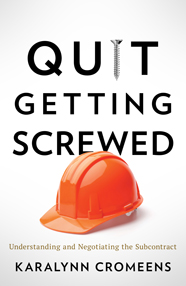
Karalynn Cromeens: Quit Getting Screwed: Understanding and Negotiating the Subcontract
Read the full transcript
Karalynn Cromeens
Karalynn Cromeens, author of Quit Getting Screwed: Understanding and Negotiating the Subcontract, and creator of The Subcontractor Institute, has been a licensed attorney for over sixteen years. She has spent her entire legal career in construction law, advising countless clients on how to avoid litigation.
Karalynn is on a mission to educate and inform subcontractors about the importance of understanding their lien and collections rights, sparking change and leveling the playing field in the construction industry.
📚 Books by Karalynn Cromeens
Transcript
[00:00:31] DA: Everyday, subcontractors across all trades face the same critical dilemma. Should I sign a subcontract I don’t understand, one that may even put my company at risk? Or should I refuse to sign and potentially lose the job? This is why attorney Karalynn Cromeens wrote her new book, Quit Getting Screwed. She aims to help every subcontractor, no matter how big or small, understand what those subcontracts mean. Karalynn wants you to know which provisions you should expect and which ones to avoid, and how to identify dangerous provisions that need to be removed, so you can come to the table armed with fair language that can be substituted for unfair clauses. Signing a subcontract you don’t understand can put your entire livelihood in jeopardy. If you’re a subcontractor, don’t sign another subcontracting agreement without knowing what it means. Hey, listeners. My name is Drew Applebaum, and I’m excited to be here today with Karalynn Cromeens, author of Quit Getting Screwed: Understanding and Negotiating the Subcontract. Karalynn, thank you for joining. Welcome to the Author Hour podcast.
[00:01:31] Karalynn Cromeens: Thank you for having me.
[00:01:32] DA: Let's kick this off. Karalynn, can you give us a rundown of your professional background?
[00:01:37] Karalynn Cromeens: Yes. Well, I’m a licensed attorney and I have been for 16 years in the construction industry, specifically construction collections and subcontracts. Before that, I did my undergraduate in Wisconsin in criminal justice with a minor in psychology. And before that, I started working at 14. I had multiple jobs at Walmart, nursing assistant. I tried a little bit of everything. A lot of my experience comes from my roots coming from that background.
[00:02:07] DA: Now, why was now the time to write this book? Did you have some extra time because the way the world is in 2020? Did you have some inspirational moment out there or maybe an aha moment that you decided that now is the time?
[00:02:19] Karalynn Cromeens: Yeah. I definitely had an aha moment. I was pissed. I had a trial in January and I represented a client, a great guy, a great company. e And he did his work and he did what he was supposed to do. They got into a dispute, and we went to trial. And I’m sitting at the counsel table with my client next to me, and the judge was about to read the verdict of the jury. After we went through this contract dispute, the general contractor sued my client. We sued back and we lost. My client got a $400,000 judgment taken against the company and basically put the company out of business. And I was just so angry because there's nothing I can do. He had signed the subcontract. Even though he had done everything right, it didn't matter at the end of the day. These things are so one-sided against the subcontractor that, even when you’re doing everything right, that can still happen to you. So when I started this in January, COVID wasn’t a thing. Don’t get me wrong. I did get a little bit more time to work on it seriously since COVID hit, but I was angry. That’s what it was, my starting point.
[00:03:32] DA: Now, were there any learnings or breakthroughs that you had during the writing of the book maybe through doing some research or just from the maybe the introspective journey or some of your previous work history?
[00:03:43] Karalynn Cromeens: That there's nothing out there like this. That a subcontractor is the one who is out there doing the work. They're installing the electrical outlets. They're putting the carpet. They are really good at their trades and they’ve come up during that. But they don't know anything about subcontracts, and there's nothing out there to teach them. And I think there's – One, they just sign them and they have no idea. Or, two, they just think that it couldn't be bad. I couldn't sign something so bad that it could put me out of business. They would never do that to me. Then the other thing is that it is your source of work, so you don’t know how hard to push back or what your rights are. And I want to help them. I want to help them learn what they’re signing, learn how to negotiate, and put the power in their hands so that they know.
[00:04:29] DA: Now, who is this book for? Is this for specifically contractors who work with a subcontractor? Or should anyone who signs a contract, should they be reading this as well?
[00:04:38] Karalynn Cromeens: Mostly to subcontractors because, I mean, honestly speaking, there are no contracts that are written so bad out there, except subcontracts. If a regular contract attorney were to read the subcontract, he’d like, “I would never sign this. I would never advise a client to sign this because it's so far out of the realm of what you think would be acceptable.” What's happened over years is that they didn't sign it and they didn’t review it. They would just sign it and send it over, and so attorneys would just keep cramming stuff in there — like a personal guarantee, and these things that are completely out of line to be in a contract.
[00:05:18] DA: Now, you kick off the book saying, “Are you tired of being a general contractor's bitch?” What does that mean exactly or does it mean exactly what you just said, anything that the contractor wants to put in a contract a subcontractor has to blindly sign off on?
[00:05:35] Karalynn Cromeens: I mean, that’s what happens, right? That line was written fresh from my anger up by the throat from losing that trial in that that's what really happened to my client in that case. Had we negotiated some things in the contract, he could’ve had a much better outcome. I want to get people's attention that I know this is not a very – That nobody wants to talk about in public. It's like, “What did I tell my marketing staff?” It's like 50 shades of grey. You don’t want to admit to reading it, but I know you’re going to because you want to know what’s in there because nobody wants to come out and say, “General contractor, quit screwing me.” They want to be quiet about it and do it, so they still have the work. And so, that is attention-grabbing thing because that's really what can happen if you don’t protect yourself.
[00:06:21] DA: Now, does this happen because the folks signing these contracts are inexperienced or are the contracts that difficult to really understand?
[00:06:30] Karalynn Cromeens: I think it’s a combination of both, right? They don't know where the dangerous parts and where to look for them and they really are written. Like I said, written just so one-sided that you wouldn't believe some of the things that they’ve put in there.
[00:06:45] DA: Is this very prevalent in the industry that you’ve seen or is this just a few companies out there trying to take advantage of subcontractors?
[00:06:52] Karalynn Cromeens: No. I think it's the rule. And don’t get me wrong, you can go through projects, and it's never an issue. But it puts you in a situation where even if you don't do anything wrong but they don't appreciate the way you respond to them or something that doesn't, they could cram it down your throat and make your life very miserable, and you couldn’t do anything to defend yourself. Even if you didn't do anything that was legally wrong, they could sue you and make it seem like you did.
[00:07:20] DA: I’d love to hear what are some of the worst items you've ever seen get crammed into a contract that was signed.
[00:07:27] Karalynn Cromeens: Well, one of the worst ones that I see and it’s in every subcontract I read, it’s called the pay-when-paid clause. All right, in normal business, somebody provides a service or a material or something, and they provide that and then they get paid. The owner pays them or whoever hired them paid them. This pay-when-paid clause says the general contractor, the higher sub says, “I don’t have to pay you subcontractor, until the owner pays me for your work.” The owner paying the general contractor the subcontractor has no control over. So the subcontractor’s waiting on payment, and some currents that they have no control over has to occur before that happens. What happens if there's some – I don’t know. The owner loses their checks, and they have to get new ones, and it’s 60 days behind. The general contractor, although the subcontractor has already done the work, has no obligation to pay the sub. And in no other industry is someone's payment controlled by an event that’s completely out of their hands, and that’s some of the worst things. Then at that point, I’ve had clients that had to wait over 90 days for payment. Not only are waiting for payment, you still have to keep working. You still have to keep paying your guys and buying your material while you're waiting for payment.
[00:08:44] DA: Now, I mentioned this is the start of where things can go wrong when you are creating a bid for a job. What are some of the pitfalls to look out for?
[00:08:53] Karalynn Cromeens: Well, the main thing is that when you’re doing a bid, make sure you review everything that you’re going to be required to do and always submit things in the form of itemized bid, which means I'm going to do X work for Y price. I don’t just say I’m going to – If a bid comes over and you’re going to do all the AC work, don't say, “I'm going to do all AC work mentioned in here for a flat price.” Because if you miss something, then you’ve already agreed to do the work and that can be held against you, as opposed to an itemized bid where you spell out exactly what you going to do for a flat price.
[00:09:27] DA: How many times have you seen a subcontractor get all googly-eyed when there is a nice large number on the contract to only not look at the entire scope of the contract and what's included?
[00:09:38] Karalynn Cromeens: I mean, that's probably where I see subcontractors who’ve already signed the contract get into the most trouble is because they did the bid. They get a subcontract back. They assume that they're being hired to do what was in the bid, so they just sign it. But when it comes to the end of the day and they look the scope attached to that contract can be way different than their bid and can have way more work required than they agree to do in their bid. So the scope is what they're hired to do, and the thing that they don't realize, the bid never becomes part of the contract. What I hear all the time is, “They didn’t hire me to do that. I didn't bid that.” You got to produce your bid to show what you were hired to do but that’s not allowed. If you sign a contract, you’re bound by the four corners of that document. You can't use some other document that's not referenced in that subcontract. So that's where people lose a lot of money.
[00:10:31] DA: What’s a subcontractor bond and what protections does it offer?
[00:10:36] Karalynn Cromeens: Well, the first thing, a subcontractor bond is not insurance. I think there's a lot of misunderstanding there. It’s not insurance. So normally, like in a big project or public works project, the subcontractor is going to go to a company and obtain a bond that basically promises to the general contractor that says, “If I go out of business, this bond will pay you to pay my laborers or materials. If I go out of business, and I can’t pay them.” What happens is the subcontractor thinks that if a claim is filed, the insurance, the bond company just pays the claim, and that’s the end of it. That's not what happens. If the bond company has to pay a claim, the bond company will seek reimbursement of that claim from the subcontractor. And most of those bonds, I think all of them, require a personal guarantees. So not only will it come after the subcontractor business. They’ll come after the individuals that guaranteed that bond. They really lose a lot of leverage in the situation because it doesn’t have to be a valid claim for a claim to be filed. If you don't respond to a claim filed on your bond, the bond company will just pay it. So there’s a lot of pitfalls when it comes to subcontractor bonds as well.
[00:11:48] DA: Could a subcontractor actually be liable for work of a contractor before them? Could you actually be on the hook for someone else's mess?
[00:11:58] Karalynn Cromeens: The way most subcontracts are currently written is yes. The answer to that is yes. How they word it is the subcontract says that subcontractor has a duty to inspect before he begins his work. If he inspects and he fails to find some defect of the contractor before him, it then becomes his defect. So if the painter goes and there's a problem with the drywall that he doesn't see or doesn't notice and he doesn’t point out in writing, he's now got to – If the general contractor finds a defect, he’s now going to have to fix the paint and the drywall, even though it wasn't within the scope.
[00:12:38] DA: You also go into detail in the book about payments, and you call them the big pay. How can one navigate getting paid and what are the best ways to guarantee payment?
[00:12:48] Karalynn Cromeens: As a subcontractor, making sure you timely submit pay applications that are complete with lean waivers and everything all submitted timely. You also need to be aware of your lean rights and knowing when to send timely notices. Another thing is that to collect retainage and almost – Retainage is 10% of the subcontract amount that is withheld to a 30 days after final completion. And then to collect that money, you will definitely need to file lean. But payment is such a huge thing. Like I said the pay-when-paid clause that are in the subcontracts need to be dealt with. In the book, I give three specific examples how to negotiate a pay-when-paid clause that the way they're currently written, the sub is taking all the risk of non-payment. In there, there are some suggestions of how to split the risk with the general contractor. So the subcontractor is not taking all the general contractors and not passing all the risk onto the sub.
[00:13:48] DA: Now, for practice, you tell subcontractors who find their latest contract signed or when they're about to sign and compare it to the issues you talk about in the book to assess any risk. But what would you say is an acceptable amount of risk to take on in these contracts?
[00:14:06] Karalynn Cromeens: It’s going to be based on business by business. It’s knowing where the risk is, so then you can evaluate what's best for you. Like most of these guys have worked with these sub GCs for years and don't have a problem, and that's great. But it's knowing what the risk is if a problem does arise and then knowing the risk going into a situation you've never been in before with the party that you've never worked with, and so that you can truly evaluate with your – You can sign the contract with your eyes wide open and know and understand what you're agreeing to.
[00:14:40] DA: One of the cool things about the book is that you actually offer other resources outside of the book. What are those resources and where can they be found?
[00:14:49] Karalynn Cromeens: Well, I'm launching at the same time the book launches a website called The Subcontractor Institute, where I actually go into – There's a class for each of the chapters, and I teach it. Then also, there's free resources that are mentioned in the books. At Subcontractor Institute, you have a link for the free resources but there are also the paid classes that you can that you can do. There is more content and more documents and drafts of letters that you can send and things that – It’s all like in word docs, so you can customize it to exactly what you need — available. I hope to grow Subcontractor Institute. So not only cover subcontracts, I'm actually working on the second book that'll follow the same process that has to do with collections. I’m on a mission to inform subcontractors of all their rights under the subcontract and generally.
[00:15:42] DA: Karalynn, writing a book, especially one like this one which will help so many business professionals out there or subcontractors out there of which we just scratched the surface of is no small feat, so congratulations.
[00:15:54] Karalynn Cromeens: Thank you.
[00:15:55] DA: Now, if readers could take away just one thing from the book, what would you want it to be?
[00:16:02] Karalynn Cromeens: That you don't just have to sign the subcontract. If you don't want to read it, you can hire a competent attorney to do it but don't just sign them. There are risks involved. Even if you are the best in your trade, which most of these subs are, they're really good at what they do, there are so many dangers lurking in a subcontract it won't matter at the end of the day, you won't be able to go to work. So just knowing that there's dangers and they need to protect themselves.
[00:16:31] DA: This has been a pleasure, and I’m really excited for people to check out this book. Everyone, the book is called Quit Getting Screwed, and you could find it on Amazon. Karalynn, besides checking out the book, where can people connect with you?
[00:16:41] Karalynn Cromeens: Subcontractor Institute is a great place. My law firm also has a website, Cromeens Law Firm. They are on Facebook at Cromeens Law Firm and Instagram. My personal LinkedIn page is under my name, Karalynn Cromeens. Any of those places are great. Feel free to give me a call or email or any. I’m here to help.
[00:17:00] DA: If you're listening to this and you're a subcontractor, I don't see how you do not call Karalynn.
[00:17:05] Karalynn Cromeens: I agree.
[00:17:06] DA: Check out the book as well. Karalynn, thank you so much for coming on the show today and best of luck with the book.
[00:17:11] Karalynn Cromeens: Thank you. I appreciate it.
[00:17:13] DA: Thanks for joining us for this episode of Author Hour. You can get Karalynn Cromeen’s new book, Quit Getting Screwed, on Amazon. Also, you can find a transcript of this episode and all our other episodes on our website at authorhour.co. For more Author Hour, subscribe to this podcast on your favorite subscription service. Thank you for joining us. We'll see you next time. Same place, different author.
Want to Write Your Own Book?
Scribe has helped over 2,000 authors turn their expertise into published books.
Schedule a Free Consult