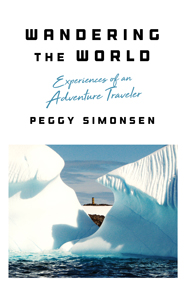
Peggy Simonsen: Wondering the World: Experiences of an Adventure Traveler
Read the full transcriptPeggy Simonsen
Peggy Simonsen has been a sailor, skier, and nature lover most of her life. As the owner of an international consulting company, she traveled for both business and pleasure, visiting more than sixty countries and all seven continents. A career development leader by profession, she is also the author of Career Compass and Promoting a Development Culture in Your Organization. Now a retired widow, she continues to seek adventure in far-flung parts of the world with family and friends, journeys she recounts in her travel memoir Wandering the World.
📚 Books by Peggy Simonsen
Transcript
[0:00:27] Jane Borden: Peggy Simonsen has traveled the world, setting foot on all seven continents and boating on six of the seven seas. Now she has written it all down in her book: Wandering the World: Experiences of an Adventure tTaveler. Whether writing about the feeling of white water rafting or the flavors of world cuisines, Peggy intends to inspire readers to seek their own adventures. She joins us today on Author Hour to discuss the beauty of Petra, Jordan, meeting penguins in Antarctica, and the power of enduring curiosity. Hi Author Hour Listeners, I’m Jane Borden and I’m here today with Peggy Simonsen, author of Wondering the World: Experiences of an Adventure Traveler. Peggy, thank you so much for being with us today.
[0:01:12] Peggy Simonsen: It’s my pleasure, thank you.
[0:01:13] Jane Borden: First of all, I read that you captained a boat in the famous Mackinac Race. Talk about adventure.
[0:01:20] Peggy Simonsen: Yes.
[0:01:22] Jane Borden: Can you tell us all a little bit about that experience?
[0:01:24] Peggy Simonsen: I’ve been sailing for most of my life and my husband and I bought a new racer sailor in 2002. Before that, we had been on several Mack’s on our previous boat and by the way, it’s Mackinac, even though there’s a C at the end, it’s the way it’s pronounced. We had this brand-new boat and fast racer, we put it in the water in 2002. My husband got sick that summer and died in the fall and never was able to race it. The following year, well, that year, I decided I needed to keep the boat and see if I could do it on my own and then the following summer and for another three years, I was the skipper on the Mack race on this boat. I had a crew of eight, which are skilled people, it was a 50-foot boat. I was one of two women skippers. There’s over a hundred boats that go in the race each year. Kind of a unique little slot for me.
[0:02:18] Jane Borden: Wow, that must have been quite a challenge but very rewarding.
[0:02:22] Peggy Simonsen: It was, it’s a tough race. As I write in the book, one of the races, Larry Ellison from Oracle had his big 70-foot boat shipped to Chicago so he could race in it, and he was joking about how he was going to come race in the pond and he learned a lesson. It can be really tough. It’s a narrow lake so the waves get really choppy and high and if you have a north wind, it’s more than 300 miles long, so the winds are coming the whole length of the lake. You can crash around on them if you don’t know what you’re doing. He got his comeuppance and he did well on it but he realized that Lake Michigan isn’t a pond.
[0:03:01] Jane Borden: You open the book with a section on boats and I love how you write about preferring being in crafts that are closer to the water, such as a kayak for example, as supposed to a big yacht and that seems like a theme for an adventurer traveler. Tell us about that distinction?
[0:03:22] Peggy Simonsen: I know a number of people who travel a lot. In fact, one couple has taken many, many, many cruise ships and that’s not my idea of adventure. Yes, you go to new places that way but I want to be actively involved, not sitting in what I call a hotel on the water. The idea of being able to manage my own sail boat, or my own kayak, or in some cases, a white-water raft is where the adventure comes in.
[0:03:50] Jane Borden: That feeling of being on the water is second to none.
[0:03:54] Peggy Simonsen: Well, I grew up on a lake in Minnesota, land of 10,000 lakes and we were in the water all summer and doing – jumping, diving off rafts, we took canoes out, we didn’t have kayaks then, and gunel jumped, which is two people standing on the edges of the canoe and trying to knock the other person off. Just all sorts of crazy stuff that was because we were really used to being in the water. That has been a theme for my life. When we first lived in Illinois, we didn’t have little lakes around but we started sailing on boats big enough to sail on Lake Michigan because I needed to be – my husband too, we needed to be on the water or in the water. That’s been a theme of my travel and that’s why the chapter on boats comes first. It’s really my preferred way to experience new places in the world and all sorts of different boats. I have been on expedition ships in places like Antarctica, where you wouldn’t want to be in a little boat, but that’s with the purpose of getting you through the tough water and being able to do things on land, rather than just sitting back in a lawn chair. I kind of feel the same way about beaches. I like to be on beaches on occasion but I’m not a person that goes on vacation just to sit on a beach, I want to be actively doing something.
[0:05:07] Jane Borden: How do you relax?
[0:05:10] Peggy Simonsen: Well, actually being on the water is relaxing to me unless it was in the case we were kayaking in Alaska at the base of a glacier that was calving, that’s not relaxing, you’re paying attention that you’re not supposed to, that’s going to swamp you. I also, I relax in nature and that’s one of the chapters in the book, is on all of the different aspects of nature that I find exhilarating but also relaxing. Again, my youth in Minnesota made a difference, my family were campers. We’d go up into the north woods. I appreciated being in the woods. Forests is one of the sections in that chapter on nature. The Old Growth Forest in the Pacific Northwest of the US are my favorite place. I am just in awe of those thousand-year-old trees, the redwoods and the sequoias and you know, the huge dense forest there.
[0:06:01] Jane Borden: They’re spectacular. Tell me a little bit about the structure of the book and how you came to organize it that way, and also how you came to write the book?
[0:06:11] Peggy Simonsen: Well, the organization is based, I didn’t intend it to be a travel guide. Many years ago, someone said, I should write a book about my travels and I thought, “I’m not going to be telling people what hotels to stay in or, you know, which museums to see.” That’s not what it would be about. As I was thinking about it, first of all, I’ve always kept a journal when I travel. I had the impressions and the experiences written down. Each Christmas, I wrote a Christmas letter with a photo page of where I’d been that year and I got very consistent feedback from people that they both wait for my Christmas letter to hear about my exploits but they also, a number of people have encouraged me to put it into a book. That was some prompting for it, but the organization of the book was based on the kind of experiences I have rather than the countries I’ve been to. I’ve been to more than 60 countries. It wasn’t listed by countries. That’s why the category of boats came up. The second chapter is on snow and ice because I’m a skier and I like winter and I like to be out, and it’s not just skiing, but because Antarctica was one of my favorite trips so that’s snow and ice and nature. There is a chapter on people and culture, which is sort of country-specific because what I find is there are some countries that I just love everything about it. My number one favorite is New Zealand but there are other countries where I love the people but there are problems with the culture in some ways. I had to separate it, I don’t dislike the country because of the problems, because the people were so nice or, you know, there’s some variation of the combination of those. Another chapter is on architecture, archeology, and artifacts because one of the things I love is exploring the older the better of the archeology, like the Middle East with Egyptian tombs, and pyramids, and temples from four or 5,000 years ago. I’m just in awe of that. My very favorite are the gothic cathedrals, particularly in France and England. That’s adventure but it’s not physical adventure, it’s just, it’s the excitement of learning about that. I had an art history minor in college and my favorite of all of the media or the areas is architecture. I’m much more involved in researching and visiting architectural sites and archeological sites than I am museums looking at paintings, for example.
[0:08:45] Jane Borden: That tracks with your ethos. You said that you were always keeping a journal while you were traveling. What prompted you to do that and what did you get out of it?
[0:08:57] Peggy Simonsen: I didn’t really have an end purpose. The reason I was doing it was so I would remember some of the specifics, you know? Maybe some of the names of the places we went but to a large extent, the kind of impressions I had. Sometimes, I mean, we were busy going a lot, I would not write as much but I always had something written down. When I was writing the book, I could go back and go, “What was the name of that river?” Or you know, some little specifics of the trip. It was really more a record keeping than anything and, as I said, I didn’t really have an outcome purpose for it but it served me well when I decided to write the book.
[0:09:32] Jane Borden: Talk to me a little bit if you can about the travel bug itself. How has your sense of adventure served you and shaped you?
[0:09:43] Peggy Simonsen: Well, I’ve always had a wanderlust. We didn’t travel a lot when I was a kid but, as I mentioned, we did go camping. I always looked forward to just being in a different place and having new experiences. My work over my career involved travel. That sort of met that need even though I wasn’t out just for the fun of it, I was going to places for business but it also opened my eyes to different parts of the country to start with and then internationally. It really is just sort of a part of who I am. One of the things I mentioned actually in the afterward in the book is about, when I was working and I was a career coach, and would have people come who are unhappy with their work, with their careers. One of the things I asked them was you know, what we try to get out was, “What is the key anchor?” we call them of, “What drives you in your work?” For me, it’s challenge, whether I get it from travel or in the case of the work itself. After I retired, I needed to continue to have some way to have my need for challenge met. I get it in skiing, and hiking up mountains, and sailing, and various physical ways. I also still – I’m very active with a conservation group here in the Barrington area in Illinois, so I get mental challenge as well from that. Those are the driving forces for my life and I am really very fortunate that I can travel as much as I do and have all the kind of experiences that I delight in.
[0:11:20] Jane Borden: It’s so interesting that you work as a career coach and I understand that wasn’t your first act but I wonder if you see any parallels between that work and your adventuring?
[0:11:34] Peggy Simonsen: Well, the biggest parallel I think as an entrepreneur, I mean I started business in 1979 and you know, there is all sorts of risks that goes with that and again, it is not physical risk but it’s the challenge of creating something and making the business successful and maintaining it but I also, my master’s degree is in psychology. I think there is some of that is involved with liking to meet people in various parts of the world and understand differences. You know, open up conversations and possibilities with people that – I’m away from the routine. I’m away from some of the people that I see every day, which I love, but this is that exploration aspect of it.
[0:12:20] Jane Borden: Yeah. Okay, I got to ask you about a couple of specific locations because I read about your trip to Petra. I’ve always wanted to go there. Can you tell our listeners a little bit about it?
[0:12:31] Peggy Simonsen: Yes, it’s really an amazing site and yes, you bet, you really do need to keep it on your bucket list. Petra is in Jordan, it was not even known about until the 19th century, even though it was a thriving city in the first part of, well, like, first and second centuries. It was hidden because it’s a city carved in the wall of the rock behind a canyon, and to get there, you go through a narrow little slot canyon called a siq, with very, you know, like just – You could touch both walls of it as you are walking through until you come to the end of it and then it opens up and here is this magnificent carved city of the red rock of the desert in front of you. It has stayed pretty much intact because it’s been protected from the winds and the sand eroding it because of the canyon in front of it. It is pretty – it is jaw-dropping awesome. It’s pretty amazing.
[0:13:32] Jane Borden: Wow and then you mentioned you’ve been to Antarctica and I remember from the book, you said that was the last of the continents on your list. You checked them all off?
[0:13:43] Peggy Simonsen: I’ve been to seven continents, yes that was the last one but –
[0:13:47] Jane Borden: As if being in Antarctica weren’t cool enough, you had the additional bonus. Tell me about that trip?
[0:13:55] Peggy Simonsen: It was really spectacular. I had wanted to go to Antarctica for a long time and I had a relationship with a partner who was also a traveler. Antarctica wasn’t high on his list of places to go but he went with me because I wanted to, because it was my number one and he said it was the best trip that he’d ever been on and he had travelled a lot. We were on an expedition ship that was – it was interesting. When we were in Ushuaia, which is the southernmost city at the tip of South America, and had lunch in a restaurant up on a hilltop and we were looking down, and our expedition ship looked little compared to a cruise ship that was anchored there. The cruise ship went through the Magellan Passage that goes to the other side of South America and ours went out into the Drake Passage, which is the open ocean that goes between the southern tip of South America and the Antarctic Peninsula, and it looked little at the time. It held about a 100 people including the crew and the passengers, so a good size ship to handle those waters. We were lucky to have a smooth crossing. The Drake Passage can be pretty wild, but then we got up to Antarctica and the first place we were going to try to stop was the rocky shore where Shackleton’s crew, where their ship had broken up and the crew was stayed on this little rocky promontory over the winter and they had one dingy that they had to row to for – I don’t know, hundreds of miles to try to get help, but any case, when we got to that spot, it was too rough for us to be able to anchor there and I wasn’t too unhappy about that. We had to bring boots that came over our knees because when we would get off, we’d get off the boat into the dingy and the dingy is called a Penga to get to shore. Sometimes, we were be stepping into icy water, so we had the boots on, but anyway, we did get to many places where we could get on to shore and walked among the penguins there. There is a number of different kinds that live there and there is just – there is colonies of them and they’re so tame. I mean they don’t have any fear of humans because there are so few of us around there and so you know, you walk up and just kind of look at them in the eyes. They’re cuddly looking little things, but we also hiked out in the glaciers and went into a – there is a spot called Deception Island because when you come up to it, you can’t tell that there is an entrance but you can get in. It is a little bay inside, in fact the whalers, a century ago, anchored in there but there is a hot spring, icy water, but the hot spring, people were encouraged if they wanted to, to put a bathing suit on under our heavy coats and go in. It is interesting, we went in January, which is summer there but people in Illinois said, “Oh wasn’t that going to be awfully cold?” and I said, “No, it is actually was 30 degrees warmer in Antarctica that winter than it was in Chicago in January,” but really just again, an exciting trip. You learn the history of it and the only settlements there now are the scientific stations and we visited one of them to see what they’re doing.
[0:17:00] Jane Borden: Oh wow, that’s cool.
[0:17:02] Peggy Simonsen: Yeah, really great trip.
[0:17:06] Jane Borden: After COVID, what’s your next adventure? What’s on the list?
[0:17:12] Peggy Simonsen: Well, I have a trip planned for June this year if things work out, right? For a barge trip in France. I did one a few years ago, this one was on the Canal du Midi in the South of France. It goes from Marseille over to the Pyrenees, but it is a boat that holds ten passengers, so it won’t be a crowd. We booked it on the condition that France will let us in because you know right now, Europe is blocking American travelers. That’s in the summer and then next fall, I have a trip to Croatia, and Montenegro, and Herzegovina, and the area in the Balkans there that was scheduled for this past fall that had to be cancelled. Instead of cancelling, I postponed, so that is on the next trip. That’s a part of the country I have not been to, a part of the world I haven’t been to.
[0:18:00] Jane Borden: That would be remaining on your bucket list.
[0:18:02] Peggy Simonsen: Oh, I’ve got lots of others.
[0:18:04] Jane Borden: Really? Tell us.
[0:18:06] Peggy Simonsen: Well, I have not been to the Amazon and to Machu Picchu in South America. I’ve been a lot in other places there, so that’s in the tropics I wanted to go to, and the other direction, I have a friend and I are planning to go to Iceland and Greenland when we can make that happen. It probably won’t be this summer but it will be the next year instead, and also to the very north of Norway, to the Svalbard Islands, which are above the Arctic Circle, so some cold places and some warm places.
[0:18:36] Jane Borden: We all have bucket lists, we don’t always get to them for a variety of reasons. What would you say to listeners to encourage them to make their travel dreams happen?
[0:18:49] Peggy Simonsen: For most people, it wouldn’t be as many different places but most people probably have one spot. As you mentioned, you’ve always wanted to go to Petra. I’d say, you know, put it on the top of the list and try to make it happen. Sometimes it’s a cost issue, so you have to either save for a while to do it or make some adjustments in the cost, but it is really a matter of determination I think. For some people, it’s probably going to be more a matter of more learning about them from being the armchair traveler instead of actually going. That doesn’t do it for me. I mean, if I am watching Rick Steve’s program on a particular place, I want to go there. I don’t just want to watch it on television, but I do. I think for people to determine the kind of travel they like to do, and the places, and I have a friend for example that is very active with Rotary. She takes service trips every year. They go to Guatemala and have helped build a school for example and in fact, she and I, it was her prompting that got me to go to Nigeria with her where we administered doses of polio vaccine, the oral dosage to kids, with the local healthcare people. You know, sometimes there’s those kind of intentions or purposes that people might have that are different than just being a tourist.
[0:20:10] Jane Borden: That really enhances the experience to be of service to the community.
[0:20:15] Peggy Simonsen: It does. In fact, I am a member of a stewardship circle as it’s called for the Unitarian Universalness Service Committee, and we are not taking service trips right now, but they work with refugee organizations all over the world and people seeking asylum. Both helping on the spot when there is urgent needs, like there is at the American border right now with Mexico, but they also work with the local service organizations to try to deal with the underlying cause of the problems. The war, the injustices, the problems that are causing people to – you know, sometimes its climate issues causing people to become refugees. That is one of my service focuses.
[0:20:56] Jane Borden: I thank you for doing that work and for telling us about it.
[0:20:58] Peggy Simonsen: Again, it is combining my need for travel and adventure but also making a difference.
[0:21:03] Jane Borden: Yeah. Well Peggy, it has been such a pleasure speaking with you. Congratulations on the book. Again listeners, it’s called, Wondering the World: Experiences of an Adventure Traveler. Peggy, where can people find out more about you and your book?
[0:21:18] Peggy Simonsen: The book is going to be launched on Amazon on February 23rd. It will be available on Kindle as well as a paperback, and then after that at some time, hoping that some of the bookstores like Barnes & Noble will carry it.
[0:21:33] Jane Borden: Okay, great. Thanks so much.
[0:21:35] Peggy Simonsen: Thank you, this was fun to do.
[0:21:38] Jane Borden: Thanks for joining us for this episode of The Author Hour Podcast. You can get Peggy Simonsen’s book, Wondering the World: Experiences of an Adventure Traveler, on Amazon. You can also find a transcript of this episode as well as previous episodes on our website, authorhour.co. Make sure to subscribe to The Author Hour Podcast for more interviews and insights into life-changing books. Thanks for joining us.
Want to Write Your Own Book?
Scribe has helped over 2,000 authors turn their expertise into published books.
Schedule a Free Consult