Phillip Stutts: Episode 682
Read the full transcript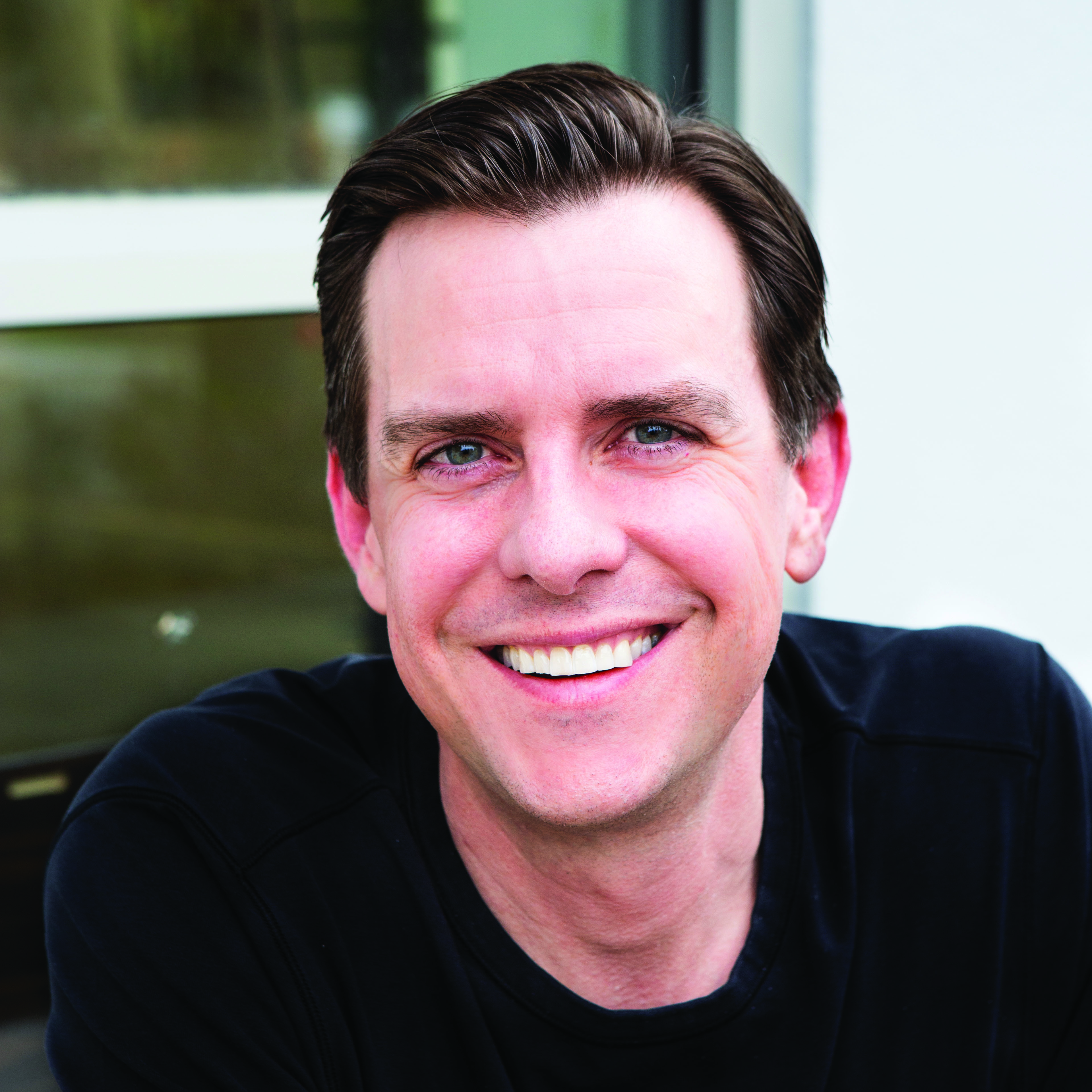
Phillip Stutts
Founder, CEO, and bestselling author Phillip Stutts plays the game of corporate and political marketing on the highest level, battling with fierce competition, multibillion-dollar budgets, and a win-or-die mindset. He’s worked with multiple Fortune 200 companies, contributed to more than 1,400 election victories (including three presidential wins), and made more than 350 national media appearances on outlets like ESPN, CBS, and CNN. Phillip has been lauded by Fox Business as a “marketing genius” who has “generated record sales for his clients.”
📚 Books by Phillip Stutts
Transcript
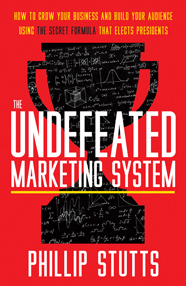
[0:00:35] JB: Today’s guest, Phillip Stutts has been called the Michael Jordan of political marketing. He has contributed to more than 1,400 campaign victories. Along the way, he realized that companies could benefit from the same marketing strategies. Now, he has put all of that into his new book, The Undefeated Marketing System: How to Grow Your Business and Build Your Audience Using the Secret Formula That Elects Presidents. On Author Hour today, he talks about what’s missing from most corporate marketing campaigns, he breaks down his five-step system, and he discusses the importance of building data-based relationships. Hi Author Hour listeners, I’m here today with Phillip Stutts, author of the The Undefeated Marketing System: How to Grow Your Business and Build Your Audience Using the Secret Formula That Elects Presidents. Phillip, thank you so much for being with us today.
[0:01:32] Phillip Stutts: I’m so excited to be here. I’m a return guest.
[0:01:36] JB: That’s right. This is your second Author Hour interview for your second book and they’re somewhat related, I gather, which I want to talk about a little bit later. This is a very specific topic. I want our readers to kind of understand where you’re coming from. Can you tell us a bit about who you are and what you do for a living that led to this?
[0:01:56] Phillip Stutts: I have spent 25 years working on political marketing campaigns. I own a political ad agency and we run ads and run marketing campaigns to get politicians elected. About six, seven years ago, I said, “You know, I’d be really curious to see if how we elect politicians from presidents to senators, to governors, to congressmen and women.” “We could apply those same principles to businesses to grow” and I did, started and launched a corporate marketing agency, utilizing this approach, this undefeated marketing system approach, which we can get into what it is actually. We’ve seen every business we worked with over the last few years, grow their bottom line by taking a very unique approach to the way they market their business, utilizing the principles of political marketing campaigns. There’s a stat out there from a guy named Jonah Berger, wrote a book called Contagious. In the book, he says that we are seeing up to 10,000 ads per day, online and offline. Each individual person in America, we’re seeing 10,000 ads – up to, excuse me. Up to 10,000 ads per day, per person offline and online. The whole point is okay, if you’re a business owner out there and you’re trying to break through the clutter of 10,00 ads per day, how are you doing it different and are you taking a systematic approach to marketing that gives you an advantage in the marketplace? What I find is that most business owners just run out and say, “I don’t know, I’m just running some Facebook ads” And that didn’t work. “I hired a marketing agency and they told me to run Instagram and I don’t know, I just did it and nothing really happened” and you can play – in a land of 10,000 ads a day, the winners in that game are following a systematic approach and the big winners are the ones that are doing what no one else is doing in the marketing game and that’s what I’m trying to teach through this book.
[0:04:11] JB: Now, obviously, a political campaign is pretty different from running a business but of course, there are some commonalities presumably or you wouldn’t be doing this work. What made you first think like gosh, what works for A might work for B?
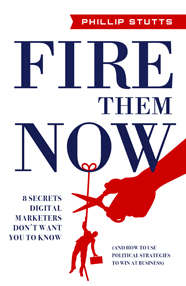
[0:04:29] Phillip Stutts: I had a business owner who is a landowner out in Hawaii who had spent $50,000 on marketing a land development out in Hawaii and had received one lead after spending $50,000 and he came to me and he said, “I got to do things differently, I got to shake things up, I got to try something different, can you guys help me?” He was fascinated by politics and I said, “Sure, let us try that” and I think we ended up with a $5,000 budget, getting him over 700 leads. I went, “Oh, there’s something there” and so I write about that story in my first book, which is Fire Them Now: The seven lies digital marketers sell. But we just expanded on that over the years and then the funny thing was, what happened, about a year or two after that, is we ended up landing the biggest client in the history of our company. It was a supplement company, there were eight figure company, they were about to be nine figures and they came to us and they said, “Love this approach, can you help us?” I said, “Sure.” We started doing some marketing work for them and doing some really good work and seeing some good ROI on things and then, one day, the owner came to me and said look, into or team and said, “Look, Instagram is where I get the most traction in my business and I want to run an ad on the highest selling supplement we have” and so, we got our creative team, we did a photo shoot with the supplement, just the supplement alone and then we went out and we were about to run this ad. The business owners catches wind of the exact ad we’re putting out and calls a meeting of all of them, everybody in my company and says, “What in the hell are you doing?” We went, “What? What are you talking about?” He said, “If you post either in an ad with a picture of a supplement, even if it’s my bestselling supplement and there’s not a human being in it”, he goes, “You’re going to ruin an algorithm that I’ve spent five years cultivating.” “It will literally crash because it cost me hundreds of thousands of dollars. How do you not understand my business?” I went, Oh my god, I didn’t realize that.” He said, “Well, that’s a big problem” and I said, “We will get this fixed” and he goes, “Fine, I’ll talk to you tomorrow.” That was the last time I actually ever talked to him because he ghosted us and we lost him as a client. When I said “Something’s not right.” We have this approach of applying these political marketing principles into businesses but it’s not systematic and I didn’t know what it was and so I literally locked myself in my office and just started writing in a notebook what is it that we do differently in politics to get candidates elected and how could we apply that to businesses. Then I mapped out the five steps that we inherently, it’s never spoken off or written down but inherently, we utilized in political campaigns to elect presidents, to elect senators, governors, congress people, anybody. I went, “Oh my god, this is it, this is the five-step process.” While we were doing really good work for this particular business, we weren’t following it in a formulaic way. I just said, “Okay, we’re going to follow this going forward, this five-step marketing system.” We ended up getting in touch with all of our clients and telling them that we’re going to reorganize the way we’re working with them, that was a scary moment but they agreed to it and we started working with them and from that point on, every business that we worked with that has followed this five-step system has grown their bottom line. At one point, about two years ago as I was thinking about writing this book, I screamed out, “This damn system is undefeated” and that’s how we decided to name it the undefeated marketing system. We’ve used this approach ever since and then what I did in this book, ultimately is this. The book is very – it is not a textbook. If you’re looking to buy a text book on marketing, this is not your book. This book is, all it is is told through stories, the five-steps are told through stories, they’re told through political war stories, political campaign stories. If you want to know how political campaigns are really run behind the scenes, I will tell you. I will tell you how George W. Bush won his presidency using the five-step system. I’ll tell you how Barack Obama did it, how Donald Trump did it, and how Joe Biden did it. Then, I translate that over into how corporate America is starting to use these steps. The one area of corporate marketing that is not utilizing this is corporate marketing agencies. I figured, this is a chance to explain an outlier approach in a land of 10,000 ads a day that could exponentially grow a business's bottom line.
[0:09:18] JB: Okay. Well, let’s get into it. What are the five steps of the undefeated marketing system?
[0:09:26] Phillip Stutts: Best way to approach that is to say, how does the five-step undefeated marketing system work in politics and then I’ll translate it over business. When a candidate sits down with me and they say, “I want to run for office and I’m like great.” What do you care about, tell me your top policy issues and it inevitably, that egotistical candidate tells me about 20 to 25 things they think they’re going to run their campaign on and I’m like, “Oh my god, no one wants to –” I’m thinking this in my head, “No one wants to hear about 25 issues from one politician." I say, “Okay cool, you care about these 25 issues, let’s go find out what the voters think of these 25 issues.” We ended up running out and doing what we call a benchmark surveyor poll, not the kind you see in CNN where it’s like who is winning, who is losing. You try to figure out within those 25 issues, you test them, you poll them with the voters and ultimately, you’re going to find of the 25 issues, there are only really two issues that voters will really care about, that have alignment with that candidate. That candidate already said they cared about those 25 issues but they’re only two of those that the voters go, “I care about that issue so much that I cross party lines” or “If I don’t know who the candidate is, I’d vote for them, if I knew they supported that particular policy issue.” Then I go back to the – this is step one for us which is, you have to have a deep understanding of what the voters want, right? They have to be in alignment with what the politician wants to talk about. This is not about, “What do the voters want” and then let’s just talk about what the voters want. No, there has to be an alignment between the politician and the voter. For us, step one is always getting a deep dive on what it’s going to take to win by looking at the data, the voter data and you could say the same thing in business. I have a partnership with the largest data collection analytics and AI company in America. When we work with businesses, we can overlay their customer base and find out everything we need to know about the customer. What social media platform is on there, chronological order? What their values are in life, what they watch, what they read, we can find out everything. What I always tell business owner is this is your first step, find out what your customers want and what moves them before you go spend a lot of money marketing to them. That’s step one. Step two is now that you know what the voter wants in politics and you know what the politician – you know, it’s two issues that the politician already cares about, you have to build a strategic marketing plan around that and in politics, we call it the campaign plan. The campaign management plan and in business, it’s a marketing plan for your business. You have to have a strategy behind it, you can’t just run out and play whack-a-mole with a bunch of Facebook ads, that doesn’t work. What if you knew your voters or even your customers, didn’t buy things on Facebook, they’re on Facebook but they don’t buy things on Facebook. Why would you market there? That’s what we’re trying to determine and we’re trying to determine what’s your budget, what’s your timeline, what markets are you going to go into, how are you going to message to certain demographics and certain voters, we’re trying to determine all that and put it in one place, that’s step two. Step three is the branding of the candidate. I don’t want to build a website or a brand for a candidate unless I know what the voters care about because if I am going to market to the voter and send them to the website, you should check out the candidate and the website doesn’t speak to that voter, why would I do that? It’s a waste of money, so I don’t brand first. I hate people that are marketers that talk about, “You got to brand before you do anything else.” No, you don’t. You have to figure out what your customers want or in this case, what the voters want and then you have to build your brand around that and that has to be the third step and in fact, let me give you an example on what I mean by that. In 2016, Donald Trump’s campaign ran with, you know, this is back in the wild west of Facebook. There weren’t a lot of restrictions and they would run one particular message of one at a 162 ways on Facebook. They’d have a red background, a green background, they’d have women in the ad, they’d have men in the ad, they had the different font sizes, they’d have this font in the right corner, the font in the left corner, they would literally do a 162 test of one message and ultimately, they would find one ad or excuse me, eight or nine of the ads of the 162 that blew through the roof. The engagement was through the roof and they didn’t know why. It was different versions of the same message that they already knew would work but they just tested it in various ways and now, that’s so important to them. For them, that’s like when I talk about step four, this is where you go and you test all the messages and the reason that works. Effective it was that I mean they spent millions, hundreds of millions of dollars on Facebook, this is how they did it in 2016 and the point is that before you go out and run a big marketing campaign, you need to know what works. Your job as a business owner is to – or a marketer really is to eliminate the risk of the people that are utilizing their dollars every step of the way and this system does that. Once you’ve tested all of those ads in step four then you move to step five, which is you’re ready to launch your marketing campaign. Why? Because you know what the voter cares about or in business, you know what the customer cares about. Step two, you build a plan that brings the alignment between the candidate and the voter or in business, the business owner or product and the customer and step three is you build the brand now that you know all of these things, you build the brand so when you spend money on marketing and they come check out your brand it resonates with them and step four is now that you’ve got all of those during set-up, you start testing variations of your message to figure out what’s going to pop at the hardest point and then step five, now that you known this and you’ve eliminated all of your risk you are ready to go spend real money on your marketing campaign. The difference between politics and business is every political marker is doing the same, is following these five steps. My opponent, if I am running a political race, their marketing team is doing the same thing I am and we have an election day. It’s a win or die moment. It’s like a deadline that you can’t escape and so it produces an amount of innovation, Jane that we never stop innovating in political marketing. It is constant, because the competition is so fierce. And in business marketing, it’s not that at all. There is no competition, it’s just, “Let’s run an ad campaign. Did it work? Did it not? Okay, well, maybe we’ll try something different” and what I’m trying to tell business owners through this book and teach them about how to run a marketing system that eliminates their risk, grows their bottom line and helps break through the clutter of a ten thousand a day ad market.
[0:16:20] JB: Okay, I feel like what I’m hearing a lot is the importance of data being able to collected and analyze it and a lot of that I mean it’s only been available to us in the last decade or so. Is that why you think there’s this opportunity in marketing to revolutionize marketing the way you see it?
[0:16:47] Phillip Stutts: Well, data is in anything. Google is not a search engine, it’s a data company. Coco-cola isn’t a soft drink company, it’s a data company. Facebook isn’t a social media platform, it’s a data company. The reason it is that these billion-dollar companies know that understanding their customers is the number one factor to success and too many times, business owners, the vast majority of business owners don’t understand those. I was on an interview last night with James Altucher and he asked me, “Okay, you don’t have a lot of money and you want to start a restaurant. How do you start with step one in data?” and I’m like, “Cool, you have no money? Good, you stand outside the restaurant and you get people into the restaurant. The second thing you do is once people start coming in, you empower the waiters or the waitresses to ask the question and the meal. What do they like the best? What did they not like?” How could they improve their services? You collect that data, you see what dishes are selling the most off, what are selling the least off. You are seeing what drinks sell the most, sell the least. You are getting feedback in data, this doesn’t cost you anything but you can do it whether you have money or you don’t have money. The question is, does the business owner want to start with understanding their customer before they run out and talk about whatever it is they want to talk about. The problem I see so many times, and I’m just as guilty of this, is that business owners love to tell everybody how great their business is except the customer may not give a damn about that and so what I am trying to do is find out what the customer values in life and where that is an alignment with what the business owner selling a product or a service can find some commonality and then to communicate that and get that message across so you can build a deeper connection with that customer or client. This can work for sales and it can work for marketing but the bottom line is, when we’re looking at a 10,000 a day market, no one wants to build real human connections anymore and my thing is, and what I’m screaming about from the hill is everybody wants deeper connections except we have less of it than ever and so what we need to do is build marketing campaigns to understand in an empathetic way how people are motivated to buy things and then try to speak to them in that manner.
[0:19:02] JB: Okay, so the point is you can’t have a deeper or a more authentic connection unless you understand the person with whom you’re trying to connect.
[0:19:11] Phillip Stutts: I think that’s a great lesson in life too, right? I mean you’re a reporter. I mean the first thing, I mean I’ve dealt with a million reporters in my life. That reporter always try to get to know me a little bit so that they can make a connection and then I can give them more information that then they can use to develop a story and it’s the same thing. It’s just how we look at marketing and I don’t look at it as a transaction, I look at it as a connection.
[0:19:41] JB: That’s certainly true in politics I imagine.
[0:19:47] Phillip Stutts: Everything is the connection. You know, you have politicians that go door to door and knock on door that tell the story of John Thune is a US Senator out in South Dakota. He run for the US Senate and lost in 2002 by like less than 0.0001% then he ran again in 2004 and he beat the senate majority leader, Tom Daschle but I know for a fact that every Sunday for about two or three years, he literally would get a list of voters sent to him by the campaign and every Sunday after church, he would literally go out for three or four hours and knock on doors. In a state with 300 to 400,000 voters, he literally was going door to door for years to build deeper connections with voters, ended up beating Tom Daschle by about 10,000 votes and I can guarantee you, a large percentage of those people were the people he knocked on their door and got to introduce himself to them personally.
[0:20:43] JB: Yeah, it’s powerful. Supreme Court has decided that corporations are people, are you also saying corporations could be politicians?
[0:20:53] Phillip Stutts: I think they can learn from politicians. I don’t know if anybody needs to be a politician, you know? We’re in a day and an age like I would say this, my background man, it would have been powerful in 2004 but right now, it has such a negative connotation and no, I don’t think corporate America should get into politics at all. I think they should learn from the strategies that we use to market their own businesses and make deeper connections like we do in politics and voters. I don’t think politicians should be political, though or I mean excuse me, corporations should be political, though.
[0:21:28] JB: Of the things that corporations can learn from politicians or political campaigns more specifically, what’s kind of the number one thing you want listeners to walk away understanding about that connection?
[0:21:45] Phillip Stutts: If you’re seeing up to 10,000 ads a day and you’re just running around throwing up a bunch of ads and hoping it works, you will lose a 100% of the time. I’m going to say this and it sounds like it’s something nefarious or unethical, it’s not, but the game is rigged. The smartest people in the room know how to game, to play the game and I talk about how Uber and Coke and Google and Facebook, how they play the marketing game and I am trying to teach small businesses how to play just as smart without having to spend all of that money, but the game is rigged. If you are throwing up your hands and saying, “I think I’ll just try this” you are going to lose and waste your money. You are going to lose a 100% of the time, it’s guaranteed. You must follow a systematic approach. I have one, it could be another one but I think ours is the systematic approach and the undefeated marketing system works but it could be any systematic approach but if you are just playing what I call the whack-a-mole tactical marketing game where you are just throwing things against the wall and hoping it works, you’re going to lose every time. We are moving in a very disruptive world where everything changes every ten minutes in technology and this is a principled way to take what you’re doing and utilize it no matter what changes in the technology and that is really what I want to teach in the book.
[0:23:12] JB: Is there anything you want to talk about that I haven’t asked?
[0:23:14] Phillip Stutts: The one thing I’d say is if you’re a business owner out there and you’re like, “Well, how would I even start looking at data from my customers or my clients?” because this works for B2B, B2C, e-commerce, we created a free customer data assessment form online. You can go to my name, phillipstutts.com/insights, it takes you 20 seconds and my team will evaluate your business and your customers and we’ll give you some free strategies that we can use to try to understand your customer or client better and win in the game of marketing.
[0:23:48] JB: Phillip, it’s been a pleasure speaking with you. Again listeners, the book is The Undefeated Marketing System: How to Grow Your Business and Build Your Audience Using the Secret Formula That Elects Presidents. Phillip, congratulations on the book. Thanks for being with us.
[0:24:03] Phillip Stutts: Thank you.
[0:24:06] JB: Thanks for joining us for this episode of The Author Hour Podcast. You can get Phillip Stutts’s book, The Undefeated Marketing System: How to Grow Your Business and Build Your Audience Using the Secret Formula That Elects Presidents, on Amazon. You can also find a transcript of this episode as well as previous episodes on our website, authorhour.co. Make sure to subscribe to The Author Hour Podcast for more interviews and insights into life-changing books.
Want to Write Your Own Book?
Scribe has helped over 2,000 authors turn their expertise into published books.
Schedule a Free Consult