Mikhail Naumov: AI Is My Friend
Read the full transcript
Mikhail Naumov
Mikhail Naumov is a technology entrepreneur and the co-founder of DigitalGenius, a platform that combines human and machine intelligence for customer service. He was recognized in Forbes' 30 Under 30 for Enterprise Technology and is a frequent speaker on emerging technology, artificial intelligence, and entrepreneurship. In AI Is My Friend: A Practical Guide for Contact Centers, he draws on years spent working inside contact centers to show how businesses can put practical artificial intelligence to work.
📚 Books by Mikhail Naumov
Transcript
[0:00:39] Charlie Hoehn: You’re listening to Author Hour, enlightening conversations about books with the authors who wrote them. I’m Charlie Hoehn. Today’s episode is with Mikhail Naumov, author of AI Is My Friend. When you call a company’s customer support line, what’s your experience like? It’s usually pretty bad, right? Well, Mikhail is trying to make that experience better for everyone by using artificial intelligence. In this episode, Mikhail shares what he’s learned as the cofounder and president of Digital Genius, the leading platform for human and AI customer service. Over the last few years, his company has worked with dozens of contact centers to implement AI. You’ll learn about the future of customer support. How companies are scaling faster while making their employees better at their jobs and not to mention, keeping their customers happy. Now, here is our conversation with Mikhail Naumov.
[0:01:57] Mikhail Naumov: I’ll never forget when we launched our very first chat bot for BMW. They were an early customer of ours, this is going back three and a half years and at the time, we were still a couple of guys, you know, sitting down in a not so nice office and we had just one mission. To build technology that helps companies automate conversations with their customers and we thought that the best way to do that was to build technology that can help you create a chat bot that would be able to have a meaningful conversation with the end customer on behalf of the brand. As it happened, one of our first deployments was with a great automotive manufacturer called BMW, a great brand and at the time, they were launching their electric cars in the UK, the I3 and I8. Part of the message they wanted to get across is that their marketing for these vehicles was going to be as innovative as the car itself. Hence why they wanted to go down the technology route and have a chat bot that can carry on a conversation with a potential customer. That was sort of our first foray into helping large brands, successful enterprises have technology infused conversations with their customers.
[0:03:09] Charlie Hoehn: That’s really cool. How did that campaign go and how did you end up getting hooked on chat bots?
[0:03:18] Mikhail Naumov: As I mentioned, this was our first experience into building technology for large brands, successful enterprises to improve their conversations and communications with customers and we started with a campaign, at the time they were launching their electric car. The technology was supposed to support this whole message. They started with TV ads which would show the new car and at the end of every single television ad, there will be a little phone number that anyone could take out their phone and they could send a text message to this number to the short code, with whatever question they had about the car. “How much does it cost, where can I buy one, how long does it go on one electric charge?” Different things around the car that might be interesting and ranging from the easiest questions like factoid questions, all the way to more complex conversational experiences like scheduling a test drive or signing up for dealership visit. That campaign lasted overall more than a year and you know, hundreds of thousands of people wrote in after seeing these advertising on TV and have either ask questions or provided some kind of comments to BMW and it was a great tool for BMW to be able to engage with their customers, without necessarily having to hire thousands of people to have these conversations. The idea of you know, doing this autonomously was very interesting. Now, we also learned a lot of lessons through this process. The first lesson we learned is that chat bots, while they’re cool in very narrow use cases like for example, answering basic questions about a car or telling you the weather or helping you order pizza, they’re really effective at those narrow use cases. But when it comes to the world of end to end customer service, scripted chat bots just don’t measure up. After about six to eight months of doing these chat bots, we learned that what we should really be doing is narrowing our focus to the world of customer service, these are contact centers I’m talking about, and building a technology that is a lot more resilient than a traditional chat bot which can actually help customers. People like you and me solve their problems with the company that they – who’s products they use.
[0:05:27] Charlie Hoehn: What do you mean by making it more resilient? Do you just mean adding more scripts so they know what to say in more situations or what?
[0:05:37] Mikhail Naumov: That’s definitely part of it. I think that today, chat bots in particular are getting a lot of attention and they’re quite hyped up but we must always remember that a chat bot is just a title, what you really need to do is look under the hood and figure out what’s powering these bots. If it’s a – most of the time, in most cases today, those chat bots are powered by a traditional form of natural language processing, which essentially relies on someone sitting down and writing manually a bunch of scripts that help the bot understand questions based on the keywords that the person is using in their question. Somebody would have to sit down and think of every way somebody can ask a question about this new car. Then try to match those questions to the appropriate answers. As you could imagine, this process is very lengthy, very arduous, take a lot of time. It doesn’t really scale well, especially in an environment like customer service where each unique question is so different from the other. They might be dealing with the same topics but the way people phrase questions, is quite different. That’s one of the reasons why chat bots based on basic scripts and rules don’t really work in customer service. That was the first insight which we had and so we took that as an opportunity and redid our entire backend of our technology, from basic NLP to a full force machine learning and deep learning technology. Well, we got a chance to recruit some fantastic people from different AI labs from Oxford, from Cambridge who are at the forefront of the deep learning space. We have taken some of these research and we’ve productized it to bring the first practical application of deep learning to the contact center.
[0:07:19] Charlie Hoehn: What is deep learning?
[0:07:21] Mikhail Naumov: Deep learning is a subset of a study of machine learning where essentially you are using technology to ingest massive amounts of historical data, these would be inputs and outputs. In our world, these are questions and answers that exist inside of a contact center. Every time you had a problem with your bank or with your airline, you write in an email or make a phone call, we consider that an input. On the other end of that input is an answer that you got from the company or from the company’s representative and that’s an output. Believe it or not, in those contact centers, there are millions upon millions of historical customer service conversations stored in the format of transcripts and logs and we can take that data and ingest it into the deep learning algorithm, which converts all of these language into math. Then uses those inputs to train a model that could make predictions moving forward.
[0:08:13] Charlie Hoehn: Yeah, okay. An example might be, if AT&T has all these questions from people who are struggling with failed text messages, right? They’re calling in and they’re saying the same question but all these different ways, right? You’re inputting all of those, the machine is learning all of those and deep learning refers to the machine doing the deep learning, right?
[0:08:43] Mikhail Naumov: That’s right, and it’s all done automatically so unlike a chat bot where you had to actually go in and manually script all the different ways someone can ask you a question and hope that the bot gets it right. With deep learning, you are relying on already existing, real historical conversations that already took place to train the model which makes it a lot more resilient and a lot easier and cost efficient to train.
[0:09:08] Charlie Hoehn: Interesting. I’d love to see how this works because I’ve tried to create a chat bot, I think it was called mini bots or mini chat, or something like that. I both enjoyed and hated the process for the exact reason that you said. It was fun to create something but man, it was time consuming. Thinking of all the different variations.
[0:09:30] Mikhail Naumov: Couldn’t agree more and that’s from the perspective of somebody creating one, creating a chat bot. Now let’s look at it from someone who is trying to use it. You know, most people when they see it, you know, they might get excited thinking, “I don’t have to call the airline or I don’t have to call my bank, I can just get my problem solved right there.” The idea of a chat bot is so alluring and exciting because you think you can get an answer quick but the reality most times is that you actually come in and the bot’s just not sophisticated, it’s just not smart enough to help you solve your problem. In fact, I think the information just reported that the failure rate among chat bots is over 70% which means that you know, people coming in with a question, you know, seven out of 10 times, they’re coming back with some kind of negative experience and those questions that would have – were supposed to answer end up in the contact center.
[0:10:18] Charlie Hoehn: Right, I’m thinking of when you hear a robot, a recorded voice answering your message and saying, “Enter your card number now.” Just say your card number and you say it but it’s so quick that it cuts you off while you’re saying it. Or it’s like, “Sorry, I didn’t quite get that.” Now, initially was like when I heard those, I was excited because great, I don’t have to talk to a person. I can just efficiently go through this. Now I dread them because I know they don’t work half the time. Chat bots are going through that cycle right now because people are still learning how to use them and there’s not an efficient way of doing it if they’re manually inputting for these bigger corporate clients. It’s really efficient because they have all the inputs already ready to roll.
[0:11:12] Mikhail Naumov: That’s right.
[0:11:13] Charlie Hoehn: And all the outputs, cool. Tell me what’s in your book then so your book then. Your book is AI Is My Friend, is your book about the lessons you’ve learned inputting these things and how it’s benefitted companies?
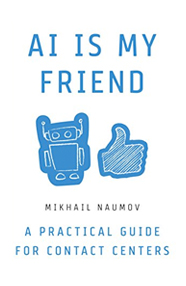
[0:11:26] Mikhail Naumov: Yeah, I’ve spent the last three and a half years of my life living inside contact centers. You know, literally sitting down next to hundreds of agents and watching what they do every day, watching their job, talking about the things that they have to do, the types of tools that they use and figuring out one thing: How do we make the latest advancements in machine learning, practical and useful in the contact center environment? Having spent this many years figuring this out, we decided to put all of these insights into a book which we called simply AI Is My Friend: A Practical Guide For Contact Centers. It’s really written as an underground guide as a guide from the trenches, if you will, for customer service experts, practitioners and leaders who have heard about AI, understand its importance, they know it’s going to make a big difference in their work and in their life but they’re not quite sure how to cut through all this hype. This book is there to help them do just that, addressing the entire ecosystem of AI, figuring out how to pick the right partners to work with, dispelling any of the myths and figuring out how to put this stuff into place.
[0:12:37] Charlie Hoehn: Yeah, let’s go through some of those, what are the big things that people really need to know from this book? What can you tell them, straight from this conversation that you would tell a client in a consultation?
[0:12:51] Mikhail Naumov: The first thing that’s important to recognize when looking into AI solutions for your contact center is, actually making a differentiation between what AI is and what it is not. First and foremost. AI is not there to replace your contact center overnight. You won’t be able to shut down your call center tomorrow once you implement AI, that’s just not how it works. The second part of it is, there’s a lot of noise out there with companies claiming that they do AI for your contact center where really, once you look under the hood, you realize that what it actually is, is a bunch of traditional rule based scripts that have been written to try to mimic what artificial intelligence could do. Asking that question upfront is really important and this book gets to the root of that as how do you tell what is AI and what it is not, when you see something in front of you. That’s part one. Part two is that there’s a spectrum and the spectrum ranges from the low-level intelligence applications. Things like for example scripted chat bots all the way to the stuff you see in Hollywood. I call that Hollywood AI. A lot of those things you see in movies are obviously fiction and although there’s a lot of hype around them, they’re really not coming to life anytime soon. And really don’t have much practical application in businesses. In the middle of the spectrum is an area we like to call, practical AI. This is where you can actually implement the latest advancements in machine learning and deep learning into your business today.
[0:14:24] Charlie Hoehn: Author Hour is sponsored by Book in a Box. For anyone who has a great idea for a book but doesn’t have the time or patience to sit down and type it out, Book in a Box has created a new way to help you painlessly publish your book. Instead of sitting at a computer and typing for a year, hoping everything works out, Book in a Box takes you through a structured interview process that gets your ideas out of your head and into a book in just a few months. To learn more, head over to Bookinabox.com and fill out the form at the bottom of the page. Don’t let another year go by where you put off writing your book. Let’s say I’m a skeptical contact center manager, right? I’m listening to this and I’m thinking, “Okay, I get it, why does this really matter? I mean, I’ve got a contact center here, it works well enough, we know our numbers, we know the turnover. Why does it really matter to them to implement this system?”
[0:15:31] Mikhail Naumov: I think there’s a number of reasons why it’s important to implement AI and figure out an AI strategy for your contact center right now. The first thing is that inside of a customer service environment, we’re always facing the same challenges. Where the volumes are usually growing, customers have higher expectations for better service than ever before and our budgets in a contact center are unfortunately either staying the same or trying to get cut. The reality is, a lot of contact centers today are being portrayed and perceived as a cost center to a business. You’re constantly under pressure to try to deliver more for your customers with a smaller budget or with less resources. What happens when a new channel comes out like Facebook Messenger and suddenly, your customers are expecting to be able to talk to your company and your brand through Facebook Messenger. By the way, this just happened to one of our clients, KLM, Royal Dutch airlines. They became the first airline to serve their customers via Facebook Messenger and What’sapp and unexpectedly, the volumes that started going through this new channel were just astronomical. Where they used to get email and chat, now all of these people that love their brand that are using it to fly all over the world can now talk to them via Facebook Messenger and What’sapp. Well what do you think happens, their volumes spike and in a contact center, it’s very difficult to plan for that. The only way to really solve for that is you have to hire more people. Now, when you hire more people, it becomes a challenge because you’re having all these new professionals but you’re forcing them to work with outdated technologies and this is where really AI comes in. By implementing this in the contact center, you can reinforce your existing team of agents. You can give them the right tools so they could be at their best and AI is great for that because it trains automatically on all the historical conversations that already happened in your contact center before and then whatever new messages or new questions come in, the AI is able to first help the agents answer those questions faster. So improving your agent efficiency but also overtime is AI learns from the agents. It can begin automating some repetitive questions and answers. Helping those customers get their resolutions faster than ever before. So for companies like KLM and many others that have implemented digital genius software or just AI software in general, what they are looking for is to scale their contact center in a cost efficient way and invest in their people by providing them with the best tools.
[0:18:04] Charlie Hoehn: Yeah, I mean everything you are saying resonates and while I understand why some might be afraid even, or skeptical of new technology potentially taking over their job, I’ve personally seen with people I know who runs similar companies doing extremely well in boosting the efforts of the existing staff. One guy I know named Andrew Magliozzi, he did this AI for college campuses and he was able to boost enrollment because a lot of students drop out during the summer. But the reality is, if you can have a college admission staff, enough people helping them get re-admitted and go through this application processes that are really time consuming and tedious, if you can help them get through those – admission doesn’t drop off so much. So they had chat bots and AI handling all the things that you are talking about. It boosted all of the staff’s existing efforts, it took the burden off of them and it increased the enrollment of the school by the highest it’s ever been by millions of dollars. Now, I don’t want to have the attention beyond him though, I want to hear about what your company has been doing for your clients. Tell us some of the results you’ve gotten and tell us some of the companies that you’ve been working with?
[0:19:30] Mikhail Naumov: Yeah, thanks for that. So first of all, AI needs to be put in place in order to reinforce the existing contact center to help it scale. Where it starts is by helping your agents be more productive every single day. So whereas it used to take them three or five or 10 minutes to handle and incoming email, or a call, or a live check conversation, we’re trying to drive that time down so that they can handle these questions a lot faster. So they don’t have to do the repetitive steps that are normally done manually. The machine does it for them and so what this does is it helps companies address their high level of customer service metrics. Metrics like average handling time, how long it takes for an agent to handle your case. Metrics like CSAT or customer satisfaction, how satisfied are the customers with the experience that they’re getting. Metrics like first response time, how long do you have to wait until you get an answer, the first answer to your question? And so these are all the typical metrics that are measured in contact centers and these are the ones that are AI solution is addressing. Now, when it comes to talking about some anecdotes, we have some great customers. So the software is already powering over 30 contact centers globally. Among them we have KLM, Royal Dutch Airlines, which was as I mentioned, the first company to serve their customers on these new exciting channels like Facebook Messenger and What’sapp. And in their case, we have significantly reduced our average handling time to the tune of about 35% and what that does is that allows their agents to unlock time. So they can handle more cases or be more attentive. In the few cases that are really sensitive, really going above and beyond the call of duty to help their customers. So that’s an example for you.
[0:21:11] Charlie Hoehn: Excellent. 30 globally, that’s really impressive. So where are most of these based? Are you in Europe or in the States?
[0:21:19] Mikhail Naumov: Our company is based, we have two offices, we have an office in London and an office here in San Francisco. So we truly are a global company at this point. We have customers in I think on almost every continent at this point. We are deployed in multiple languages and actually that’s one of the advantages of using deep learning to reinforce your contact center is it really does not discriminate against languages. As long as you have enough historical customer service logs in a language, the machine can use that data to train and can already start creating value very quickly. So you don’t need to hire translators or anybody to help you with the language component.
[0:21:54] Charlie Hoehn: Yeah, so what is enough?
[0:21:57] Mikhail Naumov: In terms of data to train the models?
[0:22:00] Charlie Hoehn: Yeah.
[0:22:01] Mikhail Naumov: So it varies based on the complexity of the types of questions that come to the contact center but generally, we worked with companies that have no less than a couple of thousand incoming messages every single month. For the most part, that covers a great variety of companies. So mid-market companies, enterprise companies certainly they are getting thousands of messages per day. So I would say the absolute minimum threshold is that we should be getting at least a couple of thousand messages per month, that have been aggregated over a period of time which we could train on.
[0:22:35] Charlie Hoehn: Mikhail, did you build the product that your company sells?
[0:22:41] Mikhail Naumov: Did I personally build it? So we have a team at this point, we’ve got 60 people and 40 of them are focused on engineering and product. So thankfully I didn’t have to build this myself. You know we have a team of professionals and engineers and PHD’s in mathematics, physics. You know really putting their life’s work into this product and the flipside of it is we’re not just building a product because we think it’s cool. We are building a product that solves the problem in the contact center and the only way we were able to do that is by actually going into those contact centers and listening to our users, our agents, our managers and figuring out what is important to them and how do we make a product that really addresses their needs.
[0:23:26] Charlie Hoehn: Yeah, you know I really think that speaks volumes and I really admire and respect that that you took the time to properly understand every scenario. I had imagined before you really started building. But wow, I am impressed and also surprised that it took that many people to engineer those things. Is it because you are having to make custom software AI for each company or I mean I assume it’s white label stuff and you are able to apply it to their system pretty easily but maybe not, I don’t know. How come it took so many people to make it?
[0:24:07] Mikhail Naumov: So it is actually quite the opposite. The reason we have lots of great engineers is not because we have to build custom software and custom AI for every client. It’s quite the opposite.
[0:24:15] Charlie Hoehn: Maintenance?
[0:24:19] Mikhail Naumov: Well no, not even that. It’s actually much harder to build a product that scales, especially when it comes to a data driven product like machine learning and AI for contact centers. Building it the right way that will work for a great multitude of customers without requiring professional services or customization is not an easy task. Which is why we have some of the greatest minds in engineering working on this and figuring out how do we make this deep learning stuff work in production. Now remember, up until a few years ago deep learning was pretty much a science, a research. There weren’t really any practical applications of this technology in the world. So our team was among the first to focus and figure out how do we put the stuff in production and that took some time and resources and thankfully, we built something which is now powering over 30 contact centers but that’s just the beginning. You know our hope is that every contact center that is growing that wants to provide the best tools for their team and the best service for their customers is going to be looking at AI, which is part of the reason why we wrote this book is just to share our experience as a perspective that industry practitioners are going to have to be looking at to make better decisions going down the line.
[0:25:35] Charlie Hoehn: Remarkable. So five years from now where do you think you’re going to be with your company?
[0:25:41] Mikhail Naumov: I think the goal for the next few years is to continue establishing relationships and really being the market leader in AI for customer service. You’ve got the situation now where AI is so hyped up and everybody is talking about it but it’s not quite clear who has it and who doesn’t. Whether there is any real success stories of customers using it and we’re fortunate. The companies we worked with now are getting results and are sharing those publicly through case studies and through press releases. So that feels good but this is just the beginning. So five years from now, I want to make sure we maintain our market leadership in AI for customer service but I also believe that by then, we’ll be branching even beyond the customer service space. So, while today we remain focused on contact centers. I think the trend in the world is that contact centers are very quickly evolving from being a place where people go to ask questions and you know agents are there to answer those questions and that’s it. I think those contact centers are evolving into the first line of communication between the company and the customer. So that means those professionals working the contact centers need to evolve their role. They need to be able to do things that are more than just answering basic questions. They need to be representing the brand and we really hoped to help companies achieve this by providing them with tools that help their agents be better.
[0:27:03] Charlie Hoehn: What’s the one company you really hope to work with?
[0:27:09] Mikhail Naumov: Well every company we work with now I really do enjoy and I appreciate. So we have as I mentioned, great companies in the travel, transportation, hospitality sector. So I can’t say there is one company that I dream about working with. I’d say about it just has to be a really good fit.
[0:27:25] Charlie Hoehn: Mikhail, could you give our listeners a challenge this week? People who maybe are working for a company that has customer service, or even the contact center, what can they do this week from your book to maybe test this out?
[0:27:44] Mikhail Naumov: Yeah, so I think the first part of being competent in your job or in your role or even in your career at large, is to be educated at every stage of the game. The world is evolving today faster than it ever has before. I mean think back to our parents and our grandparent’s day and age and it was like, you know, new technology wasn’t coming out every year or every month, certainly not every day. Now, you’ve got things coming out by the minute, by the hour and so, especially in a cutting edge industry like artificial intelligence, it’s really important to get educated. My challenge to the listeners today would be very simple, is to go out there and read up about what are these things called deep learning and neural networks and AI and try to cut through the hype of “Hey, AI is going to take over the world and we’re all going to be living in the world of terminator in the future.” Really try to look for practical applications of AI and how you can leverage them yourself in your career to get ahead.
[0:28:48] Charlie Hoehn: Do you have any advice for somebody – not advice but an example of somebody who’s used AI in their own career to get ahead, apart from you and your team?
[0:29:01] Mikhail Naumov: Absolutely. So, apart from our team, it’s a lot of our customers actually, the end users of our software are customer service agents and professionals who have dedicated their career to helping people have a better experience with companies, right? That’s why they work in a contact center, they want to help you. So having deployed our software to these folks, they’ve been using it to get ahead in their career and in fact, we’ve had – I’m sure you know this but in the contact center world, the rate at which people switch jobs is very high so an agent might work in one contact center for a year and then they’ll go on to work in another one. Well, I think the coolest thing that I’ve seen happen is, they would take our digital genius software with them. Having had it in their first job, they show up to their next job and they say “Hey, where’s my AI? How come there’s not AI here to help me do my job and help me perform at my best.” Those are the best stories because those people, because they’ve been educated, because they had a chance to experience what it’s like to work with AI every single day, they’re now leading. They are now being considered for promotion, for their opinion is important to their management and what they’re trying to do is figure out, “Okay, that’s okay, I’m now working with a company that doesn’t have AI. I kind of want it back because it was really helping me.” They become leaders overtime in that new company.
[0:30:19] Charlie Hoehn: A strong testament. Well, this has been great, how can our listeners connect with and follow you?
[0:30:25] Mikhail Naumov: I think the easiest ways to connect on Twitter, it’s just my first name and my last name and obviously, you know, through our website, you can send me an email at mikahil@digitalgenius.com.
[0:30:36] Charlie Hoehn: Perfect, thanks so much for being on the show Mikhail.
[0:30:39] Mikhail Naumov: Hey, thanks for having me, it was a lot of fun.
[0:30:43] Charlie Hoehn: Many thanks to Mikhail Naumov for being on the show. You can buy his book, AI Is My Friend on Amazon.com. Thanks again for listening to Author Hour, enlightening conversations about books with the authors who wrote them. We’ll see you next time.
Want to Write Your Own Book?
Scribe has helped over 2,000 authors turn their expertise into published books.
Schedule a Free Consult